
Table of Contents
THE HUMAN EXPERIENCE: A MORNING ON THE SACRED RIVER
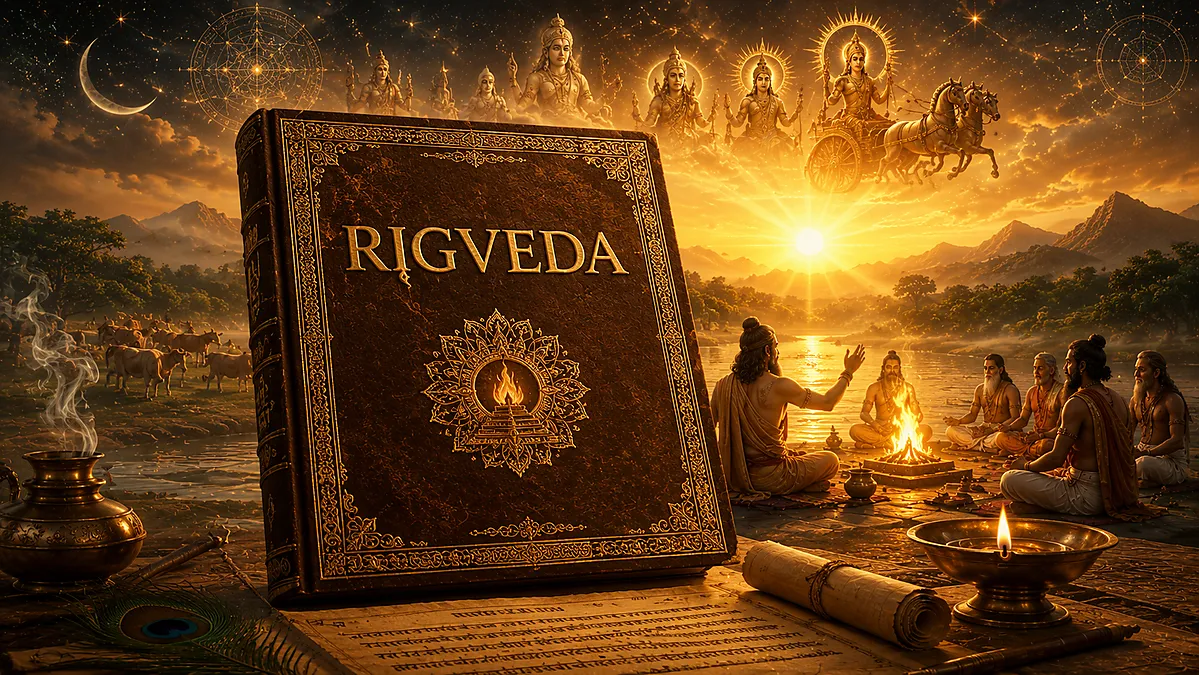
It is still dark when you reach the riverbank. The air is cool, carrying the scent of wet earth, wild grass, and the faint smoke of a distant fire. Somewhere in the stillness, a single voice begins to chant – ancient syllables, rising and falling like the current itself:
“Agnim īḷe puróhitaṃ…”
You do not understand the words. Yet something in your chest loosens. The sounds seem to belong to the dawn itself – as old as the sun rising over the water, as fresh as the breeze on your face.
This is what the Rigveda has been for thousands of years: not a book to be studied in silence, but a voice to be heard at sunrise, a prayer to be offered when the world is still new.
In this moment, standing at the edge of the Ganga, the Yamuna, or the mythical Sarasvati – at the Triveni Sangam in Prayagraj – you are joining a conversation that has been ongoing for over three thousand years. The same mantras that rise from your lips were once chanted by sages on the banks of the Sarasvati, by priests around fire altars, by rishis who saw the stars not as distant lights but as the very body of the Divine.
What were those first prayers? Who were the seers who composed them? And why, after millennia, do their voices still resonate in the human heart?
Let us journey back to the dawn of Indian civilization. The Rigveda awaits.
WHAT IS THE RIGVEDA?
The Oldest Veda, The Oldest Text
The word Rigveda (ऋग्वेद) comes from two Sanskrit roots: ṛc (ऋच्), meaning “praise” or “hymn of praise,” and veda (वेद), meaning “knowledge.” The Rigveda is thus the “Knowledge of the Hymns of Praise” – a collection of over a thousand sacred hymns that form the oldest and most important of the four Vedas.
The Rigveda is widely regarded by scholars as the oldest surviving text in the Indo-European language family, and one of the oldest sacred texts still in continuous use by any living tradition. While Western scholarship dates its composition to approximately 1500–1200 BCE, Hindu tradition holds that the Vedas are eternal – not composed in any historical moment, but “heard” (śruti) by the ancient rishis at the dawn of creation.
The Four Vedas
The Rigveda is the first and oldest of the four Vedas:
- Rigveda – The Veda of hymns and praises, the oldest.
- Samaveda – The Veda of chants and melodies. Most of its verses are drawn from the Rigveda, set to music.
- Yajurveda – The Veda of sacrificial formulas (yajus), used for ritual prose.
- Atharvaveda – The Veda of the Atharvan priests, containing spells and practical knowledge.
The Rigveda is considered the root source of all later Hindu wisdom. All other Vedas, Upanishads, and even the epics and Puranas ultimately trace their authority back to the Rigveda.
Oral Transmission: An Unbroken Chain
Perhaps the most astonishing fact about the Rigveda is how it was preserved. For centuries – perhaps millennia – the hymns were never written down. They were memorized and chanted, generation after generation, with such precision that the text has remained virtually unchanged for over three thousand years.
The priests who preserved the Rigveda developed techniques of recitation that remain among the most sophisticated oral traditions in human history. They chanted the text in multiple ways: the Saṃhitāpāṭha (with all sandhi rules applied, used for recitation) and the Padapāṭha (with each word isolated, used for memorization). This elaborate system ensured that not a single syllable was altered.
The Rigveda was eventually written down. But in the Hindu tradition, the “true” Rigveda is still the spoken sound, the vibration, the mantra as it rises from the human voice at dawn.
THE WORLD OF THE VEDIC RISHIS: POETS OF THE ETERNAL
Who Were the Rishis?
The hymns of the Rigveda were not composed by a single author, but by hundreds of seers, called Rishis, across many generations. The Rigveda mentions many rishi families – the Atris, the Vasishthas, the Vishvamitras, the Bhrigus, the Angirasas – who preserved their hymns within their clans.
According to tradition, the rishis did not “compose” the hymns. They saw them (from the root dṛś, “to see”) or heard them (śruti) in states of deep meditation. The hymns were not human inventions but the cosmic vibration of the universe itself, received by purified minds.
The Family Books and the Great Seers
The six “family books” (Mandala 2 through 7) are each traditionally associated with a specific rishi clan:
| Mandala | Associated Rishi Family |
| Mandala 2 | Gritsamada |
| Mandala 3 | Vishvamitra |
| Mandala 4 | Vamadeva |
| Mandala 5 | Atri |
| Mandala 6 | Bharadvaja |
| Mandala 7 | Vasishtha |
Among these, Vishvamitra is traditionally credited as the author of all the hymns in Mandala 3, while Vasishtha is the principal poet of Mandala 7. The remaining Mandalas (1, 8, 9, and 10) are attributed to a wider variety of seers.
Agastya, Atri, and Kanva are among the most frequently mentioned rishis. Atri, one of the seven great sages (Saptarishi), is the author of several hymns in the Rigveda.
Life in the Vedic Age
The Rigveda gives us glimpses of a world both ancient and familiar. The Vedic people were pastoralists and agriculturists who valued cows, horses, chariots, and the protection of their settlements. They prayed for rain, for victory in battle, for healthy sons, and for a long life. Their hymns reveal awe before the forces of nature – the dawn, the fire, the storm, the sun – and a profound sense of the sacred order that governed all things.
STRUCTURE OF THE RIGVEDA: THE TEN MANDALAS
The Rigveda consists of 1028 hymns (suktas), containing approximately 10,600 stanzas (verses), organized into ten books called Mandala (meaning “circle” or “cycle”). The total length of the Rigveda equals, scholars have calculated, the surviving poems of Homer – but it is far older.
Here is a guide to the ten Mandalas:
Mandala 1 (191 hymns)
The first book, equal in length to the last, is a diverse collection attributed to many rishis, including Agastya, Kanva, and Gotama. It contains hymns to Agni, Indra, the Ashvins, and many other deities. Notably, hymns 1.1.1 (the famous Agnim īḷe) is the traditional opening of the Rigveda, addressing the god of fire.
Mandala 2–7 – The Family Books
These six books form the oldest core of the Rigveda. They are homogeneous in character and are traditionally attributed to specific rishi families:
- Mandala 2 – Attributed to Gritsamada (focused on Agni, Indra)
- Mandala 3 – Attributed to Vishvamitra (contains the Gayatri Mantra, RV 3.62.10)
- Mandala 4 – Attributed to Vamadeva
- Mandala 5 – Attributed to the Atri clan
- Mandala 6 – Attributed to Bharadvaja
- Mandala 7 – Attributed to Vasishtha (contains the famous hymns describing the Battle of the Ten Kings)
In these family books, the hymns are arranged in a consistent order: first addressed to Agni, then to Indra, then to other deities. This arrangement reflects the ritual importance of Agni as the sacrificial fire, the first to be invoked.
Mandala 8 (103 hymns, plus Valakhilya supplements)
This book is attributed to a variety of rishis, including Kanva and the famous rishi Dirghatamas. It contains the eleven Valakhilya hymns (8.49–8.59), considered supplementary or apocryphal by some traditions.
Mandala 9 – The Soma Mandala (114 hymns)
Unique among the Mandalas, Book 9 consists entirely of hymns addressed to Soma Pavamana – Soma the ritually purified – the sacred drink of Vedic sacrifice. The hymns describe the process of pressing the Soma plant and the flowing of its juice through the woolen strainer.
Mandala 10 (191 hymns)
The final book is the latest in composition, and in many ways the most philosophical. It contains the great “philosophical hymns”: the Hiranyagarbha Sukta (Creation Hymn, 10.121), the Nasadiya Sukta (The Hymn of Creation, 10.129), the Purusha Sukta (The Hymn of the Cosmic Being, 10.90), and the Devi Sukta (The Hymn of the Goddess, 10.125).
THE GREAT DEITIES OF THE RIGVEDA
The Rigveda’s hymns are dedicated to a pantheon of deities, most of whom represent natural forces – the fire, the sun, the dawn, the storm, the river. These are not distant gods in a faraway heaven, but immediate, intimate presences: Agni is the fire on your altar; Ushas is the sunrise you see; Surya is the sun warming your skin.
Agni (over 200 hymns)
Agni – the god of fire – receives the very first hymn of the Rigveda: Agnim īḷe puróhitaṃ (“I praise Agni, the priest of the sacrifice”). Agni is the messenger between humans and the divine: he carries offerings from the earthly fire altar to the gods in heaven. He is also the household fire, the fire of the hearth, the fire of life itself. Without Agni, no sacrifice, no prayer, no connection to the higher realms is possible.
Indra (almost 250 hymns)
Indra is the most frequently invoked deity in the Rigveda, receiving approximately 289 hymns – more than any other god. He is the warrior god, the king of heaven, the wielder of the thunderbolt (vajra). His greatest deed is the slaying of the serpent-demon Vritra, who had coiled around the mountains and blocked the rivers. When Indra killed Vritra, the waters were released, bringing life to the land – a powerful metaphor for the victory of order over chaos, light over darkness.
Indra is praised as a heroic, boisterous, sometimes reckless god – fond of Soma, fierce in battle, loyal to his worshippers. In the Rigveda, he is the god of the warrior class, the exemplar of courage and strength.
Soma (over 120 hymns, concentrated in Mandala 9)
Soma is both a sacred plant and a god. The Rigvedic hymns describe the ritual pressing of the Soma plant, yielding a juice that is offered to the gods (especially Indra) and also consumed by the priests. Soma is associated with immortality, inspiration, and ecstatic vision. The entire ninth Mandala is dedicated to Soma Pavamana, “Soma the Purified,” as the juice flows through the woolen strainer.
Varuna and Mitra
Varuna (mentioned approximately 46 times) and Mitra are twin deities associated with the cosmic order, Rta (see Phase 9). Varuna is the guardian of truth, the upholder of law, the sovereign who sees all. He is a stern, majestic god, associated with night, the celestial ocean, and retributive justice. Mitra is associated with day, contracts, and the social order. Together, they represent the dual sovereignty of cosmic and social law.
Ushas (the Dawn)
The goddess Ushas (Aurora) is one of the most beautiful figures in the Rigveda. Each dawn, she is born anew, dispelling darkness and bringing light to the world. She is praised for her beauty, her generosity, and her role in awakening all beings. Her name is cognate with Greek Eos and Latin Aurora – a shared inheritance from Indo-European antiquity.
Savitr, Surya, and the Gayatri Mantra
Savitr and Surya are solar deities. Savitr is the vivifier, the divine sun as the generator of life, the impetus behind all movement. The most famous of all Vedic mantras – the Gayatri Mantra (Rigveda 3.62.10) – is addressed to Savitr.
Vishnu, Rudra, and Other Deities
Vishnu (mentioned approximately 50 times) is a relatively minor figure in the Rigveda, praised for his three strides through the universe – the three steps with which he measured the worlds (the earth, the sky, and the heavens). This Vedic Vishnu would later evolve into the supreme deity of Vaishnavism. Rudra (the Howler), the precursor of Shiva, is invoked as a fearsome storm god, a healer, and a god of the wilderness.
The Ashvins (the twin horsemen), the Maruts (the storm gods), Vayu (the wind), Prithvi (the Earth), Dyaus (the Sky), Vak (Speech) – the Rigveda’s pantheon is vast and varied, reflecting a civilization that saw the sacred in every facet of existence.
THE MOST FAMOUS HYMNS OF THE RIGVEDA
The Rigveda contains hymns of stunning philosophical depth, poetic beauty, and spiritual power.
The Gayatri Mantra (Rigveda 3.62.10)
The most famous Vedic mantra in the world, the Gayatri Mantra is addressed to Savitr, the divine sun. It is a prayer for the illumination of the intellect. For millennia, it has been chanted daily by millions of Hindus at dawn and dusk. The mantra’s very meter – the Gayatri meter (24 syllables) – gives it its name.
The Purusha Sukta (Rigveda 10.90)
The “Hymn of the Cosmic Person” is one of the foundational texts of Hindu theology. It describes the primordial sacrifice of Purusha, the cosmic being whose body becomes the universe:
His mouth became the Brahmin, his arms became the warrior (Kshatriya), his thighs became the merchant (Vaishya), his feet became the servant (Shudra). The moon was born from his mind, the sun from his eyes, Indra and Agni from his mouth, the wind from his breath.
This hymn later became central to Hindu social philosophy and to the theology of sacrifice.
The Nasadiya Sukta (Rigveda 10.129) – The Hymn of Creation
Perhaps the most astonishing hymn in the Rigveda, the Nasadiya Sukta is a philosophical meditation on the origins of the universe – and it is remarkable for its agnostic humility. The hymn asks:
There was neither non-existence nor existence then. There was neither the realm of space nor the sky beyond. What stirred in the depths? Where? Under whose protection? Was there water? There was neither death nor immortality then. There was no sign of day or night. That One breathed, windless, by its own impulse. Other than that there was nothing beyond.
After imagining various possibilities, the hymn ends with the famous verse:
He who surveys it all from the highest heaven – only He knows, or perhaps He does not know.
This open-ended questioning – the admission that even the Creator may not know the origins of His own creation – is unique in ancient religious literature. It speaks to the spirit of inquiry that characterizes the Rigveda at its most philosophical.
The Hiranyagarbha Sukta (Rigveda 10.121)
The “Hymn of the Golden Womb” describes the primordial golden embryo that floated in the cosmic void before creation. From this golden womb, all beings arise. The hymn asks: “Who is the God whom we should worship with our offerings?” The answer: “He is the Lord of all beings, the one God hidden in all beings.” This hymn, along with the Nasadiya Sukta, provides an important glimpse of emerging monotheism or monism in the later Vedic period.
The Devi Sukta (Rigveda 10.125)
A rare and powerful hymn spoken by the goddess Vak (Speech) herself. She declares:
I move with the Rudras, with the Vasus, with the Adityas, with the All-Gods. I hold up Mitra and Varuna, Indra and Agni, the two Ashvins. I am the sovereign queen, the gatherer of treasures, the most aware of those who are aware. The gods worship me. I am the breath of life, the source of all nourishment, the essence of the universe.
This hymn is foundational to the Goddess traditions (Shaktism) in later Hinduism.
SACRED RIVERS OF THE RIGVEDA
The Rigveda is a text of rivers. The Vedic people lived in a land of seven rivers – the Sapta Sindhu – a region stretching from eastern Afghanistan through the Punjab to the western reaches of the Ganga-Yamuna plains.
The Sapta Sindhu (Seven Rivers)
The Rigveda repeatedly invokes the Seven Rivers (Sapta Sindhavah) as a sacred landscape. The identification of Rigvedic rivers is the single most important way of establishing the geography of the early Vedic civilization. The seven rivers include:
- Sindhu (the Indus) – “A mother feed to her children,” as the Rigveda describes it
- Sarasvati – The most celebrated river in the Rigveda, praised in many hymns
- Vitasta (Jhelum)
- Asikni (Chenab)
- Parushni (Ravi)
- Vipasha (Beas)
- Shutudri (Sutlej)
The Sarasvati: The Most Celebrated Rigvedic River
The Sarasvati holds a place of unique importance in the Rigveda, praised in more hymns than any other river. She is described as naditama – “the best of rivers” – mighty, overflowing, sustaining the Vedic people on her banks. Several Mandalas contain hymns specifically dedicated to her.
Later, the Sarasvati dried up, turning into a river lost to time – but she remained alive in the sacred imagination. The Triveni Sangam in Prayagraj is the confluence of the Ganga, the Yamuna, and the mythical Sarasvati, believed to flow underground and join the two visible rivers at the meeting point. The Rigveda says: “Those who bathe at the place where the two rivers, white and dark, flow together, rise up to heaven”.
Ganga and Yamuna
Interestingly, the Ganga and Yamuna – the holiest rivers of modern Hinduism – are mentioned only a few times in the Rigveda, in subordinate roles. Their rise to supreme sanctity occurred in the post-Vedic period, as the center of Indian civilization shifted eastward from the Indus Valley to the Gangetic Plain.
A Sacred Landscape
The Rigveda’s reverence for rivers is more than geography. The rivers are invoked as mothers, as goddesses, as sources of life, purification, and liberation. To this day, a dip in the Triveni Sangam at Prayagraj – the mythic meeting of Ganga, Yamuna, and Sarasvati – is believed to wash away sins and grant spiritual freedom. The seed of this belief is already present in the ancient hymns.
THE HIDDEN WISDOM OF THE RIGVEDA: COSMIC ORDER AND GRATITUDE
The Rigveda is not merely a collection of archaic hymns to forgotten gods. It contains profound spiritual and ethical wisdom that remains relevant today.
1. Gratitude as the Foundation of Prayer
The Rigveda begins every prayer with gratitude – to Agni, who carries our offerings; to the Dawn, who brings light; to the Sun, who sustains life. Before asking for anything, the rishis offer thanks. This is a powerful lesson: prayer begins not with petition, but with appreciation.
2. Harmony with Nature
The Vedic people saw the natural world not as a resource to be exploited but as a sacred manifestation of the divine. The sun, the fire, the wind, the rivers – all were revered as deities. This ecological consciousness – the recognition that we are participants in a sacred order, not masters of it – is a teaching our age desperately needs.
3. The Pursuit of Truth (Satya)
The Rigveda repeatedly invokes Satya (Truth) as a sacred principle. Varuna is the guardian of truth; falsehood is punished; oaths are binding. The rishis saw that there is no lasting happiness without truthfulness in speech, thought, and action.
4. Inclusivity and Interconnection
The Rigveda acknowledges that there are many names for the same divine reality. Verse 1.164.46 famously declares: “They call Him Indra, Mitra, Varuna, Agni; the celestial-winged bird Garutman. The One Being the wise call by many names.” This spirit of inclusivity – the recognition that the Divine transcends all names and forms – is the seed of later Hindu universalism.
5. The Courage to Question
The Nasadiya Sukta’s admission that the origin of creation may be ultimately unknowable is a testament to the Rigveda’s intellectual honesty. The rishis were not afraid to say “we do not know.” True wisdom, they understood, includes the humility to recognize the limits of human knowledge.
PHASE 9: ṚTA – THE GREAT VEDIC IDEA OF COSMIC ORDER
If one concept could be said to be the axis of the Rigvedic worldview, it is Ṛta (ऋत).
What Is Ṛta?
Ṛta is derived from the Sanskrit root ṛ, meaning “to move.” It signifies the dynamic principle inherent in the universe – the cosmic order that regulates everything from the movement of the planets to the change of the seasons to the moral law governing human conduct.
Ṛta is the law of nature: the sun follows the path of Ṛta (Rigveda 1.24.8). The seasons obey Ṛta. Rivers flow according to Ṛta. Without Ṛta, the universe would descend into chaos.
The Three Levels of Ṛta
The Vedic vision conceived of Ṛta manifesting at three levels:
- The Cosmic Level – Ṛta governs the course of nature (the orbits of the stars, the rising of the sun, the flow of the seasons).
- The Socio-Ethical Level – Ṛta imparts justice, truth, and righteousness to human society.
- The Religio-Spiritual Level – Ṛta is mirrored in the ritual performances of the sacrificial act (yajna).
The Guardians of Ṛta
The gods Varuna and Mitra are the primary guardians of Ṛta. Varuna, in particular, is the enforcer of cosmic and moral order – he sees all, knows all, and punishes transgression.
From Ṛta to Dharma
One of the most important developments in Hindu thought is the evolution from Ṛta to Dharma. In the early Vedic period, Ṛta was the governing principle. By the post-Vedic period, the concept of Dharma (the rule of law and life, the upholding of social and individual duty) had emerged. Later Hindu thought identified Ṛta with the cosmic aspect of Dharma, and Dharma with the social and ethical expression of Ṛta.
The Eternal Relevance of Ṛta
The concept of Ṛta is a powerful reminder that we live in a universe that is not random, chaotic, or indifferent. There is an order – a law – that governs all things. Living in alignment with that order (whether we call it Ṛta, Dharma, or simply “the way things are”) brings peace, harmony, and liberation. To act against Ṛta is to invite suffering, individually and collectively.
THE RIGVEDA’S INFLUENCE ON HINDUISM
The Rigveda is not merely a museum piece of ancient history. It is the living root of all later Hindu traditions.
The Four Vedas
The Samaveda is essentially a musical rearrangement of Rigvedic verses. The Yajurveda’s ritual formulas derive from the same worldview. The Atharvaveda, though different in content, still operates within the Vedic framework. Without the Rigveda, the other three Vedas would not exist.
The Upanishads
The philosophical Upanishads are the “end of the Vedas” (Vedanta). They take the imagery and ritual framework of the Rigveda and internalize it: the Vedic fire altar becomes the inner sacrifice of the soul; the Vedic gods become aspects of the one Brahman. But the language and symbolism of the Upanishads is incomprehensible without the Rigveda as their foundation.
The Brahmanas and Ritual Tradition
The Brahmanas (prose texts explaining Vedic ritual) are commentaries on the Vedas, including the Rigveda. The elaborate temple rituals of modern Hinduism – the agnihotra, the puja, the homa – trace their ancestry to the yajnas described (in seed form) in the Rigveda.
The Puranas and Epics
The Puranas and Itihasas (Ramayana, Mahabharata) rework Vedic themes into narrative form. The avatars of Vishnu, the cosmic creation myths, the geography of pilgrimage – all have Vedic roots.
Daily Hindu Practice
Millions of Hindus still recite Rigvedic mantras daily. The Gayatri Mantra (RV 3.62.10) is recited at dawn and dusk. The Purusha Sukta (RV 10.90) is recited in temples and at weddings. The Hiranyagarbha Sukta (RV 10.121) is chanted for prosperity. The Rigveda is not dead – it is sung, spoken, and breathed every day.
TIMELESS VERSES OF THE RIGVEDA
Verse 1: The Gayatri Mantra (Rigveda 3.62.10)
Devanagari:
ॐ भूर्भुवः स्वः तत्सवितुर्वरेण्यं भर्गो देवस्य धीमहि धियो यो नः प्रचोदयात्
IAST Transliteration:
Oṁ bhūr bhuvaḥ svaḥ tat savitur vareṇyaṃ bhargo devasya dhīmahi dhiyo yo naḥ pracodayāt
Source Citation: Rigveda 3.62.10
Word-by-Word:
- Oṁ – primordial sound, the essence of the Vedas
- Bhūr – the earth (physical realm)
- Bhuvaḥ – the intermediate space (subtle realm)
- Svaḥ – the heavens (celestial realm)
- Tat – that
- Savitur – of the divine Sun (Savitr)
- Vareṇyam – most excellent, worthy of worship
- Bhargo – radiance, glory
- Devasya – of the divine
- Dhīmahi – we meditate upon
- Dhiyo – our intellects
- Yo – who
- Naḥ – our
- Pracodayāt – may he inspire
Translation: “We meditate upon the glorious radiance of the Divine Sun. May he inspire our intellects.”
Practical Life Lesson: This mantra is a daily prayer for clarity, wisdom, and the awakening of the intellect. Chant it at dawn or dusk to align your mind with the cosmic order.
Verse 2: The One Being Called by Many Names (Rigveda 1.164.46)
Devanagari (approximate rendering):
एकं सद्विप्रा बहुधा वदन्त्यग्निं यमं मातरिश्वानमाहुः
IAST Transliteration (standard variant):
Ekaṃ sad viprā bahudhā vadanty agniṃ yamaṃ mātariśvānam āhuḥ
Source Citation: Rigveda 1.164.46
Word-by-Word:
- Ekaṃ – One
- Sat – Being, truth, existence
- Viprā – the wise
- Bahudhā – in many ways
- Vadanti – speak
- Agnim – as Agni (fire)
- Yamam – as Yama (the god of death)
- Mātariśvānam – as Mātariśvan (the wind or cosmic breath)
- Āhuḥ – they call
Translation: “The wise call the One Being by many names – Agni, Yama, Mātariśvan.”
Practical Life Lesson: Do not be trapped by sectarianism. The Divine transcends the names and forms we assign to it. Honor the one reality that shines through all traditions.
Verse 3: Let Noble Thoughts Come from All Directions (Rigveda 1.89.1)
Devanagari (approximate rendering):
आ नो भद्राः क्रतवो यन्तु विश्वतः
IAST Transliteration (standard):
Ā no bhadrāḥ kratavo yantu viśvataḥ
Source Citation: Rigveda 1.89.1
Word-by-Word:
- Ā – come
- Naḥ – to us
- Bhadrāḥ – noble, auspicious
- Kratavo – thoughts, insights, inspirations
- Yantu – let them come
- Viśvataḥ – from all directions, from everywhere
Translation: “Let noble thoughts come to us from every side.”
Practical Life Lesson: Remain open and curious. Wisdom is not the monopoly of any one culture, tradition, or ideology. Truth reveals itself wherever the mind is open.
Verse 4: The Hymn of Creation (Rigveda 10.129.1–7 excerpt)
Devanagari:
नासदासीन्नो सदासीत्तदानीं नासीद्रजो नो व्योमा परो यत्।
किमावरीवः कुह कस्य शर्मन्नम्भः किमासीद्गहनं गभीरम्॥
IAST Transliteration:
Nāsad āsīn no sad āsīt tadānīṃ nāsīd rajo no vyomā paro yat |
Kim āvarīvaḥ kuha kasya śarmann ambhaḥ kim āsīd gahanaṃ gabhīram ||
Source Citation: Rigveda 10.129.1
Word-by-Word:
- Na asat – not non-existence
- Āsīt – existed
- No – nor
- Sat – existence
- Āsīt – existed
- Tadānīm – then
- Na āsīt – there was not
- Rajaḥ – the realm of space
- No – nor
- Vyomā – the sky beyond
- Paraḥ – above
- Yat – which
- Kim – what
- Āvarīvaḥ – stirred, moved
- Kuha – where
- Kasya – whose
- Śarman – protection, shelter
- Ambhaḥ – water, deep
- Kim – what
- Āsīt – was
- Gahanam – deep, unfathomable
- Gabhīram – profound
Translation: “Then there was neither non-existence nor existence. There was neither the realm of space nor the sky beyond. What stirred? Where? In whose protection? Was there water? Deep, unfathomable?”
Practical Life Lesson: The ultimate origins of existence are a mystery that may never be fully grasped by the human mind. Let this teach humility. And let the mystery itself inspire awe, not fear.
Verse 5: The Purusha Sukta – The Cosmic Being (Rigveda 10.90.2)
Devanagari:
पुरुष एवेदं सर्वं यद्भूतं यच्च भव्यम्।
उतामृतत्वस्येशानो यदन्नेनातिरोहति॥
IAST Transliteration:
Puruṣa evedaṃ sarvaṃ yad bhūtaṃ yac ca bhavyam |
Utāmṛtatvasy eśāno yad annena atirohati ||
Source Citation: Rigveda 10.90.2
Translation: “The Purusha (Cosmic Being) is indeed this entire universe – what has been and what will be. He is the lord of immortality, and by offering the sacrificial food, he rises beyond.”
Practical Life Lesson: You are not separate from the universe. The same divine consciousness that pervades the cosmos is the deepest reality of your own being. Live in alignment with that truth.
Verse 6: The Dawn (Ushas) (Rigveda 1.113.1)
Devanagari:
इदं श्रेष्ठं ज्योतिषां ज्योतिरागात्
Source Citation: Rigveda 1.113.1
Translation: “This light has come, the best of all lights.”
Practical Life Lesson: Every dawn is a new beginning. Greet it with wonder and gratitude. The darkness is always dispelled, and the light – the best of all lights – always returns.
Verse 7: The Cosmic Order (Rigveda 1.24.8)
Devanagari:
सत्यमृता महतो वरुणस्य मित्रस्य चार्वीक्षेत
Source Citation: Rigveda 1.24.8
Translation: “The sun follows the path of Ṛta (cosmic order).”
Practical Life Lesson: The same order that guides the stars guides your life when you live in harmony with truth and righteousness. Trust in the cosmic order. You are not lost; you are held.
WHY THE RIGVEDA STILL MATTERS TODAY
The Rigveda is older than the Bible, older than the Zoroastrian Gathas, older than the Homeric epics. It is a voice from the very dawn of human civilization.
But why should a modern reader – living in an age of smartphones, social media, and artificial intelligence – care about archaic hymns to forgotten gods?
1. A Timeless Philosophy of Order
The Rigveda teaches that the universe is not meaningless chaos. It is governed by Ṛta – a cosmic order, a law, a truth. This is not a superstition; it is a profound recognition that reality has a structure, and that living in alignment with that structure brings peace, purpose, and harmony.
2. A Deep Ecology Before Its Time
The Rigveda’s reverence for rivers, mountains, sun, and fire is not primitive nature worship. It is an ecological consciousness – a recognition that the natural world is not a resource to be exploited but a sacred trust to be honored. In an age of climate crisis, this ancient perspective is urgently relevant.
3. Intellectual Humility
The Nasadiya Sukta’s admission that the origins of creation may be ultimately unknowable is a model of intellectual humility. The Rigveda does not claim to have all the answers. It asks questions, admits uncertainty, and honors the mystery.
4. Spiritual Openness
“Let noble thoughts come from all directions.” This verse (RV 1.89.1) is a manifesto for open-minded spiritual exploration. The Rigveda is not sectarian; it acknowledges that the divine can be approached through many names and forms.
5. A Living Tradition
For millions of Hindus, the Rigveda is not a museum piece – it is a living scripture. The Gayatri Mantra is chanted daily. The Purusha Sukta is recited at weddings. The hymns are sung at yajnas. The Rigveda continues to shape the spiritual consciousness of one of the world’s oldest civilizations.
6. A Cultural Root
For anyone of Indian heritage – Hindu, Buddhist, Jain, Sikh – the Rigveda is the shared root of a magnificent civilization. To read the Rigveda is to trace your own cultural DNA back to its earliest source.
FREQUENTLY ASKED QUESTIONS
Q1: What is the Rigveda?
A: The Rigveda is the oldest and most important of the four Vedas, the foundational scriptures of Sanatana Dharma (Hinduism). It is a collection of over 1,000 hymns composed in Vedic Sanskrit, dedicated to various deities such as Agni, Indra, and Soma.
Q2: How old is the Rigveda?
A: Scholars estimate its composition between 1500 and 1200 BCE, making it one of the oldest surviving sacred texts in the world. Hindu tradition holds that the Vedas are eternal (sanātana) and were “heard” (śruti) by ancient rishis at the beginning of this cosmic cycle.
Q3: How many hymns are in the Rigveda?
A: The Rigveda contains 1028 hymns (suktas) organized into 10 books (mandalas). These contain approximately 10,600 stanzas (verses) in total.
Q4: Who wrote the Rigveda?
A: The Rigveda was composed by many seers (rishis) across generations, not by a single author. The hymns are traditionally attributed to specific rishi families (the Atris, Vasishthas, Vishvamitras, and others) who “saw” or “heard” the hymns in meditation. Sage Vyasa is traditionally credited with compiling the hymns into their present form.
Q5: What is the Gayatri Mantra?
A: The Gayatri Mantra (Rigveda 3.62.10) is the most famous Vedic mantra, addressed to Savitr (the divine sun). It is a prayer for the illumination of the intellect and is chanted daily by millions of Hindus worldwide at dawn and dusk.
Q6: What is the Nasadiya Sukta?
A: The Nasadiya Sukta (Rigveda 10.129) is the “Hymn of Creation.” It is a remarkable philosophical meditation on the origins of the universe, characterized by open-ended questioning and intellectual humility. It famously admits that even the Creator may not know how creation began.
Q7: What is Ṛta?
A: Ṛta is the Vedic concept of cosmic order – the law that governs the universe, from the movement of planets to the change of seasons to the moral law of truth and justice. It is the predecessor of the later concept of Dharma.
Q8: What is the connection between the Rigveda and Prayagraj?
A: The Rigveda speaks of the confluence of rivers, which is the theological foundation for the Triveni Sangam at Prayagraj – the meeting point of the Ganga, Yamuna, and the mythical Sarasvati. Bathing at this confluence is said to purify the soul and grant liberation.
Q9: Are the Vedas and the Bhagavad Gita the same?
A: No. The Rigveda is the oldest of the four Vedas (Śruti). The Bhagavad Gita is a later text (c. 2nd century BCE – 2nd century CE) embedded within the Mahabharata (Smriti). However, the Gita draws its philosophical language and concepts from the Vedas and Upanishads.
Q10: Is the Rigveda difficult to read?
A: The original Sanskrit is highly complex and requires years of study. However, there are excellent English translations available for the general reader (e.g., Ralph T.H. Griffith’s translation, Wendy Doniger’s selection, and David R. Slavitt’s poetic rendering). For most modern seekers, studying the Upanishads and the Bhagavad Gita is more accessible as a first step, with the Rigveda as a deeper study.
Q11: What is the significance of the Ashvamedha?
A: The Ashvamedha (horse sacrifice) was a royal ritual described in the later Vedas (Yajurveda). While not central to the Rigveda, the roots of the ritual are present in the hymns praising Indra and the power of sacrifice.
Q12: Why are there different recensions of the Rigveda?
A: The Rigveda has been preserved in several recensions (shakhas) due to different priestly lineages. The only surviving recension is that of the Śākala school, which includes the Valakhilya hymns (8.49–8.59).
Q13: Can women read or chant the Rigveda?
A: The Vedas were traditionally transmitted by male priests, but there is no scriptural prohibition against women studying the Vedas. In fact, the Rigveda mentions several female rishis (brahmavadinis), such as Ghosha, Lopamudra, and Apala, who contributed hymns. The most famous female seer is Vak, who speaks the Devi Sukta (RV 10.125). Today, Vedic chanting is taught to all genders in many Hindu traditions.
Q14: What is the best English translation of the Rigveda?
A: For the complete text, Ralph T.H. Griffith’s 1896 translation is freely available online and is remarkably readable for its age. For selections, Wendy Doniger’s “The Rig Veda” (Penguin Classics) is excellent for the general reader. For a more recent translation, Stephanie Jamison and Joel Brereton’s “The Rigveda: The Earliest Religious Poetry of India” (Oxford, 2014) is the definitive scholarly translation in three volumes.
Q15: Why should a modern person read the Rigveda?
A: The Rigveda is the fountainhead of Hindu civilization. Reading it (or reading selections from it) offers insight into the earliest layers of Indian spirituality, philosophy, and culture. Its hymns on cosmic order (Ṛta), on the unity of the divine, and on the value of open inquiry (the Nasadiya Sukta) are timeless. It also offers a profound model of gratitude, reverence for nature, and intellectual humility – qualities that are urgently needed in the modern world.
BEGIN YOUR JOURNEY THROUGH THE RIGVEDA
You have journeyed through the oldest scripture of Sanatana Dharma – from the dawn hymns to Ushas to the philosophical depths of the Nasadiya Sukta, from the fire of Agni to the cosmic order of Ṛta.
The Rigveda is not an easy text. It is vast, ancient, and often puzzling. But it repays the effort many times over. In its hymns, you will not find dogmatic answers – you will find something more valuable: an invitation to wonder, to praise, to inquire, and to stand in awe before the mystery of existence.
Where to Begin Reading
If you are new to the Rigveda, start with selections, not the whole text.
- Wendy Doniger, “The Rig Veda” (Penguin Classics) – An accessible selection of key hymns with excellent commentary.
- Ralph T.H. Griffith, “The Hymns of the Rigveda” – The complete 1028 hymns in English; dated but still useful; available for free on sacred-texts.com.
- Stephanie Jamison and Joel Brereton, “The Rigveda” (Oxford, 3 vols.) – The definitive scholarly translation for advanced readers.
A Final Blessing
The Rigveda calls us to live with gratitude (thanking Agni, Ushas, and Savitr for the gifts of fire, dawn, and sun). It calls us to live with truth (Satya) – in our speech, in our actions, in our dealings with others. It calls us to live with awe before the beauty and order of creation. And it calls us to live with humility, recognizing that the ultimate mystery may be beyond our comprehension, but that the path of inquiry itself is sacred.
As the rishis said:
“Let noble thoughts come to us from every side.”
Oṃ Tat Sat.
May the wisdom of the Rigveda illuminate your path, from the banks of the sacred rivers to the deepest recesses of your heart.
This Article is published at PrayagTourism.com – Your guide to the sacred scriptures, pilgrimage sites, and eternal wisdom of Sanātana Dharma.