
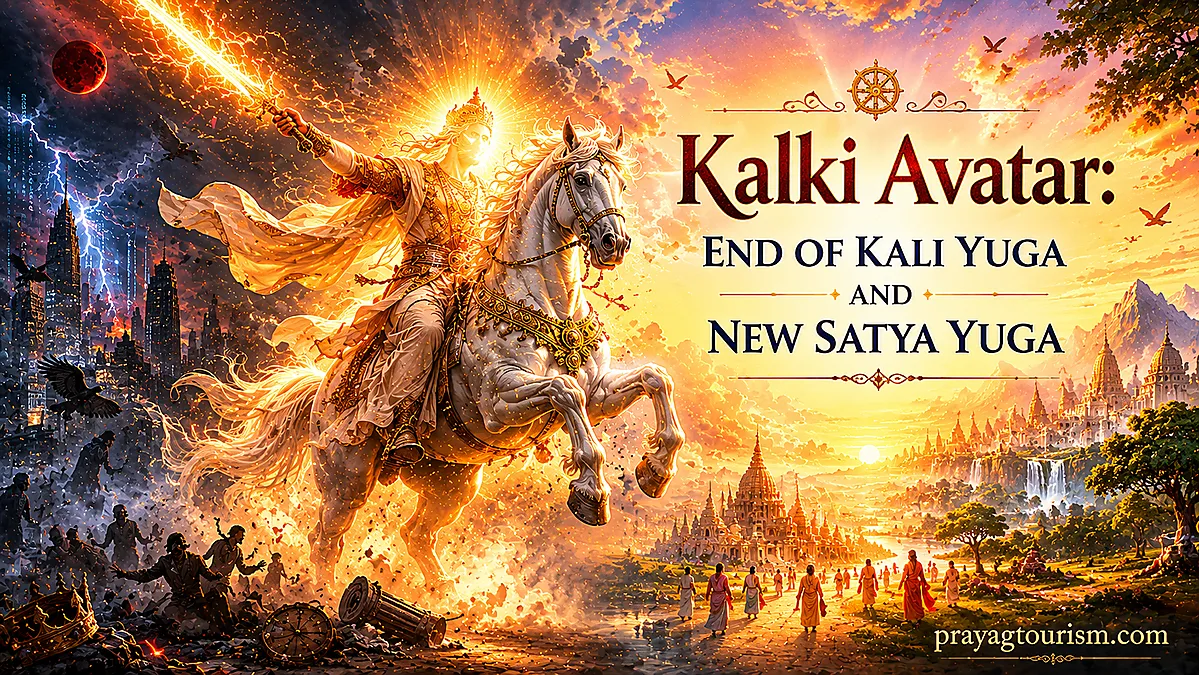
A guide to the future tenth Avatāra of Lord Vishnu, the end of Kali Yuga, and the birth of a new Satya Yuga.
Table of Contents
Kalki Avatar and the End of Darkness
Kalki Avatar is the prophesied tenth incarnation of Lord Vishnu who will appear at the end of Kali Yuga to restore dharma.
To feel the weight of the tenth Avatāra, we begin with His name.
The word Kalki (कल्कि) is commonly linked to kalka—“filth, impurity, dregs, accumulated grime”—especially the moral and spiritual pollution that cakes onto consciousness in the late stages of Kali Yuga. In this reading, Kalki is “the destroyer of kalka”—the one who clears away the built‑up sludge of an age: corruption, systemic deceit, ecological abuse, and the collapse of shared values.
A complementary line of interpretation connects the name to kāla/kal—“time” and “to reckon.” Here, Kalki is Lord of Time, the final auditor of the cosmic ledger, the one who arrives when the account of Kali Yuga is overdrawn and must be closed. He is not merely an angry god on a horse; He is the tipping point of Time itself—the moment when an exhausted pattern can no longer continue.
The Śrīmad Bhāgavatam gives a compact yet powerful prophecy:
- Devanagari Script
अथासौ युगसन्ध्यायां दस्युप्रायेषु राजसु।
जनिता विष्णुयशसो नाम्ना कल्किर्जगत्पतिः॥ - IAST Transliteration
athāsau yuga-sandhyāyāṃ dasyu-prāyeṣu rājasu |
janitā viṣṇuyaśaso nāmnā kalkir jagat-patiḥ || - Source: Śrīmad Bhāgavatam 1.3.25.
- Sense and Bhāṣya
“Thereafter, at the conjunction of the yugas, when the rulers of the earth have mostly become plunderers, the Lord of the universe will take birth as Kalki, the son of Viṣṇuyaśā.”
This verse identifies:
- Timing – the yuga‑sandhyā, the twilight between Kali’s end and Satya’s beginning.
- Trigger – a world where kings and rulers, meant to uphold rāja‑dharma, have largely devolved into dasyus—thieves and exploiters in royal dress.
- Response – the descent of Bhagavān as Kalki, not to gently reform such rulers, but to terminate a cycle that can no longer self‑correct.
Kalki, then, is the supreme clarifier. Where Kṛṣṇa taught us how to navigate complexity, Kalki appears when complexity has curdled into unreformable chaos. His very name is the promise that darkness has an expiry date.
Scriptural Origins and Theology of Time
The idea of Kalki does not arise in isolation. It is embedded in a fully developed theology of Time.
From Ṛta to Yuga‑Cycles
In the early Vedic (Śruti) period, emphasis falls on Ṛta—cosmic order maintained through yajña (sacrifice) and correct living. Time is largely cyclical, renewed continuously through ritual and season.
Later Smṛti texts—especially the Mahābhārata, Purāṇas, and auxiliary treatises—codify Time into four Yugas:
- Satya (Kṛta) Yuga – age of truth and full dharma.
- Tretā Yuga – dharma slightly diminished.
- Dvāpara Yuga – dharma half diminished.
- Kali Yuga – dharma standing on a single leg, heavily eroded
The Mahābhārata’s Vana Parva includes Markandeya’s chilling description of Kali Yuga’s moral decay and references to a future restorer, later identified with Kalki. The Viṣṇu Purāṇa, Agni Purāṇa, and others echo this theme: a final Avatāra arises when Kali’s corruption peaks and Satya must be reborn.
Bhāgavatam and Kalki Purāṇa – Full Profile of the Future Avatāra
The Śrīmad Bhāgavatam returns to Kalki in Canto 12, elaborating on Kali Yuga’s symptoms and Kalki’s intervention. It portrays a world where:
- wealth is mistaken for virtue,
- law bends to power,
- religion becomes a costume,
- and basic human qualities—tolerance, mercy, longevity, memory—decline day by day.
Within this context, Bhāgavatam 12.2 sketches the Kalki episode in bold strokes, which later texts like the Kalki Purāṇa expand into a full narrative—describing Śambhala, Viṣṇuyaśas, Devadatta the horse, and the systematic destruction of adharma.
Over centuries, Kalki evolves from being seen primarily as a martial punisher into a more subtle symbol of cosmic necessity: the moment when mercy takes the form of ending what cannot be healed.
The Grand Narrative of Śambhala and the White Horse
The Purāṇic portrait of the late Kali Yuga reads like an x‑ray of systemic collapse:
- rulers are mostly thieves,
- professions degenerate into exploitation,
- family bonds erode,
- and the earth groans under misused resources.
It is in this atmosphere that Kalki’s story unfolds.
Birth in Śambhala
In the mystical village of Śambhala, a hidden enclave of unwavering dharmic lineage, a pious Brāhmaṇa named Viṣṇuyaśas and his wife Sumati will be blessed with a wondrous child. This child, adorned with extraordinary marks from birth, is none other than Viṣṇu Himself incarnate as Kalki—the “fame of Viṣṇu” made flesh, as hinted by the very name Viṣṇu‑yaśas.
The Kalki Purāṇa describes Śambhala as a sanctuary of learning, tapas, and martial training, preserved through the darkest age as a seed of the next Satya Yuga, where Kalki’s character is shaped in an environment of uncompromised dharma.
Initiation from Paraśurāma and Gifts of the Gods
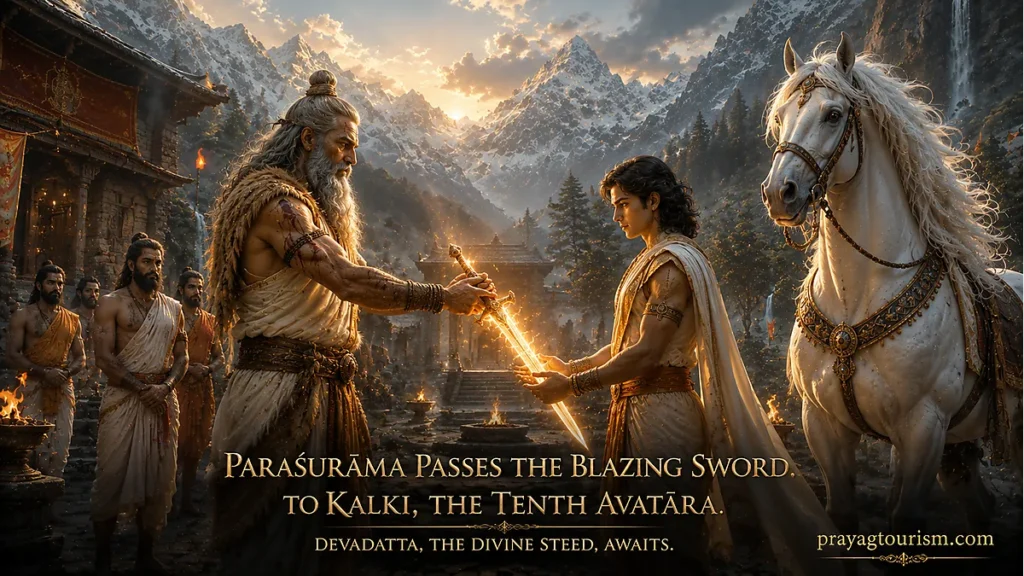
As he matures, Kalki receives spiritual and martial initiation from Paraśurāma, the sixth Avatāra, who is described in several traditions as a Cirañjīvī (immortal) still performing tapas on earth—particularly associated with Mahendra/Mahendragiri ranges. In this way, the ancient warrior‑sage personally hands the “axe‑lineage” forward, linking the earliest cleansing Avatāra with the final one.
The texts then tell us:
- Śiva bestows upon Kalki a blazing sword and armour.
- The gods give him a white horse named Devadatta—“God‑given”—swift as the wind, capable of traversing the earth with incredible speed.
Bhāgavatam summarises this phase succinctly:
- Devanagari Script
अश्वमाशुगमारुह्य देवदत्तं जगत्पतिः।
असिनासाधुदमनमष्टैश्वर्यगुणान्वितः॥ - IAST Transliteration
aśvam āśugam āruhya devadattaṃ jagat-patiḥ |
asinā sādhudamanam aṣṭaiśvarya-guṇānvitaḥ || - Source: Śrīmad Bhāgavatam 12.2.19 (cf. 19–20).
- Sense and Bhāṣya
“The Lord of the universe, Kalki, endowed with the eight mystic opulences, will mount His swift horse Devadatta. With sword in hand, He will travel over the earth, subduing the wicked who have become as thieves in royal disguise.”
The “eight mystic opulences” (aṣṭa‑siddhi) signify total mastery over material laws; Devadatta’s speed symbolises the frictionless movement of awakened consciousness; the sword is the sharp edge of viveka—discernment that cuts illusion at the root.
Esoteric Doctrine: Destruction as Compassion
Kalki is the most unsettling Avatāra for modern sensibilities precisely because His mandate is not incremental reform.
When Grace Looks Like an Ending
From the standpoint of karma and dharma:
- If a civilisation repeatedly seeds extraction, deceit, and violence,
- and systematically silences or co‑opts voices of reform,
- it eventually accumulates a collective karmic weight it can no longer bear.
At that point, continued survival in the same form would only generate ever‑greater suffering. In such a scenario, destruction can be grace—not as punishment, but as release.
Traditionally, dissolution (saṃhāra) belongs to Śiva. In Kalki, Viṣṇu temporarily assumes this dissolving function: the Preserver becomes the Resetter, demonstrating that preservation without periodic clearing is not compassion but enablement.
Kalki as Evolutionary Leap of Consciousness
Esoteric interpreters, reading the Avatāra sequence as an evolutionary arc, see Kalki as more than one future historical warrior:
- Matsya through Varāha track the emergence of life and stable worlds.
- Narasiṃha through Rāma and Kṛṣṇa track increasingly complex social orders and moral intelligence.
- Buddha introduces inwardness and psychological sophistication.
Kalki, in this scheme, may symbolise a collective mutation of awareness—a supramental, planetary consciousness where:
- narrow ego identities become untenable,
- purely materialistic paradigms collapse under their own contradictions,
- and a more integrated, non‑dual intelligence becomes the new normal.
In such a frame, the “blazing sword” is the sudden flash of non‑dual insight in humanity’s mindstream, burning away the illusion of absolute separateness.
Crucially, Kalki is not the final full stop. He is the blazing line between chapters. His work clears the field so that a new Satya Yuga—an age of clarity, simplicity, and truth—can take root.
Sacred Geography: Tracing a Future Avatāra
How does one make tīrtha‑yātrā to a deity who has not yet appeared? The tradition answers this with a blend of mystical geography and living devotion.
Śambhala – The Inner Sanctuary
Texts describe Śambhala as the village where Viṣṇuyaśas lives and Kalki is born. Various physical regions—Himalayan valleys, Tibetan plateaus, remote Himalayan borderlands—have been associated with Śambhala in different esoteric lineages, but many teachers emphasise its symbolic dimension: Śambhala as the heart‑centre of the Earth, the preserved seed of dharma in both world and individual.
In this reading, to seek Śambhala is to:
- cultivate an inner space of uncompromised truth,
- guarded from the noise of Kali Yuga,
- where the “future consciousness” of Kalki can already be born in miniature.
Kalki Mandir, Jaipur – A Temple for an Unborn Avatāra
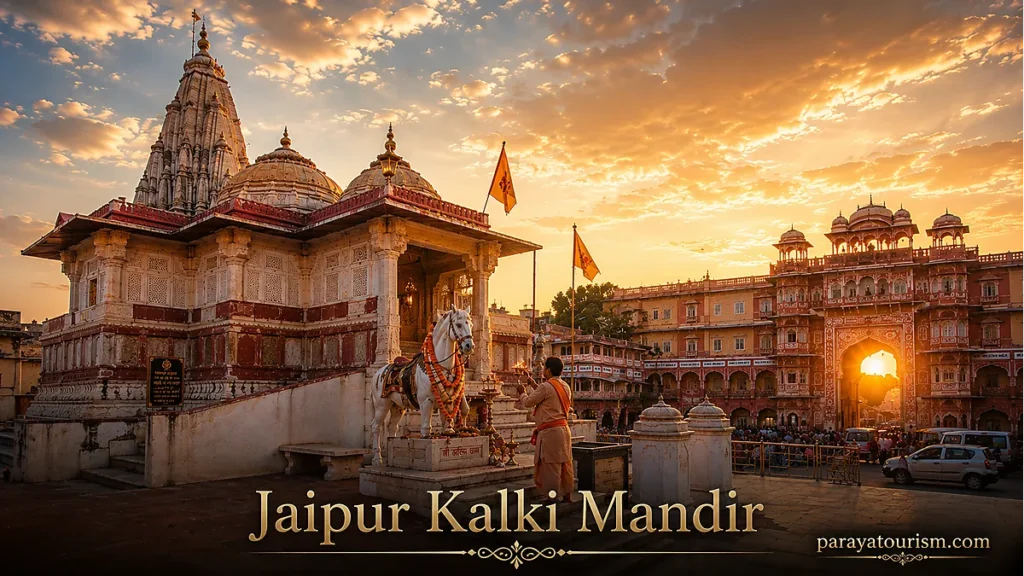
In the tangible world, one of the most fascinating shrines is Kalki Mandir in Jaipur, Rajasthan. Built in the 18th century by Maharaja Sawai Jai Singh II, founder of Jaipur, it stands in Sireh Deori Bazar, opposite the City Palace gate, in the heart of the old walled city.
Key features:
- It is widely regarded as one of the earliest temples dedicated specifically to Bhagavān Kalki, a deity who is yet to appear.
- The temple enshrines vigrahas of Kalki and Lakṣmī as primary deities, acknowledging Kalki as Viṣṇu’s final human‑form Avatāra and Lakṣmī as His co‑eternal consort.
- In the courtyard stands a white marble horse statue, representing Devadatta. One of its legs bears a visible crack or “wound”; popular belief holds that when this wound mysteriously heals, Kalki’s descent into the world will be imminent.
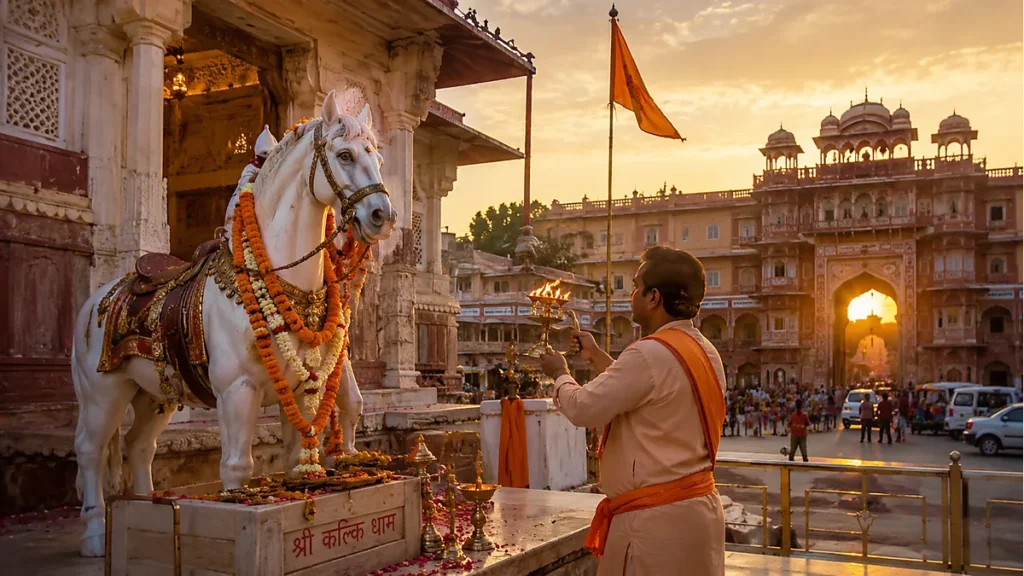
Pilgrims who visit this temple are not only venerating the future Avatāra; they are meditating on Time itself—on the certainty that every age, no matter how dark, has a built‑in dawn.
Kāśī – Watching the Fires of Ending
In Vārāṇasī (Kāśī), especially at cremation ghāṭs like Manikarnikā, ascetics and householders alike watch bodies return to ash, contemplating impermanence. While not specifically “Kalki temples,” these spaces embody the city’s ancient role as gateway between worlds, a place where individual endings mirror the cosmic dissolution associated with Kalki.
Here, a pilgrim contemplating Kalki might see every funeral pyre as a small rehearsal for the purifying fire of era‑change.
Living the Kalki Consciousness Today
Kalki is not only an event we wait for; He is a principle we can begin to embody.
Ending Kali Yuga Within
If Kalki is the end of exploitative materialism, then genuine devotion to Kalki is not passive apocalyptic anticipation; it is a Satya Yuga lifestyle lived inside Kali Yuga:
- choosing truth over expedient falsehood in business and relationships,
- practicing environmental stewardship instead of participating in blind consumption,
- refusing to normalize mockery, cruelty, and cynicism as “just how the world works.”
To “invoke Kalki within” is to pick up the inner sword of viveka (discernment) and vairāgya (wise detachment):
- cutting through personal habits that feed collective degradation,
- ending cycles of addiction, dishonesty, and apathy in your own life,
- and aligning thought, speech, and action with a future you would actually wish to see.
In this sense, every sincere act of integrity is a small advance landing of Kalki‑consciousness.
Becoming a Śambhala Cell
Śambhala need not be an unreachable valley. Every home, sangha, and community that:
- preserves ethical clarity,
- protects children from cynicism,
- cultivates meditation, service, and study,
becomes a cell of Śambhala inside Kali Yuga. There, the “future humans” of Satya Yuga can be prototyped—people who carry global empathy, ecological humility, and spiritual depth as default settings.
We do not know when the outer Kalki will ride. But we can ensure that, when He does, He finds allies already living His values.
Dawn After the Storm: Satya Yuga Returns
The Daśāvatāra sequence does not end in darkness. Kalki’s sword, however terrifying, is wielded in service of a new morning.
The Bhāgavatam closes its Kalki passage with luminous assurance:
- Devanagari Script
यदावतीर्णो भगवान् कल्किर्धर्मपतिर्हरिः।
कृतं भविष्यति तदा प्रजासूतिश्च सात्त्विकी॥ - IAST Transliteration
yadāvatīrṇo bhagavān kalkir dharma-patir hariḥ |
kṛtaṃ bhaviṣyati tadā prajā-sūtiś ca sāttvikī || - Source: Śrīmad Bhāgavatam 12.2.34.
- Sense and Bhāṣya
“When the Supreme Lord Hari appears as Kalki, the master of dharma, then Satya Yuga (Kṛta) will begin, and the progeny born at that time will be endowed with pure sattva (goodness).”
This verse reveals three consolations:
- Kalki is Hari—the same compassionate Lord who lifted Earth as Varāha and spoke the Gītā as Kṛṣṇa. His wrath is the fierce side of love.
- His descent initiates, not ends, a cycle. Immediately after the storm comes Satya Yuga—an era where truth, simplicity, and transparency are the default atmosphere.
- Souls born into that new age will be naturally sāttvika—their baseline consciousness clear, their structures aligned with dharma from birth.
To contemplate Kalki, then, is to hold two visions at once:
- a courageous willingness to face the fact that systems die and must die,
- and an unshakable trust that something more luminous is waiting on the other side of that necessary clearing.
In our present moment, the “future rider” is already casting a faint silhouette across our skies: in every whistleblower, in every community refusing hatred, in every contemplative learning to end their own inner Kali. When the last Avatāra finally rides, He will not be a stranger. He will be the outward flowering of a transformation we have already begun, one breath, one honest act, one awakened mind at a time.
May the blazing light of Lord Kalki clear the illusions from our minds. Hari Om Tat Sat.
Frequently asked Questions
Who is Kalki Avatar?
Kalki Avatar is the prophesied tenth incarnation of Vishnu who will appear at the end of Kali Yuga to restore dharma.
Where will Kalki Avatar be born?
According to Hindu scriptures, Kalki will be born in the village of Shambhala to Vishnuyashas and Sumati.
What is Devadatta?
Devadatta is the divine white horse associated with Kalki Avatar.
What happens after Kalki Avatar appears?
The appearance of Kalki marks the end of Kali Yuga and the beginning of a renewed Satya Yuga.
What is the symbolic meaning of Kalki?
Many spiritual teachers interpret Kalki as the awakening of higher consciousness and the destruction of ignorance.
Is Kalki mentioned in the Bhagavatam?
Yes. Kalki is mentioned in Srimad Bhagavatam 1.3.25 and elaborated further in Canto 12.
⁂
References:
- http://hariharji.blogspot.com/2008/09/kalki-mahavatara_27.html
- https://stephenknapp.wordpress.com/tag/kalki/
- https://www.harekrsna.com/sun/editorials/01-07/editorials1159.htm
- https://vedabase.io/en/library/sb/1/3/25/
- https://vedabase.io/en/library/sb/12/2/19-20/
- https://vaniquotes.org/wiki/SB_01.03.25_athasau_yuga-sandhyayam…_cited
- https://gaudiya.redzambala.com/srimad-bhagavatam/srimad-bhagavatam-canto-12-chapter-2.html
- https://www.facebook.com/100065482005169/posts/kalkithe-srimad-bhagavatam-sb-1325-vishnu-purana-424-agni-purana-167-9-and-padma/2042015902752650/
- https://www.youtube.com/watch?v=-lXVP_g2nNo
- https://en.wikipedia.org/wiki/Mahendragiri_(Odisha)
- https://vikasacharya.wordpress.com/2016/06/16/mahendragiri-hills-a-legendary-mountain-where-parshuram-did-penance/
- https://en.wikipedia.org/wiki/Mahendra_Mountains
- https://www.youtube.com/watch?v=hqrchgp_n8I
- https://www.news9live.com/opinion-analysis/explained-jaipurs-285-year-old-kalki-temple-and-its-horse-idol-statue-amid-hype-for-kalki-2898-ad-2594661
- https://jaipurthrumylens.com/2015/05/25/kalki-temple-jaipur/
- https://en.wikipedia.org/wiki/Kalki_Mandir
- https://roadtodivinity.wordpress.com/2023/05/14/kalki-avatar-temple-jaipur/
- https://uptourismblog.in/sarnath-where-lord-buddha-delivered-his-first-sermon/
- https://www.youtube.com/watch?v=6HQDxLYAxZw