
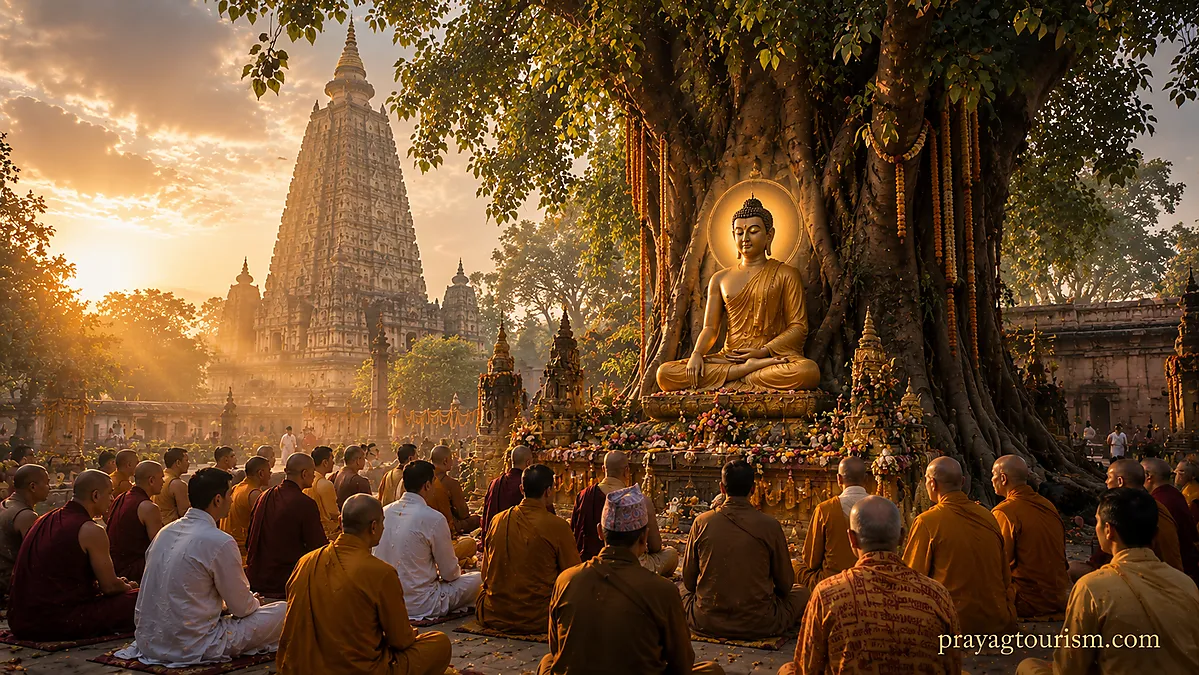
A guide to the ninth Avatāra, the revolution of consciousness, and the pilgrimage from ritual to direct insight.
Table of Contents
Name, Awakening, and the Turn Inward
As the Daśāvatāra timeline moves beyond the age of Śrī Kṛṣṇa, a radical shift occurs. Divine intervention, which so far has largely unfolded on battlefields, royal courts, and cosmic oceans, now turns decisively toward the battlefield of the mind.
The title Buddha (बुद्ध) is derived from the Sanskrit root budh (बुध्) – “to wake, to know, to notice, to recover consciousness.” A Buddha is not merely a historical figure; it is a state of being—one who has awakened from the sleep of ignorance (avidyā) into the clear seeing of reality as it is.
In this sense, the Buddha Avatār marks the age of inwardness:
- Earlier Avatāras slay external tyrants;
- The Buddha slays the inner tyrants—greed, hatred, and delusion.
- Earlier interventions rescue scriptures, planets, or kingdoms;
- The Buddha rescues attention itself, teaching us how to relate to experience with lucid compassion.
If Rāma is the perfection of conduct and Kṛṣṇa the perfection of wisdom within engagement, the Buddha is the perfection of seeing—a relentless, tender, uncompromising gaze turned upon the workings of consciousness.
Purāṇic Descent and Historical Emergence
The inclusion of the historical Gautama Buddha into the Daśāvatāra list is one of Sanātana Dharma’s most remarkable acts of theological hospitality. It signals not a rejection, but an embrace: the tradition recognises that the same Divine who once wielded axe and bow now appears empty‑handed, with only a begging bowl and a method of meditation.
Purāṇic Vision: Viṣṇu as Buddha
The Śrīmad Bhāgavatam presents the Buddha Avatar as a deliberate descent of Viṣṇu in response to a specific crisis:
- Devanagari Script
ततः कलौ सम्प्रवृत्ते सम्मोहाय सुरद्विषाम्।
बुद्धो नाम्नाञ्जनसुतः कीकटेषु भविष्यति॥ - IAST Transliteration
tataḥ kalau sampravṛtte sammohāya sura-dviṣām |
buddho nāmnāñjana-sutaḥ kīkaṭeṣu bhaviṣyati || - Source: Śrīmad Bhāgavatam 1.3.24.
- Sense and Bhāṣya
“Thereafter, at the beginning of Kali‑yuga, the Lord will appear as Buddha, the son of Anjana, in the region of Gayā, for the purpose of bewildering those who are envious of the divine principles.”
Traditional Vaiṣṇava commentators read this as follows:
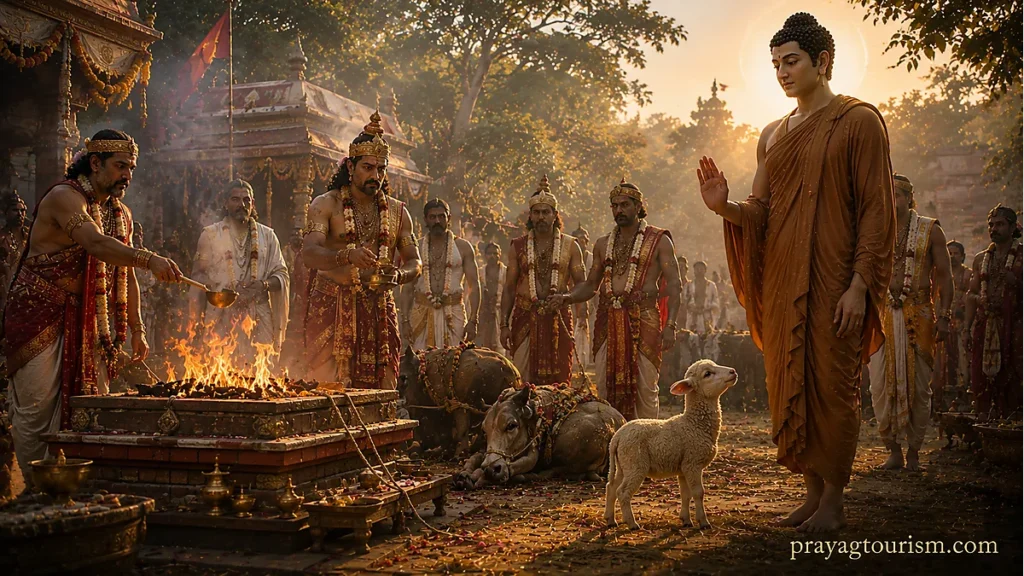
- A segment of society had begun to abuse the Vedic sacrificial system, turning it into a pretext for large‑scale animal slaughter and mechanical ritualism devoid of inner understanding.
- To halt this, the Lord Himself appears in a non‑theistic, hyper‑ethical form, temporarily suspending the authority of Vedic ritual in order to rescue its essence—ahiṃsā (non‑violence) and inward purity.
Śrī Jayadeva’s Daśāvatāra Stotram captures this paradox of a “Vedic God” who criticises Vedic ritual:
- Devanagari Script
निन्दसि यज्ञविधेरहह श्रुतिजातम्।
सदयहृदय दर्शितपशुघातम्।
केशव धृतबुद्धशरीर जय जगदीश हरे॥ - IAST Transliteration
nindasi yajña-vidher ahaha śruti-jātam |
sadaya-hṛdaya darśita-paśu-ghātam |
keśava dhṛta-buddha-śarīra jaya jagadīśa hare || - Sense
“O Keśava, who have assumed the form of Buddha, all glories to You! Seeing the slaughter of animals, You decry the mass of sacrificial injunctions. O compassionate‑hearted Lord of the universe, Hari!”
Here, Buddha is not a rebel against the true Veda, but a rebel for its heart. When the letter of the law kills the spirit of the law, the Lord descends to break the letter.
Historical Emergence: Śākya Prince in the Greater Magadha
Historically, Siddhārtha Gautama arises in the Greater Magadha region (modern Nepal–Bihar–Uttar Pradesh belt) in the 5th century BCE, a landscape already saturated with Vedic sacrifice, Śramaṇa movements, and philosophical debate.
Bodh Gaya on the banks of the Phalgu river, Sarnath near Vārāṇasī, and Kushinagar in present‑day Uttar Pradesh still bear the archaeological and living imprint of this turning. The Hindu tradition, rather than treating this as an “external” revelation, interprets it as Viṣṇu’s own choice to manifest as an historical teacher.
The Grand Narrative: From Palace Illusion to Bodhi Awakening
The life of Prince Siddhārtha Gautama is the archetype of human awakening—a story not of miracles imposed from outside, but of clarity wrested from within.
Palace of Insulation and the Four Sights
Born into the Śākya clan at Lumbinī to King Śuddhodana and Queen Māyādevī, Siddhārtha is surrounded by predictions: he will become either a Chakravartin (universal monarch) or a supreme sage. His father, fearing the loss of a political heir, encloses him in a curated world of youth, beauty, and luxury—no sickness, aging, or death is allowed to cross the palace threshold.
But reality cannot be legislated away. On four fateful excursions beyond the palace walls, Siddhārtha encounters:
- an old man,
- a sick man,
- a corpse,
- and a serene wandering ascetic.
In these Four Sights, the curtain drops. The fragile, curated bubble of privilege bursts. The prince realises that no one—not even he—can escape aging, illness, and death within the ordinary cycle of existence.
Great Renunciation and the Middle Way
Unable to rest in inherited luxury, Siddhārtha leaves the palace at night, glancing back once at his sleeping wife Yaśodharā and newborn son Rāhula, then stepping into homelessness as a Śramaṇa, a wandering seeker.
For six years, he practices extreme asceticism—eating almost nothing, reducing himself to skin and bone. He discovers that self‑torture is just another form of ego—a subtle pride in one’s endurance. Having pushed austerity to its limit, he realises it is no more liberating than indulgence.
Accepting a bowl of milk‑rice from the village girl Sujātā by the Phalgu river, he regains strength and sits beneath a peepal tree at Uruvelā (modern Bodh Gaya), vowing not to rise until he penetrates the root of suffering.
Night of Awakening under the Bodhi Tree
Beneath what is now known as the Bodhi Tree, with the Vajrāsana (Diamond Throne) as his seat—later encased in stone by Emperor Aśoka—the Bodhisattva confronts the full spectrum of Māra: fear, desire, doubt, self‑loathing, and attempted distraction.
As the night deepens, he passes through successive watches:
- remembers countless past lives,
- sees the arising and passing of worlds,
- and perceives the law of dependent origination binding suffering to craving and ignorance.
At dawn, as the morning star rises, Siddhārtha becomes Buddha—“the Awakened One.” The Mahābodhi Temple Complex at Bodh Gaya, centred on the Bodhi Tree, Vajrāsana, and a 50‑metre brick temple dating back to the Gupta period, now marks this axis mundi of awakening.
He does not vanish into private bliss. He turns back toward the world.
Turning the Wheel at Sarnath and Final Passing at Kushinagar
Traveling to Sarnath near Vārāṇasī—ancient Isipatana, the Deer Park—Buddha meets his five former ascetic companions. There he delivers his first sermon, the Dharmacakra Pravartana Sūtra (“Turning of the Wheel of Dharma”), expounding the Four Noble Truths and the Noble Eightfold Path, thus founding the Saṅgha. The massive Dhamek Stupa, originally commissioned in or after Aśoka’s era and rebuilt around 500 CE, rises today at the very site associated with this first teaching.
For about forty‑five years, Buddha walks across the Gangetic plains, teaching kings and outcastes, merchants and monks, challenging empty ritual while honouring genuine ethical effort. Finally, at around age eighty, he lies down between twin sāla trees at Kushinagar and enters Mahāparinirvāṇa.
The Parinirvāṇa Stupa and Temple at Kushinagar now house a 6.1‑metre reclining Buddha sculpture in red sandstone, depicting His final passing; the current temple structure was rebuilt in 1956 to commemorate 2,500 years since this event, enshrining the memory of His last teaching on impermanence.
Esoteric Doctrine: Four Truths, One Mind
With the Buddha Avatār, the focus of evolution shifts:
- From behavioral refinement (Rāma, Paraśurāma),
- and strategic wisdom (Kṛṣṇa),
- to the transformation of consciousness itself.
The Four Noble Truths – A Physician’s Diagnosis
The Buddha’s teaching is often summarised as Four Noble Truths—less a dogma than a clinical diagnosis and treatment plan:
- Duḥkha – The Truth of Suffering
Conditioned existence, even at its most pleasant, is fundamentally unsatisfactory. Birth, aging, sickness, death, separation from what we love, association with what we dislike—all carry an inescapable flavour of duḥkha. - Samudaya – The Origin of Suffering
The root cause is taṇhā/tr̥ṣṇā (craving) backed by avidyā (ignorance of our true nature). We cling to impermanent phenomena as “me” and “mine,” and suffer when they flow on. - Nirodha – The Cessation of Suffering
If craving and ignorance are uprooted, duḥkha ceases. This cessation is Nirvāṇa—cooling of the fires, the unbinding of the heart. - Mārga – The Path
The means is the Noble Eightfold Path: Right View, Right Intention, Right Speech, Right Action, Right Livelihood, Right Effort, Right Mindfulness, Right Concentration.
This framework does something revolutionary: it de‑centres ritual and priesthood and relocates liberation in a direct, repeatable investigation of experience.
Mind as Laboratory, Awareness as Path
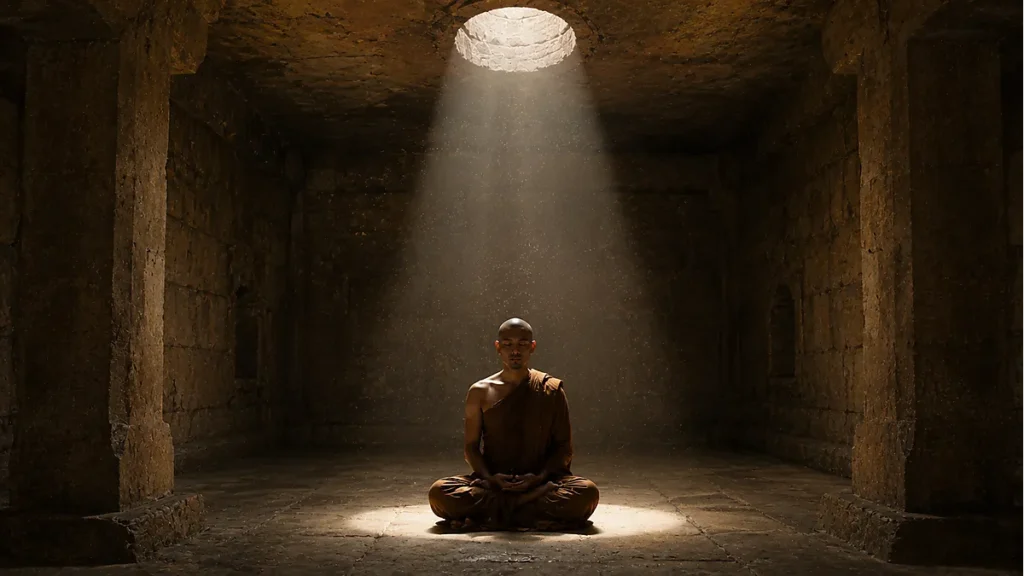
The Buddha insists that:
- The external world is not denied but is seen as intimately interwoven with mental habits.
- Suffering is not simply “out there”; it arises in how mind relates to “out there.”
- Liberation is experiential: one must see for oneself the arising and passing of sensations, feelings, and thoughts.
In this light, the Buddha Avatar can be seen as Viṣṇu manifesting as supreme inner scientist—turning attention back upon itself. He places the tools of inquiry—mindfulness and clear comprehension—directly in the hands of the layperson.
Where earlier Avatār often worked on behalf of humanity, the Buddha works with humanity, saying in essence:
“You have the same mind I used. Here is how I used it. Try it.”
Sacred Geography: The Buddha Circuit in the Hindu Heartland
For the spiritual traveller, the Buddha’s life is traceable as a pilgrimage circuit woven directly through India’s broader sacral landscape.
Bodh Gaya – Axis of Awakening
In Bodh Gaya (Bihar), on the banks of the Phalgu river, stands the Mahābodhi Temple Complex, a UNESCO World Heritage site and one of Buddhism’s four primary pilgrimage centers. The complex includes:
- The Bodhi Tree (ficus religiosa), revered as a direct descendant of the tree under which Siddhārtha attained enlightenment; the present tree is part of an unbroken lineage reaching back to a sapling planted around 250 BCE, itself linked to Aśoka’s original Bodhi planting.
- The Vajrāsana (Diamond Throne), a red sandstone platform erected by Emperor Aśoka in the 3rd century BCE at the very spot traditionally regarded as the “navel of the earth,” the seat of enlightenment.
- The Mahābodhi Temple, a 50‑metre brick structure from the 5th–6th century CE, one of the earliest surviving brick temples in India, surrounded by votive stupas and shrines marking stages of the Buddha’s awakening.
Today Bodh Gaya is a dense religious town, hosting monasteries from across Asia; yet at its core, under the tree and around the Vajrāsana, pilgrims still sit in deep, wordless meditation, continuing the Buddha’s experiment.
Sarnath – First Turning of the Wheel
About 8 km north‑east of Vārāṇasī lies Sarnath, ancient Isipatana, where the Buddha gave his first sermon to the five ascetics, setting in motion the Dharmacakra—the Wheel of Dharma.
Here:
- The Dhamek Stupa, about 34 metres high, marks the traditional spot of this first teaching; its current form dates to around 500 CE, built over an earlier structure commissioned by Aśoka in 249 BCE.
- The teaching delivered here, the Dharmacakra Pravartana Sūtra, articulated for the first time the Four Noble Truths and the Eightfold Path, and founded the monastic community (Saṅgha).
- Nearby ruins and the museum preserve remnants of Aśokan pillars and early Buddhist art, including the famous Lion Capital now India’s national emblem.
The proximity of Kāśī (Vārāṇasī)—a quintessential Śaiva Hindu city—and Sarnath, barely a short drive apart, beautifully embodies the porous boundary between Hindu and Śramaṇa traditions.
Kushinagar – The Final Release
In Kushinagar (Uttar Pradesh), the Buddha entered Mahāparinirvāṇa, lying between twin sāla trees and offering his final counsel on impermanence.
Key sites include:
- The Parinirvāṇa Temple, housing a 6‑metre reclining Buddha statue in red sandstone, resting on a stone couch, depicting His final passing; the present temple structure was rebuilt by the Government of India in 1956 to mark the 2,500th year of Mahāparinirvāṇa.
- The adjacent Nirvāṇa Stupa, believed to enshrine relics associated with His cremation, expanded and reconstructed across the Mauryan, Kuṣāṇa, and Gupta periods.
Pilgrims walking this circuit—from Bodh Gaya’s awakening to Sarnath’s first teaching to Kushinagar’s final rest—are not leaving the Hindu world; they are traversing a shared sacred landscape where Buddha and Śiva, Dharma and Veda, exist in quiet conversation.
Modern Spiritual Practice: Mindfulness in an Age of Overstimulation
In our time—defined by digital saturation, chronic anxiety, and restless consumption—the Buddha Avatāra’s inward turn feels uncannily contemporary.
Mindfulness and Vipassanā: Accessible, Empirical Practice
One of the radical gifts of the Buddha is that no elaborate belief structure is required to begin. The path starts not with metaphysics but with smṛti (mindfulness) and vipassanā (insight):
- Sit down.
- Feel the breath entering and leaving the nostrils or moving the abdomen.
- Notice sensations, thoughts, and emotions arising and passing.
- Neither cling to pleasant nor push away unpleasant experiences.
This is the Buddha’s laboratory. When a visitor at Bodh Gaya joins a group of meditators watching their breath under the Bodhi Tree, or when someone in a city apartment closes their eyes and practices the same technique, they are participating in the same Avatāric experiment—the systematic dismantling of conditioning.
Over time, such practice reveals directly:
- duḥkha – the subtle tension in grasping at experience,
- anicca – the impermanence of every sensation and thought,
- anattā – the absence of a solid, separate “me” behind the flow.
This direct seeing begins to loosen the grip of fear and craving.
The Buddha Avatār as Inner Reform
In the larger Daśāvatāra story, we might say:
- Paraśurāma cleansed society by the axe,
- Rāma refined it by perfect kingship,
- Kṛṣṇa guided it through strategic wisdom,
- and Buddha now reforms it from the inside out—one mind at a time.
For the modern seeker, this means:
- Activism without inner work easily reproduces the very aggression it opposes.
- Inner work without ethical concern risks becoming self‑absorbed.
The Buddha stands exactly at the crossing of compassion and insight: clear seeing that naturally flowers as kindness.
A simple practice for today:
- Once a day, pause for five minutes.
- Put the phone aside.
- Sit comfortably and feel the breath.
- Each time the mind wanders, gently recognise “thinking” and return.
This small act, repeated, is not trivial. It is a quiet continuation of the Buddha Avatāra’s mission—to wake up from within the very noise of the world.
Integrating Buddha into the Daśāvatāra Vision
The inclusion of Buddha Avatar in the Daśāvatāra sequence is often misunderstood. From the standpoint of Sanātana Dharma, it represents neither a concession nor an annexation, but an acknowledgment that Truth can wear many garments.
Seen together:
- Matsya to Varāha secure cosmic elements—water, stability, earth.
- Narasiṃha to Vāmana to Paraśurāma and Rāma refine social and ethical structures.
- Kṛṣṇa elevates strategic wisdom and integrated yoga.
- Buddha inaugurates the age of consciousness work—compassion married to precise attention.
In artistic depictions of Daśāvatāra, Buddha often appears serene, eyes half‑closed, seated where other Avatāras stand armed. This is not a sign of passivity, but of a different battlefield. The enemies here are not kings but kilesas—mental defilements. The weapons are not bows and axes but clarity, silence, and loving‑kindness.
To contemplate the Buddha as Avatāra is to understand that the Divine is not limited to thunderous interventions. Sometimes, God comes without sword or scripture, as a human being sitting under a tree, quietly breathing, inviting us to try it for ourselves.
If we heed that invitation—whether at Bodh Gaya, Sarnath, Kushinagar, or in our own living rooms—the age of compassion and inwardness does not remain a chapter in cosmic history. It becomes the living present.
Hari Om Tat Sat.
Frequently Asked Questions
Why is Buddha considered an Avatar of Vishnu?
Many Hindu traditions regard Buddha as the ninth incarnation of Vishnu who appeared to promote compassion, non-violence, and inner spiritual awakening.
What are the Four Noble Truths?
The Four Noble Truths explain suffering, its cause, its cessation, and the path leading to liberation.
Where did Buddha attain enlightenment?
Buddha attained enlightenment beneath the Bodhi Tree at Bodh Gaya in Bihar.
What is Nirvana?
Nirvana is the cessation of suffering, craving, and ignorance, resulting in profound freedom and peace.
What is Vipassana meditation?
Vipassana is an insight meditation practice that develops awareness of bodily sensations, thoughts, and mental patterns.
Why is Sarnath important?
Sarnath is where Buddha delivered his first sermon and established the Buddhist Sangha.
⁂
- https://smarthistory.org/bodh-gaya/
- https://indianculture.gov.in/unesco/heritage-sites/mahabodhi-temple-complex-bodh-gaya
- https://bodhgayatemple.com/the-sacred-bodhi-tree/
- https://bodhgayatemple.com/vajrasana/
- https://www.matthieuricard.org/en/sarnath-where-the-buddha-gave-his-first-teaching/
- https://uptourism.gov.in/en/page/dhamek-stupa