

A master-guide to the sixth Avatāra, the limits of lex talionis, and the bloody restoration of Dharma.
Table of Contents
What is Parashurama Avatar?
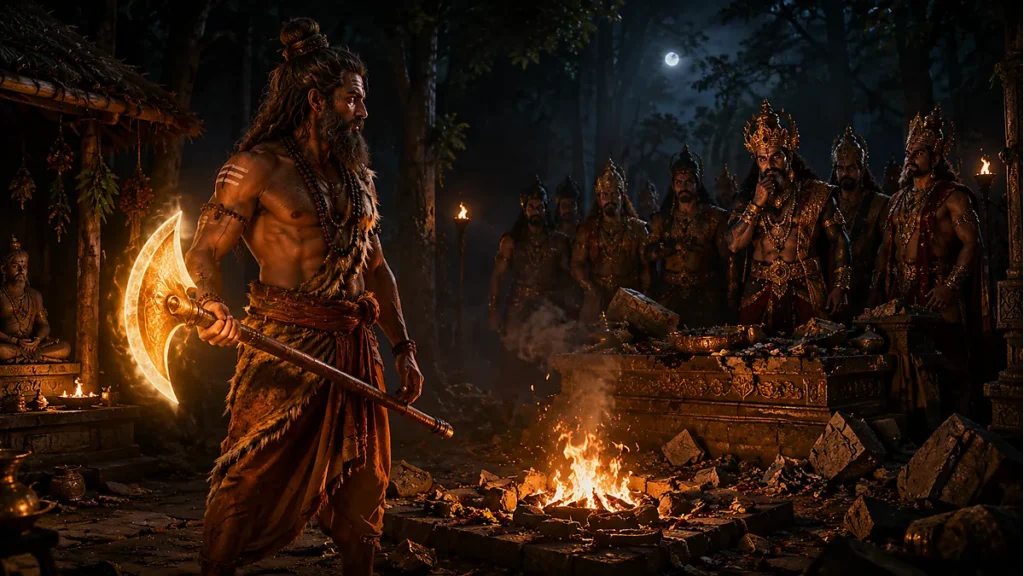
Parashurama is the sixth Avatar of Lord Vishnu, known as the warrior-sage who wielded a divine axe to restore dharma when rulers became corrupt.
Among the Daśāvatāra, Lord Paraśurāma is perhaps the most unsettling for modern readers—and this discomfort is not a bug, but the core feature of his manifestation.
Etymologically, Paraśurāma (परशुराम) is a compound of paraśu (battle-axe) and Rāma (joy, delight, the one who gives pleasure). The name thus means “Rāma who wields the axe,” or more starkly, “the one who takes delight in the axe.” His other names—Bhārgava Rāma, Rāma Jamadagni—anchor him in the fiery Bhṛgu lineage and in his father Jamadagni.
Unlike Vāmana’s quiet humility or Narasiṃha’s protective rage for a child, Paraśurāma’s story revolves around systemic injustice, vengeance, and repeated bloodshed. He incarnates in an age when the Kṣatriya class, meant to protect society, has become a predatory elite, exploiting subjects and humiliating the very Brahmins from whom they once sought guidance.
Philosophically, he embodies the era of lex talionis—the law of equivalent return. In human moral evolution, this stage corresponds to a direct, eye-for-an-eye justice: fierce, crude, effective up to a point, but ultimately insufficient for complex civilisations. Paraśurāma is Avatāra as surgical strike: when corruption saturates the ruling class, incremental reform is no longer possible; only radical excision can reset the system.
He is also the first Avatāra who looks and behaves very much like a human sage with volatile emotions—love for his parents, grief, wrath, vows, remorse. In this sense, he is one of the most psychologically “human” faces of Viṣṇu.
Bhārgava Roots and Scriptural Evolution
Parashurama Avatar is deeply tied to the Bhārgava lineage—descendants of the sage Bhṛgu—known in Vedic literature for their association with fire rituals and, later, with martial prowess.
From Vedic Bhārgavas to Bhārgava Rāma
In early Vedic layers, the Bhṛgus appear as a powerful clan of seers and ritual specialists, connected to Agni (fire) and to the maintenance of sacrificial order. By the time of the Itihāsas and Purāṇas, this lineage memory crystallises in the figure of Bhārgava Rāma, the Brahmin who takes up the axe as God’s own instrument.
The core narrative of Paraśurāma is preserved in:
- Bhāgavata Purāṇa,
- Viṣṇu Purāṇa,
- Brahmāṇḍa Purāṇa,
- and is woven into both the Mahābhārata and the Rāmāyaṇa.
This makes Paraśurāma unique: he is not confined to a single Purāṇa but appears as a cross-epoch figure, bridging multiple narratives and even co-existing with later Avatāras like Rāma and Kṛṣṇa.
Brahmin and Warrior: A Deliberate Hybrid
Traditionally, Brahmins wield knowledge, mantra, and austerity, while Kṣatriyas wield weapons. Paraśurāma is the divinely sanctioned violation of this boundary: a Brahmin who becomes the most feared warrior of his age, receiving his axe as a boon from Lord Śiva and mastering weapons while retaining his ascetic identity.
This hybrid status is theologically important:
- It shows that when the warrior class becomes the predator, spiritual authority may temporarily arm itself.
- It also foreshadows later tensions in Indian history between priestly and royal powers.
Paraśurāma stands at the pivot point where knowledge picks up the axe—not to rule forever, but to destroy a corrupted ruling order so that a more refined model of kingship (Śrī Rāma) can later emerge.
The Grand Narrative: Jamadagni, Kartavīrya, and the Twenty-One Wars
Paraśurāma’s life reads like a sequence of wounds and responses, each escalating both his tapas and his violence.
Birth and Early Tests
He is born as Rāma, son of Sage Jamadagni and Reṇukā, into a forest āśrama environment defined by simplicity, Vedic ritual, and intense austerity. Many Purāṇic tellings include the disturbing episode where Jamadagni, testing his sons’ obedience, orders each to kill their mother Reṇukā; only Rāma obeys without hesitation, and is then immediately commanded to resurrect her. Whatever its historical shape, this story underlines the extremes of obedience, detachment, and moral complexity that will define Paraśurāma’s path.
In any case, we see early on a personality of absolute loyalty to dharma as defined by his father, combined with a capacity for terrifying action.
Kartavīrya Arjuna and the Theft of Kāmadhenu
The crisis of the age is personified in Kartavīrya Arjuna, king of Māhiṣmatī, famed for his thousand arms and immense power. Over time, his strength breeds arrogance. One day, he visits Jamadagni’s āśrama with his vast retinue. The sage, through the powers of the celestial cow Kāmadhenu (sometimes named Surabhī), feeds the entire army with effortless abundance.
Blinded by greed, Kartavīrya demands the cow. When Jamadagni refuses, citing the cow’s role in sacrificial service, the king seizes Kāmadhenu by force and departs—an act that combines theft, sacrilege, and abuse of hospitality.
When Rāma returns and learns what has happened, he does not pursue negotiation. He takes up his paraśu, tracks Kartavīrya to his capital, annihilates the king’s forces single-handedly, cuts off his thousand arms, and kills him in battle, restoring the sacred cow to his father. Divine wrath has entered the political landscape.
The Murder of Jamadagni and the Vow
Vengeance, however, does not rest. While Paraśurāma is away, the sons of Kartavīrya storm Jamadagni’s āśrama and behead the sage as he sits in meditation, leaving his body pierced with multiple wounds. Reṇukā wails in grief; the āśrama is desecrated.
When Paraśurāma returns, he finds his father’s body lying in a pool of blood. According to traditional accounts, he counts twenty-one wounds on Jamadagni’s corpse. In that moment, his sense of personal loss fuses with a cosmic insight: these wounds represent not just one murder, but the entire pattern of Kṣatriya arrogance and abuse.
He takes a terrible vow:
He will annihilate the Kṣatriya class from the earth twenty-one times over—once for each wound.
Twenty-One Campaigns and the Lakes of Blood
Armed with his divine axe, Paraśurāma embarks on a series of campaigns across Bhārata. The Purāṇas describe him traveling from kingdom to kingdom, slaying tyrannical kings and their heirs, repeatedly clearing the earth of oppressive Kṣatriyas.
The Samantapañcaka region near Kurukṣetra is remembered as the site where he performed great rites after these wars. Tradition says he dug five lakes there and filled them with the blood of slain Kṣatriyas, offering that blood symbolically as oblation to his ancestors—performing a terrible yajña of justice using violence as the ghee.
Jayadeva summarises the scene in the Daśāvatāra Stotram:
- Devanagari Script
क्षत्रियरुधिरमये जगदपगतपापम्।
स्नपयसि पयसि शमितभवतापम्॥
केशव धृतभृगुपतिरूप जय जगदीश हरे॥ - IAST Transliteration
kṣatriya-rudhira-maye jagad-apagata-pāpam |
snapayasi payasi śamita-bhava-tāpam ||
keśava dhṛta-bhṛgupati-rūpa jaya jagadīśa hare || - Sense
“O Keśava, who have assumed the form of the Lord of the Bhṛgus (Paraśurāma), all glories to You! Bathing the world in the river-waters dyed with the blood of Kṣatriyas, You wash away the sins of the earth and pacify the miseries of material existence.”
The image is shocking but precise: the blood represents corrupted power; the bathing represents a cleansing that nothing milder could achieve.
Donation of the Earth and Withdrawal
Having fulfilled his vow, Paraśurāma faces the karmic weight of his violence. The texts describe him performing a grand aśvamedha-like sacrifice and donating all the conquered lands to Sage Kaśyapa or to Brahmins, thereby relinquishing any claim to rule. This act of gifting is a crucial pivot: the axe-wielder must not become the new king; his role is destroyer of corruption, not founder of a new dynasty.
Having given away the earth, he symbolically has no land left to live on. This sets the stage for his next, surprising role—not as destroyer, but as creator of new land on the western coast.
Esoteric Doctrine: Violence, Class Boundaries, and Cleansing
Beneath the vivid bloodshed lie several deep doctrinal and esoteric insights.
Why Twenty-One Times?
Scripture notes that Paraśurāma “destroyed the Kṣatriyas twenty-one times.” Esoterically, twenty-one is 3 × 7:
- 3 representing the three worlds (Bhūr, Bhuvaḥ, Svaḥ).
- 7 representing the seven dvīpas (continents) or seven layers of human nature.
To root out a deeply entrenched samskāra of oppression, one pass is not enough. The energy of violence and dominance lies at multiple levels—in institutions, in families, in individual psyches. Paraśurāma’s repeated campaigns symbolise the long, painful work required to eradicate not just a set of individuals, but an entire pattern of abuse.
Brahmin with an Axe: Class Transgression as Divine Medicine
Paraśurāma’s very existence breaks the conventional varṇa script:
- A Brahmin wielding weapons in direct warfare.
- A renunciate engaged in repeated, large-scale political violence.
This is not a licence for ordinary people to abandon their roles. Rather, it is an exceptional Avatāric intervention teaching that:
- When the class assigned to protect becomes the primary predator, the spiritual centre may itself take up arms to defend dharma.
- Class boundaries are means, not ends; their purpose is harmony, not permanent hierarchy.
Yet, precisely because this is a dangerous precedent, his story also shows that such militarisation of spirituality must be temporary and eventually submitted to a higher, gentler ethic—which arrives in Śrī Rāma.
Cleansing vs. Cruelty
The Paraśurāma Avatār confronts us with the question: Can violence ever be sacred?
His narrative answers:
- Violence driven by ego, greed, or sadism is always adharma.
- Violence used as last resort, with no personal hatred, for the sake of protecting the many and restoring justice, can function as a form of surgical cleansing.
Even so, the texts do not romanticise his path. His story is heavy, morally exhausting. That is why, after his work is complete, Paraśurāma retreats—first by donating the Earth, then by going into long tapas in the mountains. The Avatāra of wrath must leave the stage to the Avatāra of Maryādā, Śrī Rāma, who will model a more subtle, relational dharma.
In that famous encounter, when Śrī Rāma breaks Śiva’s bow and Paraśurāma realises that a higher standard of Kṣatriya dharma has arisen, he yields his bow and withdraws. The message is clear: righteous rage has a role, but it must know when to step aside.
Sacred Geography: Land Won from the Sea and the Mountain of Exile
Paraśurāma is not only a figure of myth and morality; he is credited with physically reshaping India’s western and eastern landscapes.
Paraśurāma Kṣetra – Land Reclaimed from the Sea
A famous legend, preserved in the Rāmāyaṇa, Mahābhārata, and Purāṇas, describes how Paraśurāma created a new stretch of land along the western coast after donating his conquests.
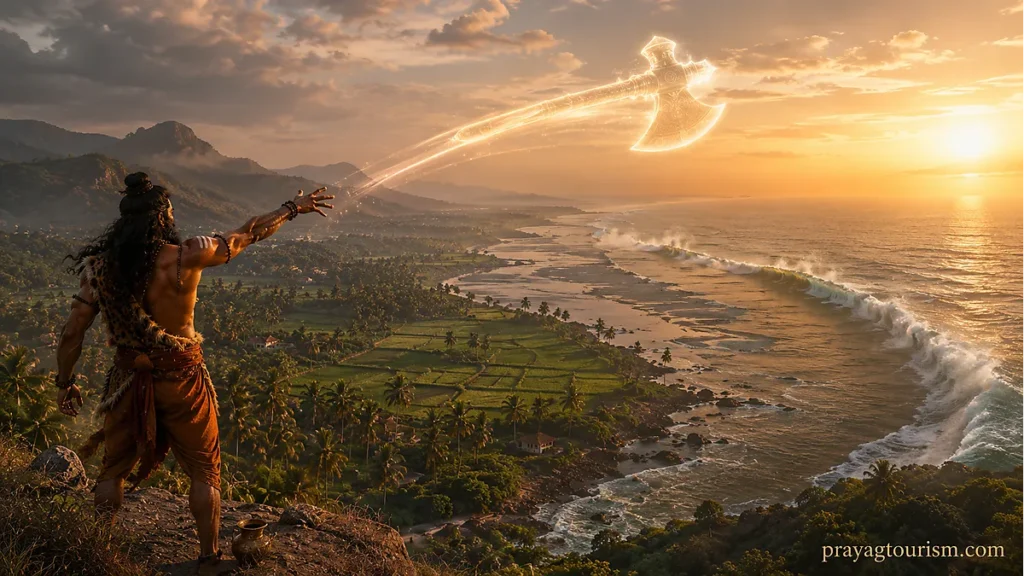
Standing upon the Sahyādri (Western Ghats), with no land left that he could claim as his own, Paraśurāma commanded the ocean god Varuṇa to recede. He hurled his axe into the Arabian Sea; wherever the axe flew, the waters retreated, exposing fertile new land from Gokarṇa in present-day Karnataka down to Kanyakumari at India’s southern tip.
This reclaimed region—covering the Konkan coast, Malabar (Kerala), and adjacent stretches—is traditionally known as Paraśurāma Kṣetra, “the Land of Paraśurāma.”
Modern scholarship notes that parts of this coastline do indeed show signs of having been under the sea in ancient geological periods, adding an intriguing natural layer to the legend.
For the pilgrim, this means:
- Traveling along the Konkan and Kerala coasts can be experienced as literally walking upon land gifted by Paraśurāma.
- Many local temple traditions—especially in Kerala—trace aspects of land tenure, Brahmin settlements, and temple foundations back to his act of reclamation as narrated in works like Keralolpatti.
Mahendra Mountains and Mahendragiri – The Mountain of Penance
After his wars and land donations, Paraśurāma withdraws into long tapas in the Mahendra Mountains, identified with stretches of the Eastern Ghats spanning Odisha and Andhra Pradesh.
The peak known as Mahendragiri (about 1,501 metres) in Gajapati district, Odisha, is especially associated with him. Legends and Purāṇic references state that:
- Paraśurāma, one of the Cirañjīvīs (immortals), resides here in meditation until the end of Kali Yuga.
- He is destined to reappear as the guru of Kalki, Viṣṇu’s tenth Avatāra, when the time comes.
- In the Rāmāyaṇa and Bhāgavata Purāṇa, Mahendra Parvata is mentioned as the place of his penance after his encounter with Śrī Rāma.
On Mahendragiri’s summit and slopes, local tradition points to ancient temples—often attributed to the Pāṇḍavas—dedicated to Śiva and other deities, with Mahāśivarātrī as the major annual festival. Pilgrims climb to these shrines with the understanding that they walk in the physical vicinity of an Avatāra still alive, still meditating.
For spiritual tourists, Mahendragiri offers a powerful experiential contrast:
- The western coast shows Paraśurāma as creator of fertile land.
- The eastern peaks show him as silent ascetic, having renounced the axe and taken up unbroken meditation.
Modern Sādhana: Using and Relinquishing Righteous Anger
Paraśurāma is an awkward mirror for modern seekers. We may resonate with his outrage at injustice but fear the scale and intensity of his response. His life offers guidance on how to work with anger without being consumed by it.
Righteous Indignation vs. Blind Rage
The first lesson is that anger itself is not automatically adharmic.
- When anger arises from wounded ego, jealousy, or thwarted desire, it is destructive.
- When it arises from a clear perception of injustice and is disciplined by compassion and principle, it can become an instrument of protection.
Paraśurāma’s fury is triggered by:
- the theft of Kāmadhenu, symbol of sacred service,
- and the murder of his father, a harmless sage.
His campaigns target systems of abuse—the Kṣatriya power-structure—not random innocents. For us, this suggests:
- It is appropriate to feel strong indignation at exploitation, corruption, and systemic violence.
- The key is to aim that energy at changing structures and behaviours, not at dehumanising entire groups.
Slaying the Inner Kṣatriya
Symbolically, the Kṣatriyas Paraśurāma slays represent the inner tyrant—our ego that uses power (wealth, intellect, status) to dominate rather than protect. This ego does not die once; it regenerates, much like the Kṣatriya line did.
To invoke the “inner Paraśurāma” means:
- ruthlessly identifying our own tendencies toward arrogance, entitlement, and manipulation;
- “cutting them down” through tapas—disciplined practice, self-honesty, and accountability;
- repeating this process as often as such tendencies reappear, perhaps many “twenty-ones” over a lifetime.
Every time you catch yourself using your strength to secure unfair advantage, you have discovered one more “Kṣatriya kingdom” inside that needs to be addressed.
Knowing When to Lay Down the Axe
Perhaps the most crucial teaching is that righteous rage is contextual, not eternal.
When Śrī Rāma appears, embodying a more refined model of royal dharma, Paraśurāma realises that his own function—as cleanser of gross corruption—is complete. In some tellings, he challenges Rāma, recognises the superiority of Rāma’s dharmic stature when the bow is strung and broken, and then withdraws into the forest.
Applied to contemporary life:
- There are times when the world genuinely needs protest, whistle-blowing, and uncompromising exposure of wrongdoing.
- There are later phases when the same person must learn to support constructive leadership, healing, and institution-building instead of remaining in permanent “rebel mode.”
- A mature spiritual activist must be able to say: “My role as axe-wielder is over; now I must learn from and support a higher, gentler dharma.”
Without this transition, we risk becoming what we once opposed: chronic destroyers unable to tolerate any structure at all.
Verses, Mantras, and Meditations on Paraśurāma
To respectfully internalise Paraśurāma’s energy, we can work with specific verses and contemplative practices.
Jayadeva’s Paraśurāma Verse for Reflection
Return to the Daśāvatāra Stotram verse already cited. Recite it with awareness of both its horror and its purification:
IAST
kṣatriya-rudhira-maye jagad-apagata-pāpam |snapayasi payasi śamita-bhava-tāpam ||keśava dhṛta-bhṛgupati-rūpa jaya jagadīśa hare ||
As you chant:
- Visualise not literal blood, but the dismantling of oppressive patterns—corrupt systems collapsing, victims freed.
- Ask that any “axe” you wield in life—your voice, vote, resources—be used only to cleanse, never to gratify ego.
Simple Paraśurāma Mantra
For regular japa:
Devanagari
ॐ भृगुपतये परशुरामाय नमः।
IAST
oṁ bhṛgupataye paraśurāmāya namaḥ |
Sense: “Salutations to Paraśurāma, Lord of the Bhṛgus.”
Chant this 11 or 21 times when you feel consumed by anger. Let the mantra remind you:
- to keep anger anchored in dharma,
- to avoid harming innocents,
- and to be willing to put the axe down when its work is done.
Visualization: From Axe to Exile
A brief guided meditation:
- Sit quietly and imagine Paraśurāma standing before you—tall, fierce, axe in hand.
- Behind him, see a montage of real-world injustices that genuinely demand action—corruption, violence, exploitation.
- See him hurl his axe into those scenes, not at people but at structures—cutting chains, breaking unjust laws, dismantling abusive hierarchies.
- Now see him standing on a mountain (Mahendragiri), placing the axe on the ground and sitting in meditation. The same hands that swung the axe now rest in jñāna mudrā.
- Ask inwardly:
“Where in my life is the axe required? Where must I now lay it down?” - End with a simple bow: “O Bhārgava Rāma, teach me when to fight and when to withdraw.”
FREQUENTLYY ASKED QUESTIONS
Who is Parashurama?
Parashurama is the sixth Avatar of Lord Vishnu, known as the warrior-sage who wielded a divine axe to restore dharma when rulers became corrupt.
Why did Parashurama fight the Kshatriyas?
According to Hindu tradition, Parashurama fought oppressive rulers after the murder of his father Jamadagni and the widespread abuse of power by certain Kshatriya kings.
What is Parashurama Kshetra?
Parashurama Kshetra refers to the western coastal region of India, including parts of Konkan and Kerala, traditionally believed to have been reclaimed from the sea by Parashurama.
Is Parashurama still alive?
Hindu tradition considers Parashurama one of the Chiranjeevis (immortals) who continue to exist and are destined to guide Kalki, the future Avatar of Vishnu.
Where did Parashurama perform penance?
Parashurama represents righteous anger, the destruction of corruption, disciplined action, and the eventual renunciation of power.
Paraśurāma Avatāra reminds us that Sanātana Dharma is unflinchingly honest about the dark, violent phases of history and the extreme measures sometimes required to reset a corrupted order. Yet it never glorifies violence as a permanent ideal. The axe-wielder appears, does what no one else can or will do, and then steps aside for a gentler embodiment of dharma.
From the blood-stained lakes of Kurukṣetra to the fertile coast of Paraśurāma Kṣetra and the silent heights of Mahendragiri, his presence marks the journey from wrath to renunciation. The stage is now set for the bow of Śrī Rāmacandra—where justice takes on not only the force of righteousness, but also the beauty of perfect bounds and compassion.
Hari Om Tat Sat.
⁂
References
- https://gayatriheritage.com/blogs/our-blogs/vishnus-sixth-avatar-parashurama-the-warrior-sage
- https://en.wikipedia.org/wiki/Parashurama
- https://www.myindiamyglory.com/2022/05/03/parasurama-flourished-around-11177-bce-recovered-land-from-sea/
- https://en.wikipedia.org/wiki/Mahendragiri_(Odisha)
- https://en.wikipedia.org/wiki/Mahendra_Mountains
- https://www.youtube.com/watch?v=Fp3M71iIw9Q
- https://nandakishorevarma.wordpress.com/2016/01/23/the-legendary-creator-of-kerala/
- https://vikasacharya.wordpress.com/2016/06/16/mahendragiri-hills-a-legendary-mountain-where-parshuram-did-penance/
- https://www.facebook.com/IndiaInPoland/posts/ancient-religious-textsparasurama-surrounded-by-settlers-commanding-varuna-to-pa/253686604760638/
- https://www.facebook.com/RapidRashmiOfficial/posts/parashurama-and-tulunadus-secretsindianhistory-ram-parshuram-justcuriousbyrapidr/1035382518149449/
- https://www.facebook.com/groups/208332826391090/posts/1122712738286423/
- https://www.facebook.com/LostTemple7/posts/one-of-the-rare-murtis-of-bhagwan-parshuram-on-top-of-the-mahendragiri-hills-odi/978336442856527/
- https://www.facebook.com/LostTemple7/posts/one-of-the-rare-murtis-of-bhagwan-parshuram-on-top-of-the-mahendragiri-hills-mah/874839559872883/
- https://www.youtube.com/watch?v=M4I0s4FH4sE
- https://www.facebook.com/thenewsroom24awaz/posts/justice-has-a-name-its-parshuram-21-times-he-cleared-the-patha-heart-of-a-sagea-/122203001006370891/