
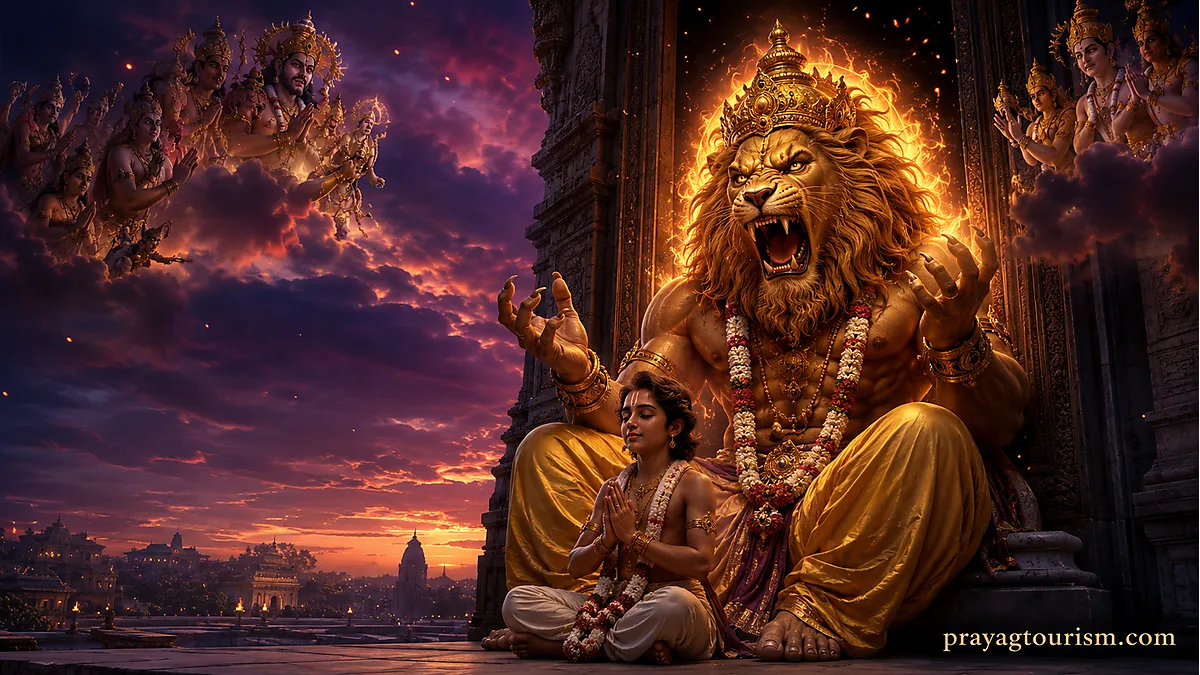
The Story of Prahlāda, Divine Protection, and the God Who Appears at Life’s Greatest Thresholds
Table of Contents
Threshold of Terror and Grace
We have stood on the back of Kūrma amid primeval waters.
We have watched Varāha rise from the abyss, the Earth cradled on His tusk.
Now, in the fourth Avatāra, the narrative steps into a space more unsettling than any ocean: the threshold between beast and human, law and exception, terror and love.
Narasimha Avatar is the fourth incarnation of Lord Vishnu. Appearing as a Man-Lion, He emerged from a pillar at twilight to protect Prahlada, defeat Hiranyakashipu, and restore dharma. His story symbolizes divine protection, justice, and the power of unwavering devotion.
Etymology: Nara + Siṃha
The Sanskrit name Narasiṃha (नरसिंह) is a karmadhāraya compound uniting two absolute concepts:
- Nara (नर) – human being, but also “the conscious principle operating through the human framework,” the locus of ethics, language, culture, and the possibility of spiritual realization.
- Siṃha (सिंह) – lion, apex predator of the forest; embodiment of raw, spontaneous, unmediated power (śakti), fearlessness, and royal ferocity.
Narasiṃha is not “half-man, half-lion” in the sense of a clumsy hybrid; He is 100% of both principles simultaneously. The human principle brings relationality, speech, and destiny. The lion principle brings irresistible force, instinct, and the power to shatter what is ossified and cruel.
Liminality: Dehalī and Sandhyā
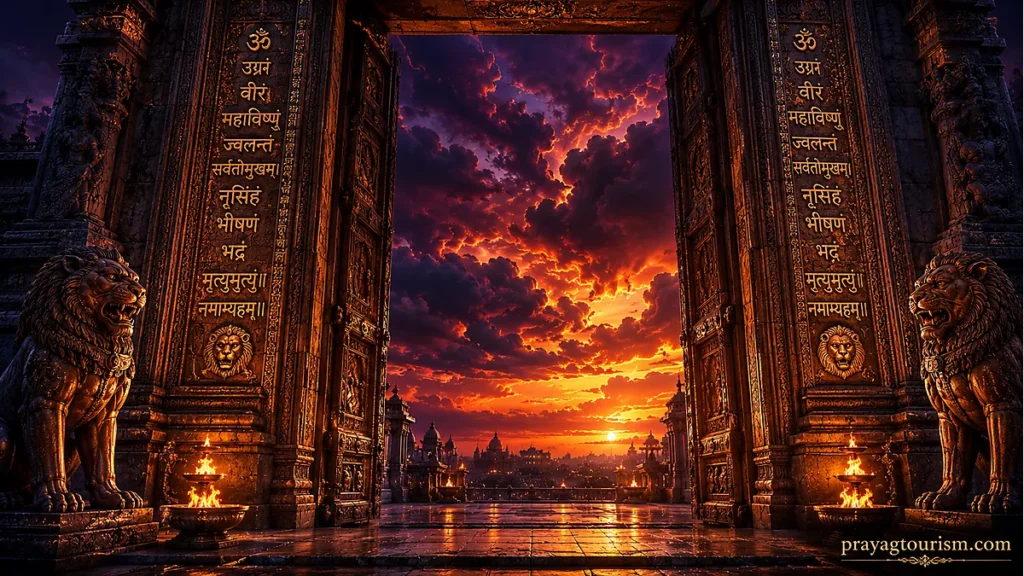
The deeper philosophy of Narasiṃha unfolds when we observe where and when He appears:
- He emerges at twilight (sandhyā) – neither day nor night.
- He manifests at the threshold (dehalī) of the palace – neither inside nor outside.
- He kills Hiraṇyakaśipu with His claws – neither conventional weapon nor non-weapon.
- He is neither man nor animal, but something entirely beyond both.
In Hindu ritual and architecture, thresholds and twilight are considered dangerous and powerful zones. One does not casually stand in a doorway; one offers lamps and prayers at sandhyā. These are moments and spaces where boundaries blur, where the usual categories fail, and where deep change becomes possible.
Narasiṃha is the Lord of such liminal zones.
When cosmic laws are twisted into a cage of oppression, the Divine does not merely rewrite the rules; He appears in the cracks between them. This is the heart of Narasiṃha theology:
When dharma is imprisoned inside the very structure of law, God must come as the exception that exposes the law’s limits.
Textual Roots and Historical Evolution
The blazing form of Narasiṃha, though fully articulated in the Purāṇas, has older echoes across Vedic and Upaniṣadic literature.
Vedic Hints: The Lion of the Heights
The Ṛgveda often speaks of Viṣṇu as a majestic being who strides across the worlds, sometimes likened to a lion dwelling in the mountains, “fierce like a wild beast” (mṛgo na bhīmaḥ kumāro giriṣṭhāḥ, RV 1.154.2). This imagery plants seeds of a lion-like protector who inhabits lofty, liminal spaces—between earth and sky, man and beast.
As Vedic religion flows into the more contemplative Āraṇyakas and Upaniṣads, the emphasis shifts from ritual imagery to meditative identity. The Nṛsiṃha Tāpanīya Upaniṣad (Atharva Veda tradition) elevates Narasiṃha from a dramatic form to Para-Brahman itself—the ultimate reality upon which the entire cosmos rests and into which all dualities dissolve. In this lens, the man-lion is not just a historical intervention; He is the very pattern of reality, eternally present as the power that protects truth and devotion.
Purāṇic Flowering: Prahlāda and the Personal God
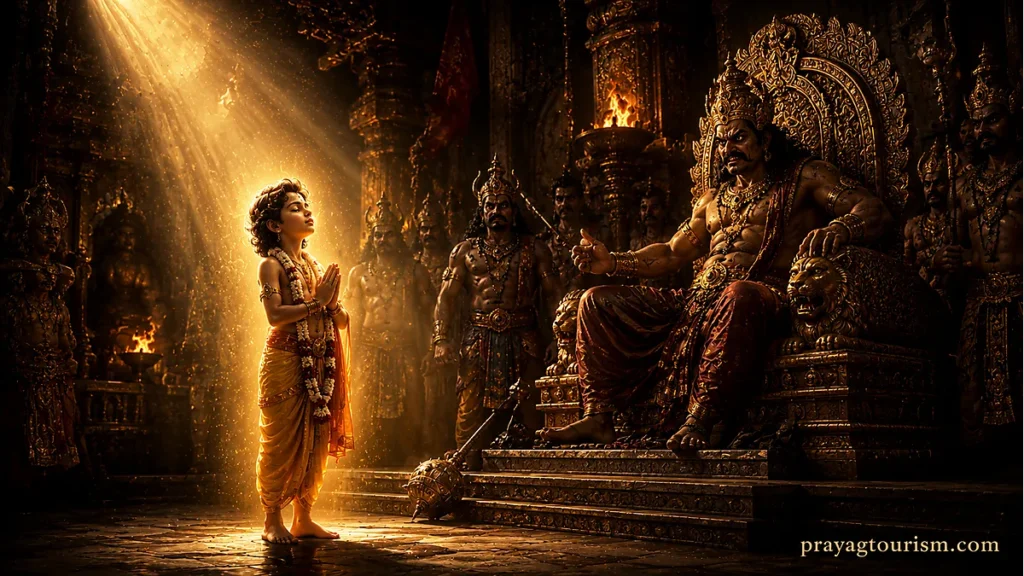
By the classical Purāṇic age, the narrative has become dramatically concrete. The Śrīmad Bhāgavatam (Canto 7) and Viṣṇu Purāṇa present the full cycle of Hiraṇyakaśipu’s rise, Prahlāda’s devotion, and Narasiṃha’s explosive manifestation.[1]
Here, Narasiṃha is no longer only a cosmic principle. He is:
- a father-figure to Prahlāda,
- a judge to Hiraṇyakaśipu,
- and a terror to all forms of hypocrisy, cruelty, and ego.
Theologically, this is a shift from impersonal order to intimate protection. Narasiṃha’s violence is not random; it is targeted, purposeful, and entirely aligned with the preservation of bhakti.
Jayadeva’s Aesthetic Theology
The 12th-century poet Jayadeva Gosvāmī condenses this awe into one unforgettable verse in his Daśāvatāra Stotram:
- Devanagari Script
तव करकमलवरे नखमद्भुतशृङ्गम्।
दलितहिरण्यकशिपुतनुभृङ्गम्॥
केशव धृतनरहरिरूप जय जगदीश हरे॥ - IAST Transliteration
tava kara-kamala-vare nakham adbhuta-śṛṅgam |
dalita-hiraṇyakaśipu-tanu-bhṛṅgam ||
keśava dhṛta-nara-hari-rūpa jaya jagadīśa hare || - Source: Gīta Govinda, Daśāvatāra Stotram, Verse 4.
- Word-by-Word Meaning
- तव (tava) – Your
- कर-कमल-वरे (kara-kamala-vare) – in Your supreme lotus-like hands
- नखम् (nakham) – the nails
- अद्भुत-शृङ्गम् (adbhuta-śṛṅgam) – wonderfully horn-like, astonishingly sharp
- दलित (dalita) – torn apart
- हिरण्यकशिपु (hiraṇyakaśipu) – of Hiraṇyakaśipu
- तनु (tanu) – the body
- भृङ्गम् (bhṛṅgam) – like a fragile insect
- केशव (keśava) – O Keśava
- धृत (dhṛta) – who have assumed
- नर-हरि (nara-hari) – the Man-Lion
- रूप (rūpa) – form
- जय (jaya) – all glories
- जगत्-ईश (jagat-īśa) – O Lord of the universe
- हरे (hare) – O Hari
- Translation & Bhāṣya
“O Lord Keśava, who have assumed the form of the Man-Lion, all glories to You, O Lord of the universe! In Your beautiful lotus-hands, the nails have become wonderful horn-like weapons that have effortlessly torn apart the body of the wasp-like Hiraṇyakaśipu.”
Jayadeva employs virodhābhāsa – the poetry of apparent contradiction. From kara-kamala (lotus-soft hands), we get adbhuta-śṛṅgam (astonishingly sharp claws). That which blesses and caresses also tears apart tyranny. Compassion and ferocity are not two different hands; they are two functions of the same divine palm.
The Grand Narrative of Prahlāda and the Pillar
The Narasiṃha līlā begins where Varāha’s story leaves off. Hiraṇyākṣa lies slain by the Divine Boar. From this wound in adharma arises a flame of vengeance.
Hiraṇyakaśipu’s Ascetic Fury and the Boon of Loopholes
Hiraṇyakaśipu—“he who is clothed in gold and soft cushions”—represents the intoxicating pride of sensory success and material power. To avenge his brother, he turns to terrifying tapasya:
- He stands unmoving for ages, arms raised, body devoured by ants.
- His austerity heats the universe; devas suffocate under the heat of his will.
Finally, Brahmā appears and offers a boon. Hiraṇyakaśipu does what many modern minds do: he attempts to game the system. He does not ask for immortality outright, but constructs a legalistic fortress of conditions:
- He shall not die by man or beast.
- Not by day or night.
- Not inside any building, nor outside it.
- Not on earth nor in the sky.
- Not by any weapon, made or living.
Convinced he has sealed every door through which fate could enter, he launches a regime of tyranny across the three worlds.
Prahlāda: Devotion in the House of a Tyrant
Paradoxically, from this dark king is born Prahlāda, luminous child-devotee of Viṣṇu. Exposed to devotion in the womb through the teachings of Nārada, Prahlāda emerges into the world singing the names of the very God his father hates.
Hiraṇyakaśipu sees his son’s devotion as treason. The episodes that follow are among the most moving in all Purāṇic literature:
- Teachers are instructed to “correct” Prahlāda; he instead converts his classmates.
- The father subjects him to poison, trampled elephants, venomous serpents, and burning fire.
- In every trial, Prahlāda remains serene, chanting the Lord’s name, and emerges unharmed.
It becomes clear that Prahlāda is not protected by luck or magic; he is protected by a relationship. Narasiṃha is the unseen, constantly intervening presence.
“Is He in This Pillar?”
The tension reaches its climax in the royal sabhā. Hiraṇyakaśipu demands:
“Where is your Viṣṇu? Is He in this palace? Is He in this pillar?”
Prahlāda answers with disarming simplicity:
“He is in the pillar, and He is in every atom of existence.”
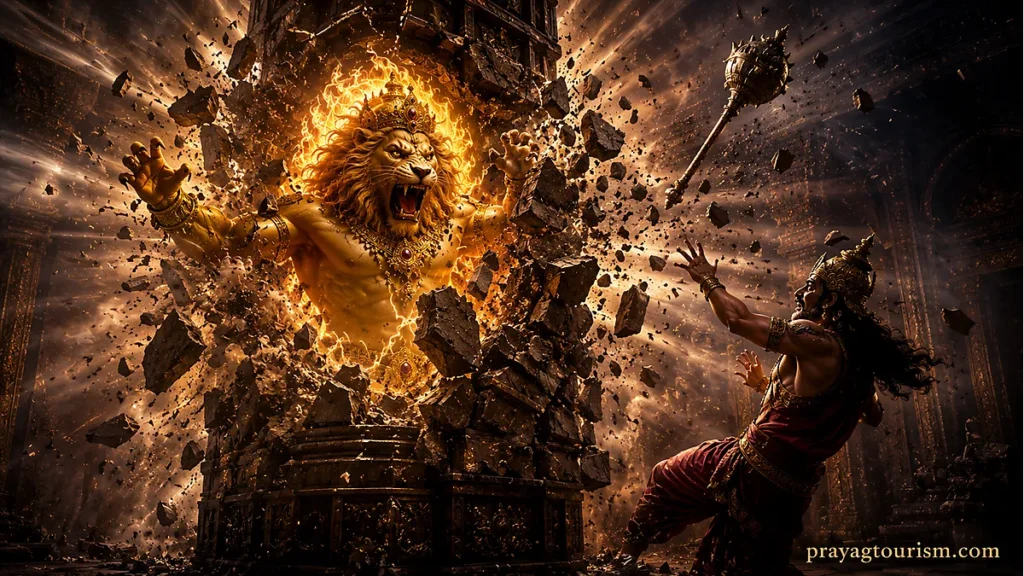
Enraged, Hiraṇyakaśipu strikes the massive stone pillar with his mace. The hall trembles. From within the fractured core of the stone, something awakens.
The Bhāgavatam captures this moment:
- Devanagari Script
सत्यं विधातुं निजभृत्यभाषितं
व्याप्तिं च भूतेष्वखिलेṣu चात्मनः।
अदृश्यतात्यद्भुतरूपमुद्वहन्
स्तम्भे सभायां न मृगं न मानुषम्॥ - IAST Transliteration
satyaṃ vidhātuṃ nija-bhṛtya-bhāṣitaṃ
vyāptiṃ ca bhūteṣv akhileṣu cātmanaḥ |
adṛśyatātyadbhuta-rūpam udvahan
stambhe sabhāyāṃ na mṛgaṃ na mānuṣam || - Source: Śrīmad Bhāgavatam 7.8.18.
- Word-by-Word Meaning
- सत्यम् (satyaṃ) – truth
- विधातुम् (vidhātum) – to make true, to fulfill
- निज-भृत्य (nija-bhṛtya) – of His own servant
- भाषितम् (bhāṣitam) – the words
- व्याप्तिम् (vyāptim) – all-pervading nature
- च (ca) – and
- भूतेषु (bhūteṣu) – in all beings
- अखिलेषु (akhileṣu) – in all things
- च (ca) – also
- आत्मनः (ātmanaḥ) – of Himself
- अदृश्यत (adṛśyata) – became visible
- अति-अद्भुत-रूपम् (ati-adbhuta-rūpam) – a most astonishing form
- उद्वहन् (udvahan) – assuming, bearing
- स्तम्भे (stambhe) – in the pillar
- सभायाम् (sabhāyām) – in the assembly hall
- न (na) – not
- मृगम् (mṛgam) – a beast
- न (na) – nor
- मानुषम् (mānuṣam) – a human
- Translation & Bhāṣya
“To make the words of His servant Prahlāda true, and to demonstrate His own all-pervading presence within all beings and all things, the Supreme Lord manifested a most astonishing form within that pillar in the royal assembly— a form that was neither animal nor human.”
The purpose of the Avatāra is given explicitly: satyaṃ vidhātum nija-bhṛtya-bhāṣitam – to prove the words of His devotee true. Narasiṃha appears first of all to defend the integrity of a child’s testimony about God’s omnipresence.
The Slaying at the Threshold
What follows is not an extended duel; it is a short, devastating lesson in the limits of legalistic boons.
- Time: Twilight – neither day nor night.
- Place: Palace threshold – neither indoors nor outdoors.
- Position: Hiraṇyakaśipu on the Lord’s lap – neither on earth nor in the sky.
- Instrument: Nails – neither forged weapon nor living entity.
- Agent: Narasiṃha – neither man nor animal.
Narasiṃha plants one knee on the palace floor, one foot across the threshold, lifts Hiraṇyakaśipu onto His thighs, and with a roaring exhalation, tears open the chest of the “invincible” king. No boon is broken; every condition is fulfilled and transcended simultaneously.
The sabhā floods with blood and light. The Lord’s fury is so intense that even the devas fear to approach Him. It is Prahlāda alone—small, unafraid, drenched in his father’s blood—who advances, falls at the Lord’s claws, and sings hymns of gratitude. It is the devotee who finally cools the Lord’s rage into compassion.
Esoteric Paradigms: Evolution, Theology, Devotion
Narasiṃha Avatāra is a multi-layered jewel. Three facets are especially illuminating: evolutionary symbolism, theological paradox, and devotional radicalism.
1. Evolutionary Paradigm – The Hominid Threshold
Seen symbolically, Narasiṃha corresponds to the hominid transition—that long threshold where our ancestors were neither fully animal nor fully human:
- They walked upright but were not yet fully bipedal.
- They used tools but had not yet formed complex language and culture.
- They felt fear and awe before nature but had not yet articulated metaphysical questions.
The Man-Lion becomes a mythic shorthand for the emergence of self-aware consciousness from raw instinct. In the Daśāvatāra staircase:
- Matsya – aquatic life.
- Kūrma – amphibious transition.
- Varāha – full claim over terrestrial earth.
- Narasiṃha – crossing into reflective, self-conscious personhood.
The boundary between “animal” and “human” is not a hard line but a twilight zone. Narasiṃha visually embodies that zone.
2. Theological Paradigm – God in the In-Between
Hiraṇyakaśipu designs his boon by listing binaries:
- Man vs. beast
- Day vs. night
- Inside vs. outside
- Earth vs. sky
- Weapon vs. non-weapon
He assumes that reality is exhausted by such opposites. But Narasiṃha appears precisely where the binary fails.
This teaches several things at once:
- The Divine honours the laws of the cosmos; He does not need to “cheat”.
- Yet the Divine is never exhausted by any conceptual framework or set of rules.
- God’s presence is most strikingly revealed when rules are weaponised against justice.
Whenever dharmic language is used to justify cruelty, whenever sacred texts are twisted to support oppression, Narasiṃha’s lesson returns: the Divine remains free to appear in ways no one anticipated, defending the vulnerable against the letter of misused law.
3. Devotional Paradigm – Radical Grace and Prahlāda
At the devotional level, the narrative is not about an angry God; it is about a God who is unreasonably biased toward His bhaktas.
Prahlāda brings nothing to the table except:
- unwavering remembrance of Viṣṇu,
- refusal to hate his father despite abuse,
- and willingness to stand alone amidst universal compromise.
He has no army, no magic weapons, no political allies. Narasiṃha’s appearance demonstrates:
- A single child’s truthful sentence about God is enough to move the entire cosmos.
- The Divine will adopt any form necessary, even a form never seen before, to honour the faithfulness of one devotee.
- Divine “anger” is not moody or arbitrary; it is targeted compassion for the oppressed and a surgical strike against hardened ego.
This is why Narasiṃha is at once bhīṣaṇa (terrifying) and bhadra (auspicious). To the ego, He is horror. To the surrendered heart, He is the safest place in all worlds.
Sacred Geography: Walking with the Man-Lion
Narasiṃha’s presence is etched into the geography of Bhārata. His temples tend to arise in rugged hills, dense forests, and liminal landscapes, mirroring His own nature.
1. Ahobilam – The Roaring Seat of Nava Narasiṃha
In the Nallamala range of Andhra Pradesh lies Ahobilam, a remote kṣetra where the Lord is believed to have actually appeared from the pillar and slain Hiraṇyakaśipu. Nestled in the Eastern Ghats, the region is marked by deep gorges, dense vegetation, and echoing cliffs—a natural amphitheatre for a lion’s roar.
Ahobilam is unique in hosting nine distinct shrines of Narasiṃha (Nava Narasiṃha), each representing a different mood of the Lord: Ahobila, Bhārgava, Jvālā, Yogānanda, Chatravāta, Karañja, Pāvana, Mālola, and Vārāha Narasiṃha.
Pilgrims traverse both Lower and Upper Ahobilam, trekking through rocky trails, climbing to cave shrines, and crossing streams. The yātrā becomes a physical sādhana; every ascent and descent mirrors the inner journey from fear to surrender.
Ugra Sthambha and the Pillar Memory
High above, a cleft in a giant rock face, known as Ugra Sthambha, is revered as the residual mark of the pillar from which the Lord burst forth. The climb is steep and not recommended in heavy rain, but those who undertake it describe a palpable sense of ancient ferocity in the air.
The Chenchu Lakṣmī Tradition
Local Chenchu tribes consider Narasiṃha as their brother-in-law. According to regional lore, after slaying Hiraṇyakaśipu, the still-fierce Lord roamed the forests and married a Chenchu girl, Chenchu Lakṣmī, whose love pacified Him. In Ahobilam, therefore, Vedic temple ritual and indigenous forest devotion coexist—the Avatāra belongs as much to the hills as to the Āgamas.
2. Panakala Lakṣmī Narasiṃha Swāmy, Mangalagiri
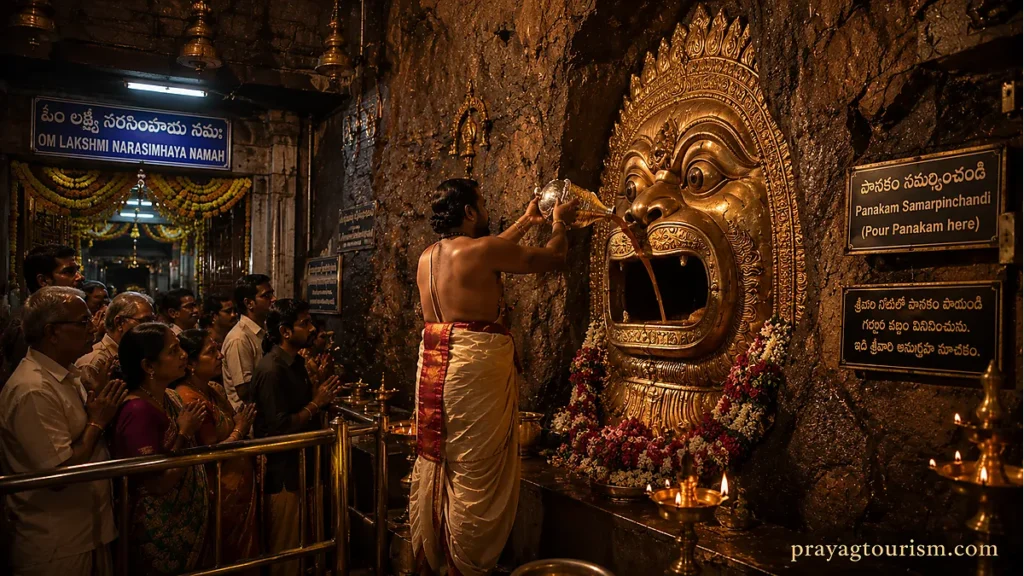
At Mangalagiri in Andhra Pradesh—literally “the auspicious hill”—Narasiṃha is worshipped in a mysterious form where only the mouth of the Lord is visible in a rock face. The temple, perched on an elephant-shaped hill, is famous as Panakala Narasiṃha, “He who drinks jaggery water.”
The Jaggery-Water Miracle
Devotees offer pānakam—jaggery water poured through a conch directly into the Lord’s mouth. Tradition describes a clear, audible gurgling or burping sound as the deity “drinks” the offering, after which only about half the liquid is ejected back, to be returned as prasāda.
Thousands of litres are offered, and yet the sanctum remains remarkably free of ants or insect infestation, a detail often noted by pilgrims and writers. Some modern observers speculate about a geological vent or volcanic cavity absorbing the liquid, but for devotees, the phenomenon is simply one more playful expression of Narasiṃha’s living presence.
Temple timings and pānakam offerings are generally restricted to the daytime—often from early morning till mid-afternoon—reinforcing the sense that devas themselves worship here at night. The entire hill is experienced as a living altar.[7][6]
3. Śrī Varāha Lakṣmī Narasiṃha Temple, Simhachalam
At Simhachalam, near Visakhapatnam in Andhra Pradesh, the Lord appears in a composite form as Varāha Lakṣmī Narasiṃha—human-bodied with facial features recalling both boar and lion, integrating two Avatāras into one deity. The temple crowns a hill and has been a major centre of Narasiṃha worship for centuries.
What sets Simhachalam apart is the sandalwood mystery:
- The original stone deity is considered so Ugra (fierce) that He is kept completely covered in thick layers of sandalwood paste for almost the entire year, giving Him the appearance of a smooth, abstract liṅga.
- Only once annually, on Akṣaya Tritīyā / Chaitra Śukla Tādīyā, is the paste removed in the famous Chandanotsavam or Nijaroopa Darśanam, allowing lakhs of devotees to glimpse the Lord’s true, detailed form for a few sacred hours.
During Chandanotsavam, the hill brims with pilgrims from Andhra, Odisha, and beyond; special darshan queues and ticketed lines are arranged to manage the ocean of people. After the festival, layers of sandal paste are reapplied in stages over specific tithis, slowly veiling the Lord again for another year.
For many, Simhachalam offers an important spiritual lesson: sometimes the most intense forms of grace must be veiled, lest we be overwhelmed. The sandalwood is not merely cooling the deity; it is gently protecting the devotee.
Modern Sādhana: Living with Narasiṃha Today
How does a 21st-century seeker in a high-rise apartment, surrounded by notifications and traffic noise, relate to a roaring Man-Lion emerging from a palace pillar?
Facing the Inner Hiraṇyakaśipu
Hiraṇyakaśipu is the archetype of the modern ego that believes:
- “With enough money, data, and contracts, I can bulletproof my life.”
- “If I close every loophole, nothing can hurt me.”
We build our own boons of invulnerability: insurance policies, gated communities, encrypted passwords, diversified portfolios. These are not wrong in themselves. The problem arises when we start to believe that these structures can substitute for inner surrender.
Narasiṃha teaches that:
- No matter how intricate the fortress, life will find a threshold—a divorce, illness, job loss, betrayal, or pandemic—where our rules break down.
- These thresholds are not punishments; they are openings where the deeper Divine can finally enter our carefully curated lives.
The practical sādhana is to stop treating these ruptures as mere misfortunes and start greeting them as Sandhyā moments, times where a deeper Narasiṃha-presence may be about to break through.
Trusting the God of Transitions
Every major transition in life is a personal threshold:
- changing careers,
- moving cities,
- recovering from addiction,
- entering or leaving a relationship,
- confronting mortality—our own or a loved one’s.
At such times, the old identity and its rules no longer fully apply, but the new identity is not yet formed. This is frightening precisely because our usual “boons” do not work.
Narasiṃha Bhakti invites a different prayer:
“O Lord who appears at twilight, stand with me in this doorway.
I do not ask You to remove the threshold; I ask You to reveal Yourself within it.”
The Nṛsiṃha Mahā-Mantra as Armor
For those facing intense anxiety, recurring nightmares, or environments of hostility, tradition offers the Nṛsiṃha Mahā-Mantra, widely recited as a spiritual kavaca (shield):
- Devanagari Script
उग्रं वीरं महाविष्णुं ज्वलन्तं सर्वतोमुखम्।
नृसिंहं भीषणं भद्रं मृत्युमृत्युं नमाम्यहम्॥ - IAST Transliteration
ugraṃ vīraṃ mahā-viṣṇuṃ jvalantaṃ sarvato-mukham |
nṛsiṃhaṃ bhīṣaṇaṃ bhadraṃ mṛtyu-mṛtyuṃ namāmy aham || - Sense
“I bow to Lord Narasiṃha—fierce and heroic, the great Viṣṇu, blazing and all-pervading, terrifying to the wicked yet supremely auspicious, the very death of death itself.”
How to practice:
- Sit quietly, spine straight.
- Inhale gently, exhale while softly chanting one line.
- Let the words “bhīṣaṇaṃ bhadram” sink in—He is terrifying and auspicious at once.
- Visualise a golden-white sphere of light forming around you, not isolating you from life but filtering out what is adharmic and unnecessary.
Bringing Narasiṃha into Home and Work
- Keep a small image of Narasiṃha near your door—invoking the Guardian of thresholds to bless all who enter and leave.
- In moments of anger at injustice, silently ask: “Is this righteous Narasiṃha-anger, or egoic Hiraṇyakaśipu-rage?” Let the Avatāra teach you the difference.
- Parents can share Prahlāda’s story with children to model courage without hatred: standing for truth while refusing to demonise even those who oppose us.
In all this, remember: Narasiṃha is not God at His most distant; He is God at His closest and most engaged, willing to tear apart even our cherished illusions to reach the vulnerable heart.
Verses, Mantras, and Meditations
To anchor Narasiṃha in daily life, here is a small sādhana toolkit that combines scriptural depth with practical use.
7.1 Jayadeva’s Narasiṃha Verse for Daily Japa
Revisit the Jayadeva verse from Phase 2. Chant it as a short daily meditation:
- Inhale, then chant:
tava kara-kamala-vare nakham adbhuta-śṛṅgam - Pause; visualise soft lotus palms from which brilliant claws extend.
- Exhale with the second half:
dalita-hiraṇyakaśipu-tanu-bhṛṅgam - Conclude softly:
keśava dhṛta-nara-hari-rūpa jaya jagadīśa hare
Let one specific fear or oppression in your life symbolically become “Hiraṇyakaśipu,” offered into the Lord’s hands to be torn away.
7.2 “He is in the Pillar” – A Micro-Meditation
Once a day, deliberately practice the Prahlāda vision:
- Choose something apparently inanimate in your environment: a concrete wall, an office cubicle, a laptop.
- Look at it and quietly state: “He is here also.”
- Recall satyaṃ vidhātuṃ nija-bhṛtya-bhāṣitam—the Lord is committed to the truth of His devotee’s intuition.
- Allow a few seconds of silence. This anchors omnipresence into the most ordinary moments.
7.3 A Short Protective Nārāyaṇa–Nṛsiṃha Mantra
For children or beginners who find longer mantras difficult, you may use:
Devanagari
ॐ नृसिंहाय नमः।
IAST
oṁ nṛsiṃhāya namaḥ |
Repeat this 11 or 21 times at night before sleep. Visualise the Lord sitting at the doorway of your room, watching over the night, letting only what is beneficial enter your mind and dreams.
7.4 Contemplation at Personal Thresholds
At moments of personal transition—a job interview, a hospital corridor, a difficult conversation—treat the doorway itself as sacred:
- Pause at the threshold; don’t rush through.
- Mentally bow: “O Narasiṃha, Lord of thresholds, be present as I step into this new space.”
- Take one conscious step, imagining that you walk under the protection of the Man-Lion whose roar dissolves fear and whose hands ensure you need not compromise truth for safety.
Narasiṃha Avatāra is not merely a story of mythic violence; it is the revelation that Ultimate Reality is willing to stand at our most terrifying thresholds—between life and death, certainty and chaos, law and justice, animal and human—and appear in whatever form is needed to protect a single, vulnerable devotee.
FREQUENTLY ASKED QUESTIONS
What is Narasimha Avatar?
Narasimha Avatar is the fourth incarnation of Lord Vishnu. He appeared as a Man-Lion to protect Prahlada and defeat the demon king Hiranyakashipu.
Why did Lord Vishnu appear as Narasimha?
Lord Vishnu manifested as Narasimha to fulfill Brahma’s boon conditions while protecting Prahlada and restoring dharma.
What is the meaning of Narasimha?
Narasimha combines “Nara” (human) and “Simha” (lion), symbolizing divine power that transcends ordinary categories and limitations.
Who was Prahlada?
Prahlada was a devoted follower of Vishnu and the son of the demon king Hiranyakashipu. His unwavering devotion led to Narasimha’s appearance.
Where did Narasimha appear?
According to the Bhagavata Purana, Narasimha emerged from a palace pillar to prove His omnipresence and protect Prahlada.
Which temple is most famous for Narasimha worship?
Ahobilam in Andhra Pradesh is considered one of the most important Narasimha pilgrimage centers, especially for the Nava Narasimha shrines.
What is the Narasimha Mantra?
One popular mantra is:
Om Nrisimhaya Namah
It is traditionally recited for courage, protection, and inner strength.
What does Narasimha symbolize spiritually?
Narasimha symbolizes divine protection, courage, justice, and the triumph of devotion over fear, oppression, and ego.
Where Varāha secures the ground of life, Narasiṃha secures the conscience of life. Together, they teach that Sanātana Dharma is not a path of escape from the world, but a fierce, tender, and unflinching engagement with it—until even our darkest pillars crack open to reveal the blazing face of grace.
Hari Om Tat Sat.
⁂
- https://sacred-texts.com/hin/hmvp/hmvp21.htm
- https://en.wikipedia.org/wiki/Ahobilam
- https://www.tirthayatra.org/ahobilam/
- https://ahobilamrooms.com/nava-narasimha-temples-ahobilam-history/
- https://www.ahobilamutt.org/us/information/visitingahobilam.asp
- https://gotirupati.com/mangalagiri-panakala-swamy-panakam/
- https://www.tamilbrahmins.com/threads/mangalagiri-–-sri-panaka-narasimha-swamy.25304/
- https://navrang1.rssing.com/chan-58541628/article295.html
- https://www.navrangindia.in/2023/12/panakala-lakshmi-narasimha-swamy.html
- http://mantrashlokas-madhuri.blogspot.com/2011/07/simhachalam-sri-varaha-lakshmi.html
- https://timesofindia.indiatimes.com/simhachalam-temple-spruced-up-for-chandanotsavam/articleshow/39453283.cms
- https://www.business-standard.com/amp/article/pti-stories/devotees-witness-lord-varaha-lakshmi-narasimha-swamy-ritual-115042101314_1.html
- https://timesofindia.indiatimes.com/city/vijayawada/significance-of-nijaroopa-darshanam-of-lord-varaha-lakshmi-narasimha-swamy/articleshow/120773418.cms