
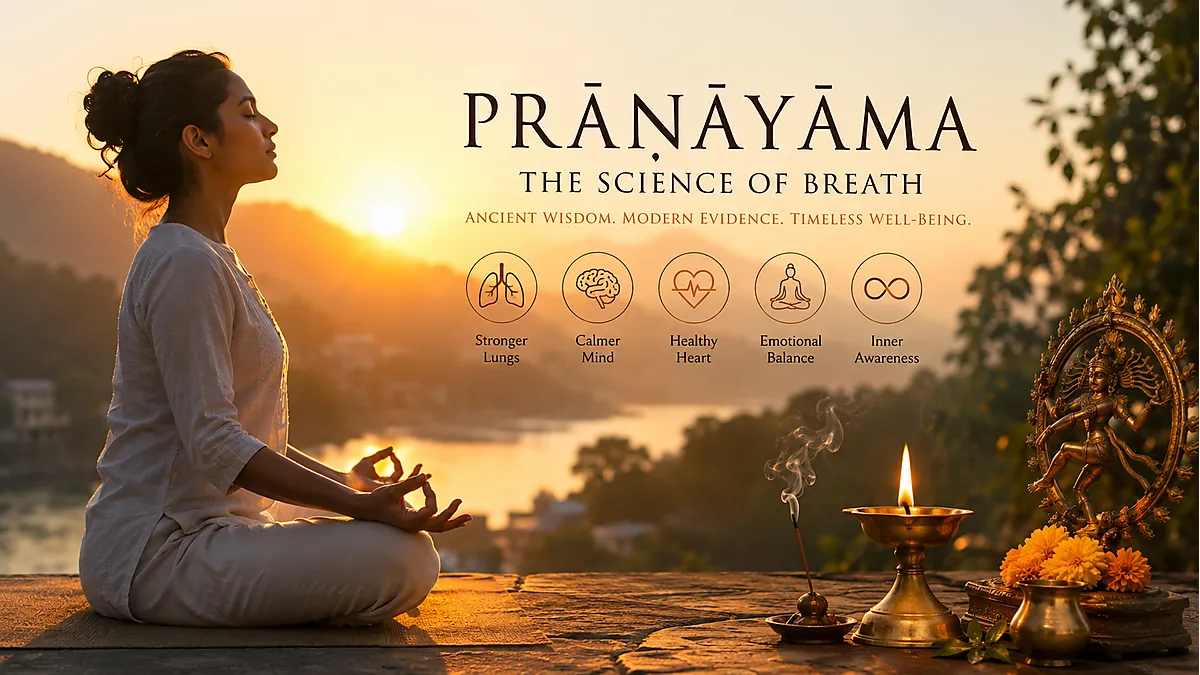
How an ancient practice of conscious breathing is being confirmed, one study at a time, as one of the most powerful tools for human well-being
Table of Contents
The Most Obvious Thing You Have Never Noticed
Take a breath right now. A normal one. The kind you have been taking all day without thinking about it — approximately 17,000 times today, in fact, most of them entirely unconscious, most of them shallow, most of them taking in only the top third of your lungs’ actual capacity.
Now take a second breath. Slower this time. Let it go a little deeper. Feel the belly expand before the chest. Hold it for just a moment at the top. Release it slowly, completely, until the lungs are empty. Notice — even from that one conscious breath — whether the quality of the moment is slightly different from the one before it.
Something happened. Something that did not require a supplement, a device, a technique, a qualified instructor, or a prescription. Something that was available to you every moment of every day of your entire life — and that you have been walking past, approximately 17,000 times daily, without stopping to notice it.[3][1]
This is the starting point of Prāṇāyāma (प्राणायाम — Prāṇāyāma, from prāṇa meaning vital energy, life-force, breath and āyāma meaning expansion, extension, regulation — literally the expansion and regulation of vital energy). Not a technique. Not a program. Not even, at its heart, an exercise. It is simply the act of turning the breath — which has been happening automatically all your life — into a conscious practice.[2][4]
The tradition of Sanatana Dharma has been refining this practice for at least three thousand years. Modern neuroscience has been studying it for about three decades. The conclusions they are reaching are identical.[1][3]
This article is the bridge between those two conversations.[5][2]
What Is Prāṇa? — More Than Just Air
Before we explore the practice of Prāṇāyāma, we need to understand what Prāṇa actually is — because it is both simpler and more profound than most modern readers first expect.
Prāṇa (प्राण — Prāṇa) is not simply oxygen. It is not simply air. It is the life-force — the animating energy that distinguishes a living body from a dead one, the invisible but entirely real presence that makes the difference between matter that is alive and matter that is not.[6][7]
The ancient Vedic teachers observed something that anyone can observe: two bodies can be physically identical in their biochemical composition — same molecules, same structures, same organs — and yet one is alive and one is not. What is present in one and absent in the other? Not a physical substance. Something more fundamental. Something the tradition called Prāṇa.[8][6]
Think of it this way. Your smartphone contains a processor, a screen, a camera, a battery, and thousands of components — all of them precisely engineered, all of them necessary. But none of them function without electricity. Without the power flowing through the circuits, the device is simply an expensive arrangement of materials. Electricity is not one more component among the others. It is the animating principle — the presence without which none of the others can do anything.[6][8]
Prāṇa is to the human body what electricity is to the device: not the body itself, but the energy that makes the body live.[7][6]
And the breath is the primary vehicle through which Prāṇa enters and circulates through the human system. Not the only vehicle — the tradition recognizes that Prāṇa is also taken in through food, through water, through sunlight, through positive experiences and relationships — but the breath is the most immediate, the most continuous, and the most directly controllable of all of them.[8][6]
This is why Prāṇāyāma — the deliberate regulation of the breath — is simultaneously the regulation of the body’s vital energy. When you change the breath, you change the Prāṇa. When you change the Prāṇa, you change the state of the entire system — physical, energetic, emotional, mental.[2][3]
This is not a metaphysical claim. It is a functional description that modern physiology is now confirming in precise neurological and biochemical detail.[1][2]
The Five Prāṇas — A Map of Your Inner Life
The tradition did not describe Prāṇa as a single, undifferentiated energy. It described five distinct expressions of vital energy — five Vāyus (वायु — Vāyu, meaning wind, air, movement) — each one governing a different domain of physiological and psychological function.[7][8]
Understanding these five is not an academic exercise. It is a practical map — once you know it, you begin to recognize which Vāyu is active in any given moment, and you understand how to work with the breath to support it.[6][8]
Prāṇa Vāyu — The Intake, The Welcoming
Prāṇa Vāyu (प्राण वायु — the in-taking wind) governs the region of the chest and heart and is the energy associated with intake: the breath coming in, the heart receiving blood, the senses receiving experience, the mind receiving new ideas and impressions.[8][6]
When Prāṇa Vāyu is strong and flowing well, you feel open, receptive, energetically present — the quality of someone who is genuinely taking in life, engaged with what is happening, available to what the moment is offering. When it is depleted or blocked, you feel closed, breathless in a deeper sense — not physically unable to breathe, but existentially contracted, unable to be nourished by the good things that are present.[6][8]
Simple modern parallel: When you are excited and open, you breathe more expansively. When you are anxious or guarded, the chest tightens and the breath becomes shallow. This is Prāṇa Vāyu responding to your inner state — and you can reverse the direction, deliberately breathing more expansively to invite the openness back.[1][6]
Apāna Vāyu — The Release, The Letting Go
Apāna Vāyu (अपान वायु — the down-moving, releasing wind) governs the lower abdomen and pelvis and is the energy associated with elimination: the breath going out, the digestive system releasing waste, the body expelling what it no longer needs, the mind releasing old thoughts and completed experiences.[8][6]
Apāna is the energy of completion, of letting go, of the natural end of cycles. When it functions well, the body eliminates efficiently, digestion is comfortable, and the mind has the capacity to release what has been processed and move on. When it is disturbed, you feel stuck — both physically (digestive sluggishness, tension in the lower body) and psychologically (rumination, the inability to release old grievances or completed experiences).[7][6]
Simple modern parallel: Stress constipates. Not metaphorically — literally. The physiological mechanism is that stress hormones suppress digestive motility, disrupting exactly the Apāna Vāyu function the tradition describes. Prāṇāyāma practices that emphasize the exhalation directly support Apāna Vāyu — and many practitioners report improved digestive comfort as one of the earliest noticeable effects of a regular practice.[2][6]
Samāna Vāyu — The Digester, The Integrator
Samāna Vāyu (समान वायु — the balancing, equaling wind) governs the navel region — the center of the body — and is the energy associated with processing and integration: the digestive fire that transforms food into nourishment, the metabolic processes that convert raw materials into usable energy, and at the psychological level, the capacity to process experience and integrate it into understanding.[6][8]
Samāna is the energy of the center — literally, the energy that finds the balance point and works from it. When it is healthy, digestion is comfortable and efficient, metabolism is steady, and the mind has a quality of equanimity — the ability to take in experience, process it, extract what is useful, and release what is not.[7][6]
Udāna Vāyu — The Upward Wind, The Expression
Udāna Vāyu (उदान वायु — the up-moving wind) governs the throat and the upward movement of energy — associated with speech, expression, the swallowing reflex, and the upward movement of awareness toward higher states of consciousness.[8][6]
Udāna is the energy behind your voice — literally and figuratively. When it is flowing well, you can speak clearly, express yourself authentically, and your words carry genuine energy. When it is depleted, speech becomes effortful, self-expression feels blocked, and there is a quality of energy that feels trapped in the body rather than moving upward and outward.[7][6]
Simple modern parallel: The nervousness before public speaking — when the throat tightens, the voice becomes thin or trembles, words do not come easily — is the disruption of Udāna Vāyu by anxiety. Prāṇāyāma practiced before a presentation or a difficult conversation directly addresses this by restoring the ease of upward energy flow.[1][6]
Vyāna Vāyu — The Pervader, The Circulation
Vyāna Vāyu (व्यान वायु — the pervading, all-moving wind) is the most expansive of the five — the energy that circulates throughout the entire body, governing the distribution of Prāṇa from the center to the periphery, maintaining the unity and coordination of all bodily systems.[6][8]
If the other four Vāyus govern specific regions and specific functions, Vyāna is the connective energy — the one that makes all the systems work as a single, coordinated whole. When it flows freely, the body has vitality, coordination, and a sense of being fully alive from center to extremities — a quality sometimes described as being in the body in a way that desk-bound, sedentary modern life makes difficult to maintain.[7][6]
A simple image: Think of the five Prāṇas as a complete enterprise. Prāṇa Vāyu brings in the raw material. Samāna Vāyu processes it. Vyāna Vāyu distributes the finished product throughout the organization. Apāna Vāyu removes the waste. Udāna Vāyu directs the work toward its highest purpose. Every functional system in the body operates by this five-fold logic — and Prāṇāyāma, by consciously regulating the breath, influences all five simultaneously.[8][6]
Three Essential Techniques — Simple, Safe, Transformative
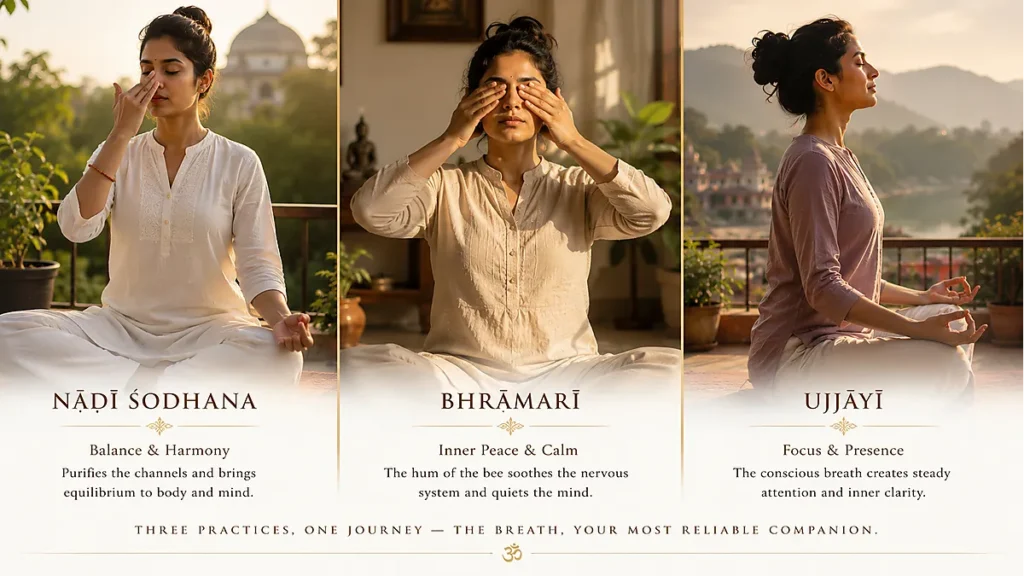
Now we arrive at the practical heart of the article: three specific Prāṇāyāma techniques that are safe for all healthy adults, simple enough to begin today, and powerful enough to produce noticeable effects within a single session.[4][9]
Important note: These practices are offered as general wellness guidance. If you have any respiratory conditions, cardiovascular issues, or other health concerns, please consult your physician before beginning any breathing practice. Always practice within comfort — Prāṇāyāma should never be effortful, strained, or uncomfortable.
Nāḍī Śodhana Prāṇāyāma — The Breath That Balances
Nāḍī Śodhana (नाडी शोधन — Nāḍī Śodhana, from nāḍī meaning energy channel, nerve, subtle passage and śodhana meaning purification, cleansing) is alternate nostril breathing — perhaps the most celebrated and most widely practiced of all Prāṇāyāma techniques. Also known as Anuloma-Viloma.[10][4]
Its principle is elegant and simple: by breathing alternately through the left and right nostrils in a regulated pattern, you balance the activity of the two hemispheres of the brain and harmonize the two main energy channels (nāḍīs) of the subtle body — the cooling, lunar Iḍā channel associated with the left nostril and the warming, solar Piṅgalā channel associated with the right.[4][10]
Modern research confirms the physiological mechanism: each nostril is connected to a different hemisphere of the brain through crossed neural pathways, and each hemisphere governs different aspects of function (analytical and logical thinking on the left, spatial and creative thinking on the right). Nasal cycle dominance — the natural alternation of airflow between the two nostrils that occurs every 90–120 minutes — has been shown to correlate with hemisphere dominance. Nāḍī Śodhana deliberately and rapidly induces the bilateral balance that the natural nasal cycle achieves slowly and automatically.[10][4]
How to practice:
- Sit in any comfortable position with your spine gently upright. Rest your left hand on your left knee, palm facing upward.
- Bring your right hand to your face. Place the index and middle fingers between the eyebrows. Your thumb will control the right nostril and your ring finger will control the left.
- Close the right nostril gently with your thumb. Inhale slowly and completely through the left nostril for a count of four.
- Close both nostrils. Hold gently for a count of two (optional — omit if any discomfort arises).
- Release the right nostril. Exhale completely through the right nostril for a count of four.
- Inhale through the right nostril for a count of four.
- Close both nostrils, hold for a count of two (optional).
- Release the left nostril. Exhale through the left nostril for a count of four.
This is one complete cycle. Begin with five to seven cycles and work gradually up to ten to fifteen over several weeks of practice.[4][10]
What you will notice: Within the first few cycles, most practitioners notice a distinct quieting of the mind’s background noise — the constant, low-level chatter of planning, worrying, and replaying. The specific bilateral quality of the practice seems to engage a whole-brain mode of awareness that the ordinary forward-rushing analytical mind does not naturally access. Many practitioners describe it as the fastest route they have found to a genuinely clear, settled inner state.[4][1]
Bhrāmarī Prāṇāyāma — The Humming Breath That Heals
Bhrāmarī (भ्रामरी — Bhrāmarī, from bhramara meaning the black bee) takes its name from the sound it produces — a soft, continuous hum, like the sound of a bee, made during the slow exhalation. It is among the simplest and most immediately effective of all the Prāṇāyāma techniques for reducing stress and anxiety.[9][4]
The mechanism is direct and physiologically well-understood: the humming sound produces vibration in the tissues of the head, throat, and chest. These vibrations stimulate the vagus nerve — the long, branching nerve that is the main highway of the parasympathetic nervous system — and directly activate the body’s relaxation response.[11][1]
Additionally, the prolonged exhalation required to sustain the hum activates the same vagal response: slow, extended exhales are one of the most reliable triggers of parasympathetic dominance available in the human body. And the focused attention on the internal sound of the hum provides a built-in Pratyāhāra (sensory withdrawal) effect — the mind is drawn inward, away from external stimulation, toward the quiet interior space that the practice opens.[11][1]
How to practice:
- Sit comfortably with your spine upright. You may keep your eyes closed.
- Take a slow, natural breath in through both nostrils.
- As you exhale, close your ears gently with your thumbs and allow the fingers to rest softly over your eyes and forehead (the Shanmukhi Mudra, or six-openings seal). Alternatively, if this feels uncomfortable, simply leave your hands on your knees and let the hum resonate freely.
- While exhaling, make a smooth, soft, continuous humming sound — like the sustained note of a bee. Keep the sound steady and even, not forced or loud. You are not projecting the sound outward. You are feeling it vibrate within.
- When the exhalation is complete, release the breath gently, inhale naturally, and begin again.
- Practice five to nine rounds. After your last round, sit for a minute in the stillness that follows and simply notice.[9][4]
What you will notice: Bhrāmarī works remarkably quickly — most practitioners report a noticeable reduction in mental agitation within the first three rounds. The specific combination of vibration, prolonged exhalation, and inward sonic focus creates a quality of inner quieting that is unlike almost any other technique. Many people find it the most immediately useful practice for moments of acute anxiety, before difficult conversations, after emotionally demanding experiences, or at the end of a long, draining day.[4][1]
Ujjāyī Prāṇāyāma — The Ocean Breath That Focuses
Ujjāyī (उज्जायी — Ujjāyī, from ud meaning upward, out and jāya meaning victory, conquest — literally the victorious breath) is the soft, gentle, slightly oceanic breathing produced by a mild constriction at the back of the throat during both inhalation and exhalation.[10][4]
If you have ever practiced yoga in a class where the entire room produces a soft, rhythmic, wave-like breathing sound — that is Ujjāyī. It is the breath that many experienced yoga practitioners maintain throughout their entire physical practice.[9][4]
The slight constriction in the throat slows the breath, deepens it, and — crucially — makes it audible to the practitioner. This audibility creates a built-in feedback loop: you can hear your own breath, which means your attention naturally stays with it, which means Ujjāyī breathing is simultaneously a breathing technique and a concentration practice.[10][4]
The physiological effects are documented: Ujjāyī produces improved vagal tone (the strength and responsiveness of the vagal system), reduced heart rate, increased heart rate variability, and a quality of sustained, focused alertness — not the drowsiness of deep relaxation, but the clear, energized calm of a mind that is fully present and unscattered.[10][1]
How to practice:
- Sit or lie comfortably. Take a few natural breaths.
- On your next exhale, make a soft haaaa sound, as if you are fogging a mirror — this activates the slight glottis constriction at the throat that creates the Ujjāyī sound.
- Once you feel that constriction, maintain it on the inhale as well. The sound on the inhale will be slightly different — softer, more like the ocean drawing back over pebbles.
- Breathe slowly and completely — the inhale filling from the belly up to the collarbones, the exhale releasing from top to bottom, until you are pleasantly empty.
- The sound should be soft enough that only you can hear it from a normal conversation distance.
- Practice for five minutes during your morning routine or during any activity that benefits from sustained, quiet focus — reading, writing, steady physical work, or extended conversation that requires full presence.[4][10]
What Modern Science Has Confirmed
The scientific study of Prāṇāyāma — which was largely dismissed or ignored by mainstream Western medicine as recently as twenty-five years ago — has now produced a substantial, peer-reviewed body of research that confirms, in neurological and biochemical detail, what the tradition has always known in experiential and philosophical terms.[3][2]
The central mechanism, now well-established, runs through the vagus nerve — the longest nerve in the human body, which travels from the brainstem down through the neck, heart, lungs, and abdomen, carrying signals in both directions between the brain and the body’s major organ systems. The vagus nerve is the main highway of the parasympathetic nervous system — the branch responsible for the body’s rest, repair, digestion, and recovery functions, which are suppressed when the stress response is active and need to be restored when the stress has passed.[12][11]
Here is what the research shows:[2][1]
Slow, deliberate breathing directly stimulates the vagus nerve. When you breathe slowly — typically six or fewer breaths per minute, compared to the typical resting rate of twelve to eighteen — the mechanical stretching of the lung tissue produces inhibitory signals in the vagus nerve that shift the autonomic nervous system toward parasympathetic dominance. The body moves from the alert, reactive, stress-hormone-producing sympathetic mode toward the calm, restorative, immune-supporting parasympathetic mode.[11][2]
This shift is measurable, rapid, and reliable. A 2022 study measuring the effects of pranayamic breathing found measurable reductions in heart rate, systolic and diastolic blood pressure, and cortisol levels — all within a single session of slow breathing. Heart rate variability (HRV) — the most reliable single marker of autonomic nervous system health and resilience — increased significantly.[13][1]
The effects accumulate over time. A five-week study on yogic breathing practice found significant improvement in autonomic function in regular practitioners compared to controls — suggesting that the shifts produced by individual sessions gradually become the body’s new baseline, creating lasting improvements in stress resilience, emotional regulation, and cardiovascular health.[13]
The amygdala quiets. The amygdala — the brain’s alarm system, responsible for triggering the fear and stress response — shows reduced activation in practitioners of regular slow breathing. This is the neurological signature of what practitioners subjectively describe as feeling less reactive, less easily overwhelmed, less immediately hijacked by stressful situations.[13][1]
Bhrāmarī’s humming specifically activates the vagus. The vibration produced by the humming exhalation in Bhrāmarī stimulates the auricular branch of the vagus nerve (which runs near the outer ear) and the recurrent laryngeal branches at the throat — two of the most accessible vagal stimulation points in the body. The practice is, in effect, a manual activation of the parasympathetic response through vibration.[11][1]
Nāḍī Śodhana produces bilateral brain synchronization. Electroencephalograph (EEG) studies of practitioners during alternate nostril breathing have found increased coordination between the left and right hemispheres — the whole-brain state that is associated with creativity, integrative thinking, emotional intelligence, and the quality of clear, spacious awareness that experienced meditators describe.[1][10]
The researchers who conduct these studies — working in medical schools, neuroscience departments, and clinical settings — arrive at these findings through entirely different methods than the ancient practitioners who developed the techniques. Yet they consistently arrive at the same conclusions: slow, conscious, regulated breathing is one of the most powerful tools available to the human being for influencing the state of both mind and body.[3][2]
The tradition did not need an MRI machine to discover this. It discovered it through the most direct and rigorous methodology available to a civilization without instruments: careful, systematic, multi-generational self-observation. And the accuracy of what it found — now confirmed by every tool that modern science has brought to bear on the question — is as close to a proof of that methodology’s validity as anything in the history of contemplative practice.[14][2]
How to Start — A Simple Daily Practice
One of the most common barriers to beginning a Prāṇāyāma practice is the belief that it requires significant time, specific equipment, a perfect environment, or a high level of existing fitness or flexibility.[9][4]
It requires none of these things. It requires five minutes and a chair.[2][4]
Here is a simple, complete, beginner-friendly daily routine that you can begin tomorrow morning and sustain indefinitely:[9][4]
Step 1: Prepare (1 minute)
Find a place where you can sit without interruption for five to ten minutes. This does not need to be a special space — a bedroom, a quiet corner, a garden chair, even a parked car before you enter the office. What matters is that you are not about to be called away.
Sit with your back reasonably upright — not rigid, not military, but naturally tall. If you are in a chair, let your feet rest flat on the floor. Place your hands wherever they rest comfortably. Close your eyes.
Take three natural, easy breaths. Not trying to control anything yet. Just noticing. Notice whether the breath is reaching the belly or staying in the chest. Notice its pace. Notice its quality. This noticing — this simple act of paying attention to something that has been happening all your life without your notice — is already the beginning of Prāṇāyāma.[15][4]
Step 2: Nāḍī Śodhana (3–5 minutes)
Begin five to seven rounds of alternate nostril breathing as described above. Use a count of four for both the inhale and the exhale, and skip the retention (holding) until you are comfortable with the basic rhythm.
Keep the breath smooth and unhurried throughout. If at any point you feel the urge to gulp air or rush the exhale, you are working slightly too hard — slow down the count until the breath feels completely easy.[10][4]
After your final round, release your hand from your face, rest both hands on your knees, and breathe normally for a few breaths. Notice the quality of the stillness.[9][4]
Step 3: Bhrāmarī (2–3 minutes)
Practice five to seven rounds of Bhrāmarī. Gently cover your ears with your thumbs if it feels comfortable, or simply rest your hands on your knees and let the sound resonate openly.
After your final round, remove your hands, open your eyes slightly (keeping the gaze soft and low), and sit in the silence for one full minute. Do not immediately reach for your phone or begin planning the day. Allow the stillness to be present for these sixty seconds.[1][4]
Step 4: Close the Practice
Before you rise, take three final slow breaths — each one a conscious, complete breath that fills from the belly through the chest and empties completely. With each exhale, carry the quality of the practice — the steadiness, the quiet, the sense of being genuinely present in your own body — as an intention into the hours ahead.[15][4]
Total time: five to eight minutes.[4][9]
A note on consistency: The benefits of Prāṇāyāma are real, significant, and well-documented — but they accumulate with practice. A single session will produce a noticeable improvement in your immediate state. A week of daily practice will begin to establish a new baseline. A month of daily practice will produce changes that you begin to notice in the quality of your responses to difficulty — less reactivity, greater capacity to pause before responding, greater access to a settled inner quality even under pressure. Three months of daily practice will produce changes that the people around you begin to notice.[13][1]
The practice asks for five minutes a day. The question is simply whether you choose to give it those minutes.[2][4]
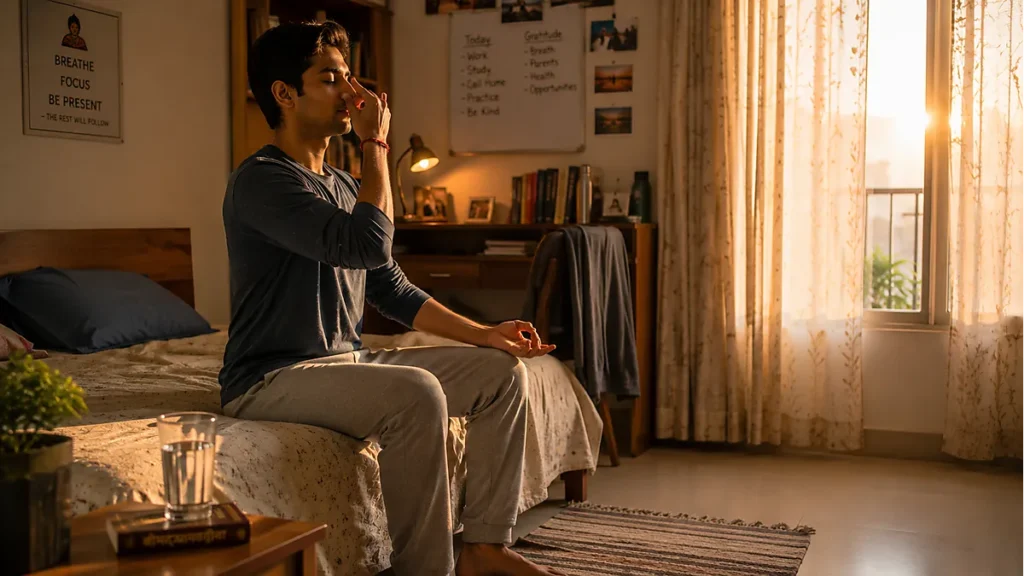
The Deepest Insight — Breath as the Bridge
We have covered the practices. We have covered the science. Now let us go to the heart of what the tradition is actually saying about the breath — because it is both simpler and more profound than anything the science can yet fully capture.
The Yoga Sūtras of Patañjali identify a remarkable fact about the breath that everyone with careful self-observation can confirm: the breath is the only function in the human body that is both involuntary and voluntary.[12][3]
Every other involuntary function — the heartbeat, the digestive process, the immune response, the hormonal secretions — operates entirely outside conscious control. You cannot decide to make your heart beat faster by simply deciding. You cannot choose to suppress your immune system by choosing. These functions run on their own, below the threshold of conscious access.
Every voluntary function — moving your hand, speaking a word, choosing where to look — operates entirely within conscious control. You do the thing, or you do not.
The breath is the only exception to this bifurcation.[12][3]
It breathes itself — automatically, continuously, without your attention or instruction, maintaining the oxygen supply that the body requires through sleep, through distraction, through unconsciousness. And simultaneously, it responds immediately and completely to conscious direction — you can slow it down right now, speed it up, hold it, deepen it, direct it, shape it — all with immediate, total effect.
The tradition recognized this unique property of the breath as the most important fact about human psychology. Because what does the breath connect? It connects the voluntary to the involuntary. The conscious to the unconscious. The realm of choice to the realm of the automatic. The mind to the body.[12][2]
The vagus nerve research is confirming this in physiological detail: when you consciously change your breath, you directly access and change the autonomic nervous system — the body’s involuntary control system — in ways that no other voluntary action can achieve as directly or as reliably. Through the breath, the conscious mind can speak to the unconscious body. Through the breath, the thinking self can calm the terrified animal. Through the breath, the person who is stressed has an immediate, always-available, completely portable tool for returning to their own center.[12][11]
This is what the tradition means when it calls Prāṇāyāma the bridge. Not a metaphor. A precise description of what the breath actually does in the architecture of the human system: it is the passageway between the world you can control and the world that controls you, and it runs in both directions.[3][12]
The practical teaching that flows from this understanding is one of the most useful things in all of Dharmic knowledge for the modern person:
You are never more than one conscious breath away from a choice.[12][1]
In any moment of stress, reactivity, fear, anger, overwhelm — in any moment when the automatic nervous system is running its ancient threat-response programming and the thinking mind has been hijacked by urgency — there is one reliable, immediate, always-available intervention: one conscious breath. One slow, complete, deliberate breath that is your signal to the nervous system: we are not dying. This is not an emergency. You can stand down.[2][1]
The tradition calls this moment — the pause, the breath, the space before the reaction — the moment of viveka (विवेक — Viveka, discernment, the ability to distinguish between the immediate and the important, between the reactive impulse and the considered choice). And it says this moment of viveka is, in the texture of daily life, where the entire practice of yoga actually lives: not in the formal sitting, but in these thousands of small moments each day where the breath offers you the choice between reacting and responding.[15][1]
The Breath That Was Always There
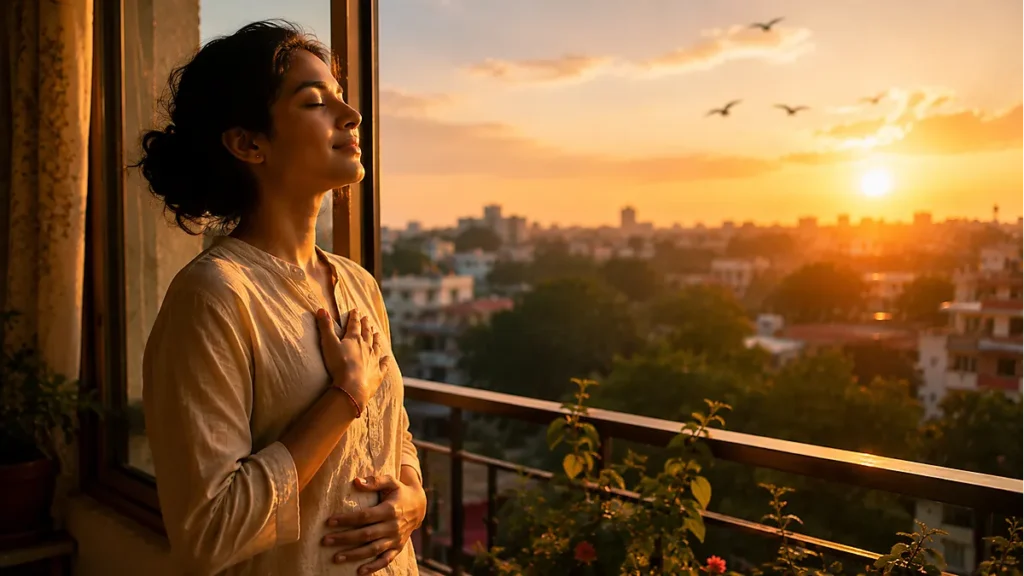
We began this article with a simple invitation: take one conscious breath and notice whether anything changed.
If you have been reading with any quality of attention, you have probably been breathing slightly differently throughout these pages — a little more slowly, a little more completely, a little more consciously. And if you check in right now with the quality of your current state compared to when you began reading, there is a reasonable chance that something is quieter. Something has settled, even slightly, even without any formal practice having been performed.[1][2]
This is Prāṇāyāma in its simplest, most immediate form: the breath, used consciously, producing its natural effect — the same effect it has been producing for every human being who has ever paid attention to it, across every tradition, in every culture, in every era of human history.[3][2]
The Praśna Upaniṣad — one of the ancient Vedic texts specifically devoted to the understanding of Prāṇa — contains a verse that captures the tradition’s most essential teaching about the breath with the precision and beauty of something that could only be said by someone who had lived it completely:
Devanagari Script:
प्राणो वाव संवर्गः।
IAST Transliteration:
Prāṇo vāva saṃvargaḥ.
Source Citation: Praśna Upaniṣad, Chapter 2, Verse 3
Simple Meaning:
“Prāṇa, verily, is the all-collector, the great gatherer — that into which everything comes together.”[6][7]
All five Prāṇas gathered in one. All functions of the living body united in their common source. The scattered, distracted, fragmented quality of the ordinary modern mind — pulled in ten directions simultaneously, half-present everywhere and fully present nowhere — collected, unified, and brought home into the single, immediate, available, intimate fact of this breath.[12][6]
Your breath is always with you. It asks nothing of you except attention. And in return for that attention — given consistently, given with practice, given in the five-minute morning sitting and in the one conscious breath before the difficult meeting and in the slow, complete exhale at the end of the long day — it gives back to you something that no supplement, no therapy, no technology, and no amount of productivity can produce:
The experience of being genuinely, fully, quietly, peacefully present in your own life.[2][1]
That is Prāṇāyāma. That is what it has always been for. And it has been waiting — patiently, twenty-odd thousand breaths a day — for you to notice it.[3][2]
⁂
References:
- https://www.manduka.com/blogs/mandukamag/the-neuroscience-of-pranayama
- https://pmc.ncbi.nlm.nih.gov/articles/PMC7336946/
- https://pmc.ncbi.nlm.nih.gov/articles/PMC7735501/
- https://gurukulyogashala.com/blog/types-of-pranayama/
- https://eu.manduka.com/blogs/mandukamag/the-neuroscience-of-pranayama
- https://www.vedanet.com/the-secrets-of-the-five-pranas/
- https://en.wikipedia.org/wiki/Prana
- https://yogawithsubhash.com/2018/02/04/five-pranas/
- https://www.scribd.com/document/738043344/Yoga
- https://ijnrd.org/papers/IJNRD2507186.pdf
- https://ijcsrr.org/wp-content/uploads/2021/10/12-12-2021.pdf
- https://pmc.ncbi.nlm.nih.gov/articles/PMC6189422/
- https://healthcare-bulletin.co.uk/article/five-weeks-to-better-autonomic-function-insights-from-yogic-breathing-3418/
- https://pmc.ncbi.nlm.nih.gov/articles/PMC10837615/
- https://liforme.com/blogs/blog/8-limbs-yoga-explained
- https://www.youtube.com/watch?v=OuYJqmuPgH0