
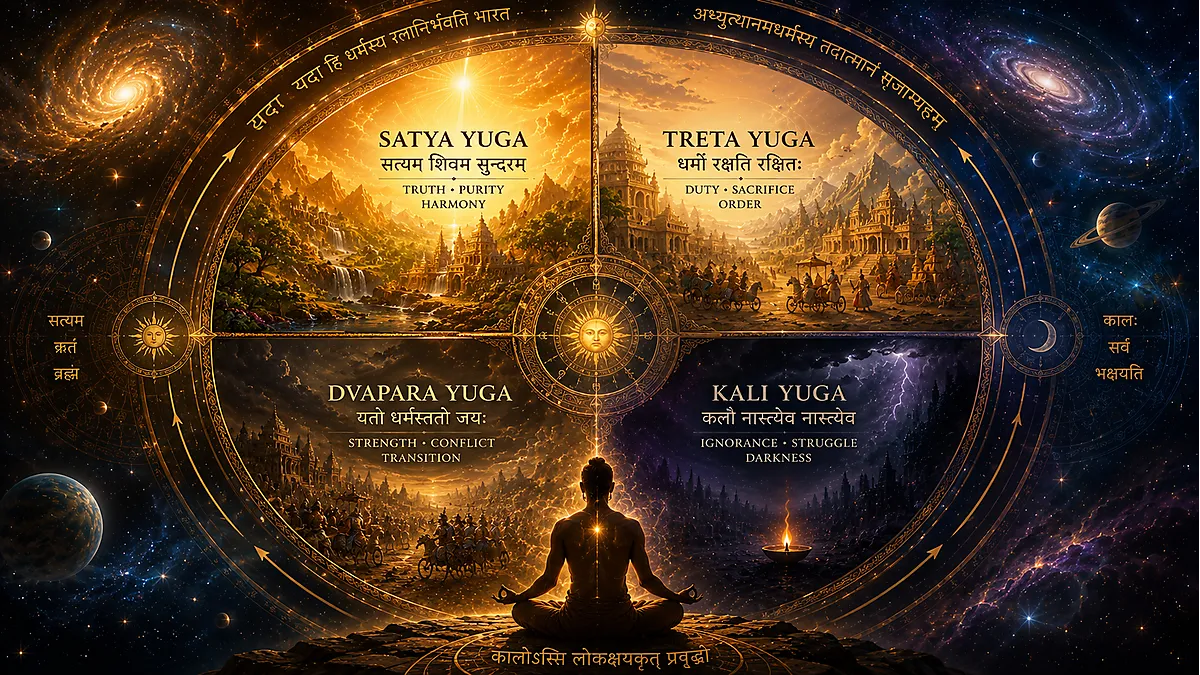
Why the universe runs on cycles — and what that means for you, right now, in this very moment. Learn the concept of four yugas in Santana Dharama
You Are Not Running Out of Time. Time Is Much Larger Than You Think.
Look at your phone screen. Somewhere on it, right now, there is a clock. A calendar. A notification telling you that something is due. A reminder that you are behind on something. An alert that time is moving and you need to keep up.
This is how modern civilization experiences time: as a straight line moving relentlessly from left to right, a conveyor belt that never slows down, that deposits each moment directly into the irretrievable past the instant it arrives. In this view, time is something you are always running out of. Deadlines loom, years accumulate, and somewhere in the distance — never acknowledged but always felt — is the end of the line.[1][2]
No wonder so many people live in a state of low-level panic. When you understand time as a scarce resource that is constantly being consumed, existence itself becomes a race. And like all races, it produces winners and losers, anxiety and exhaustion — and the persistent feeling that no matter how fast you run, you are never quite keeping up.
Sanatana Dharma looks at time very differently. Not as a straight line. Not as a conveyor belt. But as something much more like the natural world you can see from any window: a cycle.[2][1]
Time Is a Wheel, Not a Road
Step outside tonight and look at the moon. It rises, grows full, diminishes, and disappears — and then, without fail, it rises again. Watch the seasons: summer yields to monsoon, monsoon to the cool clarity of winter, winter to the tentative warmth of spring, spring to summer again. Watch a single day: dawn, noon, dusk, night — and then dawn again, as if the universe has pressed reset.[3][2]
Nature does not move in straight lines. Nature moves in cycles — Chakras (चक्र — Cakra, wheel). It always has. The tides, the breath, the heartbeat, the seasons, the generations — all of it cycles. Why, then, would the largest scale of time be any different?[1][3]
The Vedic tradition recognized this with extraordinary clarity, and built an entire cosmology of time on this single, beautiful insight: time is cyclical at every scale, from the smallest to the vastest. A breath cycles. A day cycles. A year cycles. And the life of the universe itself — the cosmos in its entirety — cycles through great ages, one after another, in a wheel so vast that any individual human lifetime is like a single heartbeat within it.[2][3]
These great ages are called Yugas (युग — Yuga, meaning age, era, cycle). And there are four of them.
The Four Yugas — The Seasons of Civilization
The easiest way to understand the four Yugas is to think of them as seasons — not seasons of weather, but seasons of human consciousness. Just as summer has particular qualities, and winter has particular qualities, each Yuga has its own distinct character, its own dominant mood, its own particular strengths and weaknesses.[1][4]
☀️ Satya Yuga (सत्य युग) — The Golden Age
Satya means truth — and the Satya Yuga is the age in which truth is the natural condition of human existence, not the exception.[5][6]
Picture, if you can, a world in which honesty requires no effort — in which people are simply, naturally, transparently what they are. A world in which violence is genuinely unthinkable, in which the natural world is healthy and abundant, in which human beings live long lives in deep inner peace. Not because they are perfect — but because the quality of consciousness in this age is such that clarity, compassion, and harmony are the default. The tradition says that in the Satya Yuga, all four pillars of Dharma stand firm: truth, compassion, austerity, and charity — all four, complete and undiminished.[1][5]
People in this age do not need external religious instruction to find the Divine — they simply know, the way we know the sun is there without having to think about it. Meditation, when practiced, produces results with extraordinary ease. The veil between inner awareness and cosmic consciousness is very thin.[7][1]
This is the season of summer — long, golden, luminous.
🌤️ Tretā Yuga (त्रेता युग) — The Silver Age
The wheel turns. Something begins to diminish — not catastrophically, but perceptibly. The Tretā Yuga is when the first shadows enter the golden light.[6][8]
Tretā means three — indicating that one of the four pillars of Dharma has weakened. Human beings are still largely virtuous, still largely oriented toward truth and righteous living — but now they need more support to stay there. The rituals of the Yajña (sacred fire-offering) become important precisely because they help people align themselves with Dharma in an age when that alignment no longer comes entirely naturally.[8][6]
This is the age of the great Rāmāyaṇa — the age of Śrī Rāma, whose extraordinary integrity is remarkable precisely because it takes effort. The tradition does not tell the Rāmāyaṇa as the story of what everyone does in his age. It tells it as the story of what one extraordinary person does against the grain. The ideal becomes necessary because the default has shifted.[1][8]
Autumn — still beautiful, still warm, but the light is changing.
🌥️ Dvāpara Yuga (द्वापर युग) — The Bronze Age
The wheel continues. Two of the four pillars of Dharma have weakened. The Dvāpara Yuga is the age of increasing complexity, increasing conflict, increasing fragmentation.[6][8]
Dvāpara means two — and in this age, the balance has genuinely shifted. Competition and rivalry are now common. Power struggles arise. Families divide over wealth and inheritance. The simple, uncomplicated goodness of the Satya Yuga is a distant memory. Yet great nobility still exists — this is the age of the Mahābhārata, the age of Śrī Kṛṣṇa. The tradition places its greatest ethical literature — the Bhagavad Gītā — in this age, precisely because this is the age when ethical clarity becomes genuinely hard to maintain. You need a teacher. You need guidance. The Gītā arises because the age has become complicated enough to require it.[8][4]
The sage Vyāsa, in the Dvāpara Yuga, recognized that the oral transmission of the Vedas was at risk — and so he wrote them down for the first time, knowing that memory and tradition would not be sufficient to carry them through the difficult age that was coming.[6][8]
Late autumn. The light is lower. The cold is coming. But the colors — oh, the colors are extraordinary.
🌑 Kali Yuga (कलि युग) — The Iron Age
And here we are.
Kali (not to be confused with the goddess Kālī) means strife, conflict, discord. The Kali Yuga is the season in which only one of the four pillars of Dharma remains standing — truth survives, but barely, and it requires tremendous conscious effort to maintain.[3][9]
What does the Bhāgavata Purāṇa say about the Kali Yuga? It is so precise that reading it today produces a strange, slightly uncomfortable feeling of recognition:
Sanskrit Verse — The Bhāgavata Purāṇa’s Description
Devanagari Script:
ततश्चानुदिनं धर्मः सत्यं शौचं क्षमा दया।
कालेन बलिना राजन् नङ्क्ष्यत्यायुर्बलं स्मृतिः॥
IAST Transliteration:
Tataś cānudinaṃ dharmaḥ satyaṃ śaucaṃ kṣamā dayā |
Kālena balinā rājan naṅkṣyatyāyur balaṃ smṛtiḥ ||
Source Citation: Śrīmad Bhāgavata Purāṇa, 12.2.1
Word-by-Word Meaning:
- धर्मः (dharmaḥ) — righteousness, right living
- सत्यम् (satyam) — truthfulness
- शौचम् (śaucam) — cleanliness
- क्षमा (kṣamā) — tolerance, patience
- दया (dayā) — compassion, mercy
- अनुदिनम् (anudinam) — day by day, steadily
- नङ्क्ष्यति (naṅkṣyati) — will diminish, will decrease
- आयुः (āyuḥ) — lifespan
- बलम् (balam) — physical strength
- स्मृतिः (smṛtiḥ) — memory
Simple Meaning:
“In the age of Kali, O King, righteousness, truth, cleanliness, tolerance, compassion, lifespan, physical strength, and memory — all these will diminish day by day, under the influence of the powerful tide of time.”[9][10]
Look at that list again: truthfulness diminishes. Tolerance diminishes. Compassion diminishes. Memory diminishes. And then — and this is where the Bhāgavata Purāṇa becomes almost uncomfortable in its accuracy — it adds: “In Kali Yuga, wealth alone will be considered the sign of a person’s good birth, proper behavior, and fine qualities. Law and justice will be applied only on the basis of power.”[10][9]
You do not need to be a Sanskrit scholar to recognize what the tradition is describing. You can see it in the news. You can feel it in the quality of public conversation. You can measure it in the mental health statistics of an entire generation of young people growing up in a world of relentless comparison, vanishing attention spans, and the quiet erosion of things that used to mean something.[1][9]
The Kali Yuga began, according to most traditional calculations, with the end of the Mahābhārata War and the departure of Śrī Kṛṣṇa — approximately five thousand years ago. We are well within it now.[4][11]
Kali Yuga Is Not a Punishment — It Is the Greatest Opportunity
And here is where the tradition offers something that no doom-scrolling news feed ever will: genuine hope, grounded in cosmic understanding.
Yes, Kali Yuga is described as the most challenging age. Yes, the qualities of consciousness are at their lowest. Yes, the road is harder than it was in the golden ages. But the tradition also says — in the same texts, in the same breath — that the Kali Yuga contains one extraordinary secret:[7][10]
Small, sincere effort yields enormous spiritual results.
In the Satya Yuga, liberation required years of intense meditation in a remote forest. In the Tretā Yuga, elaborate Yajñas and ritual sacrifices. In the Dvāpara Yuga, complex temple worship. But in the Kali Yuga — where circumstances are difficult, attention is scattered, and the outer world is noisy — the tradition says that something as simple as the genuine, heartfelt repetition of the Divine Name is sufficient to purify and liberate.[10][7]
The Bhāgavata Purāṇa states it with magnificent directness: “Although Kali Yuga is an ocean of faults, there is one great quality in this age: simply by chanting the names of the Divine, one can be freed from material bondage.”[12][10]
Think about this. A difficult age, with a simple remedy. A dark room, and one small lamp that in this darkness shines with extraordinary power. A challenging environment — and precisely because it is challenging, every genuine act of truthfulness, every moment of genuine compassion, every minute of real inner stillness, every simple prayer said with a sincere heart carries, in this age, more weight than it would have in any other.[7][12]
The light always shines brightest in the darkest room. You were not born in the wrong age by accident.[13][7]
Bigger Than All of This — The Mahāyuga and the Kalpa
Now let us step back even further — because the tradition’s vision of time does not stop at the Yugas.[3][11]
One complete cycle of all four Yugas — Satya, Tretā, Dvāpara, and Kali — is called a Mahāyuga (महायुग — Mahāyuga, meaning great age or complete cycle). The total span of a Mahāyuga is approximately 4.32 million years. Vast, by human standards — but only a beginning by the tradition’s cosmological scale.[6][3]
One thousand complete Mahāyugas — each containing its own full cycle of golden age, silver age, bronze age, and iron age — constitute a single day in the life of Brahmā (ब्रह्मा — Brahmā, the creator principle of the cosmos). This span is called a Kalpa (कल्प — Kalpa, meaning cosmic day). One Kalpa is approximately 4.32 billion years.[11][14]
And Brahmā lives for 100 such cosmic years — before the entire universe dissolves, rests in an equally vast cosmic night, and is then recreated again. The entire cycle begins once more, fresh, unbounded, as if for the first time.[14][11]
Here is what is remarkable: modern astrophysics estimates the age of our current universe at approximately 13.8 billion years. The Vedic tradition’s cosmological timescale, arrived at through philosophical reasoning thousands of years before any telescope or particle accelerator, operates in exactly this range of billions of years. The tradition was not wrong about the scale of time. It was thinking at the right scale when most other civilizations were still thinking in thousands of years.[2][3]
What This Means for You — Right Now, in This Moment
You might reasonably ask: what does any of this have to do with my Tuesday morning, my work, my relationships, my one precious life?
Everything. Because the cosmic perspective on time is not meant to make your life feel small. It is meant to do something far more useful: release you from the tyranny of urgency.[1][7]
When you understand that the current age of confusion and conflict is a season — not the permanent condition of existence, but a phase in a vast cycle that has always moved toward and then away from the golden light — you can stop catastrophizing. The problems of Kali Yuga are real. They are serious. They deserve our full attention and effort. But they are not the end of the story. The wheel turns. The season changes. The golden age will return, as surely as summer follows winter.[3][1]
And when you understand the sheer scale of cosmic time — that one human lifetime is, in the Vedic framework, smaller than a single breath in the life of the cosmos — a liberating question arises: given that I am here, in this small sliver of cosmic time, in this particular body, in this particular age — what is the most meaningful way to use it?
The tradition’s answer is clear and simple: act with Dharma. Not because it will fix everything in your lifetime. But because every Dharmic action — every moment of genuine honesty, genuine compassion, genuine service — adds to the quality of consciousness in the world, however briefly. You are a single candle. But in Kali Yuga, the texts say, a single candle burns very bright indeed.[7][13]
Sanskrit Verse — The Gift of Kali Yuga
Devanagari Script:
कलेर्दोषनिधे राजन्नस्ति ह्येको महान् गुणः।
कीर्तनादेव कृष्णस्य मुक्तसङ्गः परं व्रजेत्॥
IAST Transliteration:
Kaler doṣa-nidhe rājann asti hy eko mahān guṇaḥ |
Kīrtanād eva kṛṣṇasya mukta-saṅgaḥ paraṃ vrajet ||
Source Citation: Śrīmad Bhāgavata Purāṇa, 12.3.51
Simple Meaning:
“Although Kali Yuga is an ocean of faults, O King, there is one great quality: simply by chanting the names of the Divine, one can be freed from all bondage and reach the Supreme.”[10][13]
Time is vast. You are small within it. And yet — precisely because you are small, precisely because this moment is brief and this age is challenging — what you do with your consciousness right now matters more than you know.[1][7]
The wheel turns. The seasons change. The golden age will return. And between now and then, your one task is exactly what it has always been: live with truth, act with compassion, speak with honesty, and let the quality of your inner life be the one thing in Kali Yuga that the age cannot diminish.[13][7]
That single lamp, burning clearly in the darkness — that is you. That has always been you.[12][1]
⁂
References:
- https://www.ananda.org/blog/age-energy-intro-yugas/
- https://popularvedicscience.com/history/yugas/4-yugas/
- https://en.wikipedia.org/wiki/Yuga_cycle
- https://epuja.com/the-four-yugas-of-hinduism
- https://www.vishwaguruindia.org/2018/09/difference-between-sat-yuga-treta-yuga.html
- https://www.rudraksha-ratna.com/articles/the-four-yugas
- https://blog.dharma-renaissance.org/spiritual-insight/decoding-moksha-across-the-yugas-how-kali-yuga-becomes-the-fastest-route-to-liberation/
- https://www.youtube.com/watch?v=LWaHX7gyBXE
- https://www.vishwaguruindia.org/2018/08/bhagwat-puran-predicts-qualities-of.html
- https://www.indiadivine.org/15-most-amazing-predictions-for-kali-yuga-from-the-bhagavata-purana/
- https://iskcondesiretree.com/profiles/blogs/the-four-yugas
- https://krishna.org/kali-yuga-the-problems-and-the-solution/
- https://utsavapp.in/gyan/dharmik-gyan/features-of-kaliyuga
- https://www.youtube.com/watch?v=KObhLlMsZz0
- https://open.maricopa.edu/worldmythologyvolume1godsandcreation/chapter/from-the-matsya-purana/