
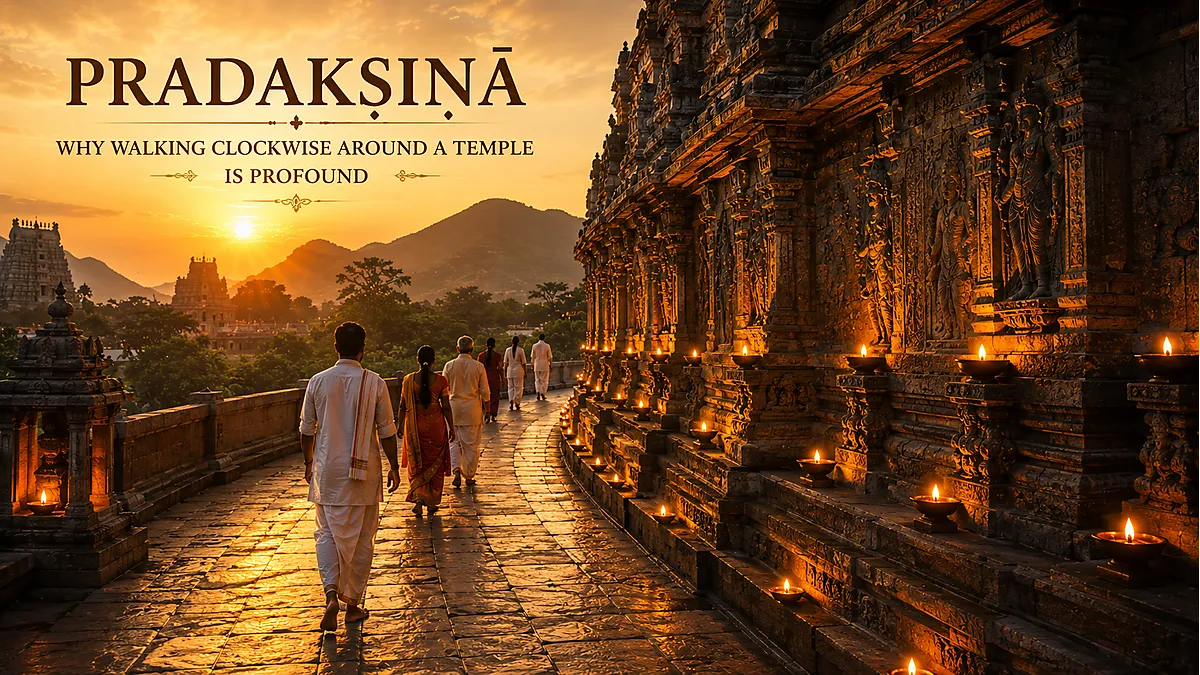
How a simple walk — done with awareness — becomes the oldest form of moving meditation
Table of Contents
The Walk We Take Without Noticing

Picture a busy temple on a weekend morning. Why Hindus Walk Clockwise Around Temples?
The queue moves quickly. People are talking in low voices — discussing what they ate for breakfast, making plans for after, reminding children to behave. Phones emerge for a moment to capture the deity, then disappear again. The darśana is brief. And then the crowd sweeps into the outer corridor — moving clockwise, naturally, almost automatically — completing the circle around the sanctum in a few brisk minutes before flowing back into the courtyard and out through the main gate.
Has a Pradakṣiṇā just been performed?
Technically, yes. The body has completed the circuit. The correct direction was maintained. The steps happened.
But the tradition — which is rarely interested in mere technical compliance — would say something gentler and more honest: the walk happened, but the Pradakṣiṇā has not quite yet begun. Because Pradakṣiṇā is not the movement of the body alone. As described in classical Hindu ritual literature, it is the movement of the body, the mind, and the heart — all three moving together, in the same direction, with the same attention — around the same sacred center.
The moment you understand this, even a single round of a small village temple becomes something extraordinary.
What the Word Is Telling You
“In Simple Terms”
Pradakshina is the Hindu practice of walking clockwise around a deity, temple, or sacred object as an act of devotion, meditation, and spiritual alignment.
The word Pradakṣiṇā (प्रदक्षिणा) speaks its meaning directly if you know how to listen.
- Pra (प्र) — forward, moving ahead with intention, completely.
- Dakṣiṇā (दक्षिणा) — the right side, the auspicious direction.
Together: moving forward while keeping the sacred on your right side.
In the Vedic understanding, keeping something on your right side is the gesture of honor — your right hand performs the sacred actions, your right side faces what is worthy of reverence. When you walk Pradakṣiṇā, the Mūrti — the deity, the consecrated image, the living presence at the center of the temple — is always on your right, always honored, always facing you even as your position around it changes.
The Skanda Purāṇa (Chapter 9, Verse 68) preserves a remarkable linguistic commentary on this practice: “In the word Pra-Da-Kṣi-Na, the syllable Pra dispels sin, the syllable Da bestows what is desired, the syllable Kṣi causes the destruction of Karman, and the syllable Na is the bestower of salvation.” Each syllable of the word is itself a teaching.
And here is the simple, beautiful message this practice encodes for the one who understands it: the Divine is the center. I revolve around it. Not the other way around. In ordinary life, we place ourselves at the center — my needs, my schedule, my desires, my agenda — and everything else, including the Divine, is expected to orbit around us. Pradakṣiṇā gently, physically, with your own footsteps, reverses this arrangement. For these few minutes, you accept your position as the periphery, and let the sacred hold the center.
Ādi Śaṅkarācārya’s understanding of Pradakṣiṇā goes even deeper: real Pradakṣiṇā, he taught, is the meditation that thousands of universes are revolving around the great Lord, the unmoving centre of all forms. The physical walk is an outer expression of this inner recognition.
The Deepest Analogy — Planets and Their Sun
Step outside on a clear night and look at the stars. Every star you can see is a sun — and almost every one of them is orbited by planets, moving in the same gravitational relationship that makes planetary life possible at all. The planet moves, the sun holds still at the center, and the relationship between them is what makes the planet habitable.
Take that image away from astronomy and bring it into your inner life: what is the sun at the center of your life? What is the fixed point that your choices, your values, your sense of meaning revolve around — or should revolve around, if you were living with full clarity and full intention?
Pradakṣiṇā is the practice of establishing that center consciously — outside yourself, in the form of the Divine — and walking around it with your own body, your own steps, your own breath. The Swāyambhūvāgama, an ancient text within the Āgama tradition governing temple worship, prescribes up to twenty-one pradakṣiṇās per day as the most spiritually beneficial practice, reflecting how deeply the tradition values this repetition.

Where Pradakṣiṇā Appears — More Places Than You Might Think
Once you understand what Pradakṣiṇā is — conscious, honoring movement around a sacred center — you start to see it everywhere in the tradition.
Around the deity in the temple — the most familiar form. The stone corridor, the lamplight, the smell of incense and flowers carried on the air, the slow procession of devotees moving clockwise through the prākāra. According to the Āgama śāstras that govern South Indian temple ritual, the prākāra (circumambulatory corridor) is architecturally designed as a sacred passage for this very purpose — not merely a walkway but a liminal space between the outer world and the inner sanctum.
Around the sacred fire — at every Yajña (fire ceremony), every marriage, every major rite of passage, the participants circumambulate the fire. The fire is Agni — the divine witness, the transformer, the intermediary between the human world and the cosmic. This Agni Parikramā is one of the most ancient and well-attested forms of circumambulation in Vedic ritual, prescribed in the Gṛhyasūtras governing household rites.
Around the Tulasī plant — in millions of Indian homes, daily. A small green plant in a simple clay pot or carved stone Tulasī Vṛndā in the courtyard, circumambulated each morning as part of the household worship. The tradition teaches that the Tulasī plant is a living manifestation of the Divine Feminine — to walk around a living being as a sacred center is among the most ecologically reverential acts of worship imaginable.
Around sacred mountains — the great Parikramā pilgrimages, where the mountain itself becomes the center and the devotee’s entire journey is one long, continuous Pradakṣiṇā. The mountain of Aruṇācala in Tiruvannamalai, the Govardhan hill of Braj, the hills of Śabarimala — all of them circumambulated by hundreds of thousands of devotees annually, feet bare, steps conscious, hearts entirely directed to what rises at the center.
In every form, the principle is identical: there is a center that is sacred and still. I am the movement at the periphery. The relationship between us — maintained by deliberate, conscious, clockwise movement — is the practice.
The Inner Science — What Happens When You Walk With Awareness
Here is something that modern research on movement and the brain has been confirming piece by piece — what the tradition knew intuitively: rhythmic, deliberate, circular movement with a focused point of attention is among the most effective practices for calming the mind and deepening inner awareness.
A 2018 randomized controlled study found that combining meditation with walking significantly decreased anxiety levels in young adults, while walking alone without meditative intention produced no significant change. A 2024 research study published in peer-reviewed literature similarly confirmed that a single bout of guided mindful walking can measurably reduce state anxiety.
Research published on stress and autonomic function confirms that slow, mindful movement activates the parasympathetic nervous system — the branch responsible for rest, recovery, and genuine presence — while reducing cortisol, the body’s primary stress hormone. The quality of attention shifts from the wide, scanning, reactive mode of daily navigation to something more inward, more receptive, more still.
When slow walking is combined with a repeated circuit — walking the same path, knowing where it leads, not needing to navigate — the problem-solving and planning functions of the brain quiet down. They have nothing to do. The route is known. The direction is fixed. The body can be trusted to continue. And in that quieting of the navigational mind, something deeper becomes available.
When all of this — slow pace, familiar circuit, quieted planning-mind — is combined with a single continuous point of attention (the deity, the mantra, the breath), the result is precisely what the tradition calls dhyāna (ध्यान): the mind resting continuously and without effort on a single object of awareness. Not because it has been forced there. But because the conditions have been arranged to make that resting natural. The American Psychological Association’s review of mindfulness research confirms this: mindfulness-based practices change brain structures in regions associated with attention and emotion regulation.
This is what Pradakṣiṇā, done properly, produces. Not through force. Not through technique. But through the simple, elegant arrangement of body, movement, pace, direction, and attention — working together the way a perfectly tuned instrument works.

How to Practice Pradakṣiṇā Properly — Simple Steps
You do not need to change anything about which temple you visit or how often you go. You only need to change how you walk once you are there.
1. Arrive before you begin. Before stepping into the circumambulatory corridor, pause at the entrance for one breath. Look at the śikhara (the tower) rising above the sanctum. Feel the stone beneath your feet. Set a simple internal intention: I am not here to complete a circuit. I am here to walk around the center of my life. I am here to practice.
2. Remove your footwear with awareness. The tradition prescribes bare feet for Pradakṣiṇā because direct contact between your soles and the consecrated stone of the temple floor is itself a form of communion. The Mayo Clinic’s guidance on walking meditation similarly notes the importance of sensory grounding through foot-to-surface contact as a key technique for deepening present-moment awareness.
3. Slow down — by half. Whatever pace you instinctively begin walking, halve it. This is not optional. Research on walking meditation confirms that intentionally slow, unhurried pacing is the key condition that shifts the practice from ordinary exercise into mindful movement.
4. Choose a mantra or a name. As you walk, repeat internally the name of the deity or a simple mantra associated with them. Oṃ Namaḥ Śivāya. Oṃ Namo Nārāyaṇāya. Rāma Rāma. Let each step carry the mantra, and let the mantra carry the step. The Swāyambhūvāgama and related Āgama texts prescribe mantra repetition as an integral part of the Pradakṣiṇā ritual, not a personal addition.
5. Keep the gaze soft and low. Not staring at other devotees, not checking your phone, not cataloguing the architecture. The gaze rests, softly, a few feet ahead on the floor. Vedic texts describe this as nāsāgra dṛṣṭi — the gaze resting near the tip of the nose, which naturally angles the eyes downward and inward, supporting the inward movement of attention.
6. Complete each round with full awareness. When you return to the starting point of a round, pause for one breath before beginning the next. Notice the quality of your inner state. Has anything shifted? Is the mind quieter? Is the body more relaxed? This conscious registration of the practice’s effect builds śraddhā (श्रद्धा) — faith grounded in direct personal experience — over time.
The Moment the Walk Becomes Something More
There is a moment — you will know it when it arrives — when something in the Pradakṣiṇā shifts.
It does not happen with any announcement. No special feeling precedes it. But somewhere in the middle rounds — when the body has settled into the rhythm and the mantra has settled into the body and the mind has stopped arguing with the pace — something very quiet becomes present.
A stillness at the center of the movement.
Not the stillness of stopped movement — you are still walking. But the stillness that the tradition calls the witness — the awareness that watches the walking without itself moving, the observer that is present in every step without being of the steps, the part of you that is permanently still even in the middle of a life in motion.
Sadhguru of the Isha Foundation describes it this way: the consecrated space is already energetically active, creating a vortex of intermingling between the Divine and the self. When you walk clockwise within it, you are moving with this motion rather than against it, and what happens gradually is not that you bring something to the space, but that the space brings something to you — a momentary dissolving of the sharp boundary between what we call the self and what we call the Divine.
You will walk out of the prākāra carrying something you did not carry in — a quality of settled presence, a calmness that does not feel effortful, a sense that the center you have been walking around has, in some quiet way, taken up residence slightly more fully inside you.
That is Pradakṣiṇā. That is what it was always designed to do.

From Tourist to Pilgrim — One Step at a Time
The difference between a tourist and a pilgrim is not geography. It is not the distance traveled or the number of temples visited. It is quality of attention.
A tourist arrives at a sacred space with their agenda fully in hand — looking for beauty, for experience, for photographs that will prove they were there. And these things are not bad. But the pilgrim arrives differently. The pilgrim arrives with a question instead: what is this place offering? What is available here that I cannot find in ordinary life?
Pradakṣiṇā, practiced with awareness rather than habit, is the single simplest act that transforms the temple visit from tourism to pilgrimage. Because it asks you to do the thing that all genuine spiritual practice asks of you: to place something other than yourself at the center, and to move humbly, attentively, and with great care around it.
Frequently Asked Questions About Pradakṣiṇā
Q1. What is Pradakṣiṇā in Hinduism?
Pradakṣiṇā is the Hindu practice of walking clockwise around a deity, temple, sacred fire, mountain, or holy object as an act of devotion, reverence, and meditation. The sacred center is always kept on the right side.
Q2. Why do Hindus walk clockwise around temples?
Hindus walk clockwise to symbolically place the Divine at the center of life. Keeping the deity on the right side is considered auspicious and expresses reverence, alignment, and spiritual orientation toward the sacred.
Q3. What does the word Pradakṣiṇā mean?
The Sanskrit word Pradakṣiṇā combines:
Pra — forward or complete movement
Dakṣiṇa — right side or auspicious direction
Together, it means moving reverently while keeping the sacred on one’s right side.
Q4. Is Pradakṣiṇā a form of meditation?
Yes. When performed slowly and consciously, Pradakṣiṇā becomes a form of walking meditation. The rhythmic movement, focused attention, mantra repetition, and sacred atmosphere naturally calm the mind and deepen awareness.
Q5. Why is Pradakṣiṇā performed barefoot?
Traditional Hindu temples encourage barefoot walking as a sign of humility, receptivity, and direct connection with the sacred space. Barefoot contact with the temple floor also supports grounded awareness during the practice.
Q6. How many rounds of Pradakṣiṇā should be done?
The number varies according to temple tradition and personal devotion. Many devotees perform one, three, or eleven rounds. The tradition emphasizes sincerity and awareness more than numerical perfection.
Q7. What is the difference between Pradakṣiṇā and Parikrama?
Pradakṣiṇā usually refers to circumambulation around a deity, temple, or sacred object. Parikrama often refers to larger pilgrimage circumambulations around sacred mountains, rivers, forests, or holy regions.
Q8. Can Pradakṣiṇā be practiced at home?
Yes. Devotees may perform Pradakṣiṇā around a home altar, sacred fire, Tulasī plant, or lamp during daily worship. The essential principle is conscious movement around a sacred center with devotion and awareness.
One step at a time. Clockwise. Barefoot. Slowly.
The way the planets move around their sun — not by effort, not by discipline alone, but because there is a gravitational truth that makes no other movement possible.
⁂
References:
- https://info.iskcondesiretree.com/why-do-we-circumambulate-pradakshina-the-temple-and-deities/
- https://www.sanskritimagazine.com/why-do-we-do-parikarma-go-around-deity-idols-or-temples/
- https://www.livevaastu.com/dr-chawla-corner/why-do-we-do-parikrama-or-go-around-the-temple-deities-vastu-shastra
- https://www.indica.today/quick-reads/symbolism-temples-pradakshina-kshetram/
- https://hariharakshethram.com/blog/giri-pradakshina-sacred-temple-circumambulation/
- https://www.psychologytoday.com/us/blog/urban-survival/201712/new-study-finds-meditation-with-walking-reduces-anxiety
- https://pmc.ncbi.nlm.nih.gov/articles/PMC11164429/
- https://pmc.ncbi.nlm.nih.gov/articles/PMC11975735/
- https://pmc.ncbi.nlm.nih.gov/articles/PMC7586536/
- https://www.mayoclinic.org/tests-procedures/meditation/in-depth/meditation/art-20045858
- https://health.clevelandclinic.org/walking-meditation
- https://www.apa.org/topics/mindfulness/meditation
- https://isha.sadhguru.org/en/wisdom/article/pradakshina-go-clockwise-around-temples
- https://www.ijcrt.org/papers/IJCRT2503990.pdf
- https://insighttimer.com/trueselfhealth/guided-meditations/walking-meditation-breath-movement-for-energy-calm
- https://www.tamilbrahmins.com/threads/pradaksina.26839/
- https://jbehavioralhealth.com/articles/Mindfulness-based walking vs seated meditation on anxiety affect fatigue and cognition
- https://www.templepurohit.com/forums/topic/why-do-we-do-pradakshina-and-what-is-its-importance/
- https://www.holybooks.com/wp-content/uploads/The-Skanda-Purana-Part-1.pdf