
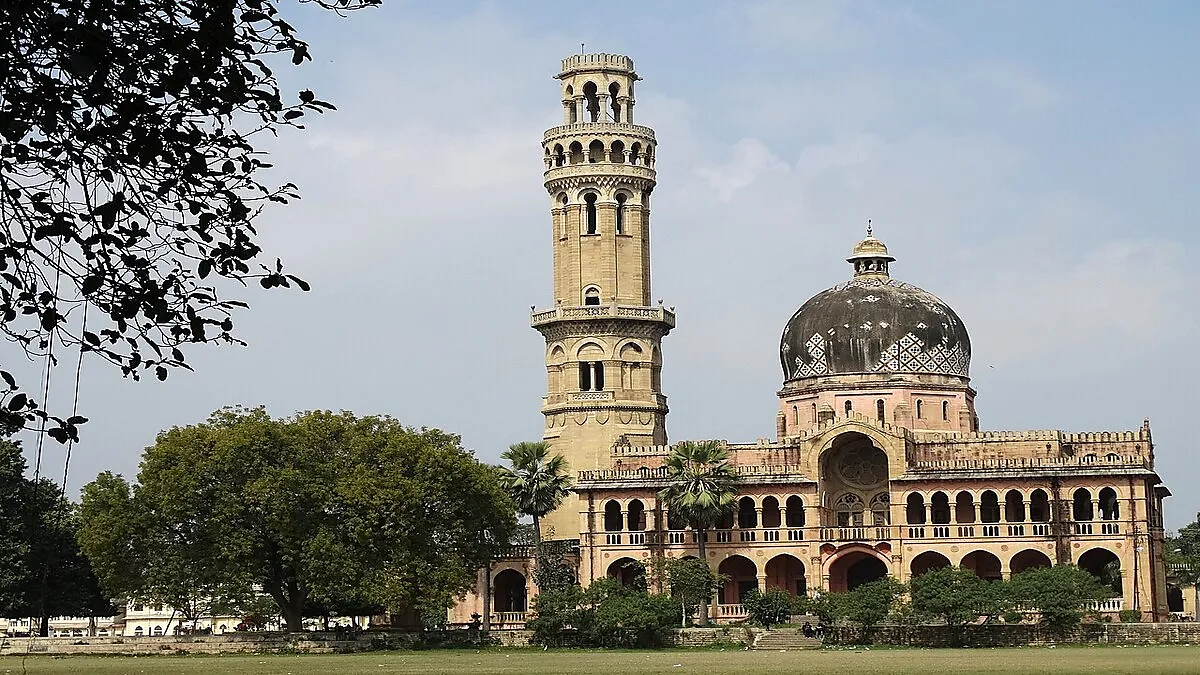
The morning sun spills over the red sandstone arches of the Muir Central College building, casting long shadows across the manicured lawns. Students, their bags slung over their shoulders, hurry between classes beneath the domes and minarets that have watched over this campus for nearly a century and a half. A young woman sits on the steps of the Senate Hall, a book open on her lap, completely absorbed. She is part of a living legacy.
This is Allahabad University – the “Oxford of the East”. It is not merely an educational institution; it is a crucible where India’s modern history was forged. Within these halls, poets like Harivansh Rai Bachchan found their voice. Freedom fighters debated the future of a nation. Prime ministers and presidents, jurists and scientists, saints and scholars – all walked the same pathways you can walk today.
As you plan your journey to Prayagraj, whether for the sacred Kumbh Mela or simply to discover the city’s layered heritage, Allahabad University stands as a proud monument to India’s intellectual awakening. Let us walk together through its historic corridors.
Quick Facts at a Glance
| Detail | Information |
| Official Name | University of Allahabad |
| Nickname | Oxford of the East |
| Established | 23 September 1887 (by Act XVIII) |
| Predecessor Institution | Muir Central College (established 1876) |
| Location | Prayagraj (formerly Allahabad), Uttar Pradesh |
| Status | Public Central University, Institute of National Importance |
| Campuses | Senate Campus, Muir Campus, Chatham Lines Campus |
| Known For | Heritage architecture, academic excellence, freedom movement links, literary legacy |
| Architectural Style | Indo-Saracenic, Gothic Revival, Egyptian influences |
| Notable Alumni | Harivansh Rai Bachchan, Madan Mohan Malaviya, Firaq Gorakhpuri, Shankar Dayal Sharma, Chandra Shekhar, V. P. Singh, Maharishi Mahesh Yogi |
| Recommended Visit Duration | 1–2 hours (campus walking tour) |
| Best Time to Visit | October–March (winter) |
Table of Contents
Why Allahabad University Is Called the Oxford of the East
The nickname “Oxford of the East” is not mere hyperbole. It arose from the University of Allahabad’s historical role as a residential, teaching, and affiliating university modelled on the lines of Oxford and Cambridge – a rare distinction in colonial India.
- A Residential University in the British Tradition: After the 1921 University of Allahabad Act, the institution became a unitary residential university, where students lived in hostels (halls) and received instruction directly from university professors – a system modelled on the ancient English universities.
- High Academic Standards: In its early decades, Allahabad University set rigorous entrance examinations and produced graduates who dominated the Indian Civil Services (ICS), the legal profession, and academia.
- A Crucible of Intellectuals: Like Oxford, Allahabad became a breeding ground for national leaders, poets, and thinkers. The university‘s influence on modern Indian literature, politics, and law earned it the nickname, which has stuck for over a century.
- The “Oxbridge” Atmosphere: The architecture – the domes, the quadrangles, the clock tower – consciously evoked an Oxbridge aesthetic, reinforcing the comparison.
Thus, the title “Oxford of the East” honours not only the university’s academic stature but also its enduring role as a guardian of India’s intellectual heritage.
The Founding of Allahabad University: Sir William Muir‘s Vision
The story of Allahabad University begins not in 1887 but a decade earlier, with a man of remarkable vision: Sir William Muir (1819–1905).
Sir William Muir was a British civil servant, scholar of Islam, and Lieutenant‑Governor of the North‑Western Provinces (now Uttar Pradesh). He was deeply impressed by the need for a central college in Prayagraj that would eventually develop into a full university – similar to the presidency universities of Calcutta, Bombay, and Madras.
The Birth of Muir Central College (1876)
In 1873, Sir William Muir laid the foundation stone for Muir Central College, named in his honour (the building was completed in 1876). The college was designed as a second‑grade degree college, affiliated to the University of Calcutta. Its aim was to provide higher education to the youth of the United Provinces without requiring them to travel to Kolkata.
The college quickly gained a reputation for excellence. Its faculty included some of the finest scholars of the era, and its students would go on to become the first graduates of the University of Allahabad.
The University Act of 1887
After years of advocacy, the University of Allahabad Act (Act XVIII of 1887) was passed on 23 September 1887. The university was established as an affiliating and examining body, with the power to grant degrees. Muir Central College became its first constituent college.
The university‘s jurisdiction initially extended over a vast territory, including the United Provinces, Central Provinces, and parts of Rajputana. It was only the fourth modern university established in India (after Calcutta, Bombay, and Madras).
The Evolution of a Premier Institution (1887–Present)
- 1889: The university held its first entrance examination.
- 1904: The Indian Universities Act defined the university‘s territorial jurisdiction.
- 1921: The University of Allahabad Act (1921) transformed the institution into a unitary residential university. Muir Central College was merged into the university, and the focus shifted to teaching and research.
- Post‑Independence: The university continued to expand, adding new departments and faculties.
- 2005: The University of Allahabad was granted Central University status by an Act of the Indian Parliament.
- 2020: It was recognised as an Institute of National Importance (INI) , a status shared by only a handful of Indian universities.
Muir Central College: The Architectural Jewel of the Campus
The most iconic building on the Allahabad University campus is the Muir Central College building (now part of the university‘s academic complex). It is a masterpiece of colonial Indian architecture.
The Architect: Sir William Emerson
The building was designed by Sir William Emerson (1843–1924), a British architect who later designed the Victoria Memorial in Kolkata. Emerson was a leading exponent of the Indo‑Saracenic Revival style, which blended Gothic, Mughal, and traditional Indian elements.
Architectural Features
- Red Sandstone Facade: The building is constructed from local red sandstone, giving it a warm, earthy hue that glows in the morning and evening light.
- Domes and Minarets: The structure is crowned with elegant domes (chhatris) and minarets, drawing from Mughal architecture.
- Pointed Arches: The verandahs feature the characteristic pointed arches of the Gothic Revival.
- Arcaded Quadrangle: A central courtyard is surrounded by covered arcades – a design that facilitates natural cooling and provides shaded walkways.
- Clock Tower: A tall clock tower rises above the central block, visible from across the campus.
- Egyptian Influences: Some details, such as the cavetto cornices, show the influence of Egyptian architecture, popular in the 19th century.
A Living Heritage
Today, the Muir Central College building houses the Departments of English, History, and Philosophy. Walking through its arched corridors, you feel transported to an earlier era – a time when every carved stone was a statement of imperial ambition and every lecture hall a space for intellectual ferment.
Senate Hall: The Heart of Academic Governance
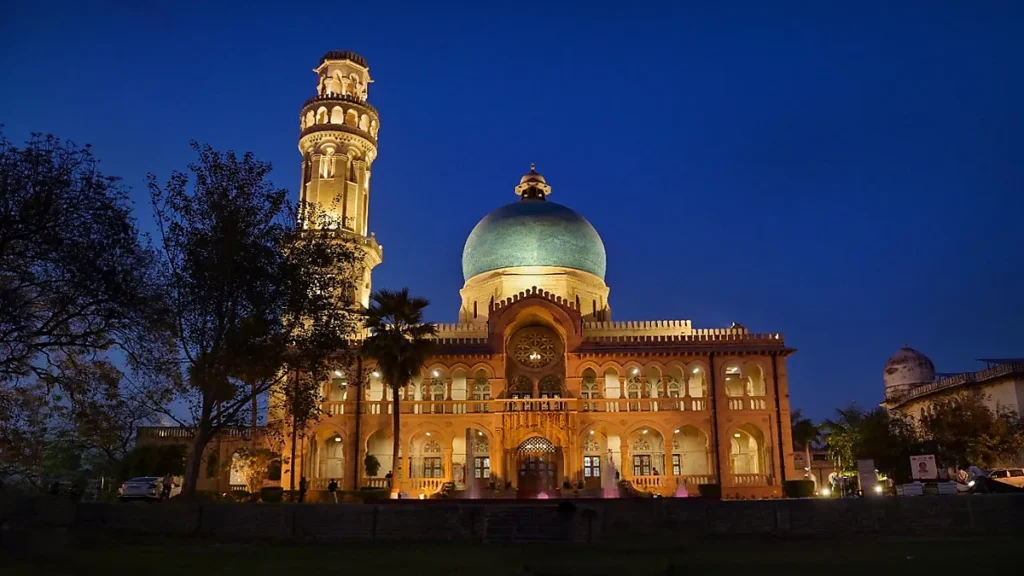
The Senate Hall (also called the Convocation Hall) is the second major heritage building on the campus. It was completed in 1915 and stands as a testament to the university‘s administrative and ceremonial importance.
Designed by Sir Swinton Jacob
The hall was designed by Sir Swinton Jacob (1841–1917), a British military engineer and architect who served as the Director of Public Works in the princely state of Jaipur. Jacob was known for his mastery of Indo‑Saracenic style, and the Senate Hall is one of his finest works.
Architectural Features
- Central Dome: A large, ribbed dome dominates the building, inspired by Mughal tomb architecture.
- Corner Chhatris (Pavilions): The four corners of the building are topped with elegant stone umbrellas (chhatris), a hallmark of Rajasthani architecture.
- Projecting Balconies (Jharokhas): Ornate stone balconies add visual rhythm to the facade.
- Cusped Arches: The entrance features multi‑cusped arches.
- Clock Tower: The Senate Hall also has a smaller clock tower integrated into its design.
Role in University Life
The Senate Hall has served as the university‘s Convocation Hall, where degrees are conferred, and as the meeting place of the university’s Senate – the highest decision‑making body. Over the decades, it has hosted countless dignitaries, including presidents, prime ministers, and Nobel laureates.
The building also housed the Registrar‘s Office and the English Department for many years, adding to its central role in the university‘s intellectual life.
Historic Hostels and Student Life at Allahabad University
As a residential university, Allahabad University’s hostels (called “halls”) are integral to its character. Each hostel has its own history, traditions, and alumni.
Amar Nath Jha Hostel (formerly Muir Hostel)
- Established: 1911
- Renamed: 1956, after Dr. A. N. Jha, a distinguished mathematician and former Vice‑Chancellor.
- Architecture: A solid two‑storey building with long verandahs and dormitory‑style rooms.
- Famous Residents: Harivansh Rai Bachchan spent his student years here.
Sir Sunder Lal Hostel (formerly Law Hostel)
- Established: 1916
- Named after: Sir Sunder Lal, the first Indian Vice‑Chancellor of Allahabad University.
- Significance: Originally built for law students; now a general hostel.
Sir Ganga Nath Jha Hostel (formerly New Hostel)
- Established: 1927
- Cornerstone laid by: Sir William Sinclair Marris.
- Notable Residents: Gopal Swarup Pathak (former Vice‑President of India) is among its famous alumni.
- Nationalist Hub: During the freedom struggle, students of this hostel organized meetings, invited nationalist leaders, and distributed pamphlets. Jawaharlal Nehru once addressed a gathering here.
Hindu Hostel (MacDonnell Hindu Boarding House)
- Established: 1901
- Founder: Madan Mohan Malaviya (later founder of Banaras Hindu University).
- Purpose: To provide accommodation for Hindu students who were not allowed in other hostels at the time.
Sarojini Naidu Girls Hostel and Shatabdi Girls Hostel
These hostels reflect the university‘s early commitment to women’s education. They are named after the famous poet and freedom fighter Sarojini Naidu, who was a role model for generations of young women.
The hostel culture at Allahabad University has always been vibrant, with its own festivals, literary societies, and debates – producing lifelong bonds and unforgettable memories for thousands of students.
Academic Excellence and Scholarly Contributions
Allahabad University has been home to some of the finest departments in India.
- Humanities: The English Department was legendary, with scholars and poets on its faculty. The Philosophy Department produced original thinkers who engaged with both Western and Indian traditions. The History Department (especially with figures like Dr. S. P. Sen) pioneered research on the Indian freedom movement.
- Sciences: The J. K. Institute of Applied Physics (on the Chatham Lines campus) is a centre for advanced research in solid‑state physics, materials science, and electronics. The Chemistry Department has contributed to organic chemistry research.
- Social Sciences: The Political Science Department nurtured many who would go on to serve in the Indian Administrative Service (IAS), the Indian Foreign Service (IFS), and as university professors across India.
- Law: The Law Faculty (now Sir Sunder Lal Hostel) was one of the earliest in the country, producing distinguished jurists, including Chief Justices of the Supreme Court.
The university has produced a steady stream of Rhodes Scholars, Fulbright Fellows, and national award winners. Its alumni have served as judges, diplomats, scientists, and civil servants at the highest levels.
Notable Alumni Who Shaped India
The list of Allahabad University’s distinguished alumni reads like a Who’s Who of Modern India.
| Name | Field / Achievement |
| Harivansh Rai Bachchan | Legendary Hindi poet; authored Madhushala; father of Amitabh Bachchan. |
| Firaq Gorakhpuri | Renowned Urdu poet; awarded Jnanpith (1969) for Urdu literature. |
| Maharishi Mahesh Yogi | Founder of Transcendental Meditation; spiritual teacher to the Beatles. |
| Madan Mohan Malaviya | Founder of Banaras Hindu University; freedom fighter; educationist. |
| Govind Ballabh Pant | Premier of United Provinces; Union Home Minister; Bharat Ratna. |
| Chandra Shekhar | 8th Prime Minister of India (1990–1991). |
| V. P. Singh | 7th Prime Minister of India (1989–1990); implemented Mandal Commission report. |
| Shankar Dayal Sharma | 9th President of India (1992–1997). |
| Gopal Swarup Pathak | 4th Vice President of India (1969–1974). |
| Ranganath Misra | 21st Chief Justice of India. |
| P. C. Chunder | Union Minister; educationist. |
| Tigmanshu Dhulia | Film director, writer, and actor (known for Gangs of Wasseypur, Paan Singh Tomar). |
| Justice Sunil Ambwani | Former Chief Justice of Gujarat High Court. |
| Pankaj Tripathi (attended, though graduated from National School of Drama) | Acclaimed actor; studied at Allahabad University before moving to theatre. |
These alumni – poets and politicians, saints and scientists – reflect the university’s extraordinary range and its profound influence on Indian society.
Allahabad University and India‘s Freedom Movement
Prayagraj (then Allahabad) was a nerve centre of India‘s struggle for independence. The university played a pivotal role.
- A Hub of Political Discourse: The university campus was a meeting place for nationalist leaders. The Senate Hall hosted speeches by Jawaharlal Nehru, Madan Mohan Malaviya, C. R. Das, and others.
- Student Activism: University students boycotted British courts, refused to wear foreign cloth, and participated in the Non‑Cooperation Movement (1920–22) and the Quit India Movement (1942). Many were arrested and served time in the city‘s Naini Central Jail.
- The Jawaharlal Nehru Connection: Although Nehru studied abroad, he maintained a close association with the university. His daughter, Indira Gandhi, was a regular visitor to the campus, and his presence inspired generations of students.
- The G. N. Jha Hostel Nationalist Meetings: In the 1930s and 1940s, the lawns of G. N. Jha Hostel (then New Hostel) were a favoured venue for political gatherings. Students invited speakers, sang Vande Mataram, and discussed the future of a free India.
The university thus not only educated the leaders of the freedom movement but also nurtured the spirit of resistance in ordinary students.
Women‘s Education and Social Progress at the University
Allahabad University was among the first in North India to admit women to its degree programmes in the early 20th century. This was a bold step at a time when women’s education was widely opposed.
- Early Admission: Women were enrolled as undergraduate and graduate students from the university‘s early decades.
- Sarojini Naidu Hostel: The construction of a dedicated women‘s hostel named after the poet‑freedom fighter Sarojini Naidu provided safe accommodation and encouraged more families to send their daughters to the university.
- Notable Women Graduates: The university produced several first‑generation female lawyers, teachers, and civil servants.
- Shatabdi Girls Hostel: A modern hostel built to accommodate the growing number of women students, reflecting the university‘s ongoing commitment to gender equality.
Today, women constitute a significant proportion of the student body, and the university has had women deans and department heads – a testament to its progressive heritage.
The Campus Experience Today
Allahabad University today spans multiple campuses:
- Senate Campus: The historic heart, with the Senate Hall, Muir Central College, and the old library building. This is where most heritage tours take place.
- Muir Campus: Adjacent to the Senate Campus, with the Faculty of Science and the J. K. Institute of Applied Physics.
- Chatham Lines Campus: A modern campus with the departments of Mathematics, Business Administration, and the New Library.
Student life remains vibrant. The university hosts annual cultural festivals, sports competitions, and academic seminars. The hostels still buzz with late‑night discussions about politics, literature, and science – just as they did a century ago.
Touring Allahabad University: A Visitor‘s Guide
A walking tour of the campus can be a highlight of your visit to Prayagraj. Here are the must‑see spots:
| Location | What to See | Photography Tip |
| Muir Central College | Arcaded verandahs, red sandstone facade, clock tower, central quadrangle | Best in early morning golden light. Stand in the quadrangle for symmetry. |
| Senate Hall | Dome, chhatris, jharokhas, entrance porch | Late afternoon light brings out the stone textures. Use a wide‑angle lens for the dome. |
| G. N. Jha Hostel | Historic gate, long balconies, old staircases | Late afternoon for warm light on the stone. |
| A. N. Jha Hostel | Verandahs, the room where Harivansh Rai Bachchan once lived (ask permission) | Morning light for soft shadows. |
| J. K. Institute | Modernist science building with lab facilities (exterior only) | Mid‑day for clear, bright shots. |
| New Library | Modern architecture; interior not generally open to tourists | Exterior only. |
| Campus Pathways | Tree‑lined avenues between heritage buildings | Golden hour for long shadows and a serene atmosphere. |
Important: While the campus is open to the public, the university is a functioning academic institution. Please be respectful of classes and examinations. Do not enter restricted areas (labs, faculty offices) without permission. Photography is generally allowed outdoors, but always be discreet and avoid photographing individuals without their consent.
How to Visit Allahabad University
Location: University Road, Civil Lines, Prayagraj, Uttar Pradesh 211002. The main entrance is opposite the Allahabad Museum and Chandrashekhar Azad Park.
Best Time to Visit: October–March (winter) offers pleasant temperatures for walking. Visit on a weekday when the campus is active; weekends and holidays are quieter but still accessible.
How to Reach:
- By Air: Prayagraj Airport (Bamrauli) – 12 km; take a taxi or auto‑rickshaw.
- By Train: Prayagraj Junction – approximately 4 km (auto‑rickshaw or taxi).
- By Road: The Civil Lines area is well‑connected by city buses and autos. The university is a landmark that local drivers know.
Parking: Limited street parking available; it is best to use public transport or hired auto.
Visitor Tips:
- Entry is free – you can simply walk in through the main gate.
- Security check – there may be a bag check. Carry a valid ID.
- Dress code: Respectful, modest attire (knees and shoulders covered).
- Photography restrictions: Avoid flash photography inside buildings; ask before photographing specific departments or offices.
- Guided tours: Not officially offered, but the campus is easy to explore on your own. A local guide or a student volunteer may be available for a small fee.
Suggested Itinerary (1.5 hours):
- Enter through the main gate.
- Walk to Muir Central College (5 min). Spend 20‑30 minutes admiring the architecture and quadrangle.
- Walk to Senate Hall (5 min). Spend 20 minutes photographing the building.
- Walk past A. N. Jha Hostel and G. N. Jha Hostel (15 minutes).
- If time permits, visit the J. K. Institute on the Muir Campus (10 minutes walk).
- Exit and proceed to nearby attractions (Allahabad Museum is a 5‑minute walk away).
Nearby Attractions – Combining Heritage in Prayagraj
Allahabad University is surrounded by other heritage sites. You can easily combine a campus tour with these landmarks:
- Chandrashekhar Azad Park (adjacent to the university’s main gate) – The largest park in Prayagraj, site of the revolutionary Chandrashekhar Azad‘s last stand.
- Allahabad Museum (within the park) – Houses the Colt pistol used by Azad, along with Gupta sculptures and terracotta art.
- Allahabad Public Library (Thornhill Mayne Memorial) – A stunning Scottish Baronial building inside the park.
- Anand Bhavan (15‑minute walk) – The Nehru family home, now a museum of the freedom movement.
- Swaraj Bhavan (adjacent to Anand Bhavan) – Original Nehru family home.
- All Saints Cathedral (Patthar Girja) – A Gothic Revival cathedral in the Civil Lines area (10‑minute walk).
- Khusro Bagh – A Mughal garden and tomb complex, about 3 km away.
A full day itinerary could be: Morning at Allahabad University → afternoon at Allahabad Museum and Anand Bhavan → evening walk through Khusro Bagh.
Why the Oxford of the East Still Matters
In an age of new universities and online education, the “Oxford of the East” remains relevant for several reasons:
- Continuity of Excellence: It continues to produce top‑ranked graduates in the civil services and competitive examinations.
- Heritage Preservation: The university is a custodian of architectural history, reminding us of the colonial origins of modern education in India.
- Symbol of India‘s Intellectual Awakening: The university was a space where Indian intellectuals first began to imagine a nation free from colonial rule.
- A Living Museum: Visiting the campus is not just a tourist activity; it is an education in itself – in history, in architecture, and in the spirit of inquiry.
The Oxford of the East is not a relic. It is a thriving institution that continues to shape the future while honouring the past.
Frequently Asked Questions (FAQs)
1. Why is Allahabad University called the Oxford of the East?
The nickname arose because Allahabad University was established as a unitary residential university on the model of Oxford and Cambridge, with rigorous academic standards and a distinctive intellectual culture.
2. Who founded Allahabad University?
The university was established by an Act of the British Indian Government in 1887. Its foundational vision was provided by Sir William Muir, who also founded Muir Central College.
3. Is Allahabad University the oldest university in India?
No. It is the fourth oldest modern university in India, after the universities of Calcutta, Bombay, and Madras (all established in 1857).
4. Can tourists visit Allahabad University campus?
Yes, the campus is open to the public. Visitors can walk through the grounds, admire the heritage buildings, and take photographs.
5. What is Muir Central College?
Muir Central College was the predecessor of Allahabad University, founded in 1876. Its historic building now houses the university’s English, History, and Philosophy departments.
6. Who designed the buildings of Allahabad University?
Muir Central College was designed by Sir William Emerson. Senate Hall was designed by Sir Swinton Jacob.
7. What is the architectural style of the university buildings?
The style is Indo‑Saracenic Revival, blending Gothic, Mughal, and traditional Indian elements.
8. Which famous people studied at Allahabad University?
Notable alumni include poets Harivansh Rai Bachchan and Firaq Gorakhpuri, former Prime Ministers Chandra Shekhar and V. P. Singh, former President Shankar Dayal Sharma, and freedom fighter Madan Mohan Malaviya.
9. Is there an entry fee to visit the campus?
No, entry is free.
10. What is the best time of year to visit?
October–March (winter) is the most pleasant season.
11. Is photography allowed on campus?
Yes, outdoor photography is allowed. Flash photography inside buildings is discouraged, and you should ask permission before photographing people.
12. Are there guided tours of the university?
Currently, no official guided tours are offered. However, local guides may be available for hire. You can also explore on your own using this article as a guide.
13. How long does a campus tour take?
Approximately 1 to 2 hours for a leisurely walk through the main heritage sites.
14. Where should I park my car?
Limited street parking is available near the main gate. It is advisable to take an auto‑rickshaw.
15. Are there any restrictions for visitors?
Do not enter academic buildings without permission. Avoid disturbing classes, examinations, or administrative offices.
16. Is the university accessible to wheelchair users?
The main pathways and the ground floors of some buildings are accessible. However, some historic buildings have steps at entrances.
17. Does Allahabad University offer accommodation for tourists?
No. Tourist accommodation is not provided. Visitors should stay at hotels in the Civil Lines area.
18. What is the J. K. Institute?
The J. K. Institute of Applied Physics is a research centre on the Chatham Lines campus, known for advanced physics research.
19. Are there any cafes or eateries on campus?
Limited canteen facilities exist for students. For a proper meal, head to the Civil Lines market near the university.
20. Why should I visit Allahabad University during the Kumbh Mela?
The Kumbh Mela attracts millions to Prayagraj. Visiting the university offers a peaceful counterpoint – a chance to explore India‘s intellectual heritage away from the crowds, and to understand the city beyond its religious significance.
The Enduring Legacy of the Oxford of the East
You walk back through the main gate, the Senate Hall‘s clock tower receding behind you. The students are still scattered on the lawns, the shadows are longer, and the red sandstone glows in the afternoon light.
You have walked the same corridors where Harivansh Rai Bachchan first discovered poetry. You have stood in the hall where leaders debated the future of a nation. You have seen the dormitories where young men and women dreamed of a free India.
Allahabad University is more than a university. It is a symbol of India‘s intellectual awakening, educational excellence, and enduring commitment to knowledge. It is a living monument where the past is not locked in glass cases but breathes through every lecture, every debate, every young person stepping into their future.
As you leave, you carry not only photographs but a deeper understanding of how Prayagraj earned its place in India‘s story – not only as a sacred city of pilgrimage but as a crucible of modern Indian thought.
May your visit to the Oxford of the East inspire you as it has inspired generations.
This article is part of a series on the heritage and cultural landmarks of Prayagraj.
Prayag Tourism
📞 Phone/WhatsApp: +91-9555313526
📧 Email: contact@prayagtourism.com
🌐 Website: PrayagTourism.com
May your journey be peaceful, safe, and intellectually enriching – and may the halls of knowledge forever welcome you.