
Table of Contents
THE PERSONAL ANECDOTE – A BOOK THAT CHANGED MY LIFE
I remember the first time I truly heard the Bhagavad Gita.
I was nineteen, anxious about a coming exam, my mind racing with “what ifs.” My grandmother, sitting on her old wooden cot, looked at me over her spectacles. She didn’t offer advice about studying. Instead, she opened a small, worn copy of the Gita – its pages yellowed, the binding held together with string – and said softly:
“Karmanye vadhikaraste ma phaleshu kadachana.”
“You have a right to action alone, never to its fruits.”
I had heard the Sanskrit words before, in temple chants, but that evening they landed differently. She explained: do your best, but let go of the result. The anxiety – that tight knot in my stomach – was not about the exam. It was about my attachment to the outcome.
That simple teaching, from a text composed over two thousand years ago, released me. I studied, I wrote, and I walked out of the exam hall with peace – because I had done my part, and the rest was not mine to control.
The Bhagavad Gita is not a book to be read once and shelved. It is a living conversation – between a confused warrior and his divine charioteer, between your own doubts and the deepest wisdom of the ages. It has been a companion to monks, kings, freedom fighters, scientists, and ordinary householders for millennia. And it can be your companion too.
WHAT IS THE BHAGAVAD GITA?
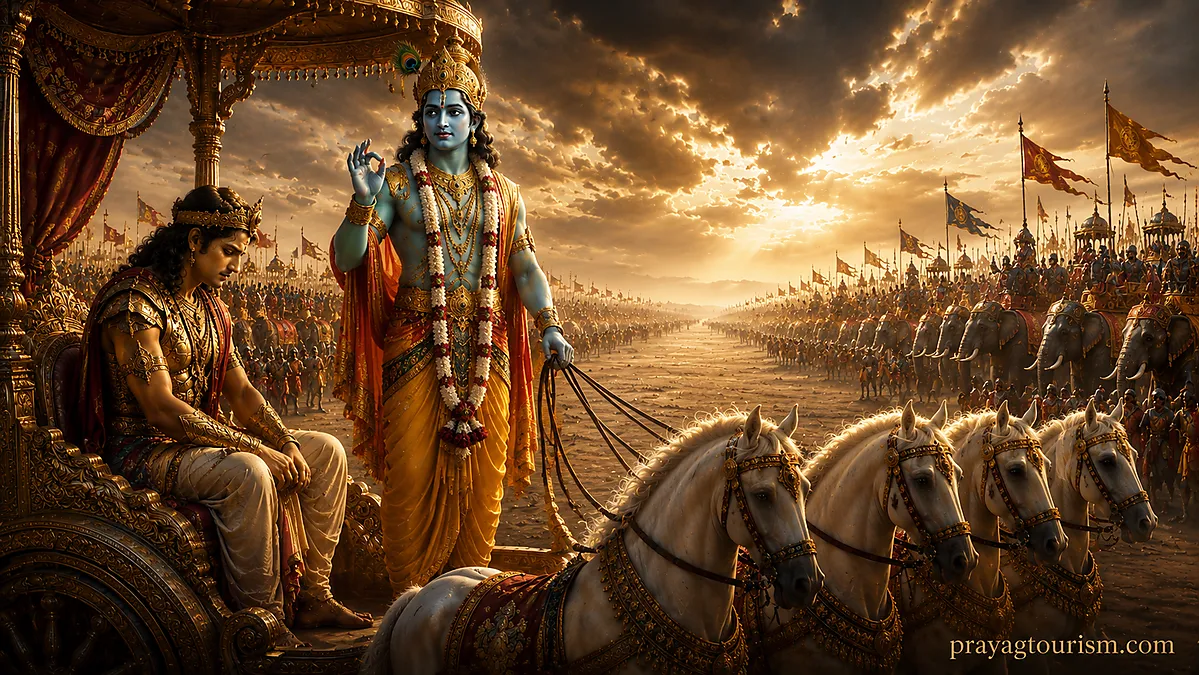
The Bhagavad Gita – meaning “The Song of the Lord” – is a 700-verse Hindu scripture that is part of the great Indian epic, the Mahabharata. It is a dialogue between Arjuna, a warrior prince, and Krishna, his charioteer who is also an incarnation of Lord Vishnu.
But the Gita is far more than a dialogue in a war epic. It is a complete spiritual manual – a self-contained guide to:
- How to live ethically in the world
- How to find peace in the midst of chaos
- How to understand the nature of the self and God
- How to act without being bound by action
The Gita is often called the “Hindu Bible” by Westerners, but this comparison is misleading. The Gita does not claim to be the only scripture, nor does it demand exclusive belief. Instead, it synthesizes the major philosophical and spiritual streams of ancient India – the Vedic sacrifice, the Upanishadic knowledge, the devotion of the Bhaktas, and the discipline of the Yogis – into one coherent, practical, and deeply moving conversation.
What the Gita Is Not
- It is not a mythological story (though it is embedded in one).
- It is not a book of abstract philosophy (though it contains profound metaphysics).
- It is not a ritual manual (though it honors Vedic traditions).
- It is not a sectarian text (though it is Vaishnava in its orientation).
The Gita is a map of the human heart – and a guide to navigating the battlefield of life with wisdom, courage, and love.
WHERE DOES THE GITA FIT IN SANĀTANA DHARMA?
To understand the Gita, we must understand its place in the vast ecosystem of Hindu scriptures.
Sanātana Dharma classifies its sacred literature into two broad categories: Śruti (“that which is heard” – the eternal, revealed texts) and Smṛti (“that which is remembered” – the traditional, composed texts).
| Category | Examples | Authority |
| Śruti | Vedas, Upanishads | Highest, eternal, impersonal |
| Smṛti | Itihāsas (Ramayana, Mahabharata), Purāṇas, Dharmaśāstras | Derived from Śruti, authoritative but subject to interpretation |
The Bhagavad Gita belongs to the Smṛti category. It is a part of the Mahabharata (specifically, the Bhishma Parva, chapters 23–40). However, its authority is so immense that it is often called the “fifth Veda” or the “essence of the Upanishads.”
The Gita’s Relationship to Other Scriptures
- The Upanishads: The Gita is a condensation and practical application of Upanishadic philosophy. Where the Upanishads say “That thou art” (Tat tvam asi) in a contemplative forest, the Gita says it on a battlefield – in the middle of life’s hardest choices.
- The Brahma Sutras: These aphorisms systematize Vedantic philosophy. The Gita is the living dialogue that illustrates those principles.
- The Bhagavata Purana: While the Gita is Krishna as teacher, the Bhagavata Purana shows Krishna as the playful, loving child and lover – completing the picture of the Divine.
The Gita is therefore the practical bridge between the lofty philosophy of the Upanishads and the daily struggles of human life. It takes the timeless truths and translates them into actionable wisdom.
ORIGIN STORY – HOW THE GITA CAME TO BE
Traditional Authorship
The Bhagavad Gita is traditionally considered to be the work of Vyasa – the same sage who compiled the Vedas, wrote the Mahabharata, and authored the Brahma Sutras and the major Puranas. Vyasa is not a “person” in the modern sense but a title – a “compiler” or “arranger” of eternal knowledge. The Hindu tradition holds that Vyasa is an incarnation of Lord Vishnu himself, empowered to systematize the Vedas for the age of Kali.
The Setting
The Gita is set on the battlefield of Kurukshetra (in modern-day Haryana, India). Two branches of the same family – the Pandavas and the Kauravas – are about to fight a devastating civil war for the throne. Arjuna, the greatest warrior of the Pandavas, asks Krishna (his charioteer and friend) to drive his chariot into the middle of the battlefield to survey the armies.
What Arjuna sees breaks him. On both sides are his relatives, teachers, friends, and grandsires. He throws down his bow and refuses to fight, overwhelmed by grief and moral confusion.
The Dialogue
Krishna’s response to Arjuna’s despair is the Bhagavad Gita. Over the course of 700 verses, Krishna does not simply command Arjuna to fight. He teaches him – about the eternal nature of the soul, the law of karma, the practice of yoga, the nature of God, and the path of loving devotion. The dialogue is not a monologue; Arjuna asks questions, expresses doubts, and gradually moves from confusion to clarity, from grief to readiness.
Historical Development
Scholars date the composition of the Gita to roughly the 5th–2nd century BCE. It was likely not a single composition but a layered text that evolved, with the final form we know today emerging around the 2nd century CE. However, for the Hindu tradition, the Gita is eternal – its truth is not bound by historical dating.
PHASE 5: THE BIG IDEA – SOLVING THE PROBLEM OF ACTION
The Central Problem
Arjuna’s problem is universal: How do I act when every choice seems wrong? He is a warrior (Kshatriya) – his duty is to fight for righteousness. But fighting means killing his own family. He is paralyzed.
This is not ancient history. This is your dilemma: How do I do my job when it harms others? How do I be honest when lies are rewarded? How do I live ethically in an unethical world?
The Gita’s Solution – The Three Yogas
Krishna does not give Arjuna a simple rule. He gives him a framework. The Gita presents three fundamental paths (Yogas) that work together:
- Karma Yoga – The Yoga of Action
- Act without attachment to results.
- Do your duty because it is right, not because you expect a reward.
- This frees you from anxiety and from the binding chains of karma.
- Bhakti Yoga – The Yoga of Devotion
- Surrender all actions and their fruits to the Divine.
- Love God without bargaining.
- This transforms action into worship.
- Jnana Yoga – The Yoga of Knowledge
- Understand your true Self (Atman) as eternal, unborn, deathless.
- Discriminate between the real (Self) and the unreal (body, mind, ego).
- This destroys the root cause of suffering – ignorance.
The Gita does not ask you to choose one path and reject the others. It asks you to integrate them – work with detachment, dedicate your work to the Divine, and know yourself as the eternal witness.
PHASE 6: THE STRUCTURE OF THE BHAGAVAD GITA
The Gita has 18 chapters (often called “Yogas” or “paths”). Each chapter focuses on a specific aspect of the teaching. The number 18 is significant – it corresponds to the 18 days of the Mahabharata war.
| Chapter | Title | Key Teaching |
| 1 | Arjuna Vishada Yoga | Arjuna’s despair – the problem stated |
| 2 | Sankhya Yoga | The immortal soul; the beginning of the teaching |
| 3 | Karma Yoga | The yoga of action without attachment |
| 4 | Jnana Karma Sanyasa Yoga | Knowledge and renunciation of action |
| 5 | Karma Sanyasa Yoga | Renunciation vs. action – both lead to freedom |
| 6 | Dhyana Yoga | The practice of meditation |
| 7 | Jnana Vijnana Yoga | Knowledge of the Divine – the manifest and unmanifest |
| 8 | Akshara Brahma Yoga | The eternal Brahman; the path at death |
| 9 | Raja Vidya Raja Guhya Yoga | The most secret knowledge – everything is Krishna |
| 10 | Vibhuti Yoga | Krishna’s divine glories |
| 11 | Vishvarupa Darshana Yoga | The Cosmic Form – Arjuna sees Krishna as the universe |
| 12 | Bhakti Yoga | The yoga of devotion |
| 13 | Kshetra Kshetrajna Vibhaga Yoga | The field and the knower of the field |
| 14 | Guna Traya Vibhaga Yoga | The three qualities of nature (sattva, rajas, tamas) |
| 15 | Purushottama Yoga | The Supreme Person – Krishna as the ultimate |
| 16 | Daiva Asura Sampad Vibhaga Yoga | Divine and demonic natures |
| 17 | Shraddha Traya Vibhaga Yoga | The three types of faith |
| 18 | Moksha Sanyasa Yoga | Final teaching – renunciation, surrender, conclusion |
The Gita is a spiral – each chapter returns to the same themes, each time deeper. The final verse (18.66) is the essence: “Abandon all dharmas and surrender to Me alone. I will liberate you from all sins. Do not grieve.”
KEY TEACHINGS AND THEMES OF THE GITA
1. The Immortal Soul (Atman)
The Gita opens with a revolutionary teaching: “Never was there a time when I did not exist, nor you, nor these kings. Nor shall any of us cease to be hereafter.” (2.12)
The body is born, grows, decays, and dies. But the Self within – the Atman – is eternal, unborn, unchanging. Death is not the end of you; it is the end of a garment. You change bodies as you change clothes.
2. Karma Yoga – Action Without Attachment
The Gita’s most famous verse (2.47) is the heart of Karma Yoga: “You have a right to action alone, never to its fruits. Let not the fruit of action be your motive, nor let your attachment be to inaction.”
This is not a call to laziness. It is a call to excellence without anxiety. When you act for the result, you are enslaved by hope and fear. When you act for the sake of duty, love, or righteousness alone, you are free.
3. The Cosmic Form (Vishvarupa)
In Chapter 11, Krishna grants Arjuna divine vision. Arjuna sees Krishna as the entire universe – with infinite faces, swallowing all beings, time as a devouring fire. It is terrifying and sublime. Arjuna trembles and begs for forgiveness.
This vision teaches that God is not a grandfather in the sky. God is the very fabric of existence – the birth, the death, and the rebirth of all things. To see God is to see both the flower and the flame.
4. Bhakti – Loving Devotion
The Gita culminates not in dry knowledge or mechanical action, but in love. Krishna declares: “Fix your mind on Me, be devoted to Me, sacrifice to Me, bow down to Me. Having thus united your whole self with Me, taking Me as the Supreme Goal, you shall come to Me.” (9.34)
Bhakti is the path for the modern person. It does not require renouncing the world or mastering complex meditation. It requires a heart turned toward the Divine.
5. The Three Gunas
The Gita describes three qualities (gunas) that pervade all of nature:
- Sattva – purity, clarity, harmony
- Rajas – passion, activity, desire
- Tamas – inertia, darkness, ignorance
Understanding these gunas helps you understand your own mind. Are you acting from sattva (calm clarity) or from rajas (feverish wanting) or from tamas (lazy avoidance)? The goal is to cultivate sattva, and then transcend even that.
6. Surrender (Prapatti)
The final teaching (18.66) is the most radical: “Abandon all dharmas and come to Me alone for shelter. I will liberate you from all sins. Do not grieve.”
This is not a rejection of ethics. It is the recognition that the ego’s attempts to “save itself” are futile. The final step is not doing – it is letting go. Surrender is the end of struggle.
GREAT VERSES OF THE BHAGAVAD GITA
Verse 1: The Immortal Soul (Chapter 2, Verse 20)
Devanagari:
न जायते म्रियते वा कदाचिन्
नायं भूत्वा भविता वा न भूयः।
अजो नित्यः शाश्वतोऽयं पुराणो
न हन्यते हन्यमाने शरीरे॥
IAST Transliteration:
Na jāyate mriyate vā kadācin
Nāyaṁ bhūtvā bhavitā vā na bhūyaḥ |
Ajo nityaḥ śāśvato ‘yaṁ purāṇo
Na hanyate hanyamāne śarīre ||
Source Citation: Bhagavad Gita 2.20
Word-by-Word:
- Na – not
- Jāyate – is born
- Mriyate – dies
- Vā – or
- Kadācit – ever
- Na – not
- Ayam – this (Self)
- Bhūtvā – having come into being
- Bhavitā – will come into being
- Vā – or
- Na – not
- Bhūyaḥ – again
- Ajaḥ – unborn
- Nityaḥ – eternal
- Śāśvataḥ – everlasting
- Ayam – this
- Purāṇaḥ – ancient
- Na hanyate – is not slain
- Hanyamāne – when it is slain
- Śarīre – the body
Translation: “The Self is never born nor does it ever die. It is not that having come into being, it will cease to be again. The Self is unborn, eternal, everlasting, ancient. It is not slain when the body is slain.”
Practical Life Lesson: Do not identify with the body. When you face loss, illness, aging, or even your own mortality, remember: the real you is untouched. This knowledge is the foundation of fearlessness.
Verse 2: The Right to Action (Chapter 2, Verse 47)
Devanagari:
कर्मण्येवाधिकारस्ते मा फलेषु कदाचन।
मा कर्मफलहेतुर्भूर्मा ते सङ्गोऽस्त्वकर्मणि॥
IAST Transliteration:
Karmaṇy evādhikāras te mā phaleṣu kadācana |
Mā karma-phala-hetur bhūr mā te saṅgo ‘stv akarmaṇi ||
Source Citation: Bhagavad Gita 2.47
Word-by-Word:
- Karmaṇi – in action
- Eva – only
- Adhikāraḥ – right
- Te – your
- Mā – not
- Phaleṣu – in the fruits
- Kadācana – ever
- Mā – not
- Karma-phala-hetuḥ – the cause of the fruit of action
- Bhūḥ – become
- Mā – not
- Te – your
- Saṅgaḥ – attachment
- Astu – let there be
- Akarmaṇi – to inaction
Translation: “You have a right to action alone, never to its fruits. Let not the fruit of action be your motive, nor let your attachment be to inaction.”
Practical Life Lesson: Work wholeheartedly, but release your grip on the outcome. This one verse, applied daily, can eliminate most anxiety, jealousy, and disappointment from your life.
Verse 3: Steady Wisdom (Chapter 2, Verse 62-63 – condensed)
Source Citation: Bhagavad Gita 2.62-63
Teaching Summary: “When a person dwells on objects of the senses, attachment to them arises. From attachment, desire is born. From desire, anger arises. From anger comes delusion. From delusion, loss of memory. From loss of memory, destruction of discrimination. From destruction of discrimination, he perishes.”
Practical Life Lesson: Watch the subtle chain reaction in your own mind. A glance at social media (contact with sense object) → wanting (attachment) → frustration (anger) → hours wasted (perishing). Cut the chain at the first link: mindful contact.
Verse 4: Equality (Chapter 5, Verse 18)
Devanagari:
विद्याविनयसम्पन्ने ब्राह्मणे गवि हस्तिनि।
शुनि चैव श्वपाके च पण्डिताः समदर्शिनः॥
IAST Transliteration:
Vidyā-vinaya-sampanne brāhmaṇe gavi hastini |
Śuni caiva śvapāke ca paṇḍitāḥ sama-darśinaḥ ||
Source Citation: Bhagavad Gita 5.18
Word-by-Word:
- Vidyā – knowledge
- Vinaya – humility
- Sampanne – endowed with
- Brāhmaṇe – in a brahmin (priest)
- Gavi – in a cow
- Hastini – in an elephant
- Śuni – in a dog
- Ca – and
- Eva – indeed
- Śvapāke – in a dog-eater (outcaste)
- Ca – also
- Paṇḍitāḥ – the wise
- Sama-darśinaḥ – see equally
Translation: “The wise see with equal vision a brahmin endowed with learning and humility, a cow, an elephant, a dog, and a dog-eater.”
Practical Life Lesson: True wisdom dissolves prejudice. The same Atman shines in all beings. Practice seeing the unity beneath apparent differences – it is the foundation of compassion.
Verse 5: The Greatest Yogī (Chapter 6, Verse 32)
Devanagari:
आत्मौपम्येन सर्वत्र समं पश्यति योऽर्जुन।
सुखं वा यदि वा दुःखं स योगी परमो मतः॥
IAST Transliteration:
Ātmaupamyena sarvatra samaṁ paśyati yo ‘rjuna |
Sukhaṁ vā yadi vā duḥkhaṁ sa yogī paramo mataḥ ||
Source Citation: Bhagavad Gita 6.32
Translation: “He who sees the happiness and suffering of all beings as his own, through the analogy of his own self – that yogi, O Arjuna, is considered the highest.”
Practical Life Lesson: The highest spiritual realization is not a trance; it is empathy. When you feel another’s pain as your own, you are living the truth of non-duality.
Verse 6: Always Remember Me (Chapter 8, Verse 7)
Devanagari:
तस्मात्सर्वेषु कालेषु मामनुस्मर युध्य च।
मय्यर्पितमनोबुद्धिर्मामेवैष्यस्यसंशयः॥
IAST Transliteration:
Tasmāt sarveṣu kāleṣu mām anusmara yudhya ca |
Mayy arpita-mano-buddhir mām evaiṣyasy asaṁśayaḥ ||
Source Citation: Bhagavad Gita 8.7
Translation: “Therefore, at all times, remember Me and fight. With your mind and intellect offered to Me, you shall certainly come to Me.”
Practical Life Lesson: Spirituality is not separate from daily life. “Remember Me” means bring your awareness of the Divine into your work, your relationships, your struggles. The battlefield and the office are both ashrams when the mind is offered.
Verse 7: The Cosmic Form (Chapter 11, Verse 32)
Devanagari:
कालोऽस्मि लोकक्षयकृत्प्रवृद्धो
लोकान्समाहर्तुमिह प्रवृत्तः।
ऋतेऽपि त्वां न भविष्यन्ति सर्वे
येऽवस्थिताः प्रत्यनीकेषु योधाः॥
IAST Transliteration:
Kālo ‘smi loka-kṣaya-kṛt pravṛddho
Lokān samāhartum iha pravṛttaḥ |
Ṛte ‘pi tvāṁ na bhaviṣyanti sarve
Ye ‘vasthitāḥ praty-anīkeṣu yodhāḥ ||
Source Citation: Bhagavad Gita 11.32
Translation: “I am mighty Time, the destroyer of worlds, fully manifest here. Even without your participation, all the warriors arrayed in the opposing armies shall cease to exist.”
Practical Life Lesson: This is perhaps the Gita’s most humbling verse. The ego thinks, “I am the doer.” The Gita says: You are not even necessary. Time itself accomplishes all. Let go of the illusion of control. Play your part, but do not mistake yourself for the playwright.
Verse 8: The Final Surrender (Chapter 18, Verse 66)
Devanagari:
सर्वधर्मान्परित्यज्य मामेकं शरणं व्रज।
अहं त्वा सर्वपापेभ्यो मोक्षयिष्यामि मा शुचः॥
IAST Transliteration:
Sarva-dharmān parityajya mām ekaṁ śaraṇaṁ vraja |
Ahaṁ tvāṁ sarva-pāpebhyo mokṣayiṣyāmi mā śucaḥ ||
Source Citation: Bhagavad Gita 18.66
Word-by-Word:
- Sarva-dharmān – all dharmas (duties, religious paths)
- Parityajya – abandoning
- Mām – to Me
- Ekam – alone
- Śaraṇam – refuge
- Vraja – go
- Aham – I
- Tvām – you
- Sarva-pāpebhyaḥ – from all sins
- Mokṣayiṣyāmi – will liberate
- Mā śucaḥ – do not grieve
Translation: “Abandon all varieties of dharma and come to Me alone for refuge. I will liberate you from all sins. Do not grieve.”
Practical Life Lesson: The final teaching is not “do this” or “don’t do that.” It is surrender. The ego’s long struggle to perfect itself – through rituals, knowledge, or action – must eventually give way to trust. You are held. You are loved. You are safe. Do not grieve.
WHY THE BHAGAVAD GITA MATTERS TODAY
The world has changed radically since the Gita was spoken on the plains of Kurukshetra. But the human heart has not.
We still face moral dilemmas where every choice seems wrong. We still feel trapped between our duties and our desires. We still lie awake at night, anxious about outcomes we cannot control.
The Gita is not a historical curiosity. It is a timeless technology for the mind:
- In the age of burnout – The Gita’s Karma Yoga (action without attachment) is a direct antidote to the anxiety of hustle culture. Work hard, but let go. You will do better work with less stress.
- In the age of distraction – The Gita’s emphasis on one-pointed meditation (Dhyana Yoga) is a prescription for reclaiming your attention from the dopamine slot machine of social media.
- In the age of isolation – The Gita’s Bhakti Yoga offers a relationship with a loving Divine presence that never leaves you, never betrays you, and is always available.
- In the age of meaninglessness – The Gita’s Jnana Yoga reveals that the question “Who am I?” is not a narcissistic spiral but the key to unlocking the deepest peace.
Leaders, scientists, and artists across cultures have found wisdom in the Gita. Mahatma Gandhi called it his “spiritual dictionary.” Albert Einstein admired its philosophical depth. Carl Jung referenced it in his work on the psyche.
The Gita matters because you matter. Your struggles are not new. And a solution exists – not as a quick fix, but as a path you can walk, step by step.
WHO SHOULD READ THE BHAGAVAD GITA?
- For Students: You face pressure from exams, peer comparison, and uncertain futures. The Gita teaches you to focus on effort, not results – reducing anxiety and improving performance.
- For Professionals: You face ethical compromises, burnout, and the emptiness of chasing promotions. The Gita gives you a framework for integrity and sustainable excellence.
- For Leaders: You carry the weight of others’ expectations. The Gita teaches you to act decisively without personal attachment – a hallmark of wise leadership.
- For Parents: You pour your life into your children, yet they have their own paths. The Gita teaches you to love without clinging, to do your duty without demanding specific outcomes.
- For Seekers: You have tried books, workshops, and apps. The Gita offers a complete, self-contained spiritual path – no additional religion required.
- For the Grieving: You have lost someone you love. The Gita’s teaching on the immortality of the soul can bring a peace that no platitude can offer.
- For Skeptics: You are not sure about God or religion. Read the Gita as philosophy, as psychology, as practical ethics. It delivers value even without belief.
If you are human – confused, striving, hurting, hoping – the Gita was written for you.
HOW TO START READING THE BHAGAVAD GITA
Choosing a Translation
The Gita is in Sanskrit. For beginners, a good translation with commentary is essential. Here are recommended options:
| Edition | Best For | Features |
| Eknath Easwaran (Nilgiri Press) | Absolute beginners | Simple, poetic, clear. No sectarian bias. Highly recommended. |
| Swami Sivananda (Divine Life Society) | Devotional seekers | Sanskrit, transliteration, word-by-word, translation, and commentary. |
| Winthrop Sargeant (SUNY Press) | Academic or Sanskrit curious | Interlinear translation – each Sanskrit word with English equivalent. |
| Bhagavad Gita As It Is (Bhaktivedanta Swami) | Krishna-devotees | Gaudiya Vaishnava perspective. Very detailed, sectarian. |
| Laurie Patton (Penguin Classics) | Literary readers | Elegant English, good introduction. |
How to Study
- Read the first chapter quickly – It sets up the problem. You may be confused by the names. That’s fine.
- Slow down at Chapter 2 – This contains the core teachings. Read it twice.
- Use a commentary – The Gita was written to be studied with a teacher. A written commentary is the next best thing.
- Read one chapter a day – 18 chapters, 18 days. You will finish in less than three weeks.
- Keep a journal – When a verse strikes you, write down why. Apply it to your current life situation.
- Listen to audio – The Gita was composed orally. Hearing it chanted (with a translation) is powerful. Free resources on YouTube.
A Simple Daily Practice
Take one verse that speaks to you. Write it on a sticky note. Put it on your bathroom mirror or computer screen. Throughout the day, pause and repeat the verse in your mind. Let it soak into your consciousness.
THE LIVING LEGACY OF THE GITA
The Bhagavad Gita is not a museum piece. It is a living force that has shaped – and continues to shape – Hindu civilization and beyond.
Influence on Culture
- Art and Literature: Countless paintings, dance dramas (Kathakali, Kuchipudi), poems, and novels have drawn from the Gita.
- Philosophy: Every major Vedantic school (Advaita of Shankara, Vishishtadvaita of Ramanuja, Dvaita of Madhva) has written commentaries on the Gita. It is the common ground.
- Festivals: Gita Jayanti – the celebration of the Gita’s birth – is observed on the 11th day of the bright half of Margashirsha (November-December). Devotees recite the entire Gita, often in a single sitting.
Influence on History
- Swami Vivekananda carried the Gita’s message to the World Parliament of Religions in Chicago (1893).
- Mahatma Gandhi wrote a translation and commentary in Gujarati, calling the Gita his “mother.” He credited it with giving him the strength for non-violent resistance.
- The Indian independence movement drew immense inspiration from the Gita’s emphasis on righteous action (svadharma).
The Gita Today
- In temples worldwide, the Gita is chanted daily.
- On YouTube and podcasts, thousands of hours of Gita discourses are freely available.
- In corporate leadership training, the Gita is increasingly cited as a source of ethical decision-making and stress management.
The Gita is not dying. It is being reborn in every new reader who asks, as Arjuna did, “What should I do?”
SPECIAL SECTION: BOOK CONNECTION MAP
The Bhagavad Gita is best understood in relation to other scriptures.
Texts to Read Before the Gita (as preparation)
- Isha Upanishad – A very short Upanishad (18 verses) that introduces the concept of the Atman and renunciation in action. It is like a prelude to the Gita’s Karma Yoga.
- Katha Upanishad – Introduces the dialogue format and the metaphor of the chariot (body, mind, intellect, senses) that the Gita expands upon.
Texts to Read After the Gita (for deeper study)
- The Mahabharata – The larger epic. The Gita makes much more sense when you know the personalities, the family history, and the background of the war.
- The Brahma Sutras – The systematic philosophy behind the Gita. Dense, but rewarding for the serious student.
- The Bhagavata Purana – The later life of Krishna. The Gita shows Krishna as teacher; the Bhagavatam shows him as the adorable child, lover, and cosmic lord – completing the picture.
- The Yoga Sutras of Patanjali – Expands on the meditation practices (Dhyana Yoga) briefly outlined in Chapter 6.
Texts That Summarize the Gita
- Narada Bhakti Sutra – A short text on the path of devotion (Bhakti), which the Gita identifies as the highest.
- Vivekachudamani (attributed to Shankara) – A poetic text on discrimination (Viveka), which is the foundation of Jnana Yoga.
This map shows that the Gita is not an island. It is a bridge connecting the Upanishads to daily life, and a gateway to the vast ocean of Sanātana Dharma.
READER CONVERSION SECTION: WHY YOU SHOULD READ THE BHAGAVAD GITA YOURSELF
You have read this guide. You now know what the Gita is, where it came from, and what it teaches. But reading about the Gita is like reading a menu – it will not nourish you.
The Gita is not a book to be understood intellectually. It is a book to be lived.
When you read the Gita yourself – not as a duty, but as a conversation with your own soul – something shifts. The verses begin to speak to your specific situation. You find yourself pausing before reacting, remembering “I have a right to action alone.” You find yourself less anxious about outcomes. You find yourself looking at the suffering of others and feeling, “He sees happiness and suffering as his own.”
These are not promises. They are testimonies – from millions of readers over thousands of years.
Where to Get It
- Free online: Bhagavad-Gita.org, HolyBooks.com, and many ashrams offer free PDFs.
- Purchase: Amazon, local bookstores, or directly from publishers like Motilal Banarsidass, Nilgiri Press, or the Ramakrishna Math.
- Audio: Audible has excellent audiobook versions; YouTube has full recitations with translations.
A Personal Request from Acharya
Do not let this guide be the end of your journey. Let it be the beginning.
Take the Gita with you on a morning walk. Leave it on your nightstand. Read one verse before you check your phone. Underline passages that confuse or move you. Argue with it. Question it. Let it question you.
And when you are done, read it again. Because the Gita is not a text you finish. It is a text that finishes you – and then rebuilds you.
May the wisdom of the Bhagavad Gita illuminate your path.
FREQUENTLY ASKED QUESTIONS
Q1: Is the Bhagavad Gita difficult to read for a beginner?
A: Not at all. With a good modern translation (like Easwaran’s), the Gita is highly accessible. The first chapter has many names, but you can skim them. The core teachings begin in Chapter 2.
Q2: Do I need to be Hindu to read the Gita?
A: No. The Gita is universal. It does not require conversion or belief in any particular deity. It addresses the human condition, not a sectarian identity.
Q3: Which is the best English translation for beginners?
A: Eknath Easwaran’s “The Bhagavad Gita” (Nilgiri Press) is widely considered the most readable and accurate for beginners. It has a superb introduction.
Q4: How long does it take to read the entire Gita?
A: The Gita has 700 verses. Reading slowly, with reflection, one chapter per day (18 days) is ideal. If you read it in one sitting (about 2-3 hours), you can get the arc, but you will miss the depth.
Q5: Is the Gita just a part of the Mahabharata? Do I need to read the whole epic first?
A: No. The Gita stands alone perfectly well. However, knowing the basic story – the Pandavas vs. Kauravas, the injustice done to Draupadi, the exile – enriches the experience. A five-minute online summary of the Mahabharata is sufficient background.
Q6: Does the Gita encourage violence? (The setting is a battlefield)
A: This is the most common misunderstanding. The Gita is not a glorification of war. It uses the battlefield as a metaphor for the human struggle. In context, Arjuna is a warrior with a duty to protect righteousness. The teaching is about acting according to your dharma without personal attachment – a principle applicable to any profession or life situation. Gandhi, a pacifist, revered the Gita as his spiritual dictionary. He interpreted the battlefield as the war within.
Q7: What is the difference between the Gita and the Bhagavata Purana?
A: The Gita (Mahabharata) is Krishna as the charioteer and teacher on the battlefield. The Bhagavata Purana is Krishna as the child in Vrindavan, the lover of the Gopis, the cosmic lord. Both are sacred; the Gita is more philosophical and concise; the Bhagavatam is more narrative and devotional.
Q8: Can I listen to the Gita instead of reading it?
A: Yes, and this is actually closer to the original tradition. The Gita was composed to be heard. Many excellent audiobook and chanting recordings are available.
Q9: What is the main message of the Gita in one sentence?
A: Act with detachment, offer all actions to the Divine, know yourself as the eternal Self, and surrender – do not grieve.
Q10: What is the significance of the 18 chapters?
A: The 18 chapters correspond to the 18 days of the Mahabharata war and are also divided into three sections of 6 chapters each: Karma Yoga (1-6), Bhakti Yoga (7-12), and Jnana Yoga (13-18).
Q11: Are there commentaries on the Gita by modern thinkers?
A: Yes. Mahatma Gandhi’s “The Gospel of Selfless Action” or “Anasakti Yoga” is a classic. Swami Vivekananda’s lectures on the Gita are also profound. Even non-Hindu thinkers like Carl Jung and Aldous Huxley have written about the Gita.
Q12: How is the Gita different from the Upanishads?
A: The Upanishads are abstract philosophical dialogues, often set in a forest hermitage. The Gita takes those same truths and places them in the middle of a crisis – a battlefield – making them immediately practical.
Q13: Does the Gita teach reincarnation?
A: Yes. Chapter 2 explicitly teaches that the soul is never born nor dies, and that it passes from body to body as a person changes clothes.
Q14: Is the Gita considered Śruti or Smṛti?
A: Technically, Smṛti (as part of the Mahabharata). However, its authority is so high that it is often called “the fifth Veda” or “the essence of the Upanishads.”
Q15: Where can I read the Gita online for free?
A: Several websites offer free, searchable Gitas with multiple translations, including:
- Bhagavad-Gita.org
- Gitaverse.com
- HolyBooks.com
- Archive.org (multiple editions)
CONCLUSION
The Bhagavad Gita begins with Arjuna in despair. It ends with Arjuna standing, bow in hand, ready to act. He has not changed his circumstances. He has changed his understanding.
That is the power of the Gita. It does not promise to remove your problems. It promises to change how you see them – and in that seeing, to set you free.
The Gita is not a book you read. It is a book that reads you. It sees your doubts, your fears, your excuses – and responds with patience, love, and uncompromising clarity.
Go now. Pick up the Gita. Your chariot is waiting.
Om Tat Sat.
May the wisdom of this sacred text illuminate your path.
Article published for PrayagTourism.com – Honoring the sacred wisdom of Sanātana Dharma and the Bhagavad Gita, the eternal song of liberation.
Jai Shri Krishna. Om Shanti Shanti Shanti.