
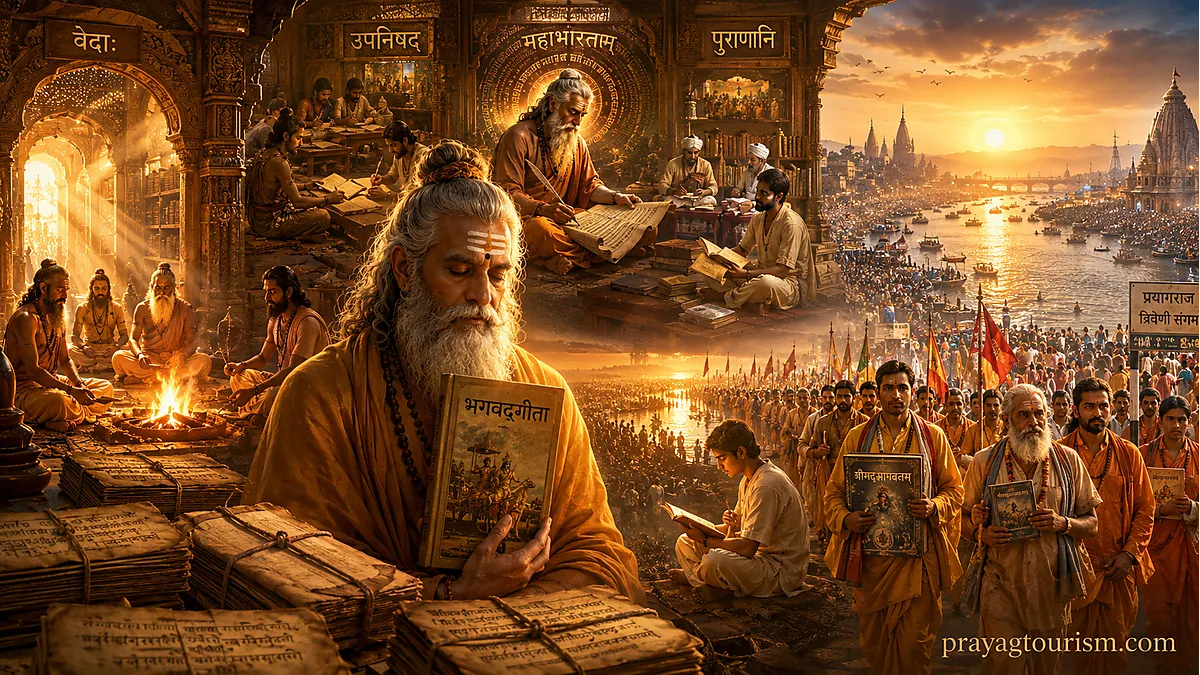
A Complete Beginner’s Guide to Hinduism’s Vast Wisdom Tradition
Table of Contents
THE HUMAN SEARCH FOR WISDOM: A QUESTION FOR THE AGES
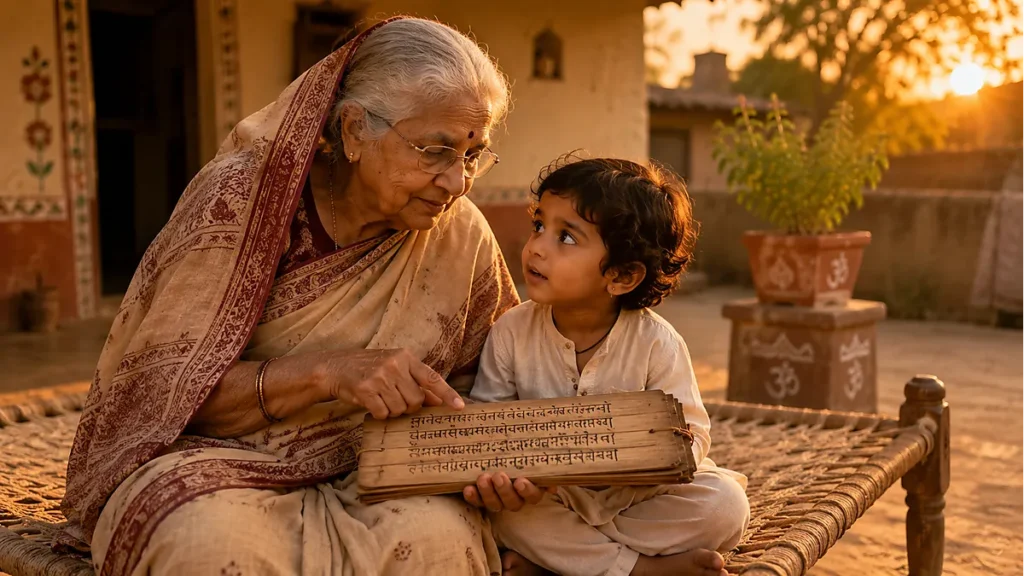
Picture a child of ten, sitting on the steps of a temple in Varanasi, looking up at the ancient stone carvings. She asks her grandmother:
“Where did we come from? Why are we here? Who first thought of all this?”
The grandmother smiles. She does not give a single answer from a single book. Instead, she begins to tell a story—then another, and another. Soon, she is chanting a verse in Sanskrit, then translating it into Hindi, then explaining how the same truth appears in a different Purāṇa, then connecting it to something the child will learn in school next week.
This is Sanātana Dharma.
It is not a religion of a single scripture. It is a civilization of knowledge—a vast, interconnected river system of wisdom, flowing through hundreds of texts developed across thousands of years.
In an age of information overload, many seekers feel overwhelmed. Where does one begin? What is the most important book? Are the Vedas the same as the Purāṇas? What is the difference between Śruti and Smṛti?
This guide is your map.
We will journey together through the entire library of Sanātana Dharma—from the ancient Vedas chanted by sages on the banks of the Sarasvati River to the epics that still resonate in village story-tellings, from the philosophical dialogues of the Upanishads to the devotional poetry of the Bhakti saints, from the science of Yoga to the living rituals of temple worship.
By the end of this journey, you will understand:
- Why Hinduism has hundreds of sacred texts and how they relate to one another
- How to navigate this vast ocean without drowning
- Which scriptures are most important for beginners
- How the sacred books of Sanātana Dharma continue to shape lives today
And most importantly, you will feel inspired to pick up one book and begin your own pilgrimage through this living river of wisdom.
WHAT IS A SACRED BOOK IN SANĀTANA DHARMA?
Before we dive into the vast ocean, we must understand the nature of the water itself.
In many world traditions, “sacred book” means a single, closed canon—a specific set of texts revealed at a specific time, after which revelation ceased.
Sanātana Dharma is radically different.
Here, sacred knowledge is not confined to a single book. It is not a document delivered to a prophet. It is an eternal, flowing river of wisdom, revealed and re-revealed through the ages, transmitted by sages (ṛṣis) who “heard” it in states of deep meditation.
This is why Sanātana Dharma uses the term Sanātana (eternal) and Dharma (law, truth, way of living). The truth is not dated. It is not owned by a single community. It is eternal—and the scriptures are its many expressions.
The Three Broad Categories of Hindu Sacred Literature
To make the vastness manageable, scholars and tradition have grouped the sacred literature into three broad categories:
| Category | Description | Examples |
| Śruti (That Which Is Heard) | The most authoritative, eternal, revealed texts; considered apauruṣeya (not composed by any human author) | Vedas, Upanishads |
| Smṛti (That Which Is Remembered) | Traditional texts derived from Śruti; composed by sages | Itihāsa (Ramayana, Mahabharata), Purāṇas, Dharmaśāstras |
| Darśana (Philosophical Systems) | Systematic philosophical treatises that explore the nature of reality, knowledge, and liberation | Six orthodox Darśanas (Nyāya, Vaiśeṣika, Sāṅkhya, Yoga, Mīmāṃsā, Vedānta) |
Beyond these, there are also Āgama and Tantra texts (guides for temple worship and ritual), Bhakti literature (devotional poetry and songs), and Nibandhas (digests and commentaries).
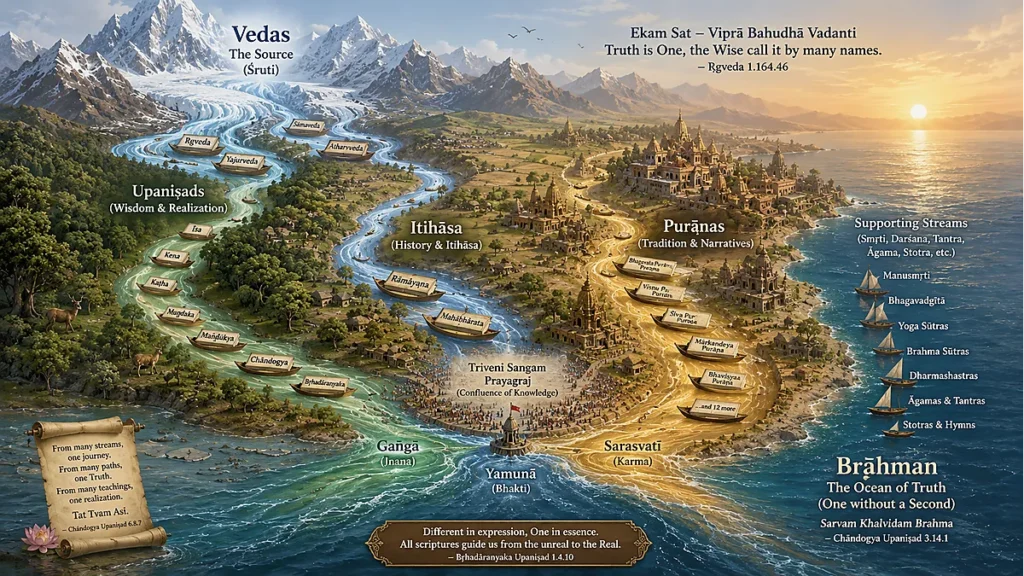
The metaphor of a river system is helpful here:
- The Vedas are the glacier springs in the Himalayas—the original, pristine source.
- The Upanishads are the upper reaches, where the water becomes clear, cold, and philosophical.
- The Itihāsa (epics) and Purāṇas are the mighty midstream rivers, carrying the water to the plains where millions drink.
- The Darśanas are the canals that channel the water for specific purposes (logic, meditation, ritual).
- The Bhakti texts are the flowering gardens along the banks—beautiful, fragrant, accessible to all.
- The Āgamas and Tantras are the irrigation systems that bring the water into the temple, the home, the daily ritual.
All these texts are not contradictory. They are complementary. They address different audiences, different levels of spiritual maturity, and different human needs.
THE GREAT CLASSIFICATION OF HINDU SCRIPTURES: ŚRUTI AND SMṚTI
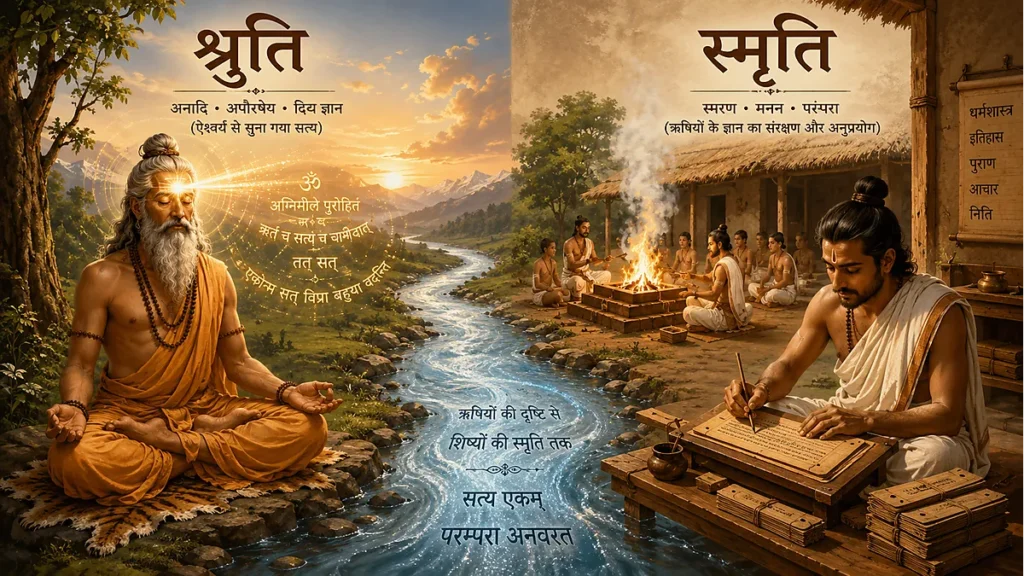
The foundational division in Hindu sacred literature is between Śruti (श्रुति, “that which is heard”) and Smṛti (स्मृति, “that which is remembered”).
What Is Śruti?
Śruti refers to the body of most authoritative and ancient religious texts, believed to be eternal knowledge authored neither by human nor divine agent but transmitted by sages (ṛṣis). These texts are considered apauruṣeya (not of human origin)—they are the very vibrations of the cosmos, “heard” by seers in deep meditation.
Śruti comprises:
- The four Vedas (Rigveda, Yajurveda, Samaveda, Atharvaveda)
- Their appendages: the Brāhmaṇas (ritual manuals), Āraṇyakas (“forest texts”), and Upaniṣads (philosophical dialogues)
In traditional Hindu society, Śruti is considered the ultimate authority. When a later text (Smṛti) appears to contradict Śruti, the Śruti prevails.
What Is Smṛti?
Smṛti (“that which is remembered”) refers to texts that are derived from Śruti, composed by human sages, and transmitted through memory and tradition. These include:
- Itihāsa – The great epics: Ramayana and Mahabharata
- Purāṇas – Eighteen major texts that narrate the history of the universe, dynasties, and divine incarnations
- Dharmaśāstras – Law books and ethical codes (e.g., Manusmṛti)
- The Six Darśanas – Philosophical systems
Smṛti texts are authoritative but subject to interpretation and can evolve with changing times. They are the “living tradition” that adapts the eternal truths of Śruti to the circumstances of different ages.
Why This Classification Matters
This two-fold division reveals something profound about Sanātana Dharma: revelation is eternal, but its expression evolves.
The Vedas remain the unchanging source, but the epics, Purāṇas, and philosophical texts translate that source into language and stories that each generation can understand. This is not a weakness—it is the secret to Hinduism’s extraordinary longevity. The tradition is rooted in the eternal yet relevant to every age.
THE VEDAS: THE FOUNDATION OF EVERYTHING
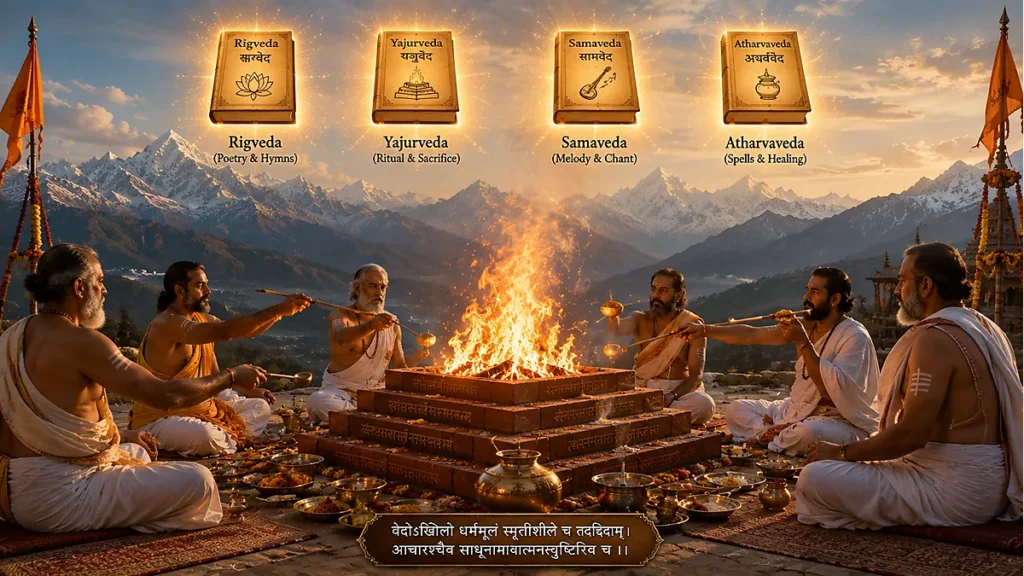
The Vedas (वेद, “knowledge”) are the oldest and most authoritative scriptures of Sanātana Dharma. They are not “books” in the modern sense but vast collections of hymns, mantras, rituals, and philosophical teachings, preserved orally for millennia before being written down.
The Four Vedas
There are four Vedas, each serving a distinct purpose:
| Veda | Meaning | Primary Content |
| Rigveda | “Veda of Verses” | 1,028 hymns in praise of deities like Agni, Indra, Varuna, and Surya. The oldest Veda. |
| Yajurveda | “Veda of Ritual Formulas” | Prose mantras for performing yajñas (sacrifices). Divided into White and Black schools. |
| Samaveda | “Veda of Chants” | Musical settings of Rigvedic verses for chanting during rituals. |
| Atharvaveda | “Veda of the Fire Priest Atharvan” | Hymns, spells, and incantations for daily life, health, protection, and prosperity. |
The Rigveda is the most ancient and, according to scholars, the oldest of the Vedas, divided into ten books (mandalas) with 1,028 hymns in praise of various deities. The Yajurveda contains mantras used in worship and rituals. The Samaveda is known for its musical rendition of verses. The Atharvaveda deals with practical aspects of life, containing spells and incantations.
The Four Parts of Each Veda
Each Veda is further divided into four sections:
- Saṃhitā – The core collection of mantras and hymns
- Brāhmaṇa – Prose texts explaining the rituals and their hidden meanings
- Āraṇyaka – “Forest texts” for ascetics, shifting from ritual to meditation
- Upaniṣad – The philosophical culmination of the Veda, exploring the nature of the Self and Brahman
The Upaniṣads are the most important part of the Vedas for most spiritual seekers today. They are the end of the Vedas in both the literal sense (the final section) and the philosophical sense (the highest goal).
Why the Vedas Remain Foundational
Every major tradition within Sanātana Dharma—whether Śaiva, Vaiṣṇava, Śākta, Smārta, or philosophical school—traces its roots back to the Vedas. The Vedas are the common ancestor of all Hindu wisdom. Even texts that appear to challenge or reinterpret the Vedas (like the Buddhist and Jain scriptures) emerged from the Vedic ecosystem and engaged with its ideas.
To the believing Hindu, the Vedas are not historical documents. They are eternal vibrations—the sound of the cosmos itself—revealed at the dawn of creation and preserved by an unbroken chain of sages and teachers.
THE UPANISHADS: THE PHILOSOPHICAL HEART OF HINDUISM
If the Vedas are the body of Hindu revelation, the Upaniṣads are its soul.
The word “Upaniṣad” means “sitting near” – a disciple sitting at the feet of a guru, receiving the secret teachings that cannot be conveyed through ritual alone.
What Are the Upanishads?
The Upanishads are philosophical dialogues that form the concluding portion of the Vedas. They mark the shift from external ritual (yajña) to internal knowledge (jñāna). They ask the deepest questions:
- Who am I?
- What is the ultimate reality?
- What happens after death?
- How can I be free from suffering?
The Principal Upanishads
There are over 200 Upanishads, but ten are considered the principal (mukhya) Upanishads, forming the core of Vedānta philosophy:
- Īśā Upaniṣad (Yajurveda) – Short (18 verses), powerfully asserting that the Divine pervades everything.
- Kena Upaniṣad (Samaveda) – On the power behind the senses and mind.
- Kaṭha Upaniṣad (Yajurveda) – The famous dialogue between Nachiketa and Yama on death and the Self.
- Praśna Upaniṣad (Atharvaveda) – Six questions about creation, prāṇa, and the Self.
- Muṇḍaka Upaniṣad (Atharvaveda) – Compares knowledge to a sharp weapon that cuts the knot of ignorance.
- Māṇḍūkya Upaniṣad (Atharvaveda) – Analyzes the syllable Om as the whole of reality.
- Taittirīya Upaniṣad (Yajurveda) – On the five sheaths of the Self (annamaya, prāṇamaya, manomaya, vijñānamaya, ānandamaya).
- Aitareya Upaniṣad (Rigveda) – On the creation of the universe and the Self.
- Chāndogya Upaniṣad (Samaveda) – One of the longest, containing the famous teaching “Tat tvam asi” (“That thou art”).
- Bṛhadāraṇyaka Upaniṣad (Yajurveda) – The longest and one of the oldest, exploring the nature of the Self and the famous “neti, neti” (“not this, not this”).
The Core Teachings of the Upanishads
The Upanishads expound the central doctrines of Vedānta:
- Brahman – The ultimate, formless, attributeless reality that is the ground of all existence.
- Ātman – The individual Self, which is ultimately identical with Brahman.
- Mokṣa – Liberation from the cycle of birth and death, achieved through knowledge of the identity of Ātman and Brahman.
- Māyā – The creative power of Brahman that makes the one appear as many.
- Neti, neti – The method of negation: the Self cannot be described positively; it is “not this, not this.”
The Upanishads are not systematic textbooks. They are dialogues – sometimes between a father and son, sometimes between a king and a sage, sometimes between a teacher and a student. They invite you not to accept but to inquire. They do not command belief; they provoke contemplation.
ITIHĀSA: THE SACRED EPICS OF INDIA
If the Upanishads are the philosophy of Hinduism, the Itihāsa (“thus indeed it was”) are its living heart. These are not merely “mythology” or “history” in the Western sense – they are the sacred narratives that have shaped the moral, spiritual, and cultural consciousness of India for millennia.
The two great Itihāsas are the Rāmāyaṇa and the Mahābhārata.
The Rāmāyaṇa: The Ideal Man’s Journey
Composed by the sage Vālmīki, the Rāmāyaṇa (approximately 24,000 verses) tells the story of Rāma, the prince of Ayodhya and an incarnation of Lord Viṣṇu.
The Story in Brief:
- Rāma, the eldest son of King Daśaratha, is exiled to the forest for 14 years due to a promise made to his stepmother.
- His devoted wife Sītā and loyal brother Lakṣmaṇa accompany him.
- In the forest, the demon king Rāvaṇa abducts Sītā and takes her to his island kingdom of Laṅkā.
- Rāma allies with the monkey king Sugrīva and the great devotee Hanumān.
- After a great battle, Rāma slays Rāvaṇa and rescues Sītā.
- They return to Ayodhya, where Rāma is crowned king, ushering in a golden age of righteousness.
Why It Matters: The Rāmāyaṇa is the story of dharma – right conduct in every situation: as a son, a husband, a brother, a king, a warrior, a friend. Rāma is the model of the ideal man; Sītā, the ideal wife; Lakṣmaṇa, the ideal brother; Hanumān, the ideal devotee.
The Mahābhārata: The Great Epic of India
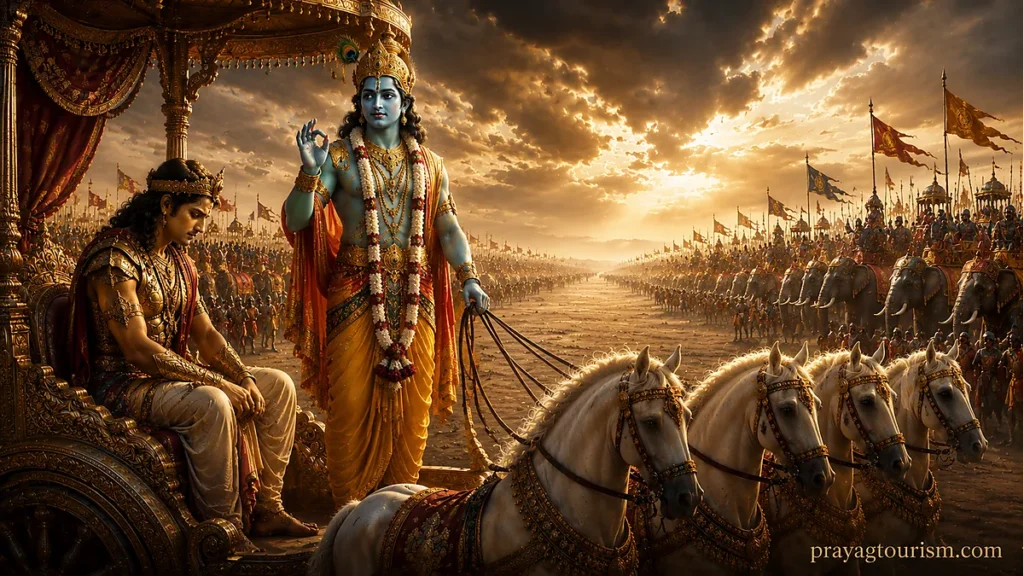
The Mahābhārata is the longest single poem in the world, containing approximately 100,000 verses (about four times the length of the Bible). It is not just a story – it is an encyclopedia of dharma, politics, philosophy, and human psychology. Attributed to the sage Vyāsa, it is famously said: “What is found here may be found elsewhere. What is not found here cannot be found anywhere.”
The Story in Brief:
- The epic chronicles the conflict between two branches of the same royal family: the five Pāṇḍava brothers (righteous) and the hundred Kaurava brothers (envious).
- After losing their kingdom in a rigged dice game, the Pāṇḍavas are exiled for 13 years.
- When they return to claim their share, the Kauravas refuse, leading to the great war of Kurukṣetra.
- On the battlefield, the Pāṇḍava prince Arjuna faces a moral crisis, refusing to fight against his own relatives.
- His charioteer, Kṛṣṇa, delivers the Bhagavad Gītā – the spiritual discourse that is the heart of the epic.
- After 18 days of war, the Pāṇḍavas win, but at a terrible cost.
Why It Matters: The Mahābhārata is the story of human nature in all its complexity. It does not present simplistic heroes and villains. Every character is flawed, every choice ambiguous. The Pāṇḍavas win, but they are haunted by the destruction they caused. The epic asks: “What is the right action when every action seems wrong?”
The Bhagavad Gītā: The Crown Jewel
Embedded within the Mahābhārata (specifically, the Bhīṣma Parva, chapters 23–40) is the Bhagavad Gītā – 700 verses that are arguably the most beloved and influential Hindu scripture worldwide. It synthesizes the three major paths to liberation:
- Karma Yoga – Action without attachment to results.
- Bhakti Yoga – Devotion and surrender to the Divine.
- Jñāna Yoga – Knowledge of the eternal Self.
The Gītā’s final teaching (Chapter 18, Verse 66) is the essence of its message: “Abandon all varieties of dharma and come to Me alone for refuge. I will liberate you from all sins. Do not grieve.”
THE PURĀṆAS: THE PEOPLE’S LIBRARY OF DHARMA
The word Purāṇa means “ancient narrative.” The Purāṇas are encyclopedic texts that bring the profound truths of the Vedas and Upanishads to the masses through stories, genealogies, cosmology, geography, and rituals.
The Eighteen Mahāpurāṇas
Traditionally, there are eighteen major Purāṇas (Mahāpurāṇas), divided into three groups of six, each associated with one of the three major deities (Brahmā, Viṣṇu, Śiva).
Viṣṇu Purāṇas (Sattva – representing goodness):
- Viṣṇu Purāṇa (23,000 verses)
- Nāradīya Purāṇa (25,000 verses)
- Bhāgavata Purāṇa (18,000 verses) – The most influential for Kṛṣṇa bhakti
- Padma Purāṇa (55,000 verses)
- Garuḍa Purāṇa (19,000 verses)
- Varāha Purāṇa (24,000 verses)
Brahmā Purāṇas (Rajas – representing passion and activity):
- Brahma Purāṇa
- Brahmāṇḍa Purāṇa
- Brahma Vaivarta Purāṇa
- Mārkaṇḍeya Purāṇa (contains the Devī Māhātmya, a core text of Goddess worship)
- Bhaviṣya Purāṇa
- Vāmana Purāṇa
Śiva Purāṇas (Tamas – representing inertia and darkness):
- Śiva Purāṇa (24,000 verses)
- Liṅga Purāṇa
- Skanda Purāṇa – The longest Purāṇa, with extensive geography of pilgrimage sites
- Agni Purāṇa
- Matsya Purāṇa
- Kūrma Purāṇa
The Subject Matter of the Purāṇas
Each Purāṇa typically covers five major topics (pañca-lakṣaṇa):
- Sarga – The primary creation of the universe
- Pratisarga – The periodic destruction and re-creation
- Vaṃśa – The genealogy of gods, sages, and kings
- Manvantara – The ages of the Manus (cosmic time cycles)
- Vaṃśānucarita – The histories of royal dynasties
Why the Purāṇas Matter
The Purāṇas democratized spiritual knowledge. Unlike the Vedas, which were restricted by language and access, the Purāṇas were sung, recited, and dramatized in village squares and temple courtyards. They brought the Divine into the lives of ordinary people – farmers, merchants, women, laborers – who could not study Sanskrit but could listen to stories.
The Bhāgavata Purāṇa (also called Śrīmad Bhāgavatam) is particularly important for its detailed account of Lord Kṛṣṇa’s life (tenth book), especially his childhood pastimes in Vṛndāvana. It is the foundational text for the Gauḍīya Vaiṣṇava tradition and has inspired countless bhakti movements across India.
The Garuḍa Purāṇa, while often associated with funeral rites, is a vast encyclopedia covering cosmology, medicine, architecture, and philosophy – only a section (Pretakalpa) deals with death and the afterlife.
THE SIX DARŚANAS: A CIVILIZATION THAT ASKS WHY
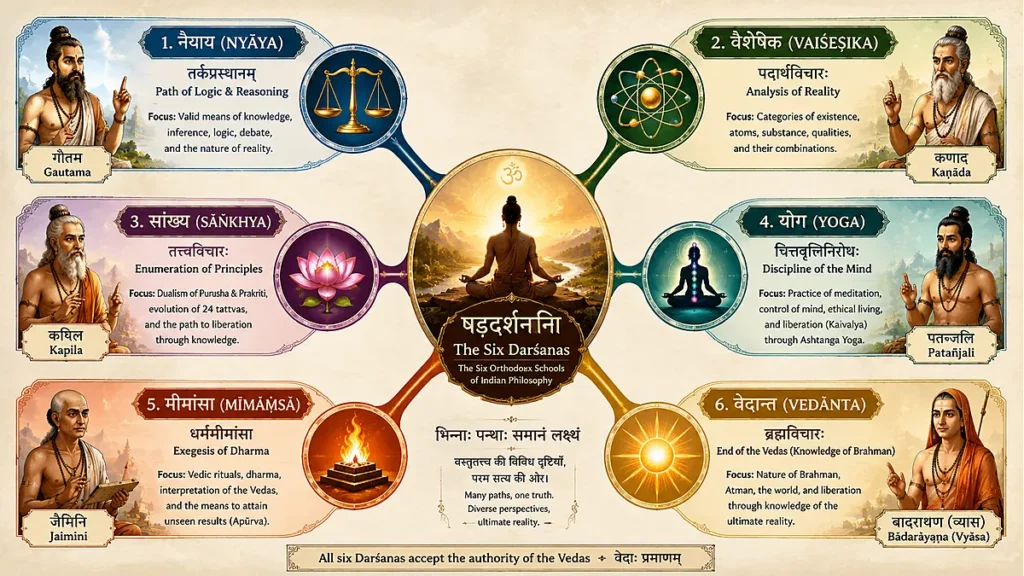
Sanātana Dharma is not a dogma – it is a civilization of inquiry. The Six Darśanas (दर्शन, “viewpoints” or “philosophical systems”) are living proof of this. They represent six distinct philosophical perspectives, each developed by a school of thinkers, each offering a systematic analysis of reality, knowledge, ethics, and liberation.
The six orthodox (āstika) Darśanas accept the authority of the Vedas. They are often presented in complementary pairs:
| Pair | School | Founder | Core Focus |
| Nyāya & Vaiśeṣika | Nyāya | Gautama | Logic, epistemology (how we know what we know) |
| Vaiśeṣika | Kaṇāda | Atomism, metaphysics (the categories of reality) | |
| Sāṅkhya & Yoga | Sāṅkhya | Kapila | Dualism of Puruṣa (consciousness) and Prakṛti (matter) |
| Yoga | Patañjali | Practical discipline to realize the Sāṅkhya vision | |
| Mīmāṃsā & Vedānta | Pūrva Mīmāṃsā | Jaimini | Ritual hermeneutics (how to interpret Vedic injunctions) |
| Uttara Mīmāṃsā (Vedānta) | Bādarāyaṇa (Vyāsa) | The end of the Vedas – Brahman, Ātman, liberation |
Nyāya – The Science of Reasoning
Nyāya is the school of logic and epistemology. It examines the valid sources of knowledge: perception, inference, comparison, and testimony. Nyāya provides the tools for philosophical debate, distinguishing valid from invalid arguments. Every Hindu philosophical text – even those that disagree with Nyāya – is indebted to its rigorous standards.
Vaiśeṣika – The Science of Categories
Vaiśeṣika analyzes the categories of existence: substance, quality, action, generality, particularity, inherence, and non-being. It posits that the physical world is composed of eternal, indivisible atoms (paramāṇus). Nyāya and Vaiśeṣika eventually merged into a single school.
Sāṅkhya – The Science of Analysis
Sāṅkhya, attributed to Kapila, is the oldest philosophical system. It presents a dualistic vision of reality:
- Puruṣa – Pure consciousness, the witness, plural (each being has its own Puruṣa).
- Prakṛti – Primeval matter, composed of three guṇas (sattva, rajas, tamas).
Suffering arises when Puruṣa mistakenly identifies with Prakṛti. Liberation occurs when discrimination (viveka) distinguishes the two.
Yoga – The Science of Discipline
The Yoga Sūtras of Patañjali (c. 400 CE) systematize the practical discipline to achieve the goal of Sāṅkhya. The text outlines the eight limbs (aṣṭāṅga) of yoga:
- Yama – Ethical restraints (non-violence, truthfulness, non-stealing, continence, non-possessiveness)
- Niyama – Observances (purity, contentment, austerity, self-study, surrender to God)
- Āsana – Posture
- Prāṇāyāma – Breath control
- Pratyāhāra – Withdrawal of the senses
- Dhāraṇā – Concentration
- Dhyāna – Meditation
- Samādhi – Absorption, the highest state
Yoga is not merely physical exercise – it is a comprehensive technology for mastering the mind and realizing the true Self.
Pūrva Mīmāṃsā – The Science of Vedic Interpretation
Mīmāṃsā focuses on the ritual portions of the Vedas, developing sophisticated rules for interpreting injunctions and prohibitions. Its concern is dharma (duty) as revealed in Vedic commands. While it may seem arcane, Mīmāṃsā’s hermeneutical principles shaped the way all later Indian philosophy approached scriptural interpretation.
Uttara Mīmāṃsā (Vedānta) – The Science of Liberation
Vedānta (“the end of the Vedas”) is the most influential philosophical school in modern Hinduism. It is based primarily on the Upaniṣads, the Bhagavad Gītā, and the Brahma Sūtras (Bādarāyaṇa’s systematic summary of Upanishadic philosophy).
Vedānta has several sub-schools, the most famous being:
- Advaita Vedānta (Śaṅkara, 8th century CE) – Non-dualism: Ātman and Brahman are identical. The world is māyā (dependent reality). Liberation is knowledge of this identity.
- Viśiṣṭādvaita (Rāmānuja, 11th century CE) – Qualified non-dualism: Ātman and Brahman are distinct but inseparable, like body and soul.
- Dvaita (Madhva, 13th century CE) – Dualism: Ātman and Brahman are eternally distinct. Liberation is loving service to Viṣṇu.
Vedānta is the philosophical backbone of most Hindu traditions today, from the meditative paths of the Rāmakṛṣṇa Order to the devotional schools of the Vaiṣṇava ācāryas.
THE YOGA TEXTS: THE SCIENCE OF CONSCIOUSNESS
While the Yoga Sūtras of Patañjali is the most famous yoga text, the yoga tradition has a rich library of its own.
Patañjali’s Yoga Sūtras
This text (c. 400 CE) is the foundational scripture of classical yoga. It consists of 196 aphorisms (sūtras) divided into four chapters:
- Samādhi Pāda – On the nature of yoga and the states of meditative absorption
- Sādhana Pāda – The practical path (the eight limbs)
- Vibhūti Pāda – The powers that arise through advanced practice
- Kaivalya Pāda – The state of liberation (isolation of Puruṣa from Prakṛti)
The Yoga Sūtras is not a book about āsanas (postures) – it dedicates only three sūtras to physical posture. It is primarily a text about mind control: “Yogaś citta-vṛtti-nirodhaḥ” (“Yoga is the cessation of the modifications of the mind”).
The Hatha Yoga Texts
A later development in the yoga tradition (c. 14th–17th centuries CE) focused on the physical body as a vehicle for spiritual awakening. The major Hatha Yoga texts include:
- Haṭha Yoga Pradīpikā (Svātmārāma) – A foundational manual on āsanas, prāṇāyāma, mudrās, and bandhas, emphasizing the purification of the body and mind as preparation for higher states of meditation.
- Gheraṇḍa Saṃhitā (Gheraṇḍa) – Describes a sevenfold path of yoga and discusses six cleansing actions (ṣaṭkarmas).
- Śiva Saṃhitā – An authoritative text on Haṭha Yoga and Kuṇḍalinī.
These texts form the basis of modern physical yoga practice. However, in the traditional understanding, Haṭha Yoga is not an end in itself – it is a preparation for Rāja Yoga (the royal path of meditation described by Patañjali).
The Backbone of Yoga
As one scholar notes, “The backbone of Yoga is furnished by Patanjali’s Yoga Sutra. The classical texts on hatha yoga – ‘Hatha Yoga Pradipika’, Gherand Samhita and Shiva Samhita – describe different asanas and breathing exercises that form the basis of practices of Yoga today.”
THE BHAKTI REVOLUTION: LOVE AS THE HIGHEST PATH
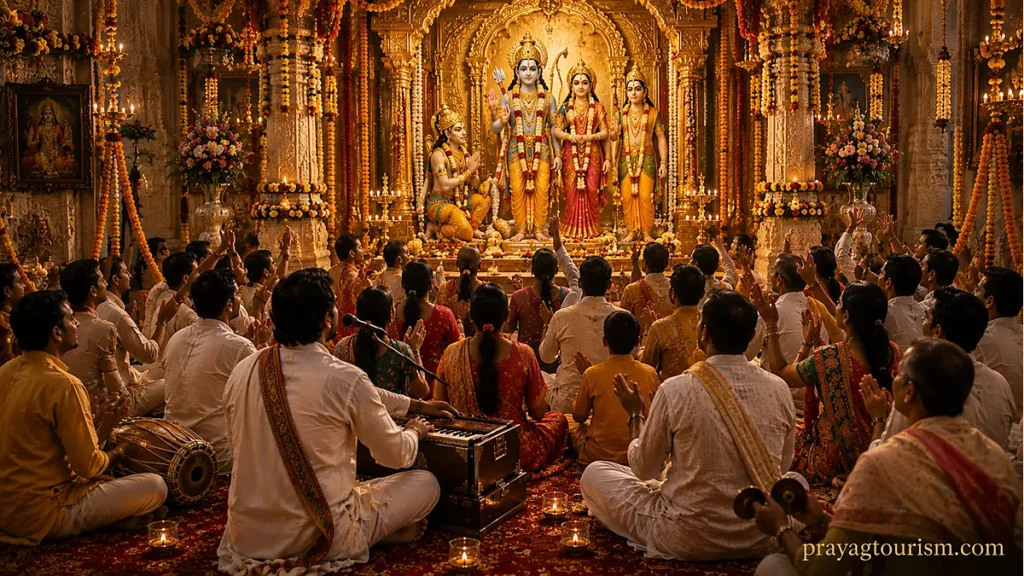
If the Vedas emphasize ritual and the Upanishads emphasize knowledge, the Bhakti (devotional) movement placed love at the center. Bhakti (भक्ति) means loving, personal devotion to a chosen deity (iṣṭa-devatā). It is the most accessible path to liberation because it requires neither wealth, nor intellect, nor renunciation – only a willing heart.
The Classical Roots of Bhakti
Bhakti is not a late addition to Hinduism. The Bhagavad Gītā (c. 2nd century BCE – 2nd century CE) already elevates Bhakti to the highest path. Kṛṣṇa declares: “Fix your mind on Me, be devoted to Me, sacrifice to Me, bow down to Me. Having thus united your whole self with Me, taking Me as the Supreme Goal, you shall come to Me.” (Gītā 9.34)
The Nārada Bhakti Sūtra
Attributed to the celestial sage Nārada, this short text (approximately 84 aphorisms) is a systematic exposition of the path of love. It defines Bhakti as “supreme love for the Divine” and describes its characteristics: “Bhakti is of the nature of the highest longing. Its attainment is the attainment of immortality.” The Nārada Bhakti Sūtra details the process of devotion, the perfectional stage of pure devotion, and the nature of selfless love. It is of particular importance to the Vaiṣṇava traditions.
The Rāmcaritmānas (Tulsīdās)
Composed in the 16th century by the saint-poet Tulsīdās, the Rāmcaritmānas (“The Lake of the Deeds of Rāma”) is a retelling of the Rāmāyaṇa in the vernacular Awadhi dialect. It is arguably the most beloved and influential text in North India, recited daily in homes and temples. Tulsīdās’s Rāma is not the distant, philosophical Rāma of the original Rāmāyaṇa – he is a loving, accessible Lord who responds to the devotion of his bhaktas with overwhelming grace.
The Bhaja Govindam (Śaṅkarācārya)
Even the great non-dualist (Advaitin) Śaṅkarācārya, often associated with dry philosophy, composed the Bhaja Govindam (“Worship Govinda”), a devotional hymn urging the seeker to turn away from material delusion and take refuge in the Lord. This text demonstrates that in Hinduism, knowledge and devotion are not opposed – they are complementary.
The Vernacular Revolution
Between the 12th and 17th centuries, Bhakti poets across India composed in their regional languages – Tamil (the Āḻvārs), Marathi (Jñāneśvar, Tukārām), Hindi (Mīrābāī, Sūrdās, Kabīr), Bengali (Caitanya Mahāprabhu, Cāṇḍīdās). These poets bypassed the Sanskrit elite and spoke directly to the heart of the common person, singing of a God who loves and is loved.
TANTRA AND ĀGAMA LITERATURE: THE TEMPLE’S INNER LIFE
Beyond the Vedas and Purāṇas lies an immense body of texts called Āgamas and Tantras – the manuals of temple worship, iconography, ritual, and spiritual discipline.
What Are the Āgamas?
The Āgamas are theological treatises and practical manuals of divine worship. The term Āgama literally means “tradition” and refers to precepts and doctrines that have come down as tradition. They are considered on par with the Vedas in authority within their respective traditions.
The Āgama literature is voluminous, and includes:
- 28 Śaiva Āgamas – For Śiva worship in temples
- 64 Śākta Āgamas (also called Tantras) – For worship of the Divine Mother in various forms
- 108 Vaiṣṇava Āgamas (also called Pāñcarātra Saṃhitās) – For Viṣṇu worship
The Scope of the Āgamas
The Āgamas do not confine themselves to temple rituals alone – they are comprehensive texts that deal with:
- Temple architecture and town planning
- Iconography (how to sculpt deities)
- Music, dance, and the arts
- Yoga and meditation
- Mathematics and astronomy
- Medicine
- The selection of materials for temples and images
Tantra: Often Misunderstood
The word Tantra (“loom, warp, weave”) refers to a vast body of texts and practices that emphasize the worship of the divine feminine (Śakti). In popular Western culture, “Tantra” has been reduced to sexual practices – a gross distortion. Traditional Tantra is a serious spiritual path that views the body not as an obstacle but as a vehicle for liberation. It seeks to transform desire, not reject it.
Tantric texts deal with:
- Mantra – Sacred sounds and syllables
- Yantra – Sacred geometric diagrams
- Kuṇḍalinī Yoga – The awakening of spiritual energy in the body
- Ritual worship – Often involving the five “M”s (madya, māṃsa, matsya, mudrā, maithuna), which are esoteric and certainly not intended for beginners or casual practitioners
The Relationship Between Vedic and Āgamic Worship
Vedic worship (yajña) is external, public, and focused on the sacrificial fire. Āgamic worship (pūjā) is internal, private, and focused on the consecrated image (mūrti) in the temple. Both are considered valid paths, appealing to different temperaments and contexts.
The temple traditions of South India, in particular, are deeply rooted in the Āgamas. Every major temple – from Śrī Raṅgam to Tirumala to Mīnākṣī Amman – follows the ritual protocols laid out in these texts.
HOW HINDU SCRIPTURES SHAPED CIVILIZATION
The sacred books of Sanātana Dharma are not merely spiritual guides – they have shaped the very fabric of Indian civilization for millennia.
Temples and Architecture
The Āgamas and Vāstu Śāstra (sacred architecture) provide the blueprints for Hindu temple construction – from the selection of the site to the orientation of the sanctum to the proportions of the tower (śikhara or vimāna). Every pilgrimage site – from Badrināth to Rāmeśvaram – is a physical manifestation of the scripture’s vision.
Pilgrimage
The Purāṇas contain extensive Mahātmyas (“greatness” sections) that describe the spiritual benefits of visiting specific pilgrimage sites (tīrthas). Prayāgraj, Kāśī, Gayā, Kurukṣetra – these are not merely geographical locations but embodied scriptures. The very act of pilgrimage is a walking meditation through the pages of the Purāṇas.
Performing Arts
The Rāmāyaṇa and Mahābhārata have inspired thousands of dance-dramas (Kathakali, Kuchipudi, Oḍissi), shadow puppets (Tholu Bommalata), folk theater (Rām Līlā), and classical music (Carnatic and Hindustani compositions). The nine rasas (emotions) of Indian aesthetics, codified in the Nāṭya Śāstra, find their fullest expression in stories drawn from scripture.
Governance and Law
The Dharmaśāstras (law books), particularly the Manusmṛti, shaped the legal codes and social structures of pre-modern India. While many of its provisions (especially regarding caste and women) are rightly questioned today, the Manusmṛti remains an invaluable document for understanding the evolution of Hindu social thought.
Science, Mathematics, and Astronomy
The Vedāṅgas (“limbs of the Veda”) include:
- Jyotiṣa – Astronomy/astrology for determining the proper timing of rituals
- Kalpa – Ritual procedure
- Śikṣā – Phonetics (crucial for preserving oral transmission)
The Śulba Sūtras (appendices to the Vedas) contain the earliest formulation of the Pythagorean theorem and advanced geometry for constructing fire altars.
Ethics and Daily Life
For most Hindus, scripture is not a weekend reading – it is the lens through which they see daily life. The Bhagavad Gītā guides ethical decision-making. The stories of the Purāṇas teach children about dharma and devotion. The mantras of the Vedas are chanted at weddings, births, and funerals. The sacred texts are woven into the fabric of existence.
WHERE SHOULD A BEGINNER START? A SIX-LEVEL ROADMAP
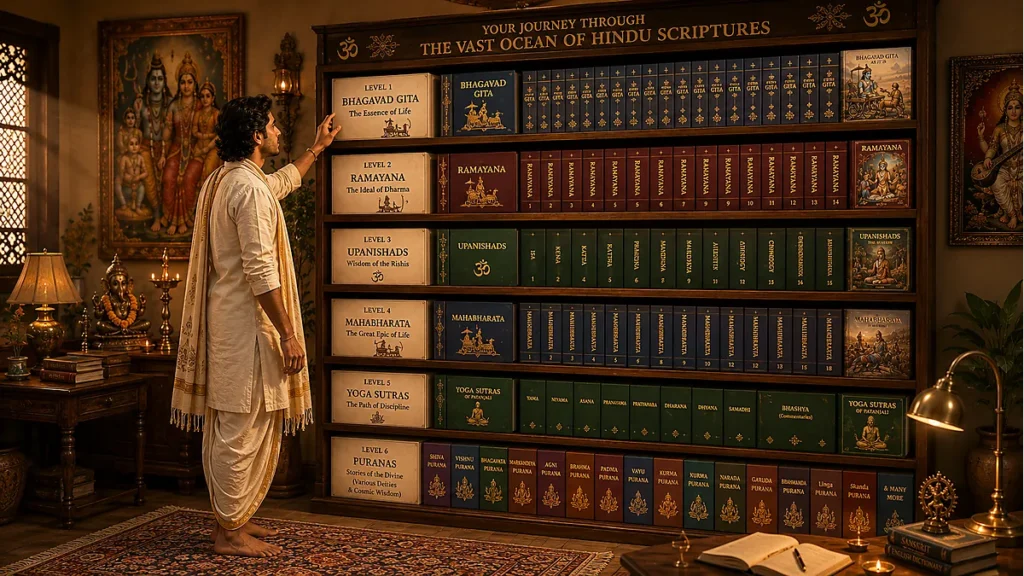
The sheer number of texts can be overwhelming. Here is a practical roadmap for the modern seeker.
Level 1: The Bhagavad Gītā
Why start here? The Gītā is the most accessible, comprehensive, and beloved Hindu scripture. It is short (700 verses), story-driven, and practical. It covers all three paths (Karma, Bhakti, Jñāna) and provides a complete spiritual philosophy that can be applied immediately.
Recommended edition: Eknath Easwaran’s translation (Nilgiri Press) – clear, poetic, and beginner-friendly. Also available: Swami Sivananda’s edition (with Sanskrit, word-by-word, and commentary).
Level 2: The Rāmāyaṇa (Rāmacaritamānas or Valmiki Rāmāyaṇa)
Why second? Stories are the best way to absorb dharma. The Rāmāyaṇa is a captivating narrative that embodies ethical ideals in action.
Recommended edition: R. K. Narayan’s abridged prose version (Penguin) for beginners. For the complete poem, Bibek Debroy’s translation.
Level 3: The Principal Upanishads (Selected)
Why third? By now, you have a foundation in action (Gītā) and story (Rāmāyaṇa). Now you are ready for the philosophical depth of the Upanishads.
Recommended edition: Eknath Easwaran’s “The Upanishads” (Nilgiri Press) – includes the ten principal texts. For deeper study, Swami Nikhilananda’s four-volume set (with extensive commentary).
Level 4: The Mahābhārata (and Gītā again)
Why fourth? After the Rāmāyaṇa, read the Mahābhārata in its entirety (or a substantial abridgment). You will understand the Gītā on a deeper level now that you know the context of the war and the characters.
Recommended edition: John D. Smith’s abridged translation (Penguin). For the complete 10-volume set, Bibek Debroy’s translation.
Level 5: The Yoga Sūtras of Patañjali
Why fifth? By now, you have the philosophy and the story. Now learn the practice. The Yoga Sūtras provide a systematic technology for mastering the mind.
Recommended edition: Edwin F. Bryant’s “The Yoga Sutras of Patanjali” (with extensive commentary) or Swami Satchidananda’s more accessible version.
Level 6: The Purāṇas – According to Your Devotion (Iṣṭa Devatā)
Why last? The Purāṇas are vast. After the foundation is laid, explore the Purāṇa that speaks to your heart:
- If you are drawn to Kṛṣṇa: Bhāgavata Purāṇa (especially Book 10)
- If you are drawn to Viṣṇu as the Preserver: Viṣṇu Purāṇa
- If you are drawn to Śiva: Śiva Purāṇa
- If you are drawn to the Goddess: Devī Bhāgavata Purāṇa or the Devī Māhātmya (embedded in the Mārkaṇḍeya Purāṇa)
Beyond Level 6
For advanced students, consider:
- The Brahma Sūtras (the systematic Vedānta text)
- The Nārada Bhakti Sūtra (devotion)
- The Haṭha Yoga Pradīpikā (physical yoga)
- The Vedas in translation (with guidance from a teacher)
- Commentaries by the great ācāryas (Śaṅkara, Rāmānuja, Madhva, Caitanya)
THE SACRED LIBRARY OF PRAYAGTOURISM.COM: A JOURNEY ACROSS CATEGORIES
PrayagTourism.com is building a comprehensive library of guides to Sanātana Dharma’s sacred literature. Below is a map of the scriptures you will find across the site, organized by category.
Category 1: Vedas & Upanishads (Śruti)
The eternal foundation. Articles in this category include:
- Vedas: An overview of the four Vedas (Rig, Yajur, Sama, Atharva)
- Principal Upanishads: Isha, Kena, Katha, Prashna, Mundaka, Mandukya, Taittiriya, Aitareya, Chandogya, Brihadaranyaka
- The Śikṣā, Kalpa, Vyākaraṇa, Nirukta, Chanda, and Jyotiṣa (the Vedāṅgas)
Category 2: Itihāsa (The Epics)
The living narratives of dharma:
- Rāmāyaṇa – The journey of Rāma, the ideal man
- Mahābhārata – The great epic of India (including the Bhagavad Gītā)
- Bhagavad Gītā – The Song of the Lord – the crown jewel of Hindu scripture
Category 3: Purāṇas (The Ancient Narratives)
The people’s library:
- Bhāgavata Purāṇa – The story of Kṛṣṇa, the supreme personality of Godhead
- Viṣṇu Purāṇa – The cosmology and avatars of Lord Viṣṇu
- Nārada Purāṇa – The guide to Bhakti, pilgrimage, and sacred observances
- Garuḍa Purāṇa – The journey of the soul, karma, death, and liberation
(More Purāṇa guides to be added)
Category 4: Darśanas (The Philosophical Schools)
The inquiring tradition:
- Yoga Sūtras of Patañjali – The science of mind control
- Sāṅkhya Kārikā – The analysis of consciousness and matter
- Nyāya and Vaiśeṣika – Logic and atomism
- Mīmāṃsā Sūtras – The interpretation of Vedic ritual
- Brahma Sūtras – The systematization of Vedānta
Category 5: Bhakti Literature (The Devotional Outpouring)
Love as the highest path:
- Nārada Bhakti Sūtra – The aphorisms of divine love
- Rāmcaritmānas – Tulsīdās’s epic of Rāma in Awadhi
- Bhaja Govindam – Śaṅkara’s hymn of devotion
- Gīta Govinda – Jayadeva’s song of Rādhā and Kṛṣṇa
- The poetry of Mīrābāī, Sūrdās, Kabīr, and Tukārām
Category 6: Yoga Texts (The Science of Consciousness)
The practical path:
- Patañjali’s Yoga Sūtras (foundational)
- Haṭha Yoga Pradīpikā – The manual of physical yoga
- Gheraṇḍa Saṃhitā – Sevenfold yoga
- Śiva Saṃhitā – Kuṇḍalinī and Haṭha Yoga
Category 7: Āgama and Tantra (Temple and Ritual)
The inner life of worship:
- Śaiva Āgamas – The 28 texts of Śiva temple worship
- Pāñcarātra Saṃhitās – The 108 texts of Viṣṇu temple worship
- Śākta Tantras – The 64 texts of Goddess worship
- Vāstu Śāstra – Sacred architecture
Category 8: Dharmaśāstra and Nibandha (Law and Ethics)
Social and ethical codes:
- Manusmṛti – The law code of Manu
- Yājñavalkya Smṛti – A later, more refined law code
- Nibandhas – Digests and commentaries on dharma
Category 9: Pilgrimage Literature (Tīrtha Mahātmya)
Walking the scriptures:
- Skanda Purāṇa – Extensive geography of pilgrimage sites
- Prayāgraj Mahātmya – The glory of Prayāgraj (Triveṇī Saṅgam)
- Kāśī Khaṇḍa – The glory of Varanasi
- Gayā Mahātmya – The glory of Gayā (ancestral rites)
Category 10: Stotra and Sūkta (Hymns and Chants)
The living sound of devotion:
- Viṣṇu Sahasranāma – The thousand names of Viṣṇu
- Lalitā Sahasranāma – The thousand names of the Goddess
- Śiva Mahimna Stotra – The glory of Śiva
- Gāyatrī Mantra – The most sacred Vedic mantra
- Puruṣa Sūkta – The hymn of the cosmic being
Each of these categories will be explored in individual articles across PrayagTourism.com, providing a complete library of guides for the spiritual seeker.
THE LIVING HORIZON: WISDOM THAT SPEAKS TODAY
A living tradition does not preserve its scriptures in museums. It chants them. It argues over them. It weeps with them. It dances to them.
Sanātana Dharma is not a religion of a single book because it is a civilization of the living word. The Vedas are still chanted in temples and homes. The Upanishads are still debated in ashrams and universities. The Rāmāyaṇa is still performed in village squares during Rāma Līlā. The Bhagavad Gītā is still carried into hospitals, boardrooms, and battlefields.
At Prayāgraj, the Triveṇī Saṅgam (confluence of the Ganga, Yamuna, and Sarasvati) is not merely a geographical location. It is a living metaphor for the sacred library of Sanātana Dharma.
The rivers come from different sources, flow through different terrains, carry different colors and qualities. But at the Saṅgam, they merge. They become one.
Similarly:
- The Vedas flow from the eternal source of revelation.
- The Upanishads carry the pure, cold water of philosophy.
- The Itihāsas bring the silt of stories and moral dilemmas.
- The Purāṇas carry the warm, accessible water of devotion.
- The Darśanas channel the water through canals of logic and analysis.
- The Yoga texts teach us to swim.
- The Bhakti texts fill the riverbanks with flowers.
- The Āgamas build the ghats for the pilgrims.
All these rivers meet at the same eternal ocean – the realization of Brahman, the truth of Ātman, the attainment of Mokṣa.
The sacred books of Sanātana Dharma are not dead scrolls in sealed libraries. They are living conversations across centuries. When you open a Gītā, you are not reading a document – you are listening to a dialogue between Kṛṣṇa and Arjuna. When you chant a Vedic mantra, you are joining the chorus of sages stretching back to the dawn of time. When you hear the story of Rāma, you are stepping into a narrative that has been told by grandmothers to grandchildren for three thousand years.
This is the gift of Sanātana Dharma: a library without walls, a river that never runs dry, a conversation that never ends.
FOUNDATIONAL VERSES OF SANĀTANA DHARMA
Here are eight foundational verses (ślokas) that appear across the sacred literature. Each verse has been carefully verified.
Verse 1: The Gāyatrī Mantra (Rigveda 3.62.10)
Devanagari:
ॐ भूर्भुवः स्वः तत्सवितुर्वरेण्यं भर्गो देवस्य धीमहि धियो यो नः प्रचोदयात्
IAST Transliteration:
Oṁ bhūr bhuvaḥ svaḥ tat savitur vareṇyaṁ bhargo devasya dhīmahi dhiyo yo naḥ pracodayāt
Source Citation: Rigveda 3.62.10
Word-by-Word:
- Oṁ – primordial sound, the essence of the Vedas
- Bhūḥ – the earth (the physical realm)
- Bhuvaḥ – the intermediate space (the subtle realm)
- Svaḥ – the heavens (the celestial realm)
- Tat – that
- Savitur – of the divine Sun (Savitar, the vivifying power)
- Vareṇyam – most excellent, worthy of worship
- Bhargo – radiance, glory
- Devasya – of the divine
- Dhīmahi – we meditate upon
- Dhiyo – our intellects
- Yo – who
- Naḥ – our
- Pracodayāt – may he inspire
Translation: “We meditate upon the glorious radiance of the Divine Sun. May he inspire our intellects.”
Practical Life Lesson: This mantra is a daily prayer for clarity, wisdom, and the awakening of the intellect. Chant it at dawn or dusk to align your mind with the cosmic order.
Verse 2: The Essence of the Upanishads (Bṛhadāraṇyaka Upanishad 1.4.10 / Chāndogya Upanishad 6.8.7)
Devanagari:
तत् त्वम् असि
IAST Transliteration:
Tat tvam asi
Source Citation: Chāndogya Upaniṣad 6.8.7
Word-by-Word:
- Tat – That (Brahman, ultimate reality)
- Tvam – you (the individual Self)
- Asi – are
Translation: “That you are.”
Practical Life Lesson: The most famous of the Mahāvākyas (Great Sayings) of the Upanishads. It declares that your true Self is not the body or mind, but the infinite, eternal consciousness that pervades the universe.
Verse 3: The Immortal Soul (Bhagavad Gītā 2.20)
Devanagari:
न जायते म्रियते वा कदाचिन् नायं भूत्वा भविता वा न भूयः।
अजो नित्यः शाश्वतोऽयं पुराणो न हन्यते हन्यमाने शरीरे॥
IAST Transliteration:
Na jāyate mriyate vā kadācin nāyaṁ bhūtvā bhavitā vā na bhūyaḥ |
Ajo nityaḥ śāśvato ‘yaṁ purāṇo na hanyate hanyamāne śarīre ||
Source Citation: Bhagavad Gītā 2.20
Translation: “The Self is never born nor does it ever die. It is not that having come into being, it will cease to be again. The Self is unborn, eternal, everlasting, ancient. It is not slain when the body is slain.”
Practical Life Lesson: Fear of death arises from identifying with the body. Know that the real you is eternal, untouched by birth or death.
Verse 4: Right to Action Alone (Bhagavad Gītā 2.47)
Devanagari:
कर्मण्येवाधिकारस्ते मा फलेषु कदाचन।
मा कर्मफलहेतुर्भूर्मा ते सङ्गोऽस्त्वकर्मणि॥
IAST Transliteration:
Karmaṇy evādhikāras te mā phaleṣu kadācana |
Mā karma-phala-hetur bhūr mā te saṅgo ‘stv akarmaṇi ||
Source Citation: Bhagavad Gītā 2.47
Translation: “You have a right to action alone, never to its fruits. Let not the fruit of action be your motive, nor let your attachment be to inaction.”
Practical Life Lesson: This verse is the practical antidote to anxiety. Do your best, but release the outcome. Work without attachment to results.
Verse 5: Non-Violence as Supreme Dharma (Mahābhārata 3.198.69)
Devanagari:
अहिंसा परमो धर्मः
IAST Transliteration:
Ahiṁsā paramo dharmaḥ
Source Citation: Mahābhārata 3.198.69 (often cited)
Word-by-Word:
- Ahiṁsā – non-violence, non-harming
- Paramo – highest, supreme
- Dharmaḥ – righteousness, duty, cosmic law
Translation: “Non-violence is the highest dharma.”
Practical Life Lesson: While the Mahābhārata itself depicts a great war, this verse reminds us that the highest ethical principle is to cause no harm. It is the foundation of ahimsa, a principle that inspired Mahatma Gandhi.
Verse 6: The Nature of the Self (Viṣṇu Purāṇa)
Source Citation: Viṣṇu Purāṇa (prose, not verse)
Text: “Nārāyaṇa is the supreme being, the infinite and eternal Brahman. He is the creator, preserver, and destroyer of the universe.”
Practical Life Lesson: This Puranic teaching affirms that the same reality that creates, sustains, and dissolves the cosmos is present within you. Let this knowledge give you courage in difficulty and humility in success.
Verse 7: Pure Devotion (Bhāgavata Purāṇa 1.1.2)
Source Citation: Bhāgavata Purāṇa 1.1.2 (prose summary)
Teaching Summary: “Completely rejecting all religious activities motivated by material desires, this Bhāgavata Purāṇa propounds the highest truth, which is understandable by those devotees who are pure in heart. The Lord is immediately captured within the heart of a sincere listener.”
Practical Life Lesson: Devotion is not a business transaction with God. Love for the Divine must be unconditional, not seeking rewards.
Verse 8: The Power of the Divine Name (Garuḍa Purāṇa – Bhakti teaching)
Source Citation: Garuḍa Purāṇa (general teaching on Nama Japa)
Teaching Summary: “In the Kali Yuga (the current age of conflict), chanting the names of the Lord is the supreme spiritual practice. Even a faint utterance of the divine name destroys sins and brings liberation.”
Practical Life Lesson: You do not need to retreat to a cave or master complex rituals. Start where you are. Chant a simple name of the Divine. Let it be your companion through the day.
FREQUENTLY ASKED QUESTIONS
Q1: How many sacred books does Hinduism have?
Hinduism does not have a fixed canon. The sacred literature includes the four Vedas, over 200 Upanishads, two major Itihāsas (Rāmāyaṇa and Mahābhārata), 18 major Purāṇas, hundreds of secondary Purāṇas, six major Darśanas, thousands of Āgamas and Tantras, and countless devotional and regional texts. It is a civilization’s library – not a single book.
Q2: Which Hindu scripture should a beginner read first?
Most teachers recommend starting with the Bhagavad Gītā. It is accessible, comprehensive, and practical. It covers the three paths of action, devotion, and knowledge in a story-driven format.
Q3: What is the oldest Hindu scripture?
The Rigveda is the oldest, composed approximately 1500–1200 BCE (traditional dating). However, the tradition considers the Vedas eternal (not composed at a specific historical date).
Q4: Are the Vedas and the Bhagavad Gītā the same?
No. The Vedas are the foundational revealed texts (Śruti), consisting of hymns, rituals, and philosophy. The Bhagavad Gītā is a later text (c. 2nd century BCE – 2nd century CE) embedded within the Mahābhārata (Smṛti). However, the Gītā is considered the essence of the Upanishads (which are the philosophical portions of the Vedas).
Q5: What is the difference between Śruti and Smṛti?
Śruti (“heard”) is the most authoritative, considered eternal and not composed by humans – primarily the Vedas and Upanishads. Smṛti (“remembered”) is derived from Śruti, composed by human sages, and includes the Itihāsas, Purāṇas, and Dharmaśāstras.
Q6: Is the Rāmāyaṇa or the Mahābhārata more important?
Both are deeply revered. The Rāmāyaṇa is often considered the model of ideal dharma in personal life (as son, husband, king). The Mahābhārata is an encyclopedia of human psychology and complex moral dilemmas. Both are essential.
Q7: Are the Purāṇas considered mythology or history?
In the traditional Hindu view, the Purāṇas are sacred history (itihāsa-purāṇa). They describe events that occurred in different cosmic cycles. Modern scholarship often classifies them as mythological and allegorical literature. The traditional belief is that they are true on a spiritual, if not literal, level.
Q8: What are the Six Darśanas?
The six orthodox philosophical systems are Nyāya (logic), Vaiśeṣika (atomism), Sāṅkhya (analysis of consciousness and matter), Yoga (discipline), Pūrva Mīmāṃsā (ritual interpretation), and Uttara Mīmāṃsā (Vedānta, the philosophy of the Upanishads).
Q9: Is the Bhagavad Gītā suitable for non-Hindus?
Yes. The Gītā addresses universal human concerns – action, duty, anxiety, death, purpose, and inner peace. It does not require conversion or belief in any particular deity. It has been studied by philosophers, psychologists, and leaders worldwide.
Q10: What is the difference between the Upanishads and the Vedas?
The Vedas include hymns (Saṃhitās), ritual manuals (Brāhmaṇas), forest texts (Āraṇyakas), and philosophical dialogues (Upaniṣads). The Upaniṣads are the concluding, philosophical portion of the Vedas, focusing on the nature of Brahman, Ātman, and liberation. For most modern seekers, the Upanishads are the most relevant part of the Vedas.
Q11: What is the Yoga Sūtras about?
The Yoga Sūtras of Patañjali is the foundational text of classical yoga. It consists of 196 aphorisms outlining the eight-limbed path (aṣṭāṅga) of ethical conduct, posture, breath control, concentration, and meditation. It is not primarily about physical postures – it is a text on mind control.
Q12: Which Purāṇa is most important for Kṛṣṇa devotion?
The Bhāgavata Purāṇa (also called Śrīmad Bhāgavatam) is the most important for Kṛṣṇa devotion. Its tenth book (canto) narrates Kṛṣṇa’s life from birth to his departure from the world, including his childhood pastimes in Vṛndāvana, his love for the gopīs, his lifting of Govardhana Hill, and his teachings.
Q13: What are the Āgamas?
The Āgamas are theological and ritual manuals for temple worship. They are considered equally authoritative as the Vedas in their respective traditions. There are 28 Śaiva Āgamas, 64 Śākta Tantras, and 108 Vaiṣṇava Āgamas (Pāñcarātra Saṃhitās). They govern temple construction, iconography, liturgy, and priestly practice.
Q14: How can I read the Vedas if I don’t know Sanskrit?
Translations of the Vedas exist, but they are challenging for beginners. Most teachers recommend starting with the Upanishads (which are the philosophical essence of the Vedas) rather than attempting to read the Saṃhitās directly. Good translations by Swami Nikhilananda, Eknath Easwaran, and Patrick Olivelle are available.
Q15: Are the scriptures of Sanātana Dharma still relevant in the modern age?
Absolutely. The questions they address – Who am I? How should I act? How can I find peace? – are timeless. The practical psychology of the Gītā and the Yoga Sūtras, the ethical frameworks of the Itihāsas, and the contemplative depths of the Upanishads are as relevant today as when they were composed.
BEGIN YOUR JOURNEY THROUGH THE SACRED BOOKS OF SANĀTANA DHARMA
We have journeyed together through the vast library of Sanātana Dharma – from the ancient hymns of the Rigveda to the devotional poetry of the Bhakti saints, from the logical sutras of the Darśanas to the ritual manuals of the Āgamas, from the epic battlefields of Kurukshetra to the serene forests of the Upanishads.
But this guide is only the map. The territory awaits you.
How to Begin
Choose one book. Just one.
Do not try to read the Vedas, the Upanishads, the Rāmāyaṇa, the Mahābhārata, and the Purāṇas all at once. That is not devotion – that is overwhelm.
Start with the Bhagavad Gītā. Get a good translation. Read one chapter a day. Keep a journal. Ask questions. Sit with the verses. Let them sit with you.
Then, let your curiosity guide you:
- Do you want philosophy? Move to the Upanishads.
- Do you want stories? Read the Rāmāyaṇa.
- Do you want the full human drama? Dive into the Mahābhārata.
- Do you want love? Open the Bhāgavata Purāṇa.
- Do you want practice? Study the Yoga Sūtras.
Where to Find Authentic Editions
For beginners, we recommend:
- Bhagavad Gītā – Eknath Easwaran (Nilgiri Press) or Swami Sivananda (Divine Life Society)
- Upanishads – Eknath Easwaran (Nilgiri Press)
- Rāmāyaṇa – R. K. Narayan (Penguin) for an abridged prose version; Bibek Debroy for the complete translation
- Mahābhārata – John D. Smith (Penguin) for an abridged version; Bibek Debroy for the complete 10‑volume translation
- Bhāgavata Purāṇa – Swami Prabhavananda (for the Kṛṣṇa story) or the complete translation by A. C. Bhaktivedanta Swami
- Yoga Sūtras – Edwin F. Bryant (for scholars) or Swami Satchidananda (for practitioners)
Many of these are available in inexpensive paperbacks, Kindle editions, or free PDFs online.
A Final Blessing
The sacred books of Sanātana Dharma are not relics of a dead past. They are living rivers – and you are standing at their confluence.
As you take the first step – opening the Gītā, listening to a Rāmāyaṇa katha, chanting a Vedic mantra – know that you are joining a conversation that has been ongoing for over three millennia. Sages, kings, merchants, farmers, poets, warriors, mothers, children – all have sat where you sit. All have asked the questions you ask.
The answers are not hidden. They are waiting in the pages of these sacred texts, waiting for you to discover them.
Oṃ Tat Sat.
May the wisdom of the sacred books of Sanātana Dharma illuminate your path, from the first page to the eternal horizon.
Jai Sītā Rāma. Jai Jagannātha. Jai Śrī Kṛṣṇa. Oṃ Śāntiḥ Śāntiḥ Śāntiḥ.
This article is published by PrayagTourism.com to help pilgrims, spiritual seekers, and students understand the timeless wisdom of the Bhagavata Purana. We invite you to explore the sacred geography of Bhakti—especially Prayagraj, where the three rivers meet at Triveni Sangam.