
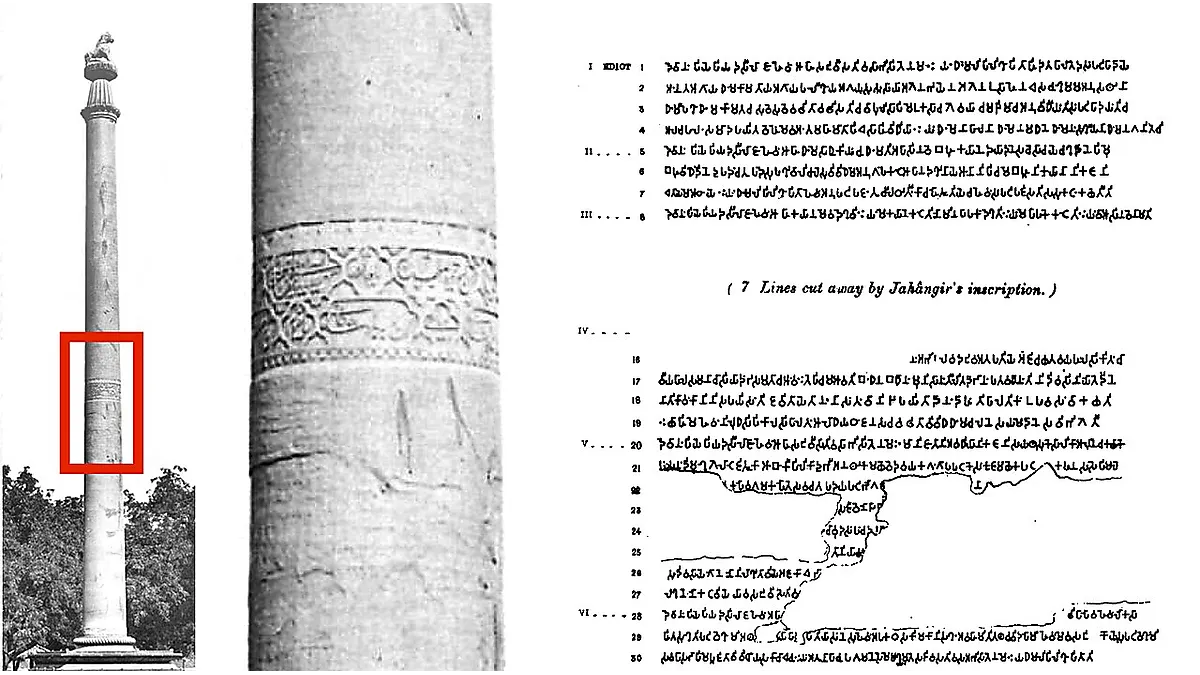
The monsoons have arrived, filling the Ganga and Yamuna with renewed vigour. The city of Prayagraj is lush with fresh greenery, and the ancient stones of the Allahabad Fort stand as silent sentinels, bearing witness to the flow of time and rivers. As you navigate the corridors of this historic Mughal fort, perhaps with the permission to view the sacred Ashokan Pillar, you are walking through history. This single sandstone pillar, worn by centuries of sun, wind, and rain, holds one of the most important historical documents of ancient India: the Prayag Prashasti.
In a world before paper or digital archives, kings commissioned inscriptions on stone to broadcast their power for eternity. But what happens when an ordinary pillar becomes the voice of not one, but two great empires? This 10.7-meter-tall column began its journey as an edict of the Mauryan Emperor Ashoka in the 3rd century BCE. Five hundred years later, another monarch, the great Samudragupta of the Gupta dynasty, engraved a masterpiece of poetry and politics onto its surface. This later inscription, the Prayag Prashasti, is not just a king’s ego—it is a detailed, first-hand account of conquests and governance that has helped historians reconstruct an entire chapter of India’s glorious past.
So, how do we reconstruct the story of one of India’s greatest emperors from a single pillar inscription? This is the detective story of the Prayag Prashasti—the eulogy that revealed the true power of the Gupta Empire.
Table of Contents
SUMMARY
| Detail | Information |
| Name | Prayag Prashasti |
| Also Known As | Allahabad Pillar Inscription |
| Date | 4th Century CE (c. 345–380 CE) |
| Language | Classical Sanskrit |
| Script | Gupta Brahmi |
| Author/Composer | Harisena (Court poet and minister) |
| Subject | Glorification of Emperor Samudragupta’s achievements |
| Location | Allahabad Fort, Prayagraj, Uttar Pradesh (inside Army Ordnance Depot, limited access) |
| Historical Importance | Primary source for the military campaigns, political geography, and ideology of the Gupta Empire |
What is a “Prashasti”? The Art of Royal Eulogy
The word Prashasti (प्रशस्ति) comes from Sanskrit and literally means “praise” or “eulogy.” In the context of ancient Indian history, prashastis were formal, ornate inscriptions composed by court poets in praise of their kings. They were not dry, factual accounts. Instead, they were literary works designed to glorify the king, comparing him to gods, and meticulously listing his achievements. They served a dual purpose: to flatter the ruler and to project a specific image of power to the public and to rival kings.
The Prayag Prashasti is considered a masterpiece of this genre. It was composed in the Champu style, a sophisticated form of Sanskrit literature that alternates between prose (gadya) and poetry (padya), allowing for both detailed narration and poetic flourish. This stylistic elegance itself speaks volumes about the high level of intellectual and artistic culture in the Gupta court.
The Pillar – A Tale of Three Empires
The physical object that carries this inscription is just as fascinating. The Allahabad Pillar is a remarkable palimpsest, a surface that has been reused to record the ambitions of three different rulers over a span of nearly 2,000 years.
🏛️ From Ashoka’s Edict to Gupta’s Glory
The pillar is a single shaft of polished sandstone, standing an impressive 35 feet (10.7 m) high. It was originally erected by the Mauryan emperor Ashoka in the 3rd century BCE to disseminate his benevolent dhamma edicts. Imagine the Guptas, centuries later, choosing an existing Ashokan pillar to engrave their own story. This act was a brilliant piece of political messaging. By repurposing an iconic Mauryan monument, the Guptas were consciously linking themselves to the prestigious imperial past, claiming legitimacy and continuity with the golden age of the Mauryas.
📜 The Layers on the Stone
The pillar contains four distinct layers of inscriptions:
- The Ashokan Edicts (c. 250 BCE): The oldest layer, containing the standard six edicts found on other Ashokan pillars, written in the Brahmi script.
- The Prayag Prashasti (c. 350-375 CE): The focus of our article, written in elegant Sanskrit, detailing Samudragupta’s reign.
- The “Queen’s Edict”: A smaller inscription, thought to be contemporary with Ashoka, praising his wife, Karuvaki.
- Jahangir’s Persian Inscription (17th century CE): A millennium and a half later, the Mughal emperor Jahangir added his own Persian inscription, marking the pillar as a site of continued significance.
There is a scholarly debate regarding the pillar’s movement. Some believe it was moved from its original location at Kaushambi and placed inside Akbar’s Allahabad Fort by the Mughal emperor himself. However, other scholars argue the pillar was already there, citing pre-Mughal inscriptions that suggest it was always at its current site.
The Subject of the Eulogy – Samudragupta, the Warrior-Poet
Who was the man behind the legend? Samudragupta, the son of Chandragupta I and the Licchavi princess Kumaradevi, was the second emperor of the Gupta dynasty, reigning approximately from c. 335 to 375 CE. The Prayag Prashasti creates an enduring image of him as the “ideal king,” a Chakravartin (universal ruler).
🗡️ The Warrior
The inscription proudly declares that Samudragupta was “without an antagonist on earth”. He is described as a muscular warrior who bore the “marks of hundreds of wounds received in battle.” The prashasti records his military genius, claiming he uprooted 9 kings in the north (Aryavarta) and subjugated 12 kings in the south (Dakshinapatha).
🎨 The Poet and Musician
But Samudragupta was more than a conqueror. The inscription also portrays him as a man of great culture and learning. He was a patron of the arts, and was himself an accomplished poet and musician, earning him the epithet Kaviraja (King of Poets). Some of his gold coins famously depict him playing the veena (a stringed instrument), a powerful symbol of his refined and intellectual nature.
The Author – Harisena, the Master of Words
Every great king needs a great chronicler. The genius behind the Prayag Prashasti was Harisena. He was not merely a poet; he was a high-ranking minister (Sandhivigrahika) in Samudragupta’s court, effectively the minister for war and peace. This dual role is reflected in the inscription, which combines exquisite poetic language with precise geopolitical detail. His famous poem, written around 345 CE, is a testament to the power of courtly literature in the Gupta era.
The Content – Reading the Prayag Prashasti
The inscription is not a continuous narrative but a structured piece of literature, divided into poetic verses and a lengthy prose section. Let’s decode its most important sections.
📜 The Genealogy (Lineage of the Guptas)
The inscription begins by establishing the legitimate rule of Samudragupta. It lists his illustrious ancestors: Maharaja Sri Gupta, Maharaja Sri Ghatotkacha, and his father, Maharadhiraja Sri Chandragupta I. It specifically mentions his mother Kumaradevi as being from the powerful Licchavi dynasty, a detail that highlights the high status and political alliances of the Guptas. Samudragupta is also called Lichchavi-dauhitra (grandson of the Lichchavis), showing how important this connection was for his royal identity.
👑 The Portrayal of the Ideal King
The prashasti then describes Samudragupta’s personal qualities, equating him with the gods themselves. It calls him:
- “A god dwelling on the earth”.
- A peer of Kubera (god of wealth), Varuna (god of the ocean), Indra (god of power), and Yama (god of justice).
This was not just flattery; it was a declaration of his divinely ordained right to rule.
🗺️ The Military Campaigns: A Map in Stone
This is the most celebrated portion of the inscription. Harisena systematically lists Samudragupta’s conquests, dividing the world into a well-organized political hierarchy.
- Āryāvarta (Northern India): The inscription records the complete “uprooting” of nine kings from this fertile Gangetic plain. This was total war. Their kingdoms were annexed directly into the Gupta Empire. Among these rulers were prominent Naga chieftains like Achyuta, Nagasena, and Ganapatinaga.
- Dakṣiṇāpatha (Southern India): Samudragupta’s southern campaign is legendary. He marched along the eastern coast, not to annex territories, but to assert his dominance. The inscription lists twelve kings of the south whom he defeated and then reinstated on their thrones as tributary vassals. Famous names include Vishnugopa of Kanchi (of the Pallava dynasty) and the kings of Mahishmati and Kalinga.
- The Forest Kingdoms (Āṭavika Rājya): The inscription states that he “subjugated” all the “Āṭavika” nations (forest kingdoms or tribes).
- Border States and Tribes: Various frontier kingdoms and tribal republics paid him homage. This includes regions like Samatata (Bengal), Devaka (Assam), Kamarupa (Assam), Nepal, and tribes like the Malavas, Arjunayanas, and Yaudheyas.
- Foreign Kings: The inscription even records the goodwill of distant rulers, such as the “Daivaputra-Shahi-Shahanushahi” (the Kushana kings of the northwest) and the “Saka-Murundas.”
🌍 Samudragupta’s Foreign Policy & Culture
The inscription also provides a glimpse of Samudragupta’s diplomacy. It notes that the king of Ceylon (modern-day Sri Lanka), Meghavarna, sent a royal embassy with rich gifts, asking for permission to build a monastery for Buddhist pilgrims at Bodh Gaya. Samudragupta granted this request, demonstrating his role as a powerful, benevolent ruler who was tolerant of other faiths. To mark his ultimate sovereignty, he also revived the ancient Ashvamedha (Horse Sacrifice). His special gold coins commemorate this grand ritual, which was a declaration of unparalleled imperial power.
What the Inscription Reveals About Ancient India
Beyond the story of one king, the Prayag Prashasti is a treasure trove of information for historians, revealing:
- Political Geography: It provides an invaluable snapshot of the political map of 4th-century India, naming kings, dynasties, and tribes across the subcontinent.
- A New Imperial Strategy: The text shows a sophisticated, multi-pronged imperial policy that involved direct annexation in the core region, establishing a tributary alliance in the south, and accepting nominal homage from frontier states.
- Gupta Administration: The titles used (like Sandhivigrahika) and the description of governance help historians reconstruct the administrative machinery of the Gupta state.
- Religion and Culture: The inscription illustrates the Hindu ideal of kingship, where a ruler is expected to be a Dharmic patron of the arts and religion, even while being tolerant of other faiths like Buddhism and Jainism.
The Prayag Prashasti and the Gupta Golden Age
The Prayag Prashasti is the foundational document of the Gupta Golden Age. It set the ideological template for all subsequent Gupta rulers. Its detailed account of conquests allowed later kings like his son, Chandragupta II (Vikramaditya) , to build on a stable and expansive empire. The literary and cultural ideals expressed in the inscription—combining martial valour with artistic refinement—became the hallmark of the classical Gupta civilization, celebrated in art, literature, and architecture for centuries to come.
Why the Prayag Prashasti Still Matters
The Prayag Prashasti is more than an ancient record. It is a remarkable reminder of India’s enduring legacy of scholarship, art, and statecraft. It allows us to hear the voice of Harisena, a 4th-century poet, and through his eyes, to see the grandeur of Samudragupta. It shows how a skilled chronicler can not only document history but shape the way an entire age is remembered. Standing before the pillar, you are not just seeing a stone; you are witnessing the moment when an empire’s ambition was carved into eternity.
Visiting the Allahabad Pillar Today
For the history enthusiast or the curious traveler, visiting the Allahabad Pillar is a pilgrimage to the source of India’s classical heritage.
- Location: The pillar is located inside the Allahabad Fort, a massive military complex overlooking the confluence of the Ganga and Yamuna rivers.
- Access: The fort is under the jurisdiction of the Indian Army. Public access is highly restricted, and special permission is required to view the pillar. Foreign nationals may have additional restrictions. It is advisable to hire a local guide or check with the tourism department in advance to navigate the permission process.
- Nearby Attractions: If you are able to secure permission, you can also visit the Patalpuri Temple (an underground temple) and the sacred Akshayavat (the indestructible banyan tree), both of which are also located within the fort.
Frequently Asked Questions (FAQs)
1. What is the Prayag Prashasti?
The Prayag Prashasti, also known as the Allahabad Pillar Inscription, is a 4th-century CE Sanskrit eulogy by the court poet Harisena, praising the military achievements and character of the Gupta emperor Samudragupta.
2. Who wrote the Prayag Prashasti?
It was composed by Harisena, who was Samudragupta’s court poet and chief minister (Sandhivigrahika).
3. Which language and script was the inscription written in?
The inscription is written in Classical Sanskrit using the Gupta Brahmi script.
4. What is the main subject of the Prayag Prashasti?
The primary subject is Samudragupta’s extensive military campaigns, which expanded the Gupta Empire across northern and southern India, and his divine and cultured kingship.
5. What does the inscription say about Samudragupta’s conquests?
It records that he uprooted 9 kings in the north (Aryavarta) and annexed their lands. In the south (Dakshinapatha), he defeated 12 kings but was magnanimous enough to reinstate them as tribute-paying vassals.
6. Who is considered the “Napoleon of India”?
This epithet is often used for Samudragupta due to his extensive and brilliant military conquests described in the Prayag Prashasti.
7. Why is Samudragupta called Kaviraja?
The inscription and his coins reveal that Samudragupta was a great patron of the arts and an accomplished poet and musician himself, earning him the title Kaviraja, or “King of Poets.”
8. Where is the Allahabad Pillar located?
It is located inside the Allahabad Fort in Prayagraj, Uttar Pradesh.
9. Can the public see the Allahabad Pillar?
Access is restricted as the pillar is inside an Indian Army Ordnance Depot. Special permission from the authorities is generally required to visit.
10. What is the historical significance of the Prayag Prashasti?
It is one of the most important historical documents of ancient India. It serves as the primary source for reconstructing the political history, military strategy, and ideology of the powerful Gupta Empire.
11. Was the pillar originally built by the Guptas?
No, the pillar was originally a Mauryan pillar, commissioned by Emperor Ashoka in the 3rd century BCE.
12. Why did the Guptas engrave their inscription on an Ashokan pillar?
It was a strategic political act. By reusing an imperial Mauryan monument, the Guptas were linking their dynasty to the prestigious Mauryan Empire, claiming legitimacy and authority.
Related Historical Journeys
If you are fascinated by the history of the Allahabad Pillar, you might also be interested in these related destinations:
- Allahabad Fort: The mighty Mughal fort that houses the pillar.
- Akshayavat: The sacred, “indestructible” banyan tree located within the same fort.
- Patalpuri Temple: The ancient, underground temple in the fort complex.
- Triveni Sangam: The confluence of the Ganga, Yamuna, and mythical Saraswati rivers, lying just below the fort.
- Bharadwaj Ashram: An ancient site associated with the sage Bharadwaj, mentioned in the Ramayana.
The Prayag Prashasti is not merely an inscription. It is one of the most important historical documents of Ancient India—a remarkable record that preserved the achievements of Samudragupta and helped historians reconstruct an entire chapter of India’s past.
This article is part of a series on the historical and sacred sites of Prayagraj.
Prayag Tourism
📞 Phone/WhatsApp: +91-9555313526
📧 Email: contact@prayagtourism.com
🌐 Website: PrayagTourism.com
May your journey into the past be as enriching as your pilgrimage is peaceful.