
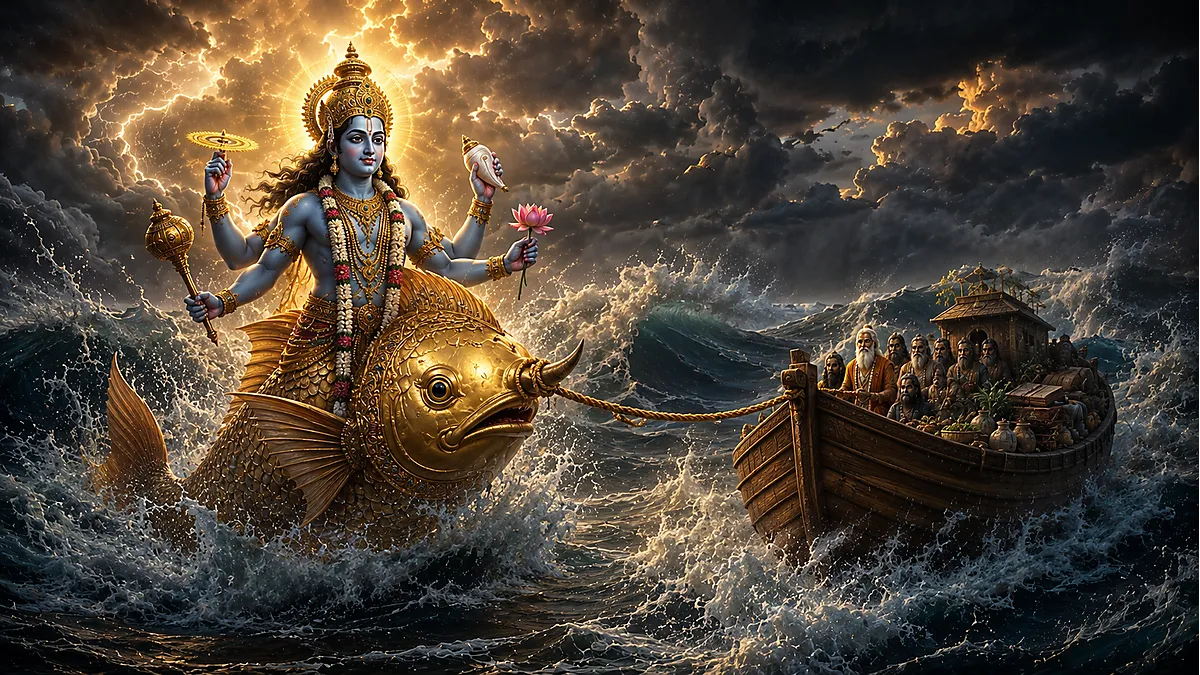
When God Became a Fish to Save the World
Daśāvatāra Series — Part One | prayagtourism.com
Table of Contents
The First Dawn — Before the Story Begins
Close your eyes for a moment.
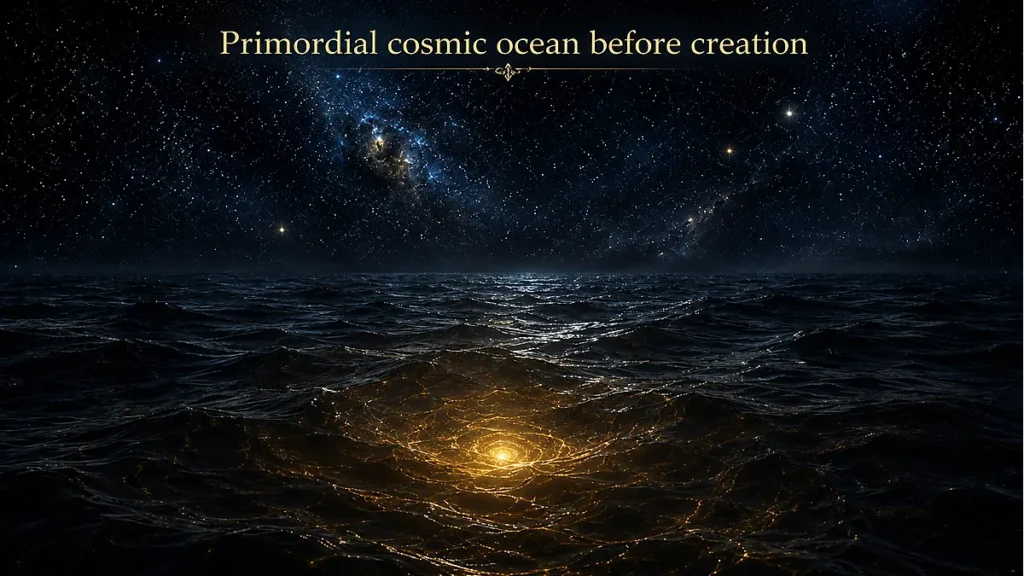
Imagine a world before this one. Not darkness, exactly — but a vast, still water. Infinite and silent. No land. No mountains. No birdsong. No fire. Just the deep, impenetrable ocean of pralaya — the cosmic dissolution — in which the universe has folded itself back into rest.
Somewhere in that water, the Lord rests. Ananta-śayana. The eternal recline. The sleeping of He who never truly sleeps.
And somewhere in that same ocean, something wicked stirs. A demon, born from a moment of divine inattention, has stolen the most precious things that existence carries forward from one cosmic cycle to the next: the four Vedas — the recorded heartbeat of universal knowledge.
The universe is waiting to be re-created. But without the Vedas, without the foundational wisdom that will guide the new creation, the next world will be born into darkness.
This is the moment in which the first Avatāra appears.
Not in golden armour. Not on a celestial chariot. Not with the blaze of divine weapons.
As a tiny fish. Swimming into the palm of a praying king.
That is how the Lord chooses to begin.
The Etymology of Matsya — What the Name Carries
The word Matsya (मत्स्य) is the Sanskrit word for fish — and one of the oldest, most elemental words in the language.
In classical Sanskrit, matsya carries connotations of the primal, the aquatic, the form of life that first organized itself in water before reaching the land.
Fish in Vedic and Purāṇic symbolism are not merely animals. They are associated with fertility, prosperity, and the abundance of life — in ancient Indian cosmology, the fish is the creature that inhabits the most primal and generative domain: the deep water, which represents the pre-manifest, the potential, the unformed abundance from which creation will arise.
The first Avatāra is a fish because the first form of complex divine action is the most elemental: preservation, protection, continuity. Before wisdom can be shared, before dharma can be established, before civilization can flourish — life must first be kept alive.
Matsya is the principle of cosmic preservation in its most basic and most powerful form.
Before the teaching comes the protection.
Before the light comes the lamp.
Matsya is the lamp.
Textual Roots — From Śatapatha Brāhmaṇa to Bhāgavata Purāṇa
The story of Manu and the great fish is one of the most ancient narratives in all of Sanātana Dharma. Its origins reach back to the Śatapatha Brāhmaṇa (Book 1, Chapter 8, Section 1) — one of the oldest prose texts in Sanskrit literature, belonging to the Śukla Yajurveda tradition.
In that earliest version, the story is remarkably spare and intimate. Manu is performing his morning ablutions. A small fish swims into his hands. The fish speaks: “Protect me, and I will save you.”
Manu asks: “Save me from what?”
The fish replies: “A great flood will come and carry away all living beings. I will protect you from it.”
Manu nurtures the fish. It grows — from jar to tank to river to ocean. And when the flood arrives, the fish is vast and powerful, and Manu ties his boat to its horn and is carried safely to the northern mountains.
The Britannica summarizes it with scholarly precision: in the Shatapatha Brahmana, Manu is warned by a fish that a great flood will destroy humanity; he builds a boat, ties it to the fish’s horn, and is steered to safety. In the Purāṇas, this fish is identified as the Matsya Avatāra of Viṣṇu.
The story then evolves and deepens as it moves through the tradition.
In the Matsya Purāṇa — one of the eighteen major Purāṇas, named after this very Avatāra — the story expands significantly. The king’s name is given as Satyavrata (also known as Vaivasvata Manu). The fish reveals itself to be the Supreme Lord. The mission becomes dual: save the living beings and the sages, and also retrieve the Vedas stolen by the demon Hayagrīva.
Scholars date the Matsya Purāṇa’s first complete version to approximately the third century CE, though elements were continuously revised and expanded through the second millennium. It is regarded as among the oldest Purāṇas.
In the Bhāgavata Purāṇa, Canto 8, Chapter 24, the most devotionally rich and philosophically complete account of the Matsya Avatāra is preserved. It is from this text that the theological understanding of Matsya as a full divine descent — with cosmic purpose, teaching function, and protective mission — receives its most articulate expression.
The Full Story — The Small Fish in the King’s Palm
Let us now enter the story.
King Satyavrata — a great and devoted ruler of the ancient Drāviḍa kingdom, a man known for his austerity and his unwavering devotion to Lord Viṣṇu — comes to the banks of the river Kṛtamālā at dawn.
He cups water in his palms to offer the morning ritual — the arghya — when he feels something moving in his hands. Something impossibly small.
He opens his palms and looks. There is a tiny fish. So tiny it is barely visible. And yet, something about it is not ordinary. It has eyes that seem to hold the depth of the ocean. It looks up at him with a calm that belongs to something far larger than it appears.
The fish speaks.
“O great king, do not release me into the river. There are larger creatures there. They will consume me. Protect me, and I will protect you when the time comes.”
Satyavrata is moved. He places the fish in his water vessel and brings it home.
The next morning, when he looks at the vessel, the fish has grown overnight. It now fills the vessel completely.
“O king,” says the fish, “this vessel can no longer hold me. Find me a larger place.”
Satyavrata moves it to a tank. Within a day, the fish fills the tank. He moves it to a pond. The fish fills the pond. He carries it to a sacred lake. The fish fills the lake. Finally, with wonder and awe building in his heart, he carries the fish to the ocean itself and releases it into the deep.
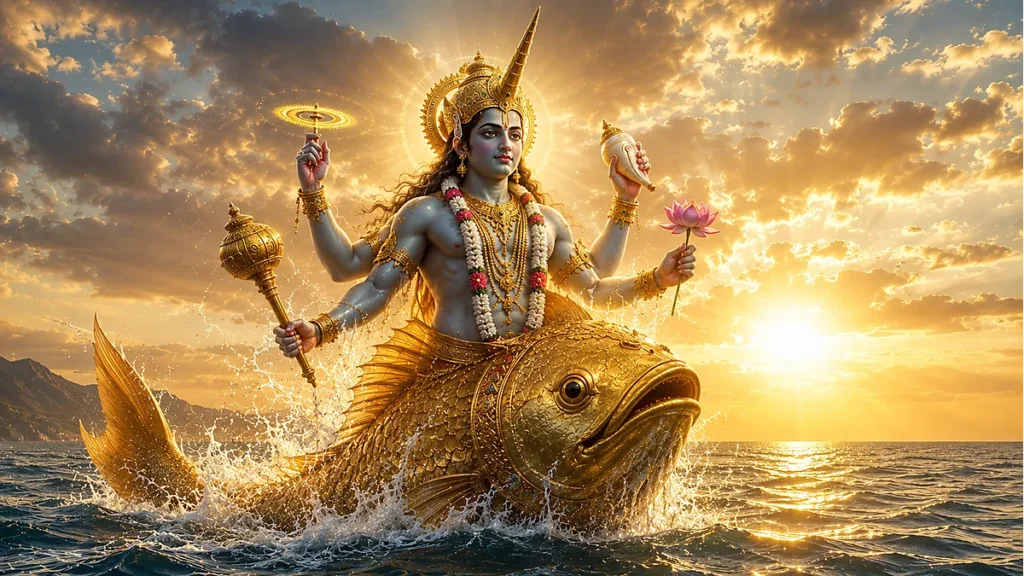
As the fish enters the ocean, it reveals its true form. A golden body of immeasurable size. The upper body of the four-armed Lord, holding śaṅkha, cakra, gadā, and padma. A single great horn rising from its head.
The fish speaks now with the voice of the universe.
“O Satyavrata, I am Viṣṇu, the Lord of preservation. In seven days, a great deluge will come. It will flood the three worlds. Build a great ship. Place in it the seeds of every living plant, every creature, and the seven great Ṛṣis. Bring the sacred texts. When the waters rise, I will come to you. Tie the ship to my horn with the serpent Vāsuki as the rope. I will carry you through the flood. And as we traverse the waters, I will speak to you the highest wisdom — the truth about the Self, the cosmos, and the Supreme.”
Satyavrata follows every instruction with total faith.
Seven days pass. The first rains come. Then the floods. Then the deluge that the tradition calls the mahā-pralaya — the great dissolution. The waters rise over the forests, over the mountains, over the cities, over the kingdoms, until nothing remains visible but an infinite expanse of dark water in every direction.
And through that darkness, from the deep, rises the great golden fish.
Satyavrata ties the ship to the horn with Vāsuki as the rope. The fish begins to move through the water — slowly at first, then with the steady, unhurried power of divine purpose.
For days and nights, through the rolling catastrophe of cosmic dissolution, the fish draws the ark. And as they move, the Lord speaks.
He teaches Satyavrata about the nature of Brahman — the Supreme Reality that underlies all existence. He teaches about Karma, Ātman, Dharma, and the means by which the soul can be liberated from repeated cycles of birth and death. These teachings, preserved and compiled, become the text known as the Matsya Purāṇa — wisdom revealed across the waters of the end of the world.
When at last the waters recede and new land emerges, Satyavrata is installed as Vaivasvata Manu — the progenitor of the present cycle of humanity. His survival is not personal luck. It is a cosmic re-seeding. He is the root from which all subsequent human civilization, in this great cycle, grows.
The Hayagrīva Episode — Reclaiming Lost Knowledge
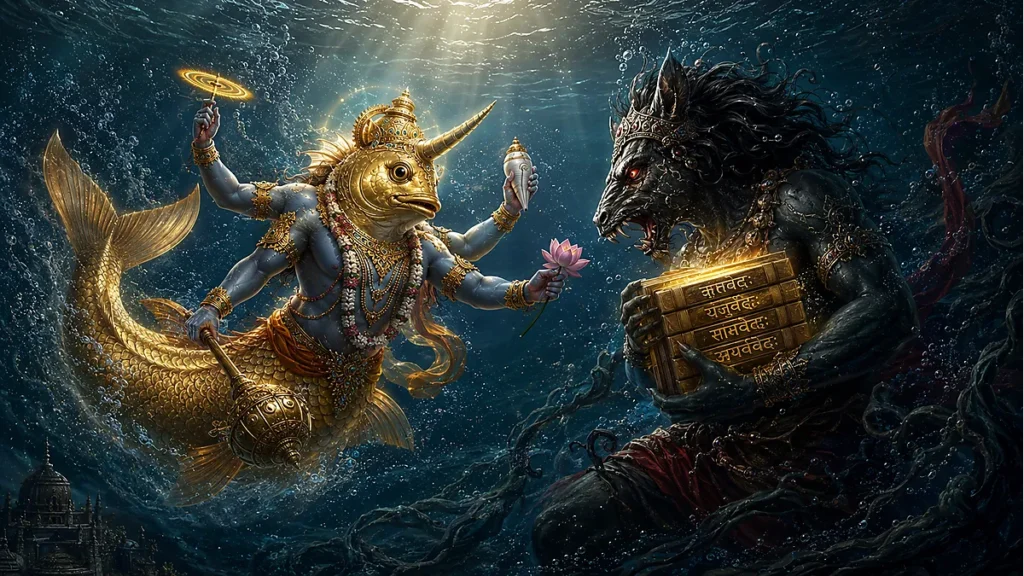
The Bhāgavata Purāṇa reveals that Matsya’s mission has two distinct parts — one visible to Manu, and one happening simultaneously in the depths of the cosmic ocean.
At the beginning of this cycle, as the creator Brahmā falls into the deep sleep of pralaya, a demon named Hayagrīva — a creature with a horse’s head, born from the waters of cosmic darkness — steals the four Vedas from Brahmā’s sleeping presence.
Without the Vedas, the new creation that Brahmā will attempt at dawn will be blind and formless. The fundamental knowledge required to sustain dharma in the new world will be lost.
Matsya slays Hayagrīva beneath the waves.
The four Vedas are restored to Brahmā as he awakens to begin the new creation.
This is the hidden layer of the story that is easy to overlook but impossible to underestimate. Matsya does not only save living beings. He saves knowledge — the accumulated spiritual and practical understanding that makes civilization and dharma possible.
The body is saved in the ark. The soul of civilization is saved in the Vedas.
The descent of Matsya is therefore a rescue on two levels simultaneously: the biological and the spiritual.
The Life Lessons — What Matsya Teaches Every Generation
The story of Matsya, when understood as living spiritual teaching rather than ancient narrative, contains a remarkable depth of practical wisdom.
Core Life Lessons from the Matsya Avatāra
| Teaching | What it looks like in the story | What it means in your life |
| Compassion precedes understanding | Satyavrata protects the fish before knowing who or what it is | Grace often arrives in forms too small to impress us |
| Obedience to divine instruction | Manu follows exactly what the fish prescribes | Spiritual transformation requires acting on inner guidance with precision |
| Preservation before expansion | The ship is filled with seeds, texts, and life before setting out | Before we build something new, we must protect what is essential |
| Knowledge is the real inheritance | The Vedas are saved as carefully as living beings | A civilization without wisdom cannot survive its own rescue |
| Divine support requires sincere effort | Manu builds the ship himself; the fish guides but does not build | Grace enables; effort is still required |
The first and most important lesson of Matsya is also the most counter-cultural in modern life: the most important things to protect are the things we cannot see.
Seeds. Knowledge. Dharma. The invisible threads that connect one generation to the next.
Satyavrata could have filled his ark with gold and armies. He fills it with seeds, sages, and sacred texts. That is wisdom. That is the teaching of Matsya.
The second great lesson is about divine disguise. The Lord arrives as a tiny fish. Not impressive. Not immediately recognizable. This is the pattern of spiritual life that every seeker knows from their own experience: the most transformative encounters often arrive without announcement.
The Lord does not always come as a king. Sometimes He comes as a small fish in your morning water.

The Science of Matsya — Evolution, Floods, and Cosmic Memory
Here is a detail that never ceases to astonish those who encounter it for the first time.
The first Avatāra is a fish. And science tells us that the first vertebrate creatures on Earth — creatures with spines, organized nervous systems, and the biological architecture that would eventually produce all complex animal life including human beings — first appeared in the sea approximately 518 million years ago during what the fossil record calls the Cambrian Explosion.
New fossil evidence from China published in Nature in 2026 describes vertebrate fossils from the Cambrian period as “some of the earliest known vertebrates,” appearing approximately 518 million years ago in the ancient ocean.
Wikipedia’s entry on the evolution of vertebrates confirms: “The earliest known vertebrates belong to the Chengjiang biota and lived about 518 million years ago.” These creatures included Haikouichthys and Myllokunmingia — small, fish-like beings with a notochord, rudimentary vertebrae, and a defined head, but without jaws.
This is not coincidence that requires forced explanation. It is the natural resonance between what the ancient seers perceived in deep meditative insight and what modern science has discovered through geological investigation.
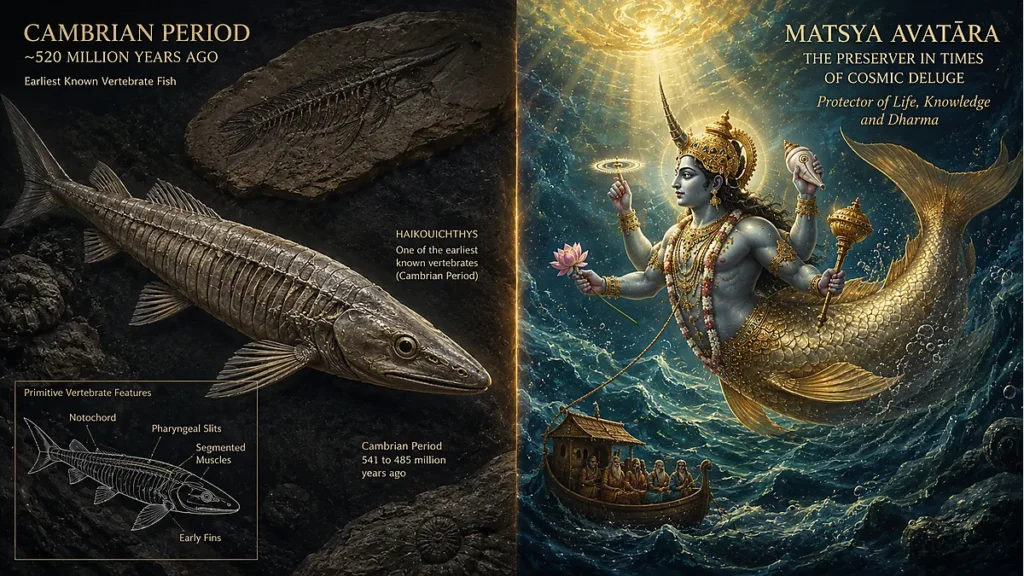
The sequence of the Daśāvatāra maps, in extraordinary parallel, the actual sequence of evolutionary emergence on Earth:
- Matsya (Fish) — aquatic vertebrate life
- Kūrma (Tortoise) — amphibious life emerging from water onto land
- Varāha (Boar) — land mammals
- Narasiṃha (Man-Lion) — the transitional creature between beast and human
- Vāmana (Dwarf) — early upright hominid
- Paraśurāma — early human, still close to violent nature
- Rāma — fully civilized, ethically disciplined human
- Kṛṣṇa — the psychologically complex, spiritually realized human
- Buddha — the renunciate, turning inward from the world
- Kalki — the future transformation
The ancient sages, in their states of deep meditative perception, mapped the entire arc of biological and spiritual evolution — and placed a fish at the beginning because that is, in fact, where vertebrate life begins.
The flood narrative also carries scientific resonance. The tradition is not only speaking of a mythological deluge. It is speaking of the periodic mass extinctions — the great filters through which life has passed — that have repeatedly destroyed most of what existed but preserved the threads from which new flourishing emerged.
The Permian extinction, approximately 252 million years ago, destroyed an estimated 96 percent of all marine species and 70 percent of terrestrial vertebrate species. Life survived. The essential threads carried forward. The story continued.
Matsya is the cosmic principle of preservation through catastrophe — the divine intelligence that ensures that when the world reaches its reset point, the essential biological and spiritual inheritance of life is not lost.
Sanskrit Verses — The Wisdom of the Ancient Seers
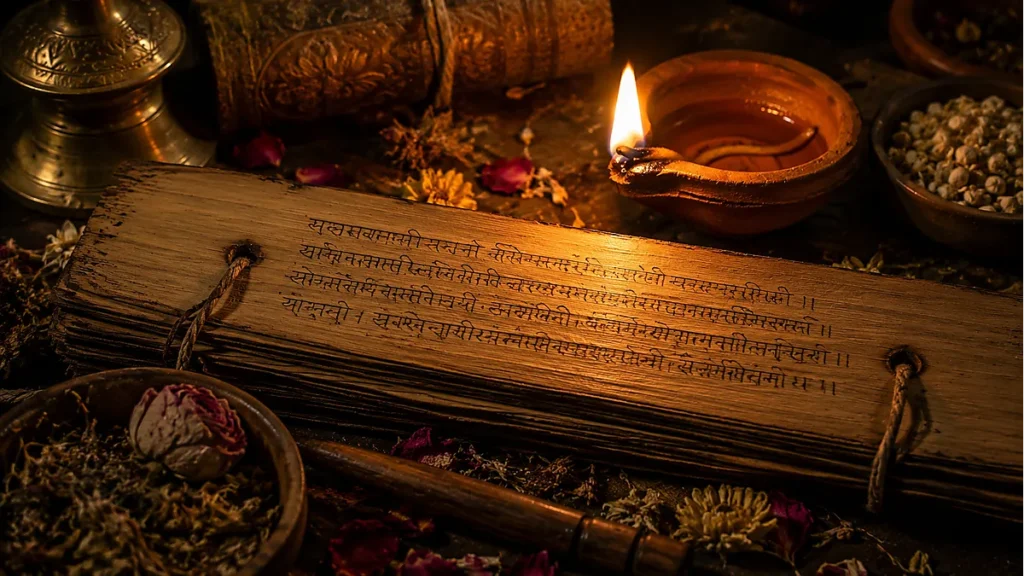
The tradition has preserved the teaching of Matsya in several classic shlokas. Here are the most important ones, in the prescribed format.
Verse One — The Declaration of Divine Purpose
Devanagari:
यदा यदा हि धर्मस्य ग्लानिर्भवति भारत ।
अभ्युत्थानमधर्मस्य तदात्मानं सृजाम्यहम् ॥
IAST:
yadā yadā hi dharmasya glānir bhavati bhārata |
abhyutthānam adharmasya tadātmānaṃ sṛjāmy aham ||
Source: Bhagavad Gītā, Chapter 4, Verse 7
Word-by-word meaning:
- यदा यदा (yadā yadā) — whenever, whenever
- हि (hi) — indeed, certainly
- धर्मस्य (dharmasya) — of dharma, of righteousness
- ग्लानिः (glāniḥ) — decline, weakening
- भवति (bhavati) — occurs, manifests
- भारत (bhārata) — O descendant of Bharata
- अभ्युत्थानम् (abhyutthānam) — rise, ascendance
- अधर्मस्य (adharmasya) — of adharma, unrighteousness
- तदा (tadā) — then, at that time
- आत्मानम् (ātmānam) — Myself, My own Self
- सृजामि (sṛjāmi) — I manifest, I create
- अहम् (aham) — I, the Lord
Simple translation: “Whenever there is a decline of dharma and a rise of adharma, O Arjuna, at that time I manifest Myself.”
Practical takeaway: The Matsya Avatāra is the first proof of this eternal promise. The deluge represents the darkest moment of the cosmic cycle — and it is exactly in that darkness that the Lord chooses to appear. For the devotee facing difficulty, this verse is not philosophy. It is a promise.
Verse Two — The Threefold Mission
Devanagari:
परित्राणाय साधूनां विनाशाय च दुष्कृताम् ।
धर्मसंस्थापनार्थाय सम्भवामि युगे युगे ॥
IAST:
paritrāṇāya sādhūnāṃ vināśāya ca duṣkṛtām |
dharma-saṃsthāpana-arthāya sambhavāmi yuge yuge ||
Source: Bhagavad Gītā, Chapter 4, Verse 8
Word-by-word meaning:
- परित्राणाय (paritrāṇāya) — for the protection, for the salvation
- साधूनाम् (sādhūnām) — of the pious, of the saintly
- विनाशाय (vināśāya) — for the annihilation, for the destruction
- च (ca) — and
- दुष्कृताम् (duṣkṛtām) — of the wicked, of the evil-doers
- धर्मसंस्थापनार्थाय (dharma-saṃsthāpana-arthāya) — for the purpose of re-establishing dharma
- सम्भवामि (sambhavāmi) — I descend, I appear
- युगे युगे (yuge yuge) — age after age, epoch after epoch
Simple translation: “To deliver the righteous, to annihilate the wicked, and to re-establish the principles of dharma, I appear age after age.”
Practical takeaway: In the Matsya Avatāra, we see all three dimensions of this mission simultaneously: Satyavrata and the sages are protected; the demon Hayagrīva is destroyed; and the Vedas — the foundation of dharma — are restored. The verse is not a theory. It is illustrated in living narrative.
Verse Three — The Offering to the Lord Who Crosses the Ocean
Devanagari:
नमस्ते मत्स्यरूपाय पालितैकाम्भसे नमः ।
विश्वसंहारकर्त्रे च पुनः संस्थापकाय च ॥
IAST:
namaste matsyarūpāya pālita-ekāmbhase namaḥ |
viśva-saṃhāra-kartre ca punaḥ saṃsthāpakāya ca ||
Source: Traditional devotional invocation to the Matsya Avatāra (Source: Matsya Purāṇa devotional tradition; exact verse location varies across editions)
Word-by-word meaning:
- नमस्ते (namaste) — I bow to You
- मत्स्यरूपाय (matsya-rūpāya) — who took the form of a fish
- पालित (pālita) — who protected, who preserved
- एकाम्भसे (ekāmbhase) — upon the single, undivided ocean
- विश्वसंहारकर्त्रे (viśva-saṃhāra-kartre) — to the one who conducts the dissolution of the world
- पुनः संस्थापकाय (punaḥ saṃsthāpakāya) — and again, the one who re-establishes
- च (ca) — and
Simple translation: “Salutations to the one who took the form of a fish and protected the world upon the single ocean — who is both the agent of dissolution and the restorer of life.”
Practical takeaway: This verse encodes the complete theological insight of the Matsya Avatāra: the Lord who ends a cycle is the same Lord who begins the next one. Endings and beginnings are both His grace.
Sacred Geography — Temples of Matsya Across India
The tradition of Matsya is not confined to scripture. It is alive in stone, worship, and pilgrimage across the subcontinent.
Matsya Nārāyaṇa Temple, Uthandi, Chennai
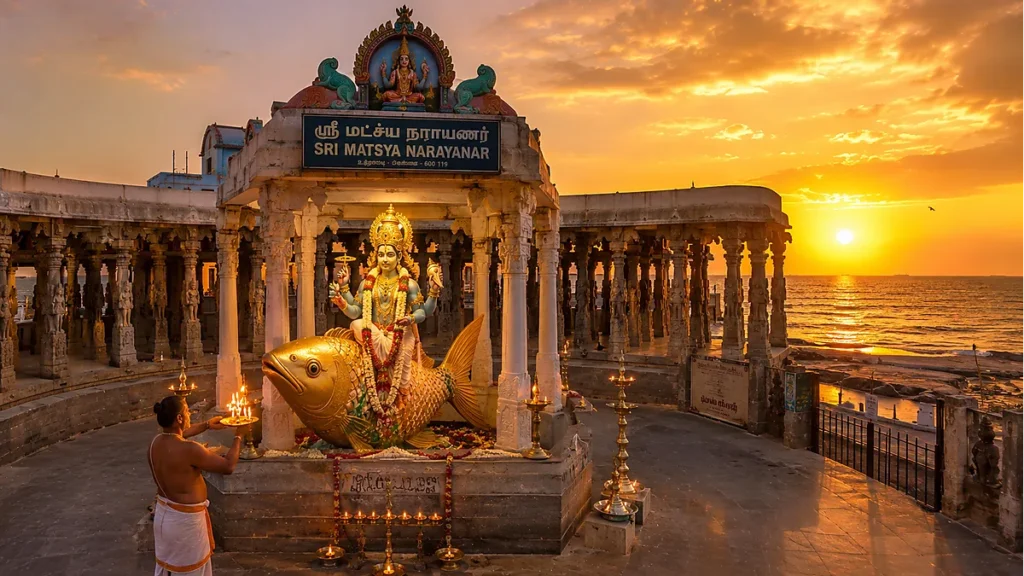
This beautifully situated open-air temple stands by the sea on the East Coast Road, approximately 25 kilometres from Chennai, near Mahabalipuram. The temple was built by Chinmaya Tarangini and houses a remarkable large statue of Matsya Nārāyaṇa at its centre, surrounded by 108 stone pillars inscribed with the 1008 names of Viṣṇu.
The placement of this temple by the ocean is deeply intentional. The ocean is the domain of Matsya. To worship the Lord at the edge of the sea — especially at the hour of sunset āratī, when the ocean glows behind the deity’s form — is to inhabit the original landscape of the Avatāra’s appearance.
Pilgrims describe sitting in the open courtyard during evening prayer, with the sound of waves mixing with the bells of worship, as one of the most quietly profound experiences available at any Hindu sacred site in South India.
Practical pilgrimage note: The temple is easy to reach from Chennai city, accessible en route to Mahabalipuram or Pondicherry. Best visited at dawn or dusk for the most meditative atmosphere.
Śrīnivāsapura Matsya Nārāyaṇa Temple, Karnataka
This dedicated Matsya temple in Śrīnivāsapura, Karnataka preserves the rare iconographic tradition of Viṣṇu in His fish form as the primary deity — a devotional emphasis that keeps the theological meaning of the first Avatāra at the centre of daily worship.
Mahabalipuram, Tamil Nadu
The ancient shore temples and rock-cut cave shrines at Mahabalipuram contain imagery associated with the Avatāra tradition in their most ancient carved stone form. The ocean setting connects this sacred landscape naturally to the Matsya narrative. Pilgrims who visit these structures walk through the earliest surviving stone record of Vaishnava sacred art in South India.
Mathura and the Vraja Region
While primarily associated with the Kṛṣṇa Avatāra, the Vraja region’s temple tradition honours all ten Avatāras in festival cycles. The Daśāvatāra representation in major Vaiṣṇava temple complexes includes detailed panels of the Matsya story and provides a comprehensive visual pilgrimage through the entire sequence.
Everyday Practice — Bringing Matsya Into Your Life
How does the Matsya Avatāra speak to the life of a modern person who will not necessarily journey to any of these sacred sites this week, but is reading these words on a phone or laptop between their daily responsibilities?
The teaching of Matsya enters ordinary life through four simple principles.
First: Protect what cannot be replaced. Every human life contains its own equivalent of Manu’s ark — the relationships, values, and commitments that are the seeds of everything else. Before we optimize or expand, we must ask: what is essential? What must survive no matter what? The Matsya principle is the practice of identifying and protecting those irreplaceable things.
Second: Recognize divine help in humble forms. The Lord arrived as a fish that fit in a palm. In your own life, the guidance that will carry you through your most difficult period may not announce itself impressively. It may arrive as a small book, a quiet conversation, a moment of unexplained clarity. Do not require signs to be spectacular before you receive them.
Third: Trust the process of growth through care. Satyavrata carried the fish from jar to tank to river to ocean — attending to its needs at every stage. The spiritual life is not very different. Grace given a little care becomes grace that fills the ocean.
Fourth: Preserve wisdom as carefully as you preserve life. The Vedas and the seeds are equally precious in Manu’s ark. In your own life, this means tending to your understanding of dharma — through reading, through community, through practice — with the same seriousness you give to physical health and livelihood.
A Simple Matsya Practice for Daily Life
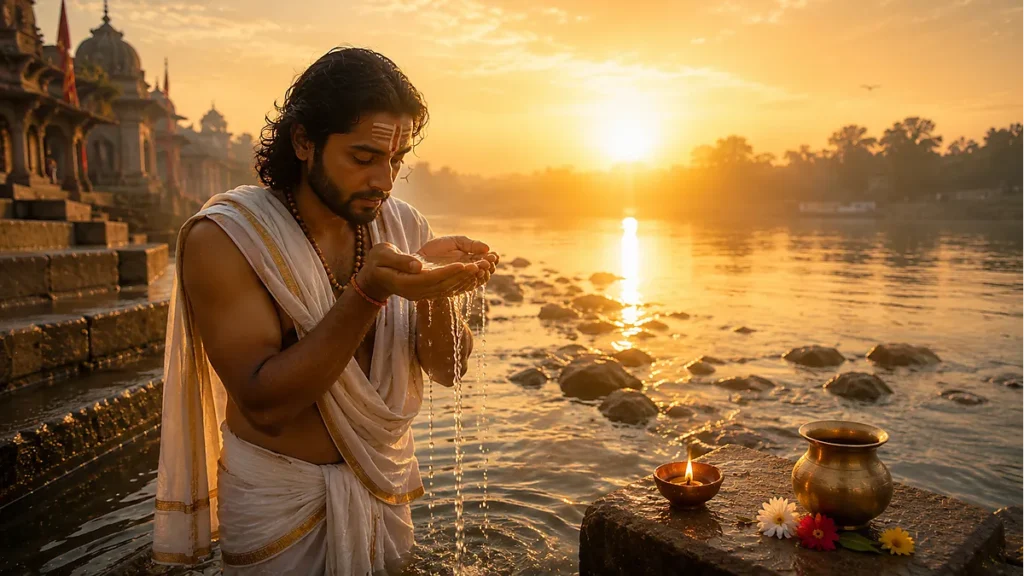
Begin the morning by placing water in your palms — as part of a simple morning ritual or while washing your face.
As the water rests in your cupped hands for a moment, remember the story of Satyavrata. A small fish. A great promise. A vast protection.
Offer the water with a simple, silent prayer:
O Lord who crossed the cosmic ocean in the form of a fish, who preserved wisdom and life in the darkest hour — protect in me what is essential. Carry forward what must not be lost. And may I recognize Your grace when it arrives, however quietly.
Then release the water. And begin your day.
This takes thirty seconds. But its inner effect, practised over months, is a gentle reorientation of the heart toward what is truly important — and a deepening sense of being held by something infinitely larger than circumstances.
The Pattern That Matsya Establishes
Every Avatāra in the Daśāvatāra sequence will carry its own unique teaching, its own crisis, its own form, and its own mission. But the Matsya Avatāra establishes the template that all the others will follow.
The pattern is always the same: the world reaches the limit of what it can bear alone. A prayer rises — sometimes from a king, sometimes from a sage, sometimes from the Earth herself. And from the side of the Divine, without delay and without drama, help arrives — in a form suited to the need of the moment.
The Lord does not always come as expected. He does not always come as impressive. But He comes.
That is the deepest assurance of the Matsya Avatāra, and it is the living heart of the entire Avatāra doctrine.
The sacred waters that have flowed since before this universe formed, the fish that carries the ark, the voice that speaks wisdom across the flood — all of them are the same.
All of them say the same thing, in the language the human heart has always recognized:
You are not alone in the water. Hold what is precious. I am here.
FREQUENTLY ASKED QUESTIONS
Q1. Who is Matsya Avatar?
Answer: Matsya Avatar is the first incarnation of Lord Vishnu in the Dashavatara. He appeared as a divine fish to save Manu, preserve life, and protect sacred knowledge during the great flood.
Q2. Why did Vishnu take the form of a fish?
Answer: Vishnu appeared as Matsya because the flood occurred during a cosmic dissolution when all existence was covered by water. The fish form allowed Him to guide Manu’s ark and preserve creation.
Q3. What is the story of Matsya Avatar?
Answer: Matsya Avatar appeared before King Satyavrata (Manu), warned him about a coming flood, instructed him to build an ark, and safely guided life and sacred knowledge through the cosmic deluge.
Q4. Who was Manu in the Matsya story?
Answer: Manu, also known as Satyavrata or Vaivasvata Manu, was the righteous king chosen to preserve life and begin the next cycle of humanity after the flood.
Q5. Did Matsya Avatar save the Vedas?
Answer: According to several Purāṇic traditions, Matsya Avatar recovered the Vedas after they were stolen by the demon Hayagriva, ensuring that sacred knowledge survived into the new creation.
Q6. What does Matsya Avatar symbolize?
Answer: Matsya Avatar symbolizes preservation, divine guidance, protection during times of crisis, and the safeguarding of wisdom across generations.
The Path Ahead
With the Matsya Avatāra, we have entered the vast, sacred story that the Daśāvatāra tells. We have met the Lord in His most elemental form — a being of the primordial water, a preserver of life, a destroyer of ignorance, a teacher of truth.
In the next article in this series on prayagtourism.com, we will rise from the water to the turning point of cosmic creation: the great Kūrma Avatāra — Lord Viṣṇu in the form of a tortoise, who becomes the foundation beneath the cosmic mountain during the churning of the ocean of milk, that the gods and demons might together win the nectar of immortality.
The story goes deeper. The teaching grows richer. The mercy of the Lord finds ever more beautiful forms.
Hari Om Tat Sat.
This article is part of the Daśāvatāra Series on prayagtourism.com. Series: The Divine Descent — Understanding the Mystery of the Avatāra in Sanātana Dharma.
Series Navigation
| Avatāra | Article Status |
| Matsya (Fish) | ✅ Current Article |
| Kūrma (Tortoise) | Coming Soon |
| Varāha (Boar) | Coming Soon |
| Narasiṃha (Man-Lion) | Coming Soon |
| Vāmana (Dwarf) | Coming Soon |
| Paraśurāma | Coming Soon |
| Rāma | Coming Soon |
| Kṛṣṇa | Coming Soon |
| Buddha | Coming Soon |
| Kalki | Coming Soon |