

An offering of water, an act of love, and a conversation that crosses the boundary of death
Table of Contents
The People We Never Knew
Think for a moment about your grandfather’s grandfather.
You almost certainly do not know his name. You have never seen his face. You know nothing about what he looked like, what he laughed at, what he was afraid of, what kind of person he was on an ordinary Tuesday afternoon in his life. And yet — without him, without the specific choices he made and the life he lived and the children he raised — you would not exist. Not you, specifically. Not this particular version of a human being who is reading these words right now.
Go back further. Your great-great-great-grandmother. A woman who lived perhaps a century and a half ago, who never heard your name, who could not have imagined the world you inhabit, who carried her own quiet sorrows and small joys through decades that have now completely vanished — and who is, nonetheless, one of the direct reasons you are alive. Her body, her choices, her perseverance through whatever difficulties her life contained — all of it is part of the invisible chain that ends, for now, with you.
We are, all of us, the latest link in a chain of lives that stretches back further than we can imagine. And most of the time, we never think about it.
Sanatana Dharma noticed this — the human tendency to live as if we appeared out of nowhere, as if we are self-made, as if the vast river of generations that carried us here stopped flowing the moment we arrived on the bank and stepped out. And with great gentleness, and great wisdom, it created a practice to correct this: not as an obligation to be discharged, not as a fearful ritual performed to avoid misfortune, but as an act of genuine love — the love of a child for parents they have never met, the gratitude of a living being for the long chain of living beings whose accumulated sacrifices made this life possible.
This practice is called Tarpaṇa in Hinduism.
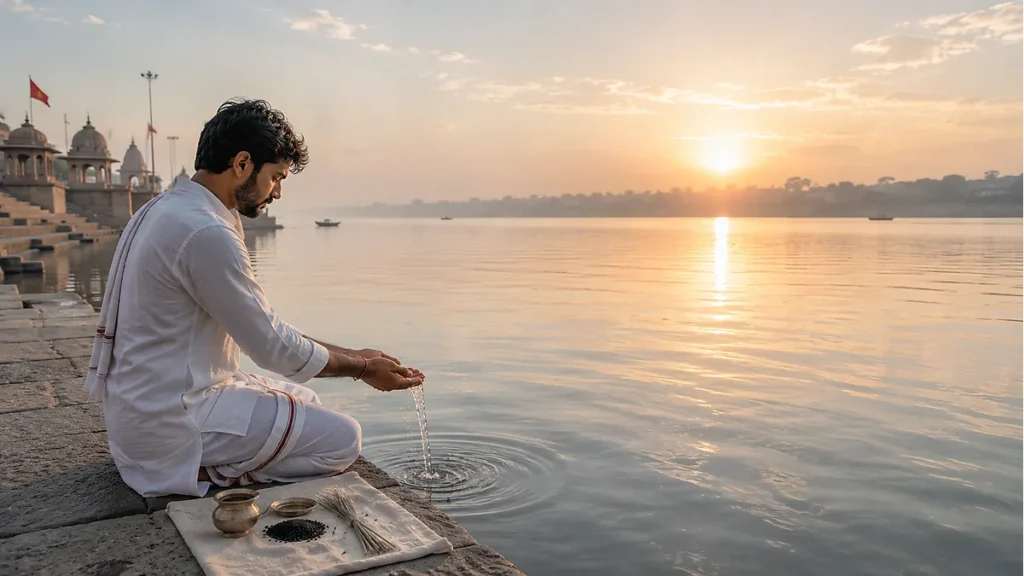
What Is Tarpaṇa? A Word That Means Satisfaction
The word Tarpaṇa (तर्पण — Tarpaṇa) comes from the Sanskrit root tṛp — meaning to satisfy, to fulfill, to quench a deep thirst. When you perform Tarpaṇa, you are not performing a magical ritual to remove curses or appease angry spirits. You are doing something much simpler, much more human, and much more profound: you are satisfying a thirst.
The thirst of the Devas — the cosmic forces of nature — to be recognized rather than exploited.
The thirst of the Ṛṣis — the great sages and teachers — to be remembered rather than forgotten.
And the thirst of the Pitṛs — your ancestors — to be held in loving memory, to know that the thread connecting them to the living world has not been cut.
The Vedic Smṛtis describe Tarpaṇa with a beautiful and immediate clarity: when a child cups water in their palms and lets it flow in remembrance and gratitude, that flow reaches the ones it is meant for — not through a supernatural postal system, but through the most natural channel in existence: the continuity of love.
Three Kinds of Tarpaṇa in Hinduism
The classical Tarpaṇa is offered to three categories of beings — corresponding, beautifully, to the three great Ṛṇas (sacred debts) that every human being carries from birth.
Deva Tarpaṇa — Gratitude to the Cosmos
The first offering honors the Devas (देव — Deva, the cosmic forces: the sun, the rain, the wind, the fire, the earth beneath our feet). These are not distant mythological figures. They are the forces that have been maintaining the conditions necessary for your life — and every life — since before this universe formed its current shape.
When we pour water in remembrance of these forces — when we pause, however briefly, to acknowledge that we live inside a system of extraordinary generosity that we did nothing to earn — we are performing the most basic and most honest act of spiritual intelligence. I received. I remember. I am grateful.
Ṛṣi Tarpaṇa — Gratitude to the Keepers of Knowledge
The second offering honors the Ṛṣis (ऋषि — Ṛṣi, the sages and seers) — the ones who spent their entire lives in the pursuit and transmission of truth, so that those who came after them would not have to begin from nothing. Every piece of genuine wisdom you have ever encountered — in scripture, in a teacher’s words, in a book that changed how you saw the world — traces its lineage back to someone who sacrificed comfort and ordinary worldly life to perceive something true and pass it on.
The Ṛṣi Tarpaṇa is gratitude for the fact that you were not born into complete darkness — that a vast library of human understanding was already waiting for you when you arrived, built by people whose names you will never know.
Pitṛ Tarpaṇa — Gratitude to Your Ancestors
The third and most personal offering honors the Pitṛs (पितृ — Pitṛ, literally fathers, but meaning all ancestors — all those who gave you life and who have completed their journey).
This is the offering that carries the most emotional weight. Because when you pour water for your Pitṛs, you are not offering to an abstract category. You are offering to specific people — people who held you, or who held the people who held you. People who worked, worried, sacrificed, hoped, loved, and endured so that their children might have a slightly better life than they did. People who are now gone — and who, in the Dharmic understanding, carry forward in the subtle realm a thread of connection to the living that remains real and nourishing as long as it is tended.
Traditional Smṛti literature expresses this idea beautifully:
Devanagari Script:
तृप्तिं प्रयान्ति पितरः पिण्डोदकक्रियाः कृता।
तस्मात् पिण्डोदकं दद्यात् स्वधाकार्यं समाहिता॥
IAST Transliteration:
Tṛptiṃ prayānti pitaraḥ piṇḍodaka-kriyāḥ kṛtā |
Tasmāt piṇḍodakaṃ dadyāt svadhā-kāryaṃ samāhitā ||
Word-by-Word Meaning:
- तृप्तिम् (tṛptim) — satisfaction, fulfillment
- प्रयान्ति (prayānti) — they attain, they receive
- पितरः (pitaraḥ) — the ancestors
- पिण्डोदक (piṇḍodaka) — offerings of rice ball and water
- क्रियाः कृता (kriyāḥ kṛtā) — when the acts are performed
- दद्यात् (dadyāt) — one should give
- समाहिता (samāhitā) — with focused mind and devotion
Simple Meaning:
“The ancestors attain deep satisfaction when offerings of water and remembrance are made to them. Therefore, perform these sacred acts with sincerity and devotion.”
What Tarpaṇa Does for the Living
Here is what the tradition understands — and what modern psychology, in its own language, is beginning to confirm: your ancestors live within you.
Not as ghosts. As genetics, as memory, as patterns — as the accumulated inheritance of every life that preceded yours, carried in your body, your instincts, your emotional tendencies, your particular gifts and your particular wounds. The fear that has no clear cause. The capacity for resilience that appears in difficult moments before you even ask for it. The love of certain kinds of music, or certain landscapes, or certain ways of being — inherited, passed down, alive in you whether you acknowledge it or not.
When you remember your ancestors consciously — when you sit at a river’s edge and pour water and speak their names into the current — you are not doing something passive. You are actively tending a relationship. You are saying, to the parts of yourself that came from them: I see you. I honor you. I carry you forward with awareness rather than with ignorance.
And the tradition says something more: that this act of remembrance brings śānti — peace — not only to the ancestors but to the person performing it. Because the grief we carry for those we have lost, the guilt we may feel about relationships left unresolved, the sense of disconnection from our own roots — all of these are forms of unfinished relationship. Tarpaṇa offers a form of completion, a ritual closure that acknowledges the relationship, honors it, and releases it into something wider than personal history.
People who have performed Tarpaṇa at the Saṅgam in Prayāgarāja — even people who came primarily as curious tourists — often describe something unexpected: a quieting of something unnamed that they had been carrying without knowing they were carrying it. A sense of lightness. An unexpected welling of feeling. The tears that come from a place beneath thought.
This is not superstition. This is the human being recognizing, in the oldest and most reliable way available, its own deep continuity with those who came before.
How to Perform Tarpaṇa — Very Simply
You do not need elaborate preparations. You do not need a pandit or an elaborate set of ritual items to begin. What you need is water, a quiet moment, and sincerity.
The most accessible way to begin:
1. Find water. If you are near a river — especially a sacred river — that is ideal. The Gaṅgā, the Godāvarī, the Kṛṣṇā, the Kāverī — all carry a particular quality of sanctity that the tradition has recognized for thousands of years, and that anyone who has stood at their banks at dawn has felt directly. If you are not near a river, a clean vessel of water at home is entirely sufficient. The water itself — simple, clear, responsive to gravity, the same substance that makes up most of your own body — is the offering.
2. Sit facing south (the traditional direction associated with the ancestors and the realm of Yama, the lord of dharma and death) or facing the river if you are at a sacred confluence. Remove your footwear. This is a threshold moment — you are stepping into relationship.
3. Cup water in your palms. Hold it gently. Feel its weight. Feel its temperature. This is water from the same source that has been flowing since the beginning of rivers — through the hands of every person who has ever stood at a river’s edge and poured an offering with love.
4. Speak the names. Aloud or silently, speak the names of those you are remembering. Your father, if he has gone. Your mother. Your grandparents — by name if you know them, or simply as Pitāmaha, Pitāmahī (grandfather, grandmother) if you do not. The sages who gave you knowledge. The unnamed ones before them — the ones whose names were lost but whose lives made yours possible.
5. Let the water flow. Slowly, from the Pitṛ Tīrtha — the part of the palm near the little finger — let the water pour forward. As it falls, hold one thought: I offer this with gratitude. May you be at peace. May you know that you are not forgotten.
6. Sit in silence for a moment. Do not rush away. Let the act settle. Let whatever feeling arises — and sometimes it is surprisingly deep — simply be present. This moment of quiet after the offering is as important as the offering itself.
That is Tarpaṇa in its most essential form. No complexity required. Only presence, only water, only the willingness to remember.
Why Prayāgarāja Is the Supreme Place for This Practice
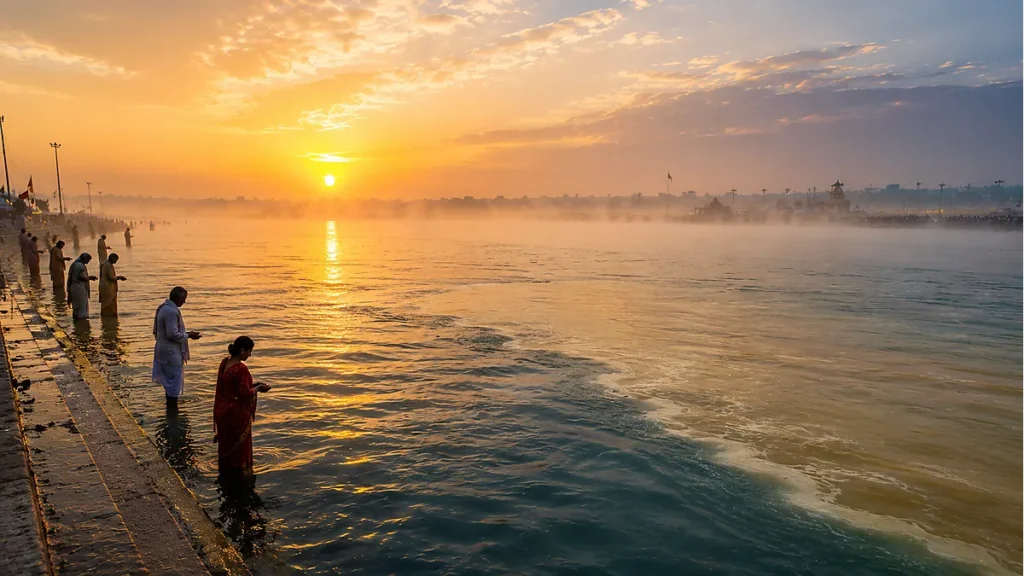
Of all the sacred sites in India where Tarpaṇa and Śrāddha are performed, Prayāgarāja holds the highest place — and has held it for as long as the tradition has existed.
The reason is the Triveni Saṅgam (त्रिवेणी संगम — Triveni Saṅgam, the confluence of three rivers): the Gaṅgā, the Yamunā, and the invisible, underground Sarasvatī, meeting at a single point in an act of cosmic convergence that the tradition understands as uniquely powerful.
The Purāṇas state that Tarpaṇa performed at the Saṅgam carries merit equivalent to a thousand similar offerings elsewhere — not because the arithmetic of ritual credit works like a bank account, but because this place carries, accumulated over millennia of human longing and prayer, a quality of atmosphere that opens the heart in ways that are difficult to explain and impossible to deny once experienced.
Every year during Pitṛ Pakṣa (पितृ पक्ष — the fifteen-day fortnight of ancestral remembrance, in the month of Āśvina), hundreds of thousands of people travel to Prayāgarāja from across India and from every corner of the world. They come not for tourism, not for entertainment, but for this: to stand at the water’s edge at dawn, to cup the sacred confluence in their palms, and to pour it slowly, prayerfully, in the direction of those who are gone.
Watch them sometime. Watch the faces of the people performing Tarpaṇa at the Saṅgam Ghāṭ as the sun rises and turns the water gold. Watch the grief that moves across faces, and then the quiet. Watch what happens in the moment when the water leaves the palms and the eyes close. Something passes. Something settles. Something that was held too long and too tightly is gently, gratefully released.
That is Tarpaṇa. That is what it has always been.
Gratitude That Crosses Time

Here is the deepest understanding the tradition offers — and it is simple enough to carry in the heart without any Sanskrit:
You are not the beginning of the story. You are a chapter in the middle of a very long book.
The story began long before you and will continue long after. Every person who came before you was a chapter, just as you are. They lived fully, loved imperfectly, struggled genuinely, and passed something forward — even if they never knew they were doing it. Even if they never knew your name. Even if the only thing they passed forward was the simple fact of your existence, which is, when you sit with it honestly, one of the most extraordinary gifts imaginable.
Tarpaṇa is the act of pausing, in the middle of your own chapter, to turn back and acknowledge the chapters before. To say: I know I did not get here alone. I know there are names I do not know, faces I have never seen, lives I can only imagine — and all of them contributed, in ways I cannot measure, to the fact that I am here.
To say that — with water, in the presence of a river, in the presence of the sacred — is not a small thing. It is the act of a person who has understood one of the most important truths available to a human being:
We are, always and everywhere, held. We are supported by more than we can see. And the most honest, most healing, most quietly powerful response to this reality — the response that the tradition has been teaching for five thousand years — is not entitlement, not indifference, not forgetting.
It is gratitude.
Poured out, slowly, from cupped palms, at the edge of a river, at the meeting of three sacred waters, at dawn, into the current that has been flowing since before any of us were born — and will be flowing long after all of us are gone.
Frequently Asked Questions About Tarpana
Q1. What is Tarpaṇa in Hinduism?
Tarpaṇa is a Hindu ritual of offering water with prayers and remembrance to ancestors, sages, and divine forces as an act of gratitude and spiritual connection.
Q2. Why is Tarpaṇa performed during Pitṛ Pakṣa?
Pitṛ Pakṣa is traditionally believed to be the sacred fortnight when ancestors are especially remembered through offerings, prayers, and acts of gratitude.
Q3. Can Tarpaṇa be performed at home?
Yes. Tarpaṇa can be performed at home using clean water, sincere remembrance, and simple prayers, even without elaborate ritual arrangements.
Q4. Why is Prayagraj Sangam important for Tarpaṇa?
The Triveni Sangam at Prayagraj is considered one of Hinduism’s holiest confluences, where Tarpaṇa and Śrāddha rituals are believed to carry exceptional spiritual merit.
Q5. Which direction should one face during Tarpaṇa?
Traditionally, one faces south during Pitṛ Tarpaṇa, as the south is associated with ancestors and Yama in Hindu ritual traditions.
Q6. What is offered during Tarpaṇa?
Water is the primary offering, often accompanied by sesame seeds, prayers, and remembrance of ancestors offered with sincerity and gratitude.
Q7. Is Tarpaṇa only for deceased parents?
No. Tarpaṇa honors the entire ancestral lineage, including grandparents, forefathers, and even unnamed ancestors remembered with gratitude.
To those who came before: I remember you. I am grateful. I am here because you were there.
May you be at peace.
⁂
References:
- https://www.sanatangyan.com/post/tarpana-in-pitru-paksha-why-offerings-of-water-and-til-hold-deep-spiritual-power
- https://prayagpandits.com/pitru-tarpan/
- https://prayagpandits.com/tarpan-vidhi/
- https://www.rudraksha-ratna.com/articles/tarpan-ritual
- https://pitrupaksha.org/step-by-step-guide-to-performing-tarpan-at-home/
- https://www.narayanseva.org/how-to-perform-tarpan-in-pitru-paksha/
- https://astrosight.ai/doshas/tarpana-transformative-power-ancestral-blessings
- https://dharmikbharatyatra.com/book-tarpan-shradh-in-prayagraj-a-sacred-ritual/
- https://temple.yatradham.org/puja/pitru-tarpan-puja-prayagraj
- https://www.poojalu.com/services/marathi/pitru-pujas-marathi/shradh-puja-in-prayagraj/
- https://www.jagran.com/uttar-pradesh/prayagraj-pitru-visarjan-2025-pitru-paksha-rituals-at-sangam-ghat-of-prayagraj-24054913.html
- https://www.astrojyotihealing.com/pitrupaksha-rituals/
- https://prayagpandits.com/tarpan-poojan-in-prayagraj/
- https://www.vedicastrologer.org/tarpana/