
Hinduism knowledge portal
Hindu Philosophy
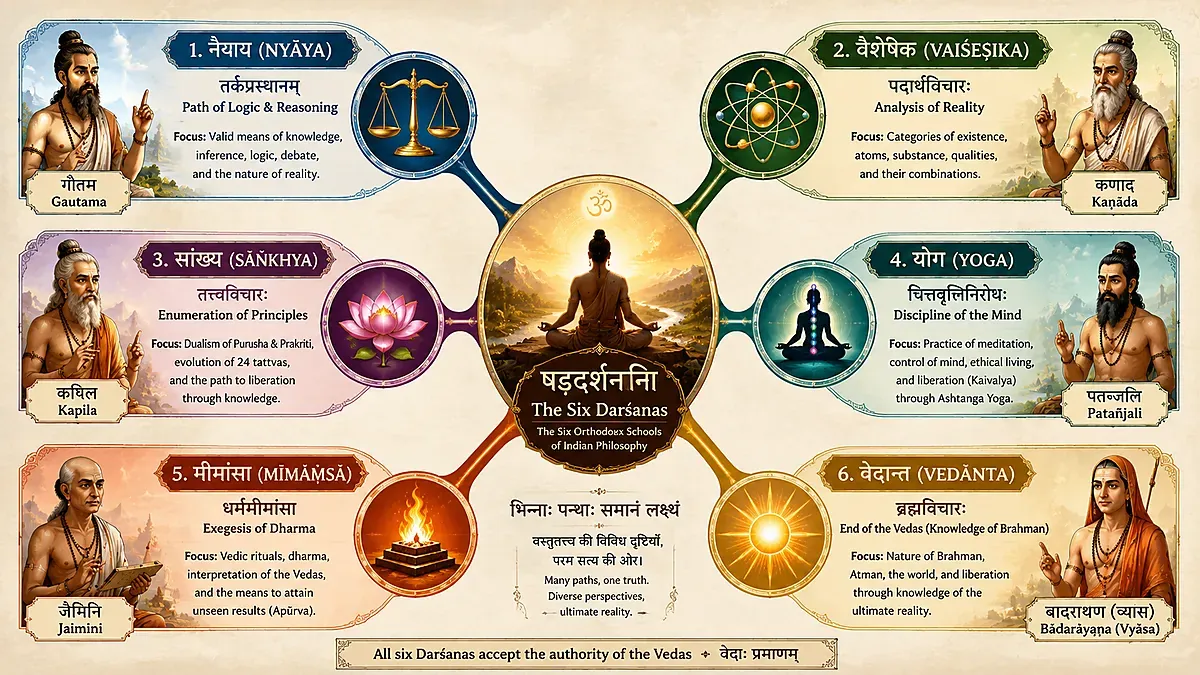
Explore the six classical darśanas, Vedānta traditions and enduring questions about self, action, knowledge and liberation.

Explore this subject
Topics and guides
Start with a short introduction, then follow the links to related topics and sources.
Advaita Vedanta
A non-dual Vedānta interpretation with its own commentarial tradition.
Ahimsa
Ahimsa is a principle of non-harming, interpreted in varying ethical contexts.
Atman
Atman refers to self or inner principle, with its status debated across schools.
Bhakti
Bhakti is devotional commitment expressed through diverse practices and lineages.
Brahman
Brahman is ultimate reality in many Upanishadic and Vedānta discussions.
Dharma
Dharma can mean duty, teaching, ethical order or a way of life depending on context.
Dvaita Vedanta
A Vedānta tradition affirming real distinction between God, selves and the world.
Jnana
Jnana is knowledge or insight pursued as a path in some Hindu traditions.
Karma
Karma concerns action and its effects; philosophical accounts differ.
Mimamsa
A school concerned with Vedic interpretation, ritual action, language and dharma.
Moksha
Moksha is liberation, understood differently among philosophical and devotional schools.
Nyaya
A philosophical school known for systematic reasoning and analysis of reliable knowledge.
Purusharthas
A framework of four aims—dharma, artha, kāma and moksha—discussed in traditional literature.
Samkhya
A philosophical tradition presenting a distinctive analysis of consciousness and material nature.
Samsara
Samsara is the cycle of birth and rebirth described in many Hindu traditions.
Vaisheshika
A school that analyses categories of reality and accounts of the natural world.
Vedanta
Interpretations of the Upanishads, Bhagavad Gita and Brahma Sutra, with multiple lineages.
Vishishtadvaita Vedanta
A qualified non-dual Vedānta tradition associated with a distinctive theology of relation.
Yoga Darshana
A philosophical discipline of practice and liberation associated with the Yoga Sutra tradition.
1. Introduction and Sanskrit Etymology
Hindu Philosophy holds a foundational place within Main Portal and Subject Landing Pages on the Prayag Hinduism Portal. In Sanskrit philology and religious studies, its meaning is rooted in precise linguistic usage: Known in Sanskrit as Darśana (from the root dṛś, ‘to see’ or ‘to experience directly’), signifying a systematic philosophical worldview and vision of truth. Across Hindu tradition, Hindu Philosophy connects scriptural revelation (Śruti), remembered tradition (Smṛti), philosophical inquiry (Darśana), ritual practice (Upāsanā), and sacred geography (Internet Encyclopedia of Philosophy – Hindu Philosophy). As one of the eleven foundational subject gateways of the Prayag Hinduism Portal, this page provides visitors, students, pilgrims, and researchers with a structured roadmap connecting primary scriptural sources with living practice across the Indian subcontinent.
2. Historical and Traditional Background
Primary scriptures and classical treatises that document and illuminate Hindu Philosophy include: Nyāya Sūtras of Gautama; Vaiśeṣika Sūtras of Kaṇāda; Sāṃkhya Kārikā of Īśvarakṛṣṇa; Yoga Sūtras of Patañjali; Mīmāṃsā Sūtras of Jaimini; Brahma Sūtras of Bādarāyaṇa; Sarvadarśanasaṃgraha. (Encyclopaedia Britannica – Hinduism Overview). Its historical trajectory spans key epochs of Indian civilization: Evolved from Vedic cosmological hymns and Upanishadic dialogues (c. 800–400 BCE) into the classical sūtra-bhāṣya period (c. 200 BCE–1200 CE) and the scholastic Navya-Nyāya and Vedāntic debates of medieval and modern India. Academic scholarship reads these primary texts alongside epigraphic, archaeological, and manuscript evidence to distinguish traditional narrative, theological commentary, and historical chronology accurately.
“Ātmā vā are draṣṭavyaḥ śrotavyo mantavyo nididhyāsitavyaḥ” — “Verily, the Self is to be seen, heard of, reflected upon, and deeply meditated upon.” (Bṛhadāraṇyaka Upaniṣad 2.4.5, Internet Encyclopedia of Philosophy – Hindu Philosophy)
3. Main Concepts and Philosophical Explanation
The core conceptual and theological structure of Hindu Philosophy has been articulated by sages (ṛṣis) and commentators (ācāryas) across centuries: Integrates rigorous epistemology (pramāṇa-śāstra—evaluating perception pratyakṣa, inference anumāna, comparison upamāna, testimony śabda, postulation arthāpatti, and non-apprehension anupalabdhi) with ontology, philosophy of language, moral causation, and soteriology. Within the pluralistic spectrum of Hinduism, Vaiṣṇava, Śaiva, Śākta, and Smārta lineages alongside the six classical darśanas (IEP – Hindu Philosophy) interpret these principles through complementary lenses of knowledge (jñāna), devotion (bhakti), righteous action (karma), and meditation (dhyāna).
4. Important Aspects, Classifications, and Editorial Scope
Key classifications, structural subdivisions, and traditional varieties of Hindu Philosophy include: Groups classical Indian thought into six orthodox (āstika) darśanas arranged in three pairs—Nyāya-Vaiśeṣika, Sāṃkhya-Yoga, and Pūrva-Mīmāṃsā / Uttara-Mīmāṃsā (Vedānta)—alongside major Vedāntic sub-schools (Advaita, Viśiṣṭādvaita, Dvaita, Bhedābheda) in dialogue with heterodox (nāstika) Buddhist, Jaina, and Cārvāka systems. Editorial differentiation within this portal: Acts as the Category 3 hub surveying the entire landscape of Hindu philosophical schools and core concepts, distinct from individual school treatises.
5. Regional Traditions and Contemporary Relevance
Across the diverse regions of India and the global diaspora, Hindu Philosophy is sustained through living customs, seasonal observances, and pilgrimage networks: Flourished in historic seats of learning including Kāśī (Varanasi), Prayagraj, Kanchipuram, Nadia (Navadvīpa), Mithilā, Udupi, and Sringeri through formal public debates (śāstrārtha). At the sacred confluence city of Prayagraj (Tīrtharāja)—where the Gaṅgā, Yamunā, and invisible Sarasvatī meet at the Triveni Sangam—pilgrims, scholars, and monastic orders from every corner of India converge, keeping this heritage vibrant and relevant for contemporary seekers.
6. Frequently Asked Questions
What are the primary scriptural sources for Hindu Philosophy?
Primary sources include Nyāya Sūtras of Gautama; Vaiśeṣika Sūtras of Kaṇāda; Sāṃkhya Kārikā of Īśvarakṛṣṇa; Yoga Sūtras of Patañjali; Mīmāṃsā Sūtras of Jaimini; Brahma Sūtras of Bādarāyaṇa; Sarvadarśanasaṃgraha., studied alongside classical Sanskrit commentaries and vernacular traditions (Internet Encyclopedia of Philosophy – Hindu Philosophy).
How do diverse Hindu traditions interpret Hindu Philosophy?
Different sampradāyas (Vaiṣṇava, Śaiva, Śākta, Smārta) and philosophical schools highlight distinct metaphysical, devotional, or ritual facets while sharing core commitments to dharma and mokṣa (Encyclopaedia Britannica – Hinduism Overview).
How does this article differ from related portal pages?
Acts as the Category 3 hub surveying the entire landscape of Hindu philosophical schools and core concepts, distinct from individual school treatises.
7. Conclusion
In summary, Hindu Philosophy exemplifies the spiritual depth, intellectual rigor, and living diversity of Hinduism, offering enduring insight for students, pilgrims, and readers on PrayagTourism.com.
References and Further Reading
Primary Scriptures: Nyāya Sūtras of Gautama; Vaiśeṣika Sūtras of Kaṇāda; Sāṃkhya Kārikā of Īśvarakṛṣṇa; Yoga Sūtras of Patañjali; Mīmāṃsā Sūtras of Jaimini; Brahma Sūtras of Bādarāyaṇa; Sarvadarśanasaṃgraha. (Bṛhadāraṇyaka Upaniṣad 2.4.5).
Academic & Institutional: Internet Encyclopedia of Philosophy – Hindu Philosophy; Encyclopaedia Britannica – Hinduism Overview; GRETIL Archive; IIT Kanpur Gita Supersite.
Government & Heritage: IGNCA (Ministry of Culture); Vedic Heritage Portal; Prayag Tourism Heritage Guides.
Related pages
How to explore this subject
Texts, practices and interpretations vary by region, lineage, philosophical school and historical setting. This overview is a starting point, not a single authoritative account. Review sources and image rights before publishing each draft.