
The Big Question — What Is Life Really About?
Picture this: It is 11 o’clock on a Tuesday night. You are lying in bed, but you cannot sleep. Your phone is face-down on the pillow beside you — you just scrolled through it for forty minutes and somehow feel emptier than before. Work was stressful today. You said something at the office that you are not entirely proud of. The bills are nagging at the back of your mind. Your relationship needs attention you don’t know how to give. The news is relentlessly heavy. And somewhere under all of this noise, a very quiet question is trying to make itself heard. Not about the bills. Not about work. Something deeper.
Is this all there is? Is life only about earning, worrying, scrolling, and repeating?
If you have felt this — even once, even briefly — then know this: you are not broken. You are not ungrateful. You are not failing at life. You are, in fact, doing something quietly courageous. You are noticing the gap between the life you are living and the life you sense is possible. You are hearing a question that human beings have always heard, in every age, in every culture.
And you are, whether you know it or not, standing at the beginning of the path that Sanatana Dharma has been illuminating for thousands of years.
Sanatana Dharma is not, first and foremost, a religion in the sense most of us understand the word — a set of rules, rituals, and beliefs one is born into and follows out of habit or fear. It is something much closer to a complete life guide — a map drawn by people who asked the deepest questions about existence and kept going until they found real answers. Not comfortable answers. Not simple ones. But honest, tested, living answers that have helped millions of human beings navigate the exact pressures you are facing today: work, money, relationships, purpose, and the persistent question of what any of it means.
Let us walk through this map together — gently, step by step.
The Four Goals of Life — What Are We Actually Chasing?
The ancient teachers of Sanatana Dharma looked at human life very honestly, without judgment. And what they saw was this: every person, in every age, is chasing four things. Not one. Not two. Four. And when one or more of these four go missing, or get pursued in the wrong way, life begins to feel out of balance.
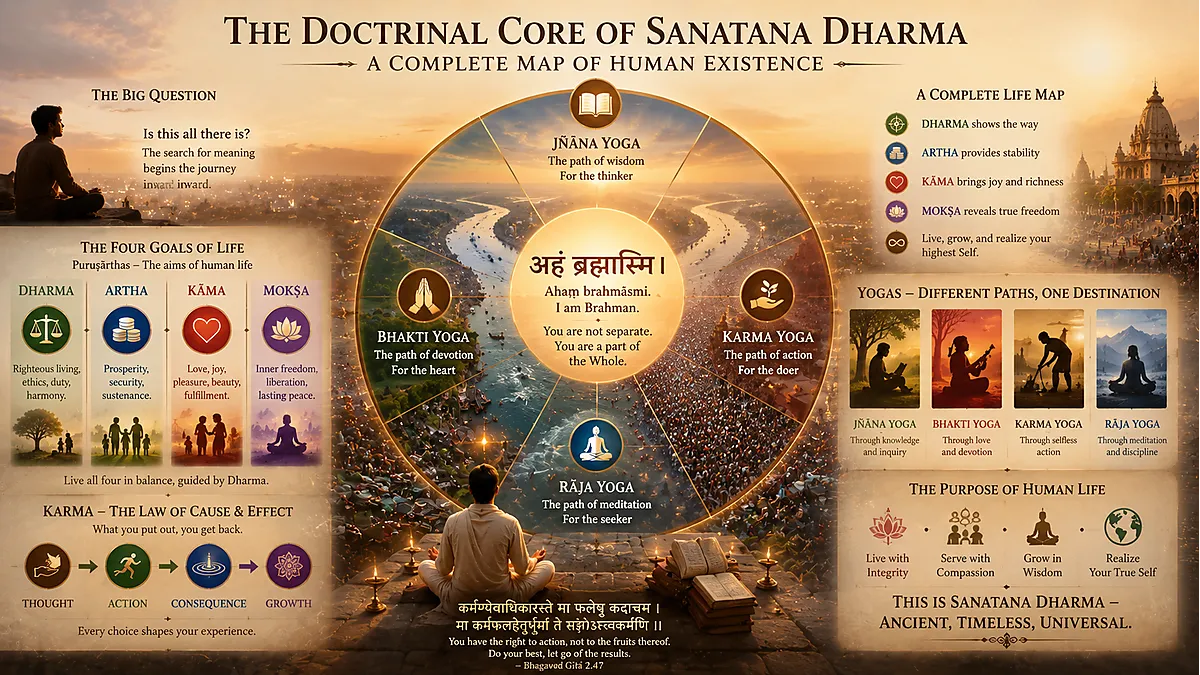
They called these four goals the Puruṣārthas — the genuine aims of human life.
The first is Dharma. Think of this as simply doing the right thing — being honest, being responsible, keeping your word, treating people fairly. Not because someone is watching, but because you know it is right. In your daily life, Dharma looks like paying your employees on time, telling your children the truth, not cutting corners at work even when no one would notice. It is the quiet foundation that makes everything else in life trustworthy.
The second is Artha. This means earning money, building security, providing for yourself and your family. And here is something important that surprises many people: Sanatana Dharma does not say money is bad. It does not tell you to give up your career and sit in a cave. It fully accepts that you need financial stability — that a person who cannot pay rent cannot be expected to think about deeper questions of meaning. Artha is a legitimate, essential, respected goal. Earn well. Build well. The only question the tradition asks is: are you earning it honestly?
The third is Kāma. This means love, joy, pleasure, beauty — the richness of life’s emotional and sensory experience. The warmth of a happy family dinner. The satisfaction of good friendship. The beauty of music, nature, and art. The tradition says: enjoy all of this, fully and joyfully. Life is not meant to be dry or joyless. Love your people. Celebrate. Laugh. Take pleasure in good food and beautiful things. Kāma is sacred, not shameful. The only problem comes when desire starts to control you — when you cannot feel content without more and more, when enjoyment becomes compulsion. That is when Kāma moves out of balance.
The fourth is Mokṣa. This one is harder to explain, because it is not a thing you can buy or achieve in the ordinary sense. Mokṣa is inner freedom — the deep, unshakeable peace that does not depend on whether your business is doing well or whether people approve of you. It is the state of being genuinely okay — not because everything is perfect, but because your sense of who you are no longer rises and falls with every external circumstance. In the modern world, we might call this psychological freedom — freedom from chronic anxiety, from the exhausting need for validation, from the fear that runs as background noise beneath so much of our lives.
The beautiful insight of this framework is how these four work together. You do not have to choose between money and meaning. Between enjoying life and living ethically. Between worldly success and inner peace. The tradition says: pursue all four, in balance, with Dharma as your guide. Earn freely, enjoy fully, live honestly — and keep your heart oriented toward that deeper peace that no salary and no social media approval can permanently deliver.
Karma — Life’s Honest Feedback System
Now let us talk about Karma — perhaps the most famous word from Sanatana Dharma, and also the most misunderstood. You have probably heard someone say “That’s karma” when something bad happens to a person who behaved badly. And while there is truth in that, it makes Karma sound like a cosmic punishment system — like a divine court keeping score.
That is not quite right.
Think of Karma more simply as: what you put out, you get back — not always immediately, not always obviously, but inevitably.
Here are some everyday examples that make it immediately clear:
You lie to a colleague to get credit for their work. They find out. Trust is broken — perhaps permanently. The relationship that could have supported your career has now become an obstacle. That is Karma — not a thunderbolt from the sky, but the natural consequence of your choice rippling outward in your own life.
You show up for your friend during a difficult period, without expecting anything in return. Months later, when you face your own difficult moment, you discover that you have built something real — people who care about you, who show up in return. That is also Karma.
You take shortcuts at work year after year, and wonder why you feel no satisfaction or pride in what you do. That quiet emptiness is Karma, too — the feedback of actions taken without integrity.
The tradition does not say any of this to frighten you. It says it to empower you. If Karma is the law of cause and effect in human life, then you are not a helpless victim of your circumstances. Your choices today are shaping your experience tomorrow. That is not a burden — it is an invitation.
On a larger scale, look at the world around us. The climate crisis — melting glaciers, burning forests, flooding cities — is the collective Karma of decades of treating nature purely as a resource to be consumed without care. The epidemic of stress and burnout is the social Karma of a culture that taught people their worth is entirely measured by their productivity and their bank balance. Karma is not punishment. It is the universe’s way of saying: “Here is the result of that choice. Would you like to choose differently?”
Who Are You, Really? (The Deepest Question)
Here we arrive at the most surprising and most liberating teaching in all of Sanatana Dharma. Put aside, for a moment, everything you normally think of when you think of yourself — your job title, your family role, your nationality, your age, your bank balance, your reputation. Put all of that to one side.
What is left?
Something is. There is something that watches all of those roles come and go. Something that was present when you were a child, and is present now, and has not fundamentally changed even as everything else about your life has shifted. The tradition calls this the Ātman — your true, innermost Self.
And its most extraordinary claim is this:
Devanagari Script:
अहं ब्रह्मास्मि।
IAST Transliteration:dre4
Ahaṃ brahmāsmi.
Source: Bṛhadāraṇyaka Upaniṣad, Chapter 1, Brāhmaṇa 4, Verse 10
Word-by-Word Meaning:
- अहं (ahaṃ) — I, the individual
- ब्रह्म (brahma) — the universal reality, the ground of all existence
- अस्मि (asmi) — am
Simple Meaning and Life Lesson:
“I am Brahman” — I am not separate from the universal reality that underlies all of existence.
In plain language: you are not just a body, not just a mind, not just a collection of roles and worries. You are, at your deepest core, connected to — and in fact a part of — the same living awareness that underlies the entire universe.
The ancient teachers used a beautiful image to explain this. Think of a wave on the ocean. The wave has a shape, a height, a particular quality. It rises, it crests, it falls. For a short while, it seems like a separate thing. But it is never, not for a single moment, actually separate from the ocean. It is made of ocean, moves by the power of ocean, and when it recedes it simply returns to what it always was — ocean.
You are like that wave. Your individual life — your personality, your body, your story — is real and beautiful and worth living fully. But at the deepest level, you are made of the same consciousness that underlies everything. You were never truly separate. The feeling of isolation, the loneliness, the persistent anxiety of being a small, vulnerable individual in a large, indifferent world — all of this arises from forgetting what you actually are.
When this is remembered — even partially, even briefly — something changes. The ego stops fighting quite so hard for attention and approval. The chronic comparison with others softens, because you begin to feel, in your bones, that you and the other person share the same source. The restless grasping for things that will “finally” make you feel complete begins to ease, because you start to sense that the completeness you are seeking was never outside you.
This is not a mystical idea available only to saints and monks. It is available to you — right now, in the middle of your ordinary life — through the simple, daily practice of stillness, reflection, and honest attention to what you actually are beneath all the noise.
Different Paths for Different People — The Four Yogas
One of the most respectful and intelligent things about Sanatana Dharma is that it never says: “There is only one way, and everyone must follow it.” It recognizes that human beings are genuinely different — we have different personalities, different strengths, different temperaments — and it offers a different path for each.
Think of it like this: four different roads, all leading to the same destination.
Jñāna Yoga is the path for the thinker — the person who cannot move forward until they understand. If you are someone who reads, questions, analyses, and needs intellectual clarity before you can commit to anything, this is your path. It works through study, reflection, and the deep practice of distinguishing between what is permanent and what is passing in your life.
Bhakti Yoga is the path for the heart — the person who connects most deeply through love, music, prayer, and devotion. If you feel most alive when you are singing, when you are moved to tears by beauty, when love — for a person, for the divine, for life itself — feels like your most natural state of being, this is your path.
Karma Yoga is the path for the doer — the active, world-engaged person who finds meaning through work and service, who expresses themselves through action rather than contemplation. If sitting still for long meditations feels impossible but you can work for hours with full absorption when the work matters to you, this is your path.
Rāja Yoga is the path for the disciplined seeker — the person who wants to understand their own mind directly, who is drawn to meditation, breathwork, and the systematic development of inner stillness. This is the path of Patañjali’s Yoga — the science of the mind, which modern neuroscience is now beginning to confirm in its own language.
The key message is this: no path is superior, and no human temperament is wrong. Wherever you are, whoever you are, there is a doorway in this tradition that opens exactly where you stand.
The Secret of Peaceful Work — Karma Yoga in Daily Life
Let us get very practical now, because this teaching has the power to change how you experience every single day.
Here is perhaps the most famous verse from the Bhagavad Gītā — a teaching given by Śrī Kṛṣṇa to Arjuna on the battlefield of Kurukṣetra, but just as relevant to you in your office, your home, your classroom, or your creative work:
Devanagari Script:
कर्मण्येवाधिकारस्ते मा फलेषु कदाचन।
मा कर्मफलहेतुर्भूर्मा ते सङ्गोऽस्त्वकर्मणि॥
IAST Transliteration:
Karmaṇyevādhikāraste mā phaleṣu kadācana |
Mā karmaphalahetur bhūr mā te saṅgo’stvakarmaṇi ||
Source Citation: Bhagavad Gītā, Chapter 2, Verse 47
Word-by-Word Meaning:
- कर्मणि (karmaṇi) — in action, in your work
- अधिकारः (adhikāraḥ) — your right, your authority
- फलेषु (phaleṣu) — in the results, in the outcomes
- सङ्गः (saṅgaḥ) — attachment, clinging
Simple Meaning:
“You have the right to do your work. You do not have the right to control the results. Do your best — but do not make results the master of your peace of mind.”
Let us bring this home with situations you actually live through.
You study hard for an exam. You revise, you prepare, you do everything you can. Then the day arrives, and despite your best effort, the result is not what you hoped for. Now two things are happening simultaneously: the action (studying, preparing) and the result (the marks). Kṛṣṇa’s teaching says: your control exists entirely over the first, and not at all over the second. Put all your energy into the quality of your preparation. Release your grip on the outcome.waybeyondthedream.
Does this mean you should not care whether you pass? No. It means you should care so much about the work that you do not allow anxiety about the result to poison the quality of your preparation. When you study with fear of failure in your mind, your mind is not fully on the studying — it is half on the studying and half on the catastrophic scenario you are imagining. Split attention produces split results. Full, calm, present engagement with the work — without the weight of outcome-anxiety — produces your best.
Think about it in your career. The best professionals you have ever known were probably not the most anxious ones — they were the ones who were fully absorbed in doing their work well, who cared more about the quality of what they were building than about the applause it would receive. That absorption, that full presence in the work itself, is exactly what Kṛṣṇa is describing.
Or think about relationships. The times you felt most loved were probably not when someone was performing love to get something from you. They were when someone gave freely — their time, their attention, their care — without calculating the return. That is Karma Yoga in a relationship: giving without keeping score, loving without demanding, contributing without always tracking what you get back.
This single teaching — do the work fully, release the result — has the power to dissolve a significant portion of the anxiety that most of us carry around every day. It is not resignation. It is not passivity. It is the discovery that the peace you have been searching for does not live on the far side of a successful outcome. It lives in the quality of your engagement with what is right in front of you, right now.
Putting It All Together — Your Complete Life Map
Let us step back and see what we now hold in our hands.
Dharma tells you how to live — honestly, ethically, with responsibility to others and to the world you share with them. It is the compass that keeps every other pursuit in its right place.
Artha and Kāma tell you what to enjoy — that prosperity and pleasure are not enemies of the spiritual life, but honest, fully supported dimensions of a human life well-lived.
Karma tells you how life responds — that your choices have consequences, that the universe is not random, and that the quality of your inner intention shapes the quality of your outer experience.
The four Yogas tell you how to grow — offering you a path tailored to your own temperament, so that the journey toward greater clarity, freedom, and meaning does not require you to be someone you are not.
Mokṣa holds it all together — reminding you that beneath the beautiful busyness of a full human life, there is a dimension of peace that no external circumstance can finally reach. Not because life becomes problem-free. But because you discover, gradually and then suddenly, that the awareness which watches all the problems was never, not for one moment, actually threatened by them.
This is the map. It does not promise you that life will stop being difficult. It promises you something better — that you will stop being undone by difficulty. That you will learn, bit by bit, to live with full engagement and inner steadiness at the same time.
Sanatana Dharma is not theory. It is not museum-piece religion. It is the accumulated, tested, lived wisdom of millions of human beings who faced the same challenges you face — loss, uncertainty, pressure, longing, the search for meaning — and found, through these very teachings, a way to live with both honesty and joy, both full engagement with the world and deep peace within themselves.
The map is here. The journey is yours.