
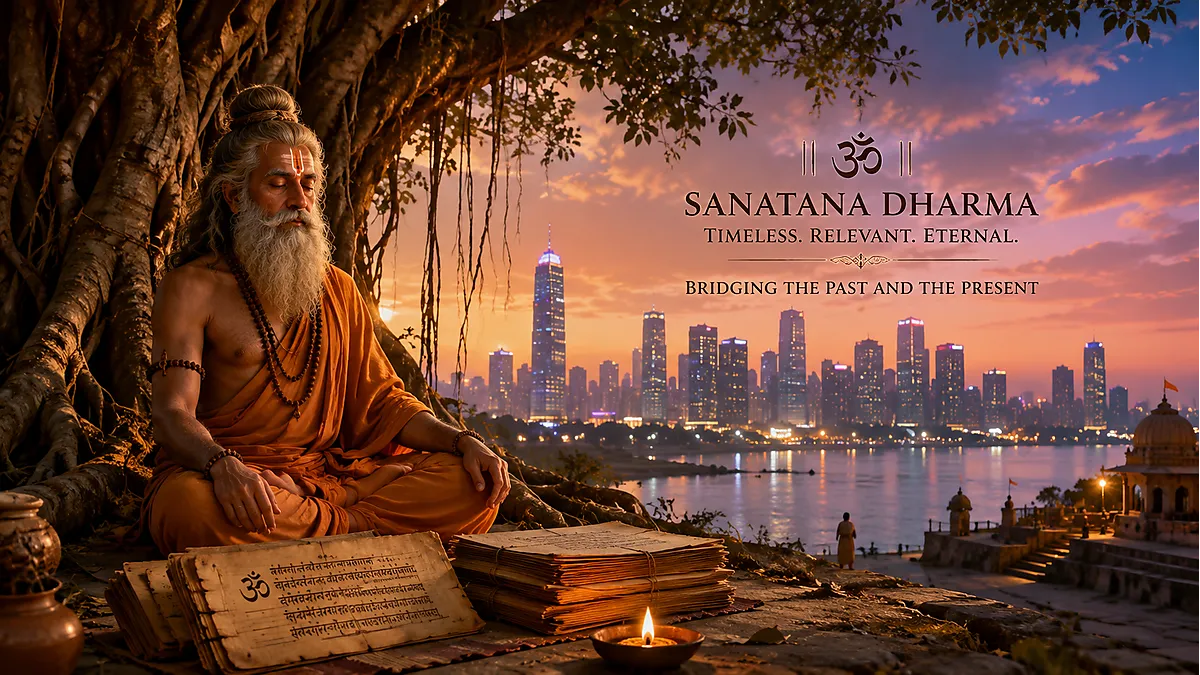
The Question That Technology Cannot Answer
Close your eyes for a moment — if such an act is still possible without reaching reflexively for a screen. Somewhere between the last notification you dismissed and the next one already assembling itself in the luminous rectangle you carry everywhere, there is a silence. Brief, uncomfortable, almost strange. In that silence, beneath the white noise of modernity, a question rises. It is not new. It is, in fact, the oldest question humanity has ever asked. It is not “What do I know?” or even “What can I achieve?” It is the far more unsettling, far more intimate question: “How should I live?”
This question haunts the 21st-century mind with a peculiar intensity, because for the first time in human history, we have constructed a civilization of unprecedented technical sophistication — a civilization capable of sequencing the human genome, of sending machines to the edge of the solar system, of building artificial minds that compose poetry and diagnose disease — and yet cannot answer this one question with any confidence. We have more information than any civilization in history and less wisdom about what to do with it. We have more connected devices than neurons in the human cortex and more people than ever report feeling profoundly, devastatingly alone.
The ancient seers of Bhārata — the Ṛṣis who composed the hymns of the Vedas in states of luminous inner absorption — did not face this precise technological landscape. But they faced the same underlying human condition: the condition of a consciousness embedded in a world of constant change, confronted by the terrible freedom of choice, and searching for an orientation that would not crumble when tested. Their answer was not a creed to be signed or a commandment to be obeyed. It was a living discovery — a recognition of the cosmic principle that structures all existence, that holds the universe together as a spine holds the body upright. They called it Dharma. And the tradition built upon this recognition, they called Sanatana Dharma — the eternal grammar of existence.
The Word That Contains a Universe
There is a reason that scholars, translators, and philosophers across centuries have thrown up their hands when asked to render Dharma in any European language. The word does not translate — not because it is obscure, but because it is too full. It is a word that has swallowed cosmology, ethics, psychology, jurisprudence, and soteriology, and still has room for more.
Let us begin with the etymology, because in Sanskrit, the root of a word is its philosophical DNA.
Sanatana (सनातन) is derived from the root san (सन्), related to the verbal base as — to be, to exist, to endure. The suffix -tana extends this being across time, denoting continuity without interruption. Sanatana thus means: that which has always been, is now, and will always be — not as a static fossil, but as a living, self-renewing principle that no revolution of history, no technological disruption, no civilizational collapse can render obsolete. It is important to feel the weight of this designation. The tradition does not call itself prācīna (ancient) or purātana (old). It calls itself Sanatana — beyond the category of time itself. This is an extraordinary philosophical claim: not that this wisdom is very old, but that it is timeless — that it pertains to the structure of reality as such, independent of any era.
Dharma (धर्म) derives from the Sanskrit root √dhṛ — to hold, to sustain, to bear. The Dharmakosha, the classical lexicon of Dharmic concepts, renders it with luminous precision:dharmawiki+1
Sanskrit Reference 1:
Devanagari Script:
धर्मो विश्वस्य जगतः प्रतिष्ठा।
IAST Transliteration:
Dharmo viśvasya jagataḥ pratiṣṭhā.
Source Citation: Mahābhārata, Ādi Parva (attributed); also reflected in the Dharmakośa formulations
Word-by-Word Meaning:
- धर्मः (dharmaḥ) — Dharma, the cosmic-moral principle
- विश्वस्य (viśvasya) — of the universe, of all existence
- जगतः (jagataḥ) — of the world in motion (jagat = that which moves)
- प्रतिष्ठा (pratiṣṭhā) — foundation, ground, the supporting basis
Translation & Bhāṣya:
“Dharma is the foundation of the entire universe in motion.”
Notice the word jagataḥ — the world is defined as that which moves (gam = to go). The universe is not static; it is perpetual flux, constant becoming, ceaseless change. And yet within this flux, something does not change — something holds the whole structure of becoming in coherent, intelligible form. That holding principle is Dharma.
This is why the greatest error a modern reader can make is to translate Dharma as “religion” — that thin, historically specific word from the Latin religio, which means to bind, originally referring to cultic obligation. Dharma is not an obligation externally imposed. It is the inner architecture of existence — as fundamental as the gravitational constant, as intimate as the rhythm of the breath. The laws of physics are a subset of Dharma. The ethical obligations of a judge are a subset of Dharma. The psychological discipline required for a calm mind is a subset of Dharma. Dharma does not live in temples alone; it lives in the structural laws of the cosmos, in the conscience of a human being, and in the silent rhythm of a forest at dawn.
The Grammar Metaphor — Why It Is More Than Analogy
When I say that Dharma is the grammar of existence, I mean this with philosophical precision. Consider what grammar does for language. Without grammar, words remain an anarchic heap — meaningful in isolation, meaningless in combination. Grammar provides the invisible architecture that transforms individual words into sentences, sentences into paragraphs, paragraphs into the sustained coherence of thought. Grammar does not create language; it makes language possible — it creates the conditions under which expression can become communication.
Dharma does exactly this for existence, operating at three nested levels:
At the cosmic level, Dharma is the principle by which the universe coheres rather than collapses into chaos. Why does the sun rise with precision? Why does water always seek the lowest point? Why do seasons succeed one another in reliable rhythm? Because there is Dharma in the fabric of the cosmos — an order that is not enforced from outside, but inherent in the nature of things. In modern scientific language, we would call this the laws of nature. But the Vedic insight goes deeper: these laws are not merely mechanical regularities. They are expressions of a moral order — Dharma at the cosmic scale.
At the social level, Dharma is the principle of ethical conduct — the recognition that individual human beings exist within webs of relationship (family, community, ecology, polity) and that these relationships carry obligations that are not merely contractual but sacred. A parent’s Dharma toward a child, a teacher’s Dharma toward a student, a leader’s Dharma toward those who follow — these are not bureaucratic job descriptions. They are participations in the cosmic order of being.
At the individual level, Dharma is the alignment of the inner human being — thought, intention, and action — with truth. It is the state in which a person acts not from ego-fear or ego-desire, but from a deep recognition of their role in the larger pattern of existence. The Bhagavad Gītā calls this svadharma — one’s own intrinsic law of being — and declares, famously, that it is better to fulfill one’s own Dharma imperfectly than to imitate another’s perfectly.
Ṛta — The Cosmic Heartbeat Beneath Dharma
Dharma, however great, is not the oldest word in this tradition’s vocabulary for cosmic order. Before Dharma, there was Ṛta (ऋत) — and to understand Dharma at its philosophical depth, one must first hear the heartbeat of Ṛta.
The word Ṛta derives from the root √ṛ — to move rightly, to flow in correct order. It is the Vedic name for the primordial cosmic harmony that governs both nature and morality before there was any distinction between them. In the Ṛgveda, Ṛta is not a human construction, not a social convention, not a divine commandment — it is the prior condition of reality itself. Even the gods do not create Ṛta. They uphold it, protect it, participate in it. This is one of the most revolutionary metaphysical positions in the history of world thought: cosmic law is higher than divine will.
Sanskrit Reference 2:
Devanagari Script:
ऋतेन ऋतमपिहितं धुलोकं ।
Transliteration:
Ṛtena ṛtam apihitaṃ dhulokam.
Source Citation: Ṛgveda, Maṇḍala 5, Sūkta 62, Verse 2
Word-by-Word Meaning:
- ऋतेन (ṛtena) — by Ṛta, by cosmic order, by truth-in-action
- ऋतम् (ṛtam) — Ṛta, the cosmic law
- अपिहितम् (apihitam) — is covered, is enveloped, is revealed through
- धु-लोकम् (dhu-lokam) — the luminous world, the shining realm
Translation & Bhāṣya:
“Through Ṛta, the world of light is enveloped and revealed.”
The principle here is profound: the luminous worlds — the worlds of truth, order, and bliss — are not separate from Ṛta. They are Ṛta made manifest. When a human civilization aligns its structures with Ṛta — when its economics honor natural cycles, when its justice reflects cosmic fairness, when its inner life is cultivated toward clarity — it participates in the luminous order of being. When it violates Ṛta — through ecological destruction, through systemic injustice, through the cultivation of restless, fragmented minds — it accumulates Anṛta (अनृत), the counter-principle of disorder, and disorder always eventually seeks resolution through suffering.
The guardians of Ṛta in the Vedic cosmos are Varuṇa and Mitra — a pairing of deep philosophical significance. Varuṇa is the transcendent sovereign, the all-seeing cosmic lord (Ṛtasya pati), who observes every violation of cosmic order and holds beings accountable with a wisdom that is never punitive but always corrective. Mitra is his counterpart — the deity of horizontal harmony, of friendship, agreements, and mutual respect among beings. Together, they represent the two axes of Ṛta: the vertical — the human soul’s accountability to the cosmic order — and the horizontal — humanity’s obligation of mutual care and covenant. Violate the vertical, and you accumulate existential confusion. Violate the horizontal, and you tear apart the social fabric. Modernity, it must be said, has been conducting a sustained experiment in violating both simultaneously.sreenivasaraos+1
Sanskrit Reference 3:
Devanagari Script:
ऋतं च सत्यं चाभीद्धात् तपसोऽध्यजायत।
ततो रात्र्यजायत ततः समुद्रो अर्णवः॥
IAST Transliteration:
Ṛtaṃ ca satyaṃ cābhīddhāt tapaso’dhyajāyata |
Tato rātryajāyata tataḥ samudro arṇavaḥ ||
Source: Ṛgveda, Maṇḍala 10, Sūkta 190, Verse 1
Word-by-Word Meaning:
- ऋतम् (ṛtam) — cosmic order, truth in motion
- च (ca) — and
- सत्यम् (satyam) — absolute truth, the unchanging Real
- अभीद्धात् (abhīddhāt) — blazed forth, was kindled into being
- तपसः (tapasaḥ) — from tapas, the primordial creative heat of austerity
- अध्यजायत (adhyajāyata) — was born, arose first
- ततः (tataḥ) — from that
- रात्री (rātrī) — the primal night, the field of potentiality
- अजायत (ajāyata) — was born
- समुद्रः (samudraḥ) — the great cosmic ocean
- अर्णवः (arṇavaḥ) — the primordial flood of existence
Translation & Bhāṣya:
“From the blazing heat of primal austerity, cosmic order (Ṛta) and truth (Satya) were the first to be born. From that arose primal night; from that arose the cosmic ocean.”
The cosmological importance of this verse staggers the mind if one pauses long enough to feel it. Creation itself — night, ocean, the entire manifest universe — emerges after Ṛta and Satya. This means that truth and cosmic order are not products of the universe; they are its preconditions. The universe is born into a pre-existing moral architecture. Dharma is not a human invention imposed on a morally neutral cosmos. It is discovered, not constructed — like the laws of mathematics, which are not invented by the mathematician but uncovered as eternal structures of reality.
The Civilizational Consequence — What Happens Without the Spine
Now let us turn the lens upon the present moment with the steady gaze that this tradition demands.
Modern Western civilization — and by contagion, the globalized world it has shaped — is built upon a philosophical architecture that is structurally incomplete. Its foundation stone is anthropocentrism: the belief that the human being is the sovereign measure of all things, that the natural world has value only insofar as it serves human ends, and that progress is to be measured by the accumulation of material wealth and technological power. From this premise flows consumerism — the organization of human desire around the endless acquisition of objects. From consumerism flows ecological devastation, because a system premised on infinite consumption cannot long survive within a finite planet. And from the systematic prioritization of external accumulation over inner development flows the silent epidemic of our age: anxiety, meaninglessness, and what the philosopher Albert Camus called the absurd — the crushing sense that life offers no inherent orientation.
This is not a counsel of despair about modernity. Technology is not the enemy — fire was also technology, and the Vedic tradition built its entire ritual cosmology around its controlled, sacred use. The error is not in possessing powerful tools; it is in possessing them without a prior answer to the question: “To what end?” Science without Dharma produces the atom bomb alongside the vaccine — both emerge from the same laboratory with equal technical brilliance, but one unmakes civilization and one protects it. Social media without Dharma amplifies both the saint’s wisdom and the demagogue’s poison with equal algorithmic efficiency. Power, without the prior orientation of Dharma, is simply energy in search of a direction — and historically, undirected energy tends toward destruction.
Sanatana Dharma does not offer this critique from a position of hostility to the intellect or to material life. It enshrines Artha (wealth) and Kāma (desire and beauty) as legitimate aims of human existence. But it insists — with the structural authority of a spine that holds the whole body upright — that these aims must be pursued within the container of Dharma, and with the liberating horizon of Mokṣa (ultimate freedom) kept always in view. A civilization without Dharma is precisely a body without a spine: it may have impressive organs, brilliant limbs, extraordinary sensory apparatus — but without the central alignment, it cannot stand for long.
This is the missing variable. Not more technology. Not more legislation. Not more information. What the modern world requires, with the same urgency with which a drowning person requires air, is Dharma — the re-orientation of human consciousness toward the cosmic grammar of existence that was never lost, only forgotten.
Om Shanti, Shanti, Shanti. (ॐ शान्तिः शान्तिः शान्तिः)
(In our next post, we will explore exactly how this ancient wisdom holds the cure for the modern world’s greatest problems—from the mental health crisis to corporate burnout. Stay tuned on PrayagTourism.com!