
Something Is Telling Us Something
Have you noticed how summers keep getting hotter every year? How the rains come late, or come all at once and cause floods? How the river that your grandparents swam in is now too polluted to touch? How children in cities grow up barely knowing what a forest smells like, because forests are disappearing faster than we can plant them?
These are not just news headlines. They are lived experiences — things you feel in your body, your neighbourhood, your water bill, your electricity bill, your allergies. Something that was fine for generations is now, within a single lifetime, becoming a crisis.
And the honest question that Sanatana Dharma asks us to sit with is this: Why? Why is nature reacting this way?
The answer the ancient sages would give — and the answer that modern ecology is slowly, reluctantly arriving at — is quite simple. It is not a failure of technology. It is not a shortage of information. We have more environmental data than any civilization in history, and the planet is still heating. The real problem is a failure of relationship.
Somewhere along the way — not with one dramatic decision, but with thousands of small, incremental ones — human civilization made a fundamental shift in how it saw the natural world. It stopped seeing nature as family and started seeing it as raw material. It stopped seeing the river as a living being and started seeing it as a pipe. It stopped seeing the forest as sacred and started seeing it as timber. It stopped seeing the soil as a mother and started seeing it as a substrate for extraction.
That shift — from relationship to transaction, from reverence to exploitation — is the root cause of the ecological crisis. And no number of solar panels or carbon credits will permanently fix a problem that begins in the human heart. What we need, at the deepest level, is a change in how we see the world. And that is precisely what Sanatana Dharma has been offering for five thousand years.
Nature Is Not a Resource — It Is Family
In the Dharmic worldview, nature is not a collection of things. It is a family of living presences — conscious, sacred, deserving of respect and care. This might sound unusual to modern ears trained to see the world in terms of chemistry and economics. But stay with it, because this ancient way of seeing is the foundation of everything that follows.
Sanatana Dharma teaches that all of creation — including every element that makes up the world we live in — is ultimately an expression of the divine consciousness that underlies all existence. The ancient sages identified five fundamental building blocks of the natural world, which they called the Pañca Mahābhūtas (the Five Great Elements):
- Pṛthvī — Earth: the ground beneath your feet, the soil that grows your food, the mountains that hold the water
- Jala — Water: the rivers and rain, the oceans and the blood in your veins
- Agni — Fire: the sun that drives all life, the heat of your body, the energy of transformation
- Vāyu — Air: the breath you are breathing right now, the wind, the atmosphere
- Ākāśa — Space: the vast, open field in which all of this exists
Here is the profound insight: these five elements are not just outside you — they are also you. Your body is built from the same earth as the mountain. The water in your blood is the same water as in the river. The warmth of your body is the same fire as in the sun. You and the natural world are not separate things looking at each other across a divide. You are made of each other.isha.sadhguru+1
This is why, in the Dharmic tradition, the river Gaṅgā is not simply a water body — she is Mā Gaṅgā, a mother, a goddess, a purifier. The Himalayan peaks are not just rock and ice — they are the abode of Śiva, the seat of consciousness at the highest altitude. The pīpal tree is not just a tree — it is sacred, worshipped, protected. The cow is not just an animal — she is Gau Mātā, a nourishing, gentle presence deserving of care and gratitude.
These are not primitive superstitions. They are relational technologies — ways of embedding reverence into everyday life so that human beings do not forget, generation after generation, that they are embedded in a sacred web of life that they did not create and cannot replace.
When you call a river your mother, you do not dump factory waste into her. When you call a tree sacred, you do not cut it down for a parking lot. The Dharmic way of relating to nature is not poetic exaggeration. It is one of the most effective environmental protection strategies ever devised.
The Story of Bhūmi Devī — Our Patient, Loving Mother
Let me tell you a story — or rather, let me remind you of a truth that our ancestors felt so deeply they wove it into the very texture of their civilization.
Long before factories and cities and smartphones, the people of ancient Bhārata looked at the Earth beneath their feet with the eyes of gratitude. They watched the soil receive a dead seed and, in the fullness of time, return it as a living plant bearing fruit. They watched the Earth absorb the rain and release it gently through springs and streams. They watched her hold the weight of mountains without complaint, nourish billions of creatures without asking anything in return.ijrpr+1
And they said: “This is exactly what a mother does.”
They called her Bhūmi Devī — the goddess of the Earth, the divine mother who holds us, feeds us, and forgives us with a patience that humbles the imagination. In the Vedic understanding, the Earth is not a rock hurtling through space. She is a conscious, sacred being — Vasudha (the one who contains all wealth), Viśvambharā (the one who bears all beings), Dharaṇī (the one who holds everything together).shisrrj+1
Think about this for a moment in your own life. Your mother — or the idea of a mother — is someone who gives without calculation. She does not present you with a bill for the meals she cooked or the nights she stayed awake when you were sick. She gives because giving is her nature. And in return, the only thing she asks — if she asks anything — is that you do not destroy the home she created for you.
The Earth has been exactly this kind of mother. She has fed every human being who has ever lived. She has absorbed every waste we have ever generated. She has held, quietly and without complaint, the weight of everything we have built on her body. For thousands of years, our ancestors understood this and responded with gratitude — with rituals of offering, with reverence for rivers and forests and soil.
What has changed in the modern era is not the Earth’s generosity. It is our response to it. We have, over the last two centuries, stopped responding with gratitude and started responding with extraction. We have treated our mother’s body as a mine. And now, with the rising temperatures, the dying reefs, the disappearing groundwater, the burning forests — she is, very gently and very seriously, asking us to remember who she is.
What the Vedas Say — The Voice of the Earth Herself
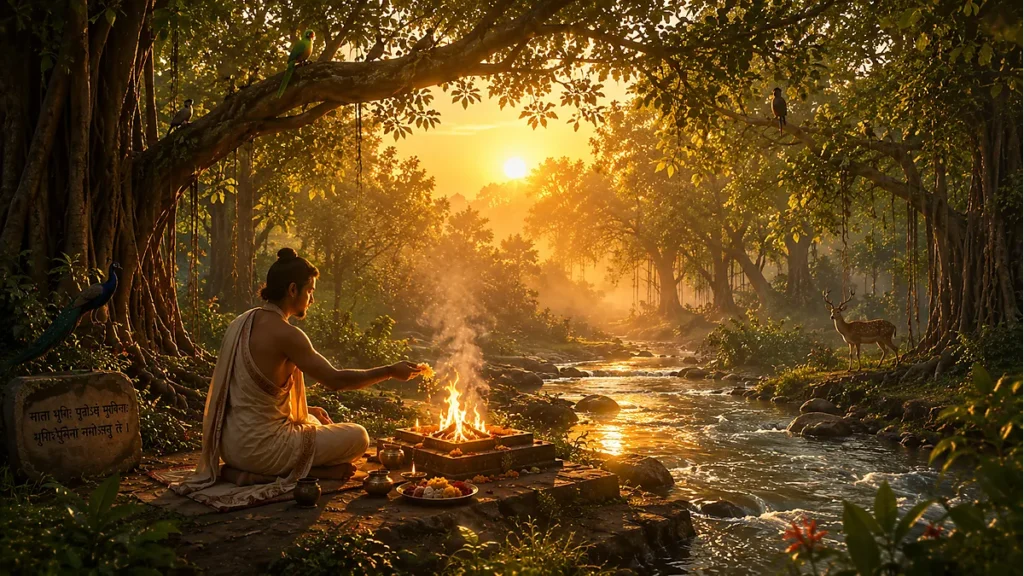
The ancient sages of Bhārata heard the Earth’s voice clearly. And in the Atharvaveda — the fourth and most encyclopedic of the four Vedas — they composed in her honour the most magnificent environmental declaration in any literature. They called it the Bhūmi Sūkta — the Hymn to the Earth — a poem of 63 verses that is, quite simply, the world’s oldest ecological philosophy.
Its very first verse sets the tone with breathtaking clarity:
Devanagari Script:
सत्यं बृहदृतमुग्रं दीक्षा तपो ब्रह्म यज्ञः पृथिवीं धारयन्ति।
सा नो भूतस्य भव्यस्य पत्न्युरुं लोकं पृथिवी नः कृणोतु॥
IAST Transliteration:
Satyaṃ bṛhad ṛtam ugraṃ dīkṣā tapo brahma yajñaḥ pṛthivīṃ dhārayanti |
Sā no bhūtasya bhavyasya patnyuruṃ lokaṃ pṛthivī naḥ kṛṇotu ||
Source Citation: Atharvaveda, Kāṇḍa 12, Sūkta 1 (Bhūmi Sūkta), Verse 1
Word-by-Word Meaning:
- सत्यं (satyaṃ) — truth
- ऋतं (ṛtaṃ) — cosmic order, Dharma
- पृथिवी (pṛthivī) — the Earth
- धारयन्ति (dhārayanti) — sustain, uphold, hold together
- पत्नी (patnī) — partner, companion, beloved
- भूतस्य भव्यस्य (bhūtasya bhavyasya) — of the past and the future
Simple Translation:
“Truth, cosmic order (Dharma), dedication, creative energy, sacred knowledge, and offering (Yajña) — these sustain the Earth. May she, the partner of the past and the future, grant us a vast and flourishing world.”
Now let us sit with what this is actually saying, because it is extraordinary.ijrpr+1
The verse is asking: “What keeps the Earth alive and flourishing?” And its answer is not technology. Not chemistry. Not economics. It is truth, Dharma, and sacred offering — the inner and outer qualities of human civilization. This means the ancient sages understood something that modern ecology is now painstakingly rediscovering: the health of the planet is inseparable from the moral and spiritual health of the people living on it.
A civilization built on greed, exploitation, and disregard for natural limits will produce a degraded Earth. A civilization built on truth, balance, and gratitude will produce a flourishing one.zenodo+1
The word patnī — which means partner or companion — is especially beautiful and important. The Earth is not our servant. She is not our property. She is our partner — in the past, in the present, and in the future. A partner you honour, protect, and reciprocate with. A partner whose wellbeing is inseparable from your own.studocu+1
Yajña — The Ancient Secret of Giving Back
Now let us talk about one of the most practical ecological teachings in the entire tradition: the principle of Yajña (यज्ञ).
Most people know Yajña as a fire ritual — priests chanting around a fire, offering ghee and grain into the flames. And yes, that is one form of it. But the principle of Yajña goes much deeper than any ritual, and it is one that modern sustainability experts are only now beginning to articulate in scientific language.
Yajña means: for everything you take, you give back.
It is the principle of reciprocity with the natural world. Think of it like a bank account — but not your personal bank account. The Earth’s account. Every time you take something from the Earth — food, water, air, minerals, timber — you are making a withdrawal. Yajña says: you also must make deposits. You must give back.
The Bhagavad Gītā puts it beautifully: “From Yajña comes rain, from rain comes food, from food come beings” (3.14). This is a complete ecological cycle described in a single sentence — rain feeds crops, crops feed people, and people, through the act of Yajña, return their gratitude and energy to the cycle. The universe is a circle. Take without giving, and the circle breaks.
What does Yajña look like in practice today? It is not complicated. It is:
- Planting a tree for every one that is cut
- Using only what you need and wasting nothing
- Composting your food scraps back into the soil
- Supporting farmers who practise sustainable agriculture
- Saying thank you — genuinely, consciously — before a meal, acknowledging the rain and soil and labour that produced it
Modern environmentalists call this a circular economy — the idea that we should design systems where nothing is wasted and everything returns to the cycle. The Vedic tradition called it Yajña five thousand years ago.
The one-way model — take from nature, use it, throw it away, take more — is not just environmentally destructive. According to the Dharmic understanding, it is a violation of the cosmic law of Ṛta. It is living against the grain of the universe. And the universe, patiently but inevitably, corrects every violation.
The Three Crises and the Three Cures
Let us get very practical and look at how Dharmic ecology speaks to the three most immediate environmental problems most people face in daily life.
A. The Climate Crisis — Greed and Its Consequences
The core cause of climate change is not complicated: human civilization has been burning fossil fuels — ancient carbon stored underground over millions of years — at a rate that the Earth’s systems cannot absorb. The carbon accumulates in the atmosphere, traps heat, and the planet warms.
The Dharmic response is not to wait for governments to act or technology to fix it. It is to change the inner orientation — from the relentless drive for more to the Dharmic principle of enough. The tradition calls this aparigraha — non-possessiveness, taking only what you genuinely need. It is not poverty. It is wisdom. A person who has learned to live with enough is, paradoxically, far richer in contentment than a person who has everything and is still anxious for more.
B. Pollution — The Cost of Disconnection
The rivers, air, and soil are polluted not because people are evil. They are polluted because people have forgotten their relationship with these elements. When the Gaṅgā is Mā Gaṅgā — your mother — you do not pour sewage into her. When she is just “the river” or “a water resource,” she becomes a convenient disposal site. The Dharmic cure for pollution is not primarily technological. It is relational — the restoration of the felt sense that these elements of nature are sacred, living presences that deserve care.
C. Stress and Disconnection — The Hidden Wound
There is a less visible but deeply real consequence of our disconnection from nature: the epidemic of anxiety, restlessness, and what researchers now call nature deficit disorder — the measurably negative psychological effects of living cut off from natural environments. Study after study confirms that spending time in forests, near rivers, in gardens, even just under open sky, reduces cortisol levels, lowers blood pressure, and restores the capacity for clear thinking and emotional regulation.
Sanatana Dharma understood this not through cortisol studies but through direct observation: the forests were the āśrama, the place of learning and spiritual practice. The rivers were the tīrthas, the sacred crossing-points. Nature was not the backdrop for human life — it was the teacher, the healer, the environment within which the highest human development was possible. Reconnecting with nature is not a weekend hobby. It is Dharma.
What You Can Do — Dharma at Home, Today
Here is the beautiful truth: you do not need to be an environmental activist, a forest ranger, or a Vedic scholar to live this Dharma. The most powerful ecological practice begins in your own home, in your own daily choices, with your own small but consistent acts of reverence.
Here is a practical guide — not as rules, but as acts of love:
Respect water. Before you turn on the tap, remember that water is Jala Devī — sacred, life-giving, irreplaceable. Use only what you need. Fix leaking taps. Do not pour chemicals into drains that lead to rivers. When you drink water, drink it consciously — with a brief, quiet acknowledgment of the rain and the earth that delivered it to you.
Plant something. A tree, a plant, a kitchen garden — anything that participates in the act of life-giving. In the tradition, planting a tree is an act of profound merit, a gift to every being that will shade under it, nest in it, breathe because of it, for decades to come.
Reduce what you throw away. Everything discarded as “waste” is, from the Earth’s perspective, a withdrawal without a deposit. Composting, reusing, repairing — these are Yajña in the most practical form.
Offer gratitude before you eat. This one practice — pausing for just ten seconds before a meal to feel genuine thankfulness for the rain, the soil, the farmer, the cook — is one of the most powerful ecological and psychological practices available to a human being. It transforms eating from consumption into communion.
Spend time in nature without a purpose. Not hiking to check a box or photographing a landscape for social media. Just sitting — under a tree, by a river, in a garden — and being present to the life that surrounds you. The tradition calls this simply being with the Divine as it is, in its simplest and most accessible form.
Every one of these small acts is, in the Dharmic understanding, a thread in the great fabric of Yajña — humanity’s sacred offering to the Earth that has always offered everything to us. And small threads, woven consistently by millions of hands, make the strongest cloth.
The Earth has not given up on us. A mother does not give up on her children. But she is speaking to us now — through the rising heat, the crying glaciers, the rivers running dry, the seasons losing their rhythm. She is asking us to remember. To come back to the relationship. To live not as exploiters of a resource, but as grateful children of a sacred home.
Caring for nature is not an obligation. It is not a sacrifice. It is, quite simply, Dharma — and returning to it is the most natural, most joyful thing a human being can do.