
A World That Keeps Choosing Sides
Open any news channel today. Read any international headline. Scroll through the comment section of any post that touches religion, nationality, or culture — if you can bear it. What you will find, almost without fail, is the same ancient, exhausting human pattern playing out at breathtaking scale: us versus them.
Somewhere, people are killing each other over which name they call God. Somewhere else, nations are building walls — physical and legal — against people whose language, skin colour, or passport is different from theirs. Families are split at dinner tables because one person prays one way and another prays differently. Social media has become a battlefield where every difference in belief is treated not as a variation of perspective, but as a personal threat, a moral failure, or an act of war.
We are, in 2026, the most technologically connected generation in human history. We can video call someone on the other side of the planet in seconds. We have translated the texts of a hundred traditions. We have scientific proof that all human beings share 99.9% of identical DNA. And yet we are fracturing — along religious lines, national lines, ideological lines — with a speed and ferocity that suggests something very deep is being ignored.
The great question is: Why? Why, when we know so much, when we are so connected, do we keep choosing division?
Sanatana Dharma has been sitting with this question for a very, very long time. And its answer is not a political solution or a diplomatic treaty. It is something simpler and more fundamental — a shift in how we see truth itself.
The Real Problem — “Only My Way Is Right”
Let us be honest about where most conflict actually begins. It rarely begins with genuine hatred of the other person. Most of the time, it begins with a sincere but deeply limiting belief: “I have found the truth. And since truth is one, anyone who sees it differently must be wrong — or worse, dangerous.”
This is the logic of exclusivism. And it is not confined to any particular religion or political ideology. It is a very human tendency — the impulse to find certainty, hold it tightly, and then experience anyone who challenges it as a threat.
Imagine five friends trying to get to the same city from different starting points. One comes from the north, one from the south, one from the east, one from the west. They are all going to the same place. But each one has a different road, a different set of landmarks, a different map drawn in a different language. If each of them insists that their road is the only real road and all others are going nowhere — not only will they never help each other, they may actually try to block each other’s paths.
The city exists. The city is real. The destination is the same. The roads are genuinely different. And all of them arrive.
This is not a dismissal of any particular path. It is the recognition that the Divine — Truth, God, Brahman, the Absolute, call it what you will — is not so small that it can only be approached from one direction. It is vast enough to receive every sincere traveller, whatever road they walked.
Sanatana Dharma’s View — Truth Is Big Enough for Everyone
Here is what makes Sanatana Dharma genuinely, structurally different from traditions that claim exclusive access to truth.
It does not say: “We are right and they are wrong.”
It says: “Truth is one. But human beings — with their different histories, cultures, languages, and temperaments — will naturally understand and express that truth in different ways. And that is not a failure. That is how it should be.”
Think of it this way. The sun rises every morning. Every language on Earth has a word for the sun. In Hindi it is sūrya. In English it is “the sun.” In Japanese it is taiyō. In Arabic it is shams. These are not different suns. There is one sun, one reality, described differently by people standing in different places on the same Earth. Does the French person’s word for sun cancel out the Telugu word? Of course not. Every word points to the same light.
Now apply this to what different traditions call the highest reality. A Christian kneels in a church and feels the presence of a loving God. A Muslim prostrates toward Mecca and feels surrender to the All-Knowing. A Buddhist meditates and touches the clear awareness beneath all thought. A Vedantin recognizes Ātman as Brahman. A grandmother in a village offers a lamp to the river and feels, in that simple act, that she is in communion with something greater than herself.
Sanatana Dharma does not say one of these is true and the rest are mistaken. It says: these are different instruments playing the same note. The note is the same. The instruments are beautifully, legitimately different. And the music they together create is richer than any single instrument could produce alone.]
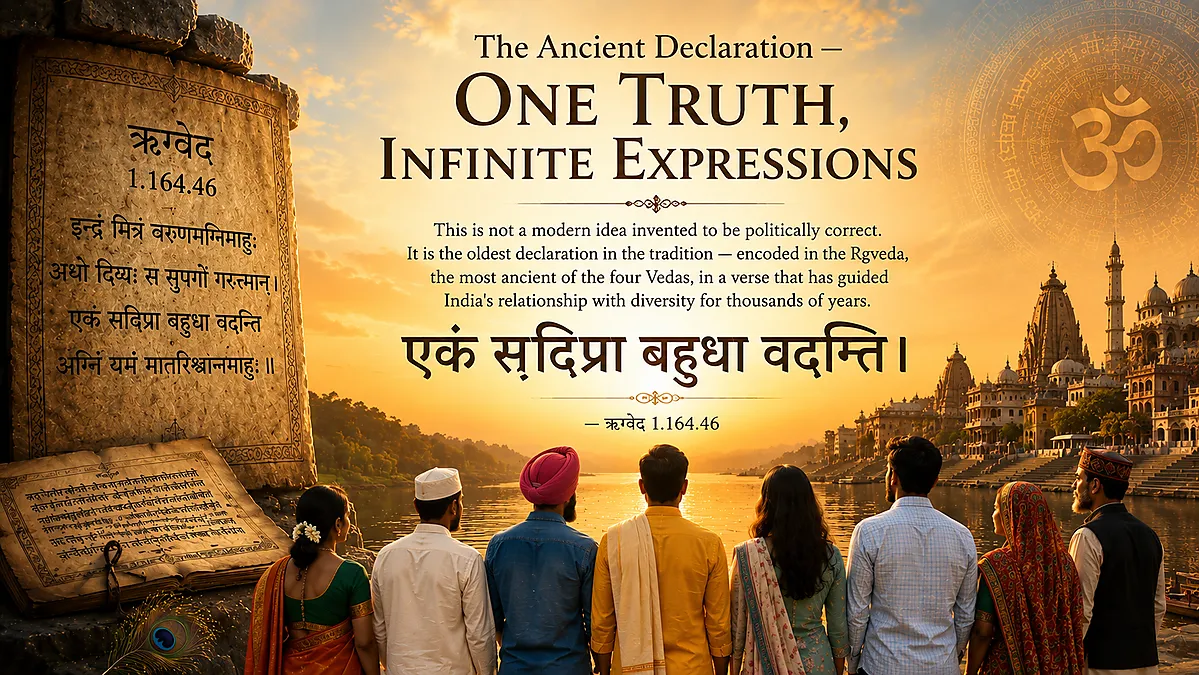
The Ancient Declaration — One Truth, Infinite Expressions
Inclusivity in Sanatana Dharma —Cure for Global Conflictot a modern idea invented to be politically correct. It is the oldest declaration in the tradition — encoded in the Ṛgveda, the most ancient of the four Vedas, in a verse that has guided India’s relationship with diversity for thousands of years.
Devanagari Script:
एकं सद्विप्रा बहुधा वदन्ति।
IAST Transliteration:
Ekaṃ sad viprā bahudhā vadanti.
Source Citation: Ṛgveda, Maṇḍala 1, Sūkta 164, Verse 46
Word-by-Word Meaning:
- एकं (ekaṃ) — one, singular
- सद् (sad) — truth, reality, that which truly exists
- विप्राः (viprāḥ) — the wise ones, the learned, the seers
- बहुधा (bahudhā) — in many ways, multiply, in diverse forms
- वदन्ति (vadanti) — speak, declare, describe, name
Simple Meaning and Life Lesson:
“Truth is one. The wise speak of it in many ways.”
Four words in Sanskrit. Perhaps the most important four words ever spoken on the subject of religious tolerance.
Notice what this verse does. It does not say: “All truths are equally true” — that would be lazy relativism. It says something more precise and more beautiful: there is one ultimate Truth (Sat), and the wise — people who have actually looked deeply, who have genuinely sought — describe this one truth in many ways, using different names, different symbols, different practices, different languages.
The keyword here is viprāḥ — the wise ones. Not the narrow-minded. Not those who have not yet looked. The wise — those who have gone deeply into their own tradition and found, at the deepest level, something that resonates with what the deepest seekers of every other tradition have found. They come back from that depth and say: it is one. The names differ. The truth is one.
This verse has been India’s civilizational philosophy for over five thousand years. It is why India — the most religiously diverse country in the history of the world, home to Hindus, Muslims, Christians, Sikhs, Jains, Buddhists, Zoroastrians, Jews, and dozens of indigenous traditions — has been, for most of its history, a place where these traditions coexisted not merely in tolerance but in genuine exchange and mutual enrichment.
When Swami Vivekananda stood at the World Parliament of Religions in Chicago in 1893 and addressed the audience as “sisters and brothers of America,” the hall exploded in applause that lasted for several minutes. Why? Because in a world of religion-driven conflict, the idea that a great spiritual teacher from the East was beginning not with theological argument but with kinship — not “I will prove my tradition is right” but “we are family” — was shockingly, electrifyingly different. He was speaking the Vedic declaration: Ekaṃ sat viprā bahudhā vadanti.[5]
Vasudhaiva Kuṭumbakam — The Whole World Is My Family
If Ekaṃ sat is the philosophical foundation, Vasudhaiva Kuṭumbakam is its living, breathing, daily expression.
The phrase comes from the Mahā Upaniṣad, and it is as simple as it is revolutionary.
वसुधैव कुटुम्बकम्
Vasudhaiva Kuṭumbakam — “The world is one family.”
- Vasudha (वसुधा) — the Earth, the entire world
- Eva (एव) — indeed, truly
- Kuṭumbakam (कुटुम्बकम्) — family
Not “the world should be treated like a family as a political strategy.” Not “the world could ideally become a family someday if we work hard enough.” Is. The world is one family. Right now. Already.
Think about what it means to be family. Family members do not all look alike. They do not all eat the same food, speak the same language, or think the same thoughts. A grandmother and her teenage grandchild may live in completely different mental worlds. A sibling may hold political views that drive you to the edge of patience. And yet — something connects you. Some deep thread of shared life, shared origin, shared stake in each other’s wellbeing. You would help a family member in need not because they agreed with you, but because they are yours, as you are theirs.
Vasudhaiva Kuṭumbakam says: that is how you should feel about every human being on this planet. And not just as a sweet aspiration — but as an accurate description of reality. Because we do share the same origin. We breathe the same air. We drink from the same water cycle. We are warmed by the same sun. We are, underneath all the categories we have constructed, the same species navigating the same brief, miraculous journey of being alive.
India carried this principle into its practical diplomacy as recently as three years ago. When India was the G20 President in 2023, its theme was Vasudhaiva Kuṭumbakam — “One Earth, One Family, One Future.” And when Turkey and Syria were struck by devastating earthquakes, India sent rescue teams and aid under Operation Dost — Operation Friend — not because Turkey is a neighbour or an ally, but because a family member was hurting.
This is not sentiment. It is Dharma in action.
Three Modern Problems and the Dharmic Answer
A. Religious Conflicts — From “Only My Path” to “All Paths Are Valid”
The cure for religious conflict is not the abandonment of faith — it is the deepening of it. When a person goes shallow in their religion, they find walls. When they go deep, they find — as the mystics of every tradition consistently report — that at the deepest level, the walls dissolve.[3][4]
The Dharmic invitation is not to abandon your faith but to hold it with open hands rather than clenched fists. To say: “This is the path that has brought me closest to truth. I honour it, I practise it sincerely. And I recognise that my neighbour’s path, though different from mine, is also bringing them closer to the same truth.” This is not weakness. This is the most advanced form of spiritual maturity.[5]
B. Nationalism and Division — From “My Country First” to “Shared Humanity First”
Nations are useful. Borders have their place. Cultural identity is real and valuable. But when national identity becomes the highest identity — when “my country” supersedes “our humanity” — it becomes the foundation for conflict that has cost more lives in the modern era than any other single cause.[10]
Vasudhaiva Kuṭumbakam does not ask you to abandon your country or your culture. It asks you to hold them in a larger frame. Love your culture the way you love your family — deeply, genuinely, without needing it to conquer everyone else’s. A person who is proud of their family does not need other families to fail.
C. Fear of Others — From Suspicion to Curiosity
Most fear of people who are different — people of different religions, races, languages, or cultures — comes not from genuine knowledge of those people, but from stories about them, constructed in their absence. We fear what we do not know. The cure is not complicated: get closer. Listen. Learn. Ask, with genuine curiosity, what their tradition teaches, what their life looks like, what they hold sacred.
The tradition that gave the world Atithi devo bhava — “the guest is God” — understood that meeting a stranger with open hands rather than a clenched fist is not naivety. It is the practical expression of Ekaṃ sat — the recognition that in this stranger’s face, if you look deeply enough, you will see the same truth that looks back at you from your own mirror.
Living Inclusivity — Small Acts, Big Dharma
The beautiful thing about Vasudhaiva Kuṭumbakam is that you do not need to be a diplomat, a philosopher, or a spiritual teacher to live it. It begins in the smallest choices of your ordinary day.
Respect someone else’s way of praying. Even if it looks entirely different from yours. Even if you do not understand it. Recognise that this person is reaching for the same light you are reaching for — through a different window.
Listen without the immediate urge to argue. The next time someone expresses a belief or opinion that differs from yours, try to genuinely hear what they mean — what experience, what longing, what understanding is behind it — before you respond. Listening with real attention is one of the most revolutionary acts of inclusivity available to an ordinary human being.
Help without checking identity. The next time you have an opportunity to help someone — a colleague, a stranger, a neighbour — notice if part of your mind is checking whether they are “one of us.” And then help anyway. Dharma does not check passport or prayer style.
Speak carefully about difference. The words we use about people who are different from us — in private conversations, in social media posts, in how we describe “those people” to our children — are the seeds from which tomorrow’s conflicts grow. Or from which tomorrow’s harmony grows. Choose the seed carefully.
Remember, daily, that we are family. Not as a mantra to repeat mindlessly, but as a living recognition to return to whenever you feel yourself hardening into “us” and “them.” We are family. Difficult, diverse, sometimes infuriating, ultimately inseparable family.
The world does not lack information about the value of peace. It lacks the felt sense — the bone-deep, heart-rooted recognition — that the person across the aisle, across the border, across the theological divide, is kin. Sanatana Dharma has been offering this recognition for five thousand years. Not as a political strategy. Not as a diplomatic nicety. But as the most accurate description of what this world actually is:
One family. One truth. Many beautiful voices singing it.