
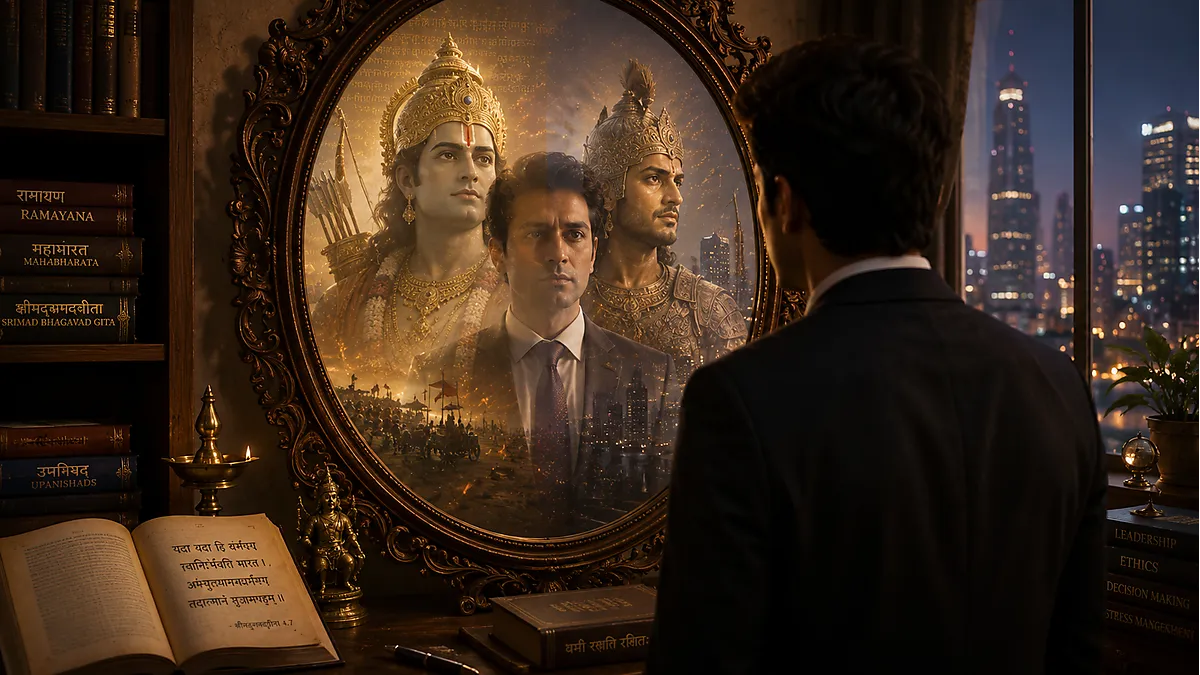
Stories as the DNA of Civilization
There is a reason that the greatest civilizations in human history did not transmit their deepest wisdom primarily through philosophical treatises, legal codes, or doctrinal manuals. They transmitted it through stories — narratives so architecturally complete, so saturated with the full spectrum of human experience, that they could hold an entire civilization’s moral imagination across thousands of years without going stale. The reason is not that ancient peoples preferred entertainment over instruction. It is because the most profound truths about human existence cannot be abstracted into propositions without losing the very quality that makes them true. They must be lived — and the next best thing to living a truth is to witness it being lived by a character whose inner world you have already made your own.
This is what the Rāmāyaṇa and Mahābhārata are — not mythology in the thin, dismissive sense of “stories that primitive peoples believed,” but something far more precise: civilizational DNA. They are seeds that contain entire forests. Within the Rāmāyaṇa, every dimension of personal and political Dharma is encoded with a compression and clarity that no treatise has matched. Within the Mahābhārata — which declares of itself, with magnificent self-awareness, “What is here is found elsewhere; what is not here does not exist” — the full moral complexity of human existence is mapped with a honesty so unflinching that it remains, after five millennia, the most sophisticated ethical document ever composed by a human hand.
These epics are not relics. They are mirrors. And what they reflect, with unsparing clarity, is us — now, today, in the 21st century, navigating the same fundamental crises of leadership, loyalty, duty, and the aching gap between the ideals we profess and the compromises we make.
The Rāmāyaṇa — Dharma as Integrity Under Pressure
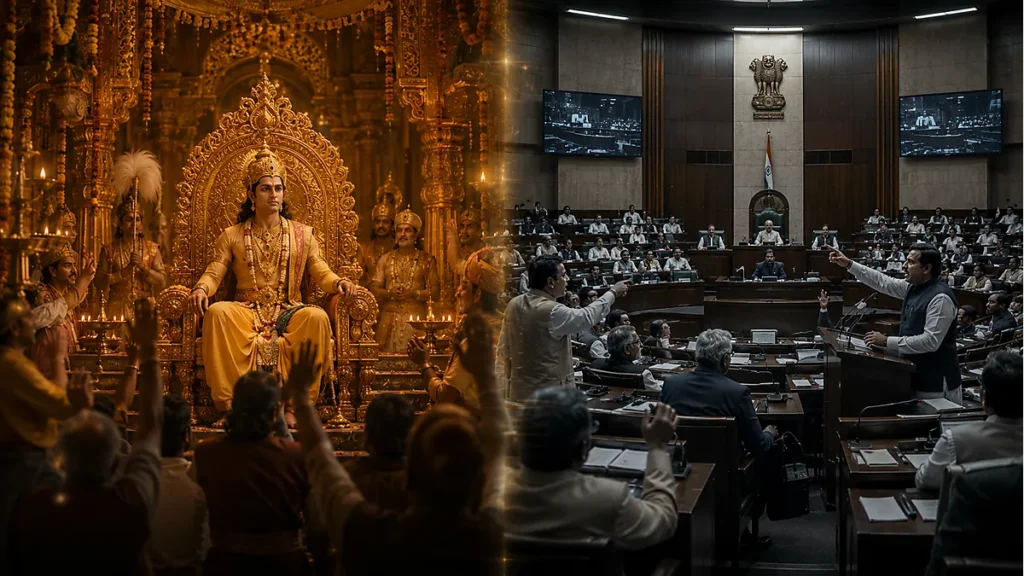
The first great truth the Rāmāyaṇa encodes is one that every human civilization eventually discovers, usually through catastrophic failure: integrity is not a virtue that exists in comfort. It is a virtue that only becomes visible under pressure. And the greater the pressure, the greater the revelation of character.
Rāma, the eldest prince of Ayodhyā, stands on the threshold of coronation — the most powerful kingdom of his age about to be placed in his hands — when his entire life is overturned by a promise made by his father Daśaratha to a minor queen. The promise was made in a moment of gratitude, in a time of war, long ago. It was always possible that it would never be claimed. Then, at the worst possible moment, it is claimed — and Rāma is exiled to the forest for fourteen years, surrendering the crown he has done nothing to forfeit.
What does Rāma do? He goes. Not with resentment, not with the secret intention of returning early, not with the political calculation that his supporters will eventually overturn the decision. He goes fully — carrying the exile as a sacred obligation, because his father’s word is his own word, and Dharma does not permit the architecture of civilization to be compromised by personal suffering. The message is not that obedience is always correct — the Mahābhārata will complicate that enormously. The message is prior to that: words have weight. Promises bind. Integrity is non-negotiable precisely because it is tested in the moments when violating it would be understandable, even justified, even applauded.
In today’s world — where political promises last until the election cycle turns, where corporate commitments dissolve with shifting market conditions, where relationships are governed by what the philosopher Charles Taylor calls “the ethics of authenticity” (a framework that often merely licenses self-interest) — the figure of Rāma in his forest exile is not a fantasy of impossibly elevated virtue. It is a standard — demanding, yes, but genuine, and desperately needed.
Rāmarājya — The Trustee, Not the Owner
The governance model that Rāma establishes upon his return — Rāmarājya — is one of the most studied and least understood concepts in Indian political philosophy. Mahatma Gandhi, who referred to it constantly in his political writings, understood precisely what it was not: not a theocracy, not a Brahmanical monarchy, not a system of religious law. What Rāmarājya is, in its essential structure, is a governance model premised on one foundational principle: the ruler is a trustee, not an owner.
In Rāmarājya, the king does not possess the kingdom. He is entrusted with it — by the people, by the cosmic order, by Dharma itself — and his authority is precisely commensurate with his fulfillment of that trust. The moment he fails to serve the welfare of even the least of his subjects, his Dharmic authority begins to erode. The state exists for the citizen, not the citizen for the state. Natural resources are held in sacred trust for future generations, not liquidated for the benefit of the present. The wellbeing of all living beings — not merely taxpaying humans — falls within the king’s moral responsibility.
This is not a romantic fantasy from a pre-modern age. It is the most rigorous formulation of legitimate governance that any civilization has produced — and its contrast with contemporary political reality is so stark that it requires no elaboration. A world where democratic systems increasingly serve concentrated interests, where the language of public service has become a performance art, where natural commons are privatized and future generations are taxed by the ecological debt of the present — this world does not need to invent an alternative governance philosophy. It needs only to remember one.
The Mahābhārata — Dharma in the Gray Zone
If the Rāmāyaṇa teaches Dharma in the mode of clarity — where the right choice is always difficult but ultimately recognizable — then the Mahābhārata performs a different and perhaps more urgent service: it teaches Dharma in the gray zone, where the right choice is genuinely obscure, where every available action carries irreversible moral cost, and where even the most virtuous individuals are complicit in outcomes they never intended.
Consider three figures whose stories form the moral spine of the epic, each one a different facet of the same, agonizing predicament:
Yudhiṣṭhira, the eldest Pāṇḍava, is the most Dharmic king in the tradition’s lexicon — truthful to such a degree that his chariot is said to travel slightly above the ground, the wheels not quite touching the earth’s soil of ordinary compromise. And yet this most Dharmic of kings gambles away his kingdom, his brothers, and his wife in a dice game — not from greed, but from the Dharmic obligation of a kṣatriya not to refuse a challenge. He then participates in a strategy of deception at Kurukṣetra — announcing the half-truth that “Aśvatthāmā has fallen” (referring to an elephant, while implying Droṇa’s son) — and with that single muttered ambiguity, the greatest teacher of his age lowers his bow and surrenders his life. The chariot touches the ground. The most honest man in the epic is complicit in the most consequential deception.
Karṇa is the epic’s most heartbreaking figure — a man of supreme natural nobility, arguably the greatest warrior of his generation, who chooses the wrong side not from corruption but from loyalty. Duryodhana recognized him when no one else would; gave him a kingdom when caste prejudice had denied him one. And so Karṇa fights for the wrong cause, wages war against the brothers he does not know are his own, and dies in the one moment when the cosmic scales were perfectly balanced — his chariot wheel sunk in mud, unable to lift it in the moment of his own death. His tragedy is precisely the tragedy of a virtue — loyalty — torn from its rightful context and placed in service of adharma. This is the story of every brilliant professional who has applied their gifts to a cause they knew to be wrong, because the person who first believed in them was on that side.
Droṇācārya — the supreme teacher, the brahmin-warrior who trained the greatest generation of archers the world has known — fights on the side of the Kauravas not from ambition but from obligation. Duryodhana feeds him; he is bound by annadāna — the obligation to the one whose salt you eat. He knows the war is unjust. He fights it anyway. And at the moment of his death, the epic makes a devastating point: even knowledge, even mastery, even virtue — divorced from moral clarity about the ultimate purpose they serve — can be instruments of dharmic catastrophe.
These are not ancient cautionary tales. They are the exact moral geography of every corporate boardroom where a brilliant manager executes a strategy they know to be harmful because their loyalty to the organization overrides their judgment. Of every bureaucrat who implements an unjust policy because the system that sustains them commands it. Of every leader who tells a half-truth because the full truth would cost a war they cannot afford to win by honest means. The Mahābhārata does not offer easy answers to these predicaments. It says, with unflinching honesty: dharma is sūkṣma — subtle. It requires not just virtue, but viveka — discernment so refined that it can navigate situations where every available choice carries moral weight.
The Bhagavad Gītā — The Psychology of Conscious Action
The battlefield of Kurukṣetra, where the Bhagavad Gītā is delivered, is the Mahābhārata’s most potent symbol — and it has been recognized as such across every culture that has encountered it. It is not just a physical battlefield. It is the battlefield of the human psyche, the field upon which every individual stands at every moment of genuine moral decision: surrounded by the forces of what they should do and what they want to do, of love and duty, of self-preservation and sacrifice, unable to move forward and unable to retreat. Arjuna’s breakdown — his bow slipping from his fingers, his body shaking, his voice cracking — is the most precise portrait of moral paralysis in world literature.
And it is precisely here — at the point of complete paralysis — that Kṛṣṇa speaks.
Devanagari Script:
योगस्थः कुरु कर्माणि सङ्गं त्यक्त्वा धनञ्जय।
सिद्ध्यसिद्ध्योः समो भूत्वा समत्वं योग उच्यते॥
IAST Transliteration:
Yogasthaḥ kuru karmāṇi saṅgaṃ tyaktvā dhanañjaya |
Siddhyasiddhyoḥ samo bhūtvā samatvaṃ yoga ucyate ||
Source Citation: Bhagavad Gītā, Chapter 2, Verse 48
Word-by-Word Meaning:
- योगस्थः (yogasthaḥ) — established in equanimity, grounded in inner stillness
- कुरु (kuru) — perform, act
- कर्माणि (karmāṇi) — actions, duties
- सङ्गं (saṅgaṃ) — attachment, clinging to outcomes
- त्यक्त्वा (tyaktvā) — having completely abandoned
- धनञ्जय (dhanañjaya) — O Arjuna, Conqueror of wealth
- सिद्धि (siddhi) — success, achievement
- असिद्ध्योः (asiddhyoḥ) — and failure, non-achievement
- समः (samaḥ) — equal, undisturbed
- भूत्वा (bhūtvā) — having become
- समत्वं (samatvaṃ) — equanimity, the balanced state of mind
- योगः (yogaḥ) — Yoga, the state of union
- उच्यते (ucyate) — is called, is defined as
Translation & Bhāṣya:
“Established in equanimity, perform your actions, O Arjuna, having abandoned all attachment. Remaining equal in success and failure — such equanimity is called Yoga.”
This verse is the psychological heart of the Gītā, and its relevance to the modern condition is so direct that one wonders why it is not taught in every business school and medical college in the world. The 21st century has constructed an entire civilization of outcome-anxiety — a culture so obsessed with measurable results, performance metrics, competitive rankings, and public validation that the act of work itself has been stripped of its intrinsic dignity and reduced to a delivery mechanism for external reward. The consequences are everywhere visible: burnout at epidemic levels, a generation of young professionals who measure their worth by their follower counts and quarterly appraisals, leaders who make decisions not by ethical discernment but by whatever produces the most impressive number in the next reporting cycle.
Kṛṣṇa’s instruction cuts through this pathology at the root. The word saṅga — attachment — is crucial. It does not mean indifference. Kṛṣṇa is not telling Arjuna to stop caring. He is telling him to stop clinging — to stop allowing the anticipated result to corrupt the quality of the action. Modern cognitive neuroscience, arriving independently at this insight five millennia later, has confirmed what Kṛṣṇa stated: outcome-focused anxiety activates the amygdala and the limbic stress-response system, literally degrading the quality of cognitive performance. Process-focused engagement, by contrast — what Mihaly Csikszentmihalyi recognized as the flow state — produces optimal neural conditions for skill expression, ethical clarity, and genuine excellence.
The equanimity Kṛṣṇa describes is not emotional flatness. It is sameness of inner state in the face of outer variation — the capacity to bring the same quality of presence and commitment to action whether the circumstances are favorable or not, whether recognition follows or not, whether the outcome serves the actor’s interests or not. This is not passivity — Kṛṣṇa is, after all, speaking to a warrior on a battlefield, urging action of the most consequential kind. It is the highest form of activity: action that emerges from complete inner stability rather than from the restless, neurotic energy of desire and fear.
Epics as Decision-Making Frameworks for the Modern World
The practical utility of these narratives for modern life is not confined to the spiritual domain. When a CEO must choose between shareholder returns and worker welfare, they are standing in Yudhiṣṭhira’s dilemma — forced by systemic obligations to make a choice whose full moral weight they can see, but whose resolution is not clean. When a young professional is asked to execute a policy they know to be harmful by the very organization that built their career, they are in Karṇa’s dilemma — loyalty at war with justice, with no third option visible. When a scientist develops technology whose destructive applications they cannot control, they are in Droṇa’s dilemma — mastery deployed in a context whose moral direction has been commandeered by others.
The epics do not resolve these dilemmas — they illuminate them. They show that Dharmic decision-making at this level is not a matter of consulting a rulebook but of developing viveka — the discriminative intelligence that can hold contradictory obligations simultaneously, weigh their cosmic significance rather than merely their personal cost, and act with the clarity of Arjuna-after-the-Gītā: fully engaged, fully responsible, and internally free.
The Bhagavad Gītā’s engagement with modern psychology is now a growing field of academic inquiry. Researchers have mapped Kṛṣṇa’s teachings onto frameworks in cognitive behavioral therapy, existential psychology, and performance neuroscience — not to validate the Gītā through Western science, but because the convergences are genuinely striking. The Gītā’s understanding of the relationship between buddhi (discriminative intelligence) and manas (the reactive emotional mind) anticipates the prefrontal-cortex/amygdala model of emotional regulation by millennia. Its taxonomy of human psychological states — tamas (inertia), rajas (restless activity), sattva (luminous clarity) — maps with remarkable precision onto modern models of cognitive and emotional functioning.
The Mirror of the Self
Here, then, is the final and deepest truth about these epics — the recognition that elevates them from great literature to sacred text: they are not stories about ancient heroes. They are stories about you. Every person reading these words is, in some dimension of their life, Arjuna — standing on a battlefield not of their choosing, overwhelmed by the complexity of what is demanded, their bow trembling in their hands. Every person is, in some season, Rāma — asked by duty to surrender something they never deserved to lose. Every person is, in some moment, Yudhiṣṭhira — the most honest version of themselves making the half-truth the situation seems to require, and feeling the chariot wheels touch the ground.
The tradition does not offer these recognitions to condemn. It offers them to illuminate. The mirror is held up not so that we may judge the reflection, but so that we may see it clearly — because clear seeing is the beginning of all genuine transformation. And the transformation the tradition points toward is not the elimination of difficulty or ambiguity. It is the development of a consciousness so grounded in Dharmic clarity — so established in what Kṛṣṇa calls yogastha, the state of inner equanimity — that it can navigate the full complexity of existence without losing its center.
The epics are the school. The Gītā is the curriculum. The life you are living — right now, with all its contradictions and demands and unchosen obligations — is the examination.
In the doctrinal section that follows, we descend from the narrative realm into the philosophical architecture of Sanatana Dharma’s core frameworks — Karma, Mokṣa, the Yoga paths, and the supreme equation of Ātman and Brahman — to understand not just what these epics say, but why they are cosmologically true.