
Table of Contents
The Moment It Hits You
Close your eyes for a second.
Imagine you are standing at the edge of the Triveni Sangam in Prayagraj. It is 4:30 in the morning. The air is cold and smells of river water, jasmine, and wet stone. Somewhere behind you, a brass bell rings three slow, heavy strokes inside an ancient temple.
Then it happens.
A hundred voices begin to vibrate together from the ashram across the ghat. Not singing. Not speaking. Vibrating.
“Ommmmmmmm…”
It moves through the air like a physical thing. You feel it in your chest before you hear it with your ears. The sound climbs, swells, and then — it does not stop. It simply dissolves into the silence that follows, and that silence feels louder than any sound you have ever known.
That moment? That is not performance. That is not ritual for the sake of ritual.
That is a ten-thousand-year-old conversation between a human being and the universe.
So What Is Om, Really?
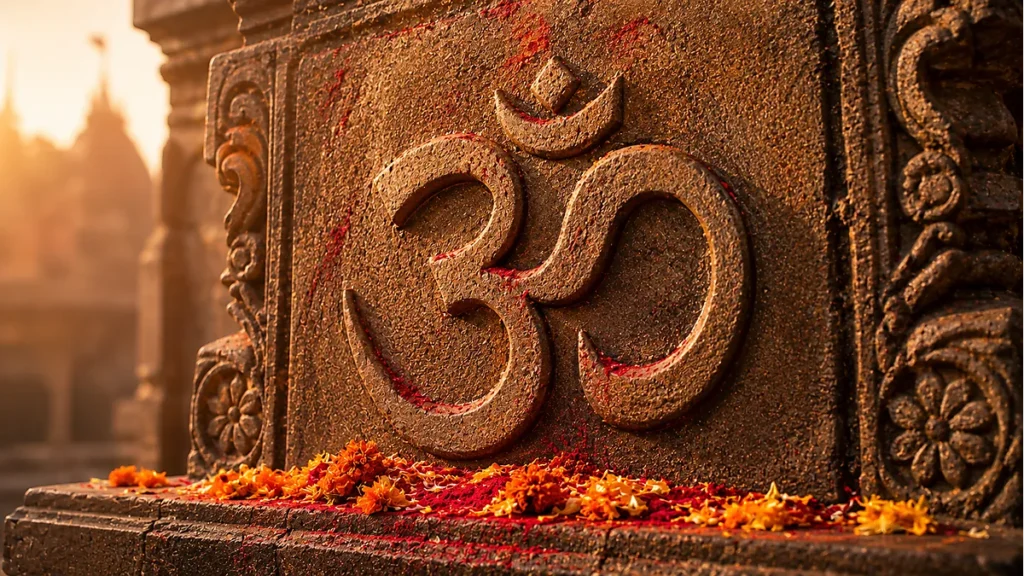
Om — also written and pronounced as Aum — is considered the most sacred sound, syllable, and mantra in Sanātana Dharma.[7]
It is not simply the beginning of a prayer.
It is not just a word.
Om is understood to be the primordial vibration from which all of creation emerged — the very first “voice” of the universe before language, before light, before time itself.[1]
Think of it this way. Scientists say the universe began with a Big Bang — a colossal explosion of sound and energy that set everything in motion. The sages of ancient India arrived at the same truth thousands of years earlier, and they gave that first sound a name: Om.[8]
“It is the one sound that contains everything else — ekākṣara, the one thing that is not perishable — akṣara — and the one sound that should begin and end every ritual — Pranava.”[7]
This is why more than a billion people in the world today begin every prayer, every yoga class, every meditation, every temple ceremony, and every sacred recitation with this one syllable. It is not habit. It is memory — a cellular, spiritual memory that your very nervous system recognizes.
Where Did Om Come From? — Textual Origins
Om in the Vedic Dawn
The story of Om does not begin in any single book. It begins in the oldest layer of human spiritual memory.
The Vedas — the most ancient scriptures of Sanātana Dharma, composed between approximately 1500 and 1200 BCE or even earlier — treat Om not merely as a syllable, but as the living breath of all Vedic ritual.[1]
In Vedic fire ceremonies, every mantra, every invocation, every hymn to the great gods — Agni, Indra, Soma, Varuna — opened and closed with Om. It was the energetic seal that made a mantra complete, the way a key makes a lock functional. Without it, the ancient priests believed the ritual was empty.
The Vedas carry a concept they call Vāc — the goddess of sacred speech, the divine power of sound. Vāc is understood as the primordial energy from which all existence originates and within which it subsists. Om is the highest, purest expression of Vāc — the sound beyond all sounds.[7]
Om and the Upanishads
If the Vedas established Om as the foundation of ritual, the Upanishads took it even deeper — into the realm of pure consciousness.
The Māṇḍūkya Upaniṣad, one of the twelve principal Upanishads linked to the Atharva Veda, is the shortest yet most explosive of all Upanishads. Just twelve verses. And it opens with one of the most breathtaking statements in all of world philosophy:[9][8]
🕉️ Verse I — Māṇḍūkya Upaniṣad, Mantra 1
1. Devanāgarī:
ॐ इत्येतदक्षरमिदं सर्वं तस्योपव्याख्यानं भूतं भवद्भविष्यदिति सर्वमोङ्कार एव। यच्चान्यत् त्रिकालातीतं तदप्योङ्कार एव।।
2. IAST Transliteration:
Oṁ ityetadakṣaramidaṃ sarvaṃ tasyopavyākhyānaṃ bhūtaṃ bhavadbhaviṣyaditi sarvamoṅkāra eva | yaccānyattrikālātītaṃ tadapyoṅkāra eva ||
3. Citation: Source: Māṇḍūkya Upaniṣad, Mantra 1[2][3]
4. Word-by-Word Meaning:
- ॐ (Oṁ) — the sacred syllable Om
- एतद् अक्षरम् (etad akṣaram) — this imperishable syllable
- इदं सर्वम् (idaṃ sarvam) — is all this (the entire universe)
- भूतम् (bhūtam) — the past
- भवत् (bhavat) — the present
- भविष्यत् (bhaviṣyat) — the future
- सर्वम् ओङ्कार एव (sarvam oṅkāra eva) — all is verily Om
- त्रिकालातीतम् (trikālātītam) — beyond the three divisions of time
- तद् अपि (tad api) — that also
5. Simple Translation:
“Om — this syllable is all this. All that is past, present, and future — all that is Om. And whatever is beyond the three divisions of time — that too is Om.”
6. Practical Life Takeaway:
When you chant Om, you are not chanting a word. You are aligning yourself with the totality of existence — past, future, and this present breath. In your daily life, beginning even five minutes of stillness with Om anchors your mind in something much larger than your anxieties. It whispers: everything is held, everything is whole.[3]
The Chāndogya Upaniṣad (1.1.1), one of the oldest and most voluminous Upanishads, opens with a thunderbolt:[4]
“Om iti etat akṣaram udgītham upāsīta — Om, this syllable, meditate upon as the Udgītha.”[4]
The Udgītha is the high note of the Sāmaveda chanting tradition — the soaring melody sung by the Udgātā priest during fire sacrifices. The Upanishad is saying: the very highest expression of divine song is nothing but Om.[4]
The Kaṭha Upaniṣad also beautifully declares Om as the supreme goal of all Vedic knowledge — the one word that all scriptures seek to express, that all austerities strive to attain:
“Sarve Vedā yat padam āmananti — that goal which all the Vedas proclaim, which all austerities declare, desiring which they live the life of brahmacharya — that goal is Om.” (Source: Kaṭha Upaniṣad, 1.2.15 — verse paraphrase of the tradition; exact Devanāgarī omitted for scholarly integrity.)
Om in the Bhagavad Gītā
Lord Krishna, speaking to Arjuna on the battlefield of Kurukshetra, elevates Om as the cosmic signature of the Absolute:[10][5][6]
🕉️ Verse II — Bhagavad Gītā, Chapter 17, Verse 23
1. Devanāgarī:
ॐ तत्सदिति निर्देशो ब्रह्मणस्त्रिविधः स्मृतः।
ब्राह्मणास्तेन वेदाश्च यज्ञाश्च विहिताः पुरा।।१७.२३।।
2. IAST Transliteration:
Oṁ tat sad iti nirdeśho brahmaṇas tri-vidhaḥ smṛitaḥ | brāhmaṇās tena vedāśh cha yajñāśh cha vihitāḥ purā ||
3. Citation: Source: Bhagavad Gītā, Chapter 17, Verse 23[5][6]
4. Word-by-Word Meaning:
- ॐ तत् सत् (Oṁ tat sat) — Om, That, Truth / Existence
- निर्देशः (nirdeśaḥ) — the designation / symbolic name
- ब्रह्मणः (brahmaṇaḥ) — of Brahman, the Absolute
- त्रिविधः (tri-vidhaḥ) — threefold
- स्मृतः (smṛitaḥ) — has been declared / remembered
- ब्राह्मणाः (brāhmaṇāḥ) — the priests / the knowers
- तेन (tena) — by that
- वेदाः (vedāḥ) — the Vedas
- यज्ञाः (yajñāḥ) — the sacrifices / sacred rites
- विहिताः पुरा (vihitāḥ purā) — were ordained from the beginning
5. Simple Translation:
“Om, Tat, Sat — this threefold designation of Brahman has been declared. By that, the Brahmins, the Vedas, and the sacrifices were all established from the very beginning.”
6. Practical Life Takeaway:
Krishna is telling Arjuna — and us — that Om is not a later addition to spiritual life. It is the foundational frequency. Every act of dharma, every sincere offering, every moment of truthful living, when dedicated with Om, becomes sacred. Begin your work day with Om. Dedicate your efforts with Om. You transform the ordinary into the consecrated.[10]
Om as Pranava
The tradition also calls Om the Pranava — from the Sanskrit root pra + nu, meaning “to resound thoroughly” or “to be constantly praised.”[7]
Pranava does not just mean a mantra. It means the eternal resonance — the divine sound that is perpetually vibrating at the foundation of all existence, whether or not any human being is chanting it.
This is the extraordinary claim of Sanātana Dharma: Om is not something we invented. We discovered it. The universe was already speaking it. We simply learned to listen.
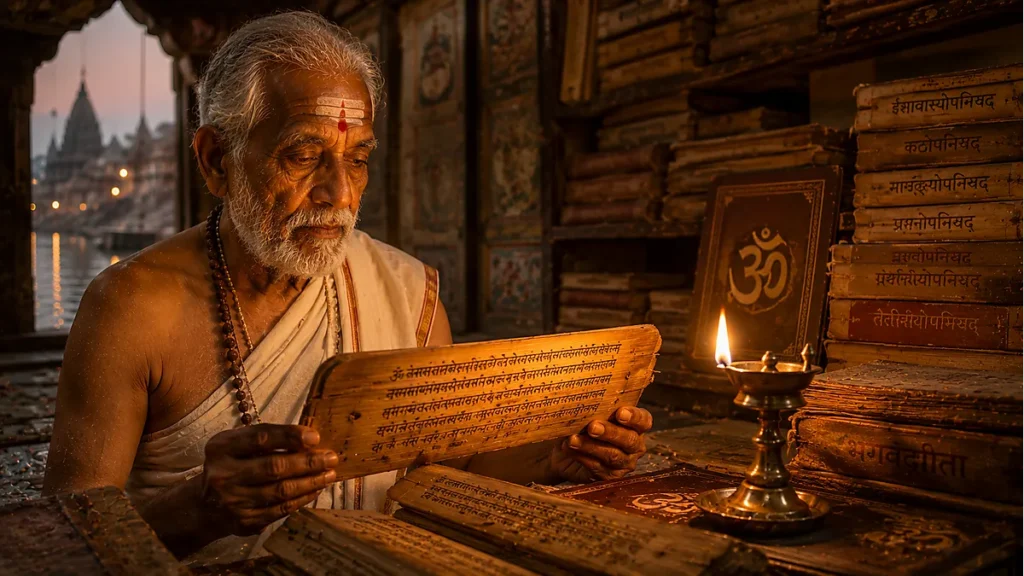
The Cosmic Story of Om — Before the Universe Began
Imagine there was a moment — before the first star, before the first atom — when existence was one vast, dark, undifferentiated ocean of pure potential.
No light. No form. No movement. Just infinite, pregnant stillness.
The ancient Puranic texts describe this as Pralaya — the cosmic dissolution between one universe and the next, when all creation has been withdrawn back into its source, like breath drawn inward.[1]
Then, from within that fathomless silence — something stirred.
Not a thought. Not a decision. A vibration.
Nāda Brahma — God Is Sound
The deepest concept in Sanātana Dharma’s understanding of creation is Nāda Brahma — “the universe is sound.” Not that the universe makes sound. Not that sound describes the universe. The universe is sound.[7]
The sages who sat in deep meditation for years and decades in the Himalayan forests — listening beyond the noise of the world, beyond the chatter of the mind, beyond the beating of their own hearts — they all reported the same thing: underneath everything, there is a hum.
A base frequency. A cosmic drone.
They called it Anāhata Nāda — the unstruck sound. The sound that is not made by any two things colliding. The sound that simply is, like the background radiation of the cosmos.
And when these sages tried to express that sound in human language, in a syllable the human voice could approximate — they arrived at: Om.
The Three Gods and the Three Sounds
The classical Puranic tradition makes a breathtaking symbolic connection: the three sounds within Om — A, U, and M — correspond to the three great cosmic forces that sustain all creation.[1][7]
- A (अ) — the sound of Brahmā, the Creator. The opening of the mouth. The beginning. The breath released. Creation springing forth.
- U (उ) — the sound of Viṣṇu, the Preserver. The sound sustained. The universe in its ongoing, flowing existence. Life being lived.
- M (म्) — the sound of Śiva, the Transformer and Dissolver. The lips closing. The breath returning. Dissolution back into pure awareness.
“OM is the three Vedas — the Ṛk, the Sāman, and the Yajus. OM is the three worlds. OM is the three fires. OM is the three gods — Viṣṇu, Brahmā, and Hara.”[1]
Think of it like the tide. The ocean rises (Brahmā — creation), it flows (Viṣṇu — preservation), it recedes (Śiva — dissolution). And then it rises again. Eternally. That rhythm — rise, sustain, dissolve — is the rhythm of Om.[1]
The Birth of Om from the Cosmic Egg
One of the most magnificent cosmogonic passages in the Purāṇas — from the Mārkaṇḍeya Purāṇa — describes the moment when the cosmic egg broke open:[1]
“From it, Om was born. Then arose Bhūḥ, matchless Bhuvaḥ, and third, the sound Svaḥ. Together they are known as Bhūr-Bhuvaḥ-Svaḥ. From this arose the sacred syllable that became the foundation of the Gāyatrī Mantra and the whole of Vedic cosmology.”[1]
Om came first. Before the three worlds. Before the gods themselves took their thrones. Before the first human opened their eyes. The universe opened like a flower — and Om was its first breath.
Om and the Sleeping Viṣṇu
The Purāṇas also speak of Viṣṇu, the great Preserver, lying in cosmic sleep upon the infinite serpent Ananta in the primal ocean — Oṃkāra resonating within him like the silence between heartbeats.[1]
At the moment of creation, as Brahmā arises from the lotus emerging from Viṣṇu’s navel, the first syllable that vibrates through the cosmos is Om.
This is why, in every Hindu temple, in every ārati ceremony, in every breath of a practitioner stepping onto their prayer mat — they begin with Om. They are re-enacting the birth of the universe. They are remembering that they, too, are made of that same primordial sound.
The Hidden Wisdom of A-U-M — Psychology of the Sacred Sound
The genius of the Māṇḍūkya Upaniṣad is not just that it declares Om to be everything — it explains precisely how Om maps onto the totality of human consciousness.
This is where ancient philosophy becomes breathtaking modern psychology.
The Four Quarters of Om
The Māṇḍūkya Upaniṣad tells us that Om has four parts (pādas) — not three, but four.[9][8]
| Sound | State of Consciousness | Experience |
| A (अ) | Vaiśvānara — Waking state | The world you see, touch, taste, and hear |
| U (उ) | Taijasa — Dreaming state | The inner world of dreams and imagination |
| M (म्) | Prājña — Deep sleep | The undifferentiated silence of dreamless rest |
| Silence after Om | Turīya — The Fourth | Pure Awareness — beyond all three states |
Consider what this means.
Every single experience you will ever have in your entire life — waking, dreaming, or sleeping — is contained within the sound of Om.[8][9]
When you are rushing through a busy day in Delhi, navigating traffic, answering messages — that is the A state, the waking world.
When you close your eyes and your mind wanders into fantasy, memory, fear, hope — that is the U state, the dreaming mind.
When you fall into the deep, wordless rest of dreamless sleep and wake feeling completely refreshed — that is the M state, the quiet, healing darkness.
And that profound stillness you sometimes touch in very deep meditation — when you are neither thinking nor sleeping, just purely aware — that is the Silence after Om. That is Turīya. That is what the sages call Brahman — pure, unbounded Consciousness itself.
Why Om Calms the Nervous System
Modern neuroscience has begun to confirm what the rishis knew intuitively.
When you chant Om, the extended M-m-m vibration directly stimulates the vagus nerve — the body’s master calming system — through the vibration in the chest and nasal cavity. The slow, deep breathing required to produce a sustained Om activates the parasympathetic nervous system, reducing cortisol, lowering heart rate, and easing anxiety.
The ancient sages designed it that way. They understood the body as the finest instrument — and Om as its tuning fork.
“A man who knows this completely, who meditates on it repeatedly, escapes the round of rebirth, his three-fold fetters loosed. He wins absorption in Brahman, in the supreme ultimate Self.”[1]
The Silence Is the Point
Here is perhaps the most profound secret of Om that most people miss.
The sound of Om is not the destination. The silence after Om is the destination.
When a roomful of people chant “Ommm…” and the sound fades — that moment of silence that follows is electrically alive. You can feel it. Your mind, which was racing a moment ago, is suddenly quiet, open, present.
That silence is called Turīya — the Fourth — in the Māṇḍūkya tradition. It is your own natural, uncluttered awareness.[9][8]
The chant of Om is like sweeping a dusty mirror. The mirror was always there. The sound simply cleared it.
The Pilgrim’s Path — Om in Sacred Geography
Om is not only an inner journey. It is also written into the landscape of India herself.
If you travel through the sacred geography of Bhārata — from the confluence at Prayagraj to the burning ghats of Kashi, from the temple bells of Rishikesh to the icy heights of Kedarnath — you will find Om not merely spoken, but lived in stone, water, fire, and community.
Prayagraj — The Confluence of Everything
Prayagraj — the city sitting at the Triveni Sangam, the meeting of the Ganga, Yamuna, and the invisible Sarasvatī — is perhaps the holiest gathering point on earth.
Here, at Kumbha Mela, tens of millions of pilgrims descend not simply to bathe, but to dissolve. To let the current carry away every identity, every burden, every fear — to merge, momentarily, with something infinite.
This is Om in its physical form. Three rivers becoming one, the way A, U, and M become a single vibration.[1]
The dawn rituals at Prayagraj begin before the sun rises. From the ashrams clustered along the river, the sound of hundreds of practitioners chanting Om rises before the first light breaks. Pilgrims standing waist-deep in the cold Ganga feel the sound vibrate through the water itself.
If you visit Prayagraj during Kumbha or Māgh Mela, arrive before sunrise at the Sangam. Sit on the sandy bank. Close your eyes. Listen. You will understand, without any explanation, exactly why the rishis chose this sound.
Kashi — Varanasi — Where Om Burns
Varanasi — the city that never sleeps, that Śiva himself is said to hold balanced on his trident — is a living Om.
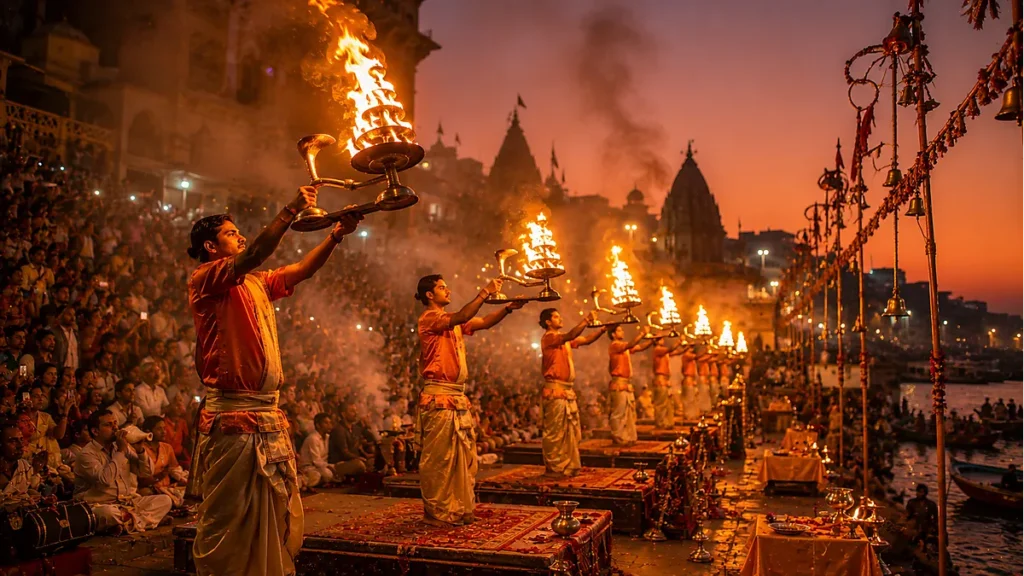
The famous Ganga Ārati at Dashāshwamedh Ghat, performed every evening at sunset, is one of the most breathtaking spectacles on earth. Seven priests in perfect synchrony, seven massive brass lamps with blazing flames, conch shells wailing, drums beating — and underneath it all, the sustained drone of Om that never fully stops.
The ghats of Varanasi are lined with small shrines, each one bearing the Om symbol in weathered stone or bright fresh paint. The entire city vibrates at a frequency that visitors from all over the world describe, without having any spiritual vocabulary for it, as different.[7][1]
Rishikesh — Where Om Meets the Mountains
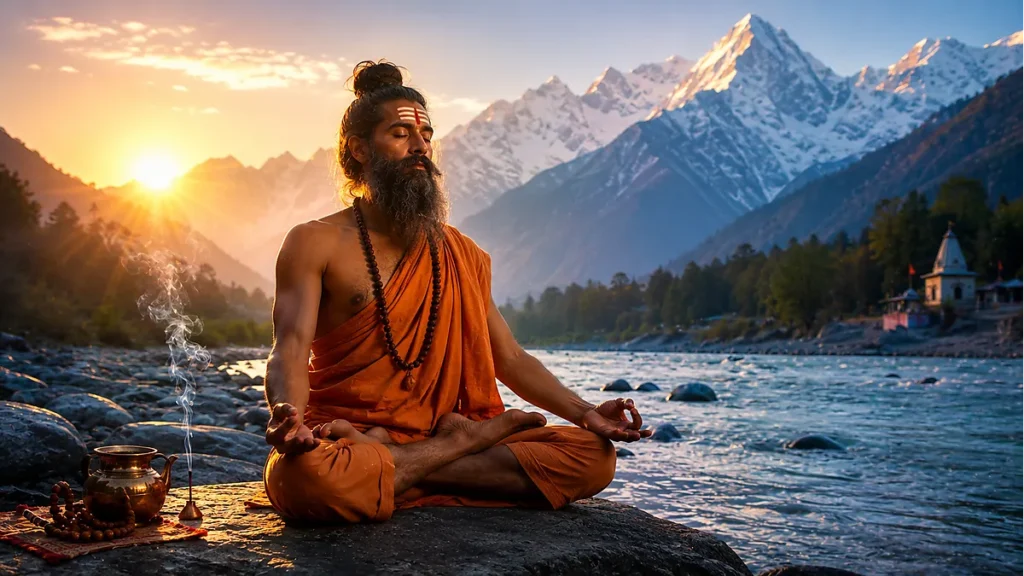
Rishikesh, at the gateway to the Himalayas where the Ganga descends from the mountains and enters the plains, is internationally recognized as the “Yoga Capital of the World” for good reason.
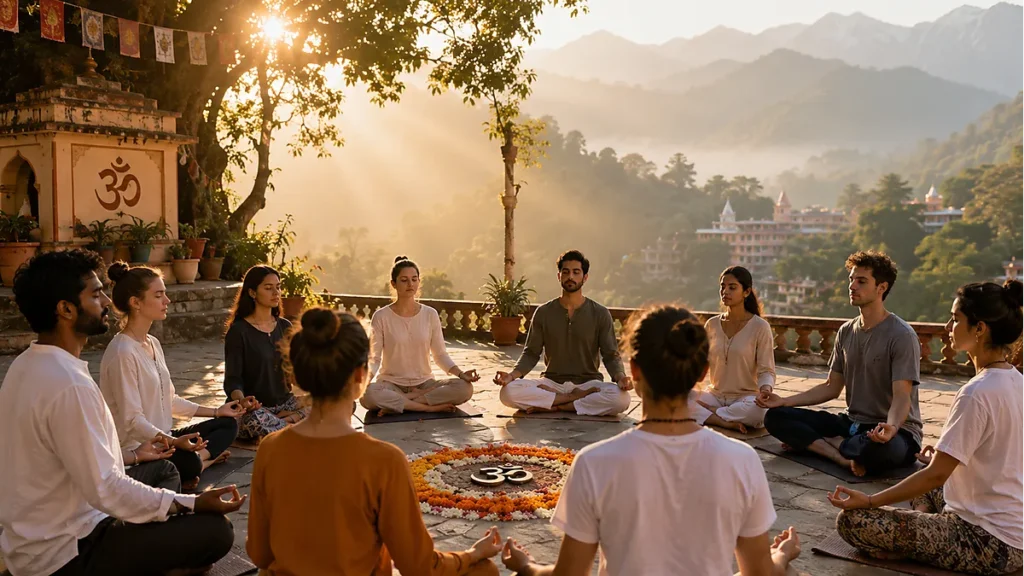
Here, Om is not only chanted — it is taught, investigated, contemplated, and lived. Dozens of ashrams along the banks of the Ganga — from the famous Parmarth Niketan to the quieter hermitages tucked into the forested hillsides — begin every single day with Om chanting at dawn.
The physical environment of Rishikesh seems to amplify the practice. The roar of the Ganga creates a natural white noise — a Nāda — against which the chant of Om feels perfectly at home.
Kedarnath — The Himalayas as Om’s Home
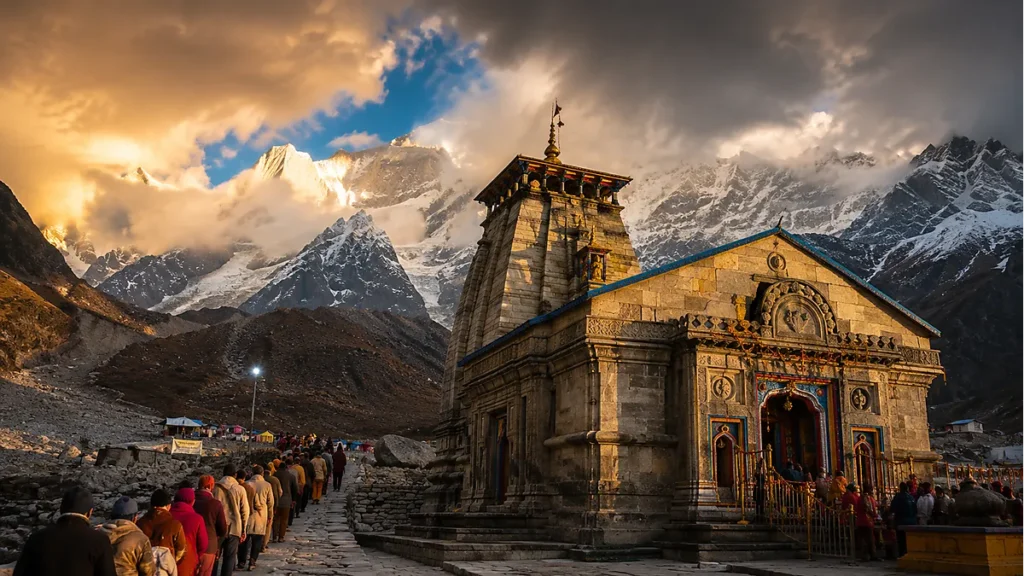
At 12,000 feet in the Himalayas, in the shadow of the snow-covered peak of Kedarnath, sits one of the twelve Jyotirlingas — the self-manifested shrines of Lord Śiva.
The approach to Kedarnath, through high-altitude meadows and glacial silence, is itself a meditation. There is no city noise. No traffic. Just wind, stone, and the sound of your own breath. Pilgrims who make this journey describe a peculiar sensation on the final ascent: the mountains themselves seem to be humming.
When the temple priests perform the morning Rudra Abhisheka, chanting the Śrī Rudram — one of the most ancient Vedic hymns — with Om woven through every verse, the sound bounces off the stone walls of the ancient temple and seems to fill the entire valley.[7]
The Temple as Om Made Physical
Every great temple of Sanātana Dharma is, at its deepest architectural level, a physical representation of Om and the human being’s journey toward its source.
The Garbhagṛha — the innermost sanctum — is the place of Turīya, of pure awareness, of Śiva’s absolute stillness. It is almost always dark, small, and silent. You must bow low to enter. The transition from the noisy outer world to the dark inner sanctum enacts the journey from the A-state (waking/noise) to the silence after Om (pure presence).[11]
The Om symbol itself is carved into doorways, temple towers, ritual vessels, and the foreheads of devotees all across India. It is everywhere because it represents everything.[7]
Bringing Om Home — Everyday Practice
Here is the beautiful thing about Om: you do not need a temple, a guru, a pilgrimage, or a single rupee to access it.
Om is always available. It is already inside you. It is the ground frequency of your own awareness.
Here is how an ordinary, busy person — a student, a parent, a professional, a grandmother — can make Om a living part of their daily life.
A Simple Morning Om Practice (5–10 minutes)
Step 1 — Create Your Space
Find any quiet corner. Light a single diya or candle if you have one. Even a window with morning light is enough. Sit comfortably — cross-legged on the floor, or in a chair with your spine upright.
Step 2 — Three Deep Breaths
Before you chant, simply breathe. Inhale through the nose for a count of 4. Hold gently for 2. Exhale slowly for 6. Do this three times. Let your body signal your nervous system: we are safe, we are still.
Step 3 — Chant Om Aloud (3 times)
Take a full, deep breath in. As you exhale, allow the sound to emerge naturally:
- A — open your mouth wide, let the sound begin in your belly
- U — lips begin to close, the sound rises to your chest and throat
- M — lips seal, the vibration moves through your skull and forehead
- Silence — hold the silence for 3–5 seconds before your next breath
Do not rush. Do not perform. Simply allow.
Step 4 — Sit in the Silence (3 minutes)
After your three Om chants, sit quietly. Do not meditate on anything in particular. Just be. Notice the quality of the silence. Notice your own presence. This is the most important step.
Step 5 — A Simple Sankalpa (Intention)
Before you rise, quietly offer your day. You might simply think: “May my thoughts, words, and actions today align with what is true and good.” Then rise with that feeling still alive in your chest.
Om in Family Life
Teaching children to chant Om is one of the most profound gifts a parent can offer.
Begin simply: after morning puja or before meals, chant a single Om together as a family. No explanation required. Children absorb the vibration instinctively — their nervous systems respond immediately to the calming resonance.
For elderly family members who may struggle with long prayers or complex rituals, three rounds of Om chanting before bed is a complete practice in itself. The Māṇḍūkya Upaniṣad assures us that even this is enough.[8][9]
Om in Yoga Practice
In the yoga tradition, Om is chanted three times at the opening and closing of every session. This is not decorative. It serves a specific function:[7][1]
- The opening Om gathers your scattered attention and plants it in the present moment
- The closing Om seals the practice — dedicating the merit of the session to something beyond your personal ego
Even if you only practice yoga online or in a gym, honour this tradition. It takes fifteen seconds, costs nothing, and changes the quality of your practice completely.
The Om Mālā — 108 Chants
For those who wish to go deeper, the traditional practice of chanting Om 108 times on a mālā (prayer beads) is among the most powerful forms of japa (repetitive chanting) available.
108 is not an arbitrary number. In Vedic mathematics and cosmic geometry, 108 carries profound significance — the distance between the Earth and the Sun is approximately 108 times the diameter of the Sun, and the distance between the Earth and the Moon is approximately 108 times the Moon’s diameter.
When you complete 108 rounds of Om, you are — in a very precise sense — aligning yourself with cosmic proportion.
The Verses That Hold Eternity
Throughout the ages, the sages and seers who most deeply understood Om did not merely explain it — they sang it, wept it, laughed it, and ultimately became it in their deepest moments of meditation.
Here is one more verse that is perhaps the most electrifying single statement about Om in all of Vedic literature — quoted directly from the classical Purāṇic tradition:
🕉️ Verse III — From the Classical Purāṇic Tradition on Om
Devanagari:
अप्रमत्तेन वेद्धव्यं शरवत्तन्मयो भवेत् ।
ओमित्येतत् त्रयो वेदास्त्रयो लोकास्त्रयोऽग्नयः ॥ ८ ॥
IAST Transliteration:
apramattena veddhavyaṃ śaravat tanmayo bhavet |
om ity etat trayo vedās trayo lokās trayo ’gnayaḥ || 8 ||
Exact Source Citation:
Source: Mārkaṇḍeya Purāṇa, Chapter 42, Verse 8.[2]
Word-by-word Meaning:
- अप्रमत्तेन (apramattena) – by one who is vigilant, careful
- वेद्धव्यम् (veddhavyam) – should be pierced / realized
- शरवत् (śaravat) – like an arrow
- तन्मयः (tanmayaḥ) – absorbed in that, identified with that
- भवेत् (bhavet) – becomes
- ओम् (om) – OM
- इति (iti) – thus
- एतत् (etat) – this
- त्रयः (trayaḥ) – three
- वेदाः (vedāḥ) – Vedas
- त्रयः (trayaḥ) – three
- लोकाः (lokāḥ) – worlds
- त्रयः (trayaḥ) – three
- अग्नयः (agnayaḥ) – fires
Simple Translation:
OM should be realized by the vigilant person, and one should become fully absorbed in it like an arrow. OM represents the three Vedas, the three worlds, and the three sacred fires.
Practical Life Takeaway:
The Purāṇas are saying something radical here: Om is not a technique. Om is not a method. Om is a destination. It is the very nature of the Absolute. When you chant Om with full sincerity and awareness, you are not invoking something outside yourself — you are recognizing something that is already the deepest truth of your own being.
The Silence That Follows
There is something the ancient sages knew that modern life has all but forgotten.
The most important moment in the chanting of Om is not the sound. It is the pause after the sound.
In that pause — that three-second, ten-second, or ten-minute space of pure stillness — the mind touches what it has been looking for in every experience it has ever sought.
Peace that does not depend on circumstances.
Awareness that is not threatened by fear.
A silence that is somehow full — not empty, not lonely, but complete.
Core Life Lessons from the Wisdom of Om
| Sanskrit Concept | Meaning | Life Application |
| Ekākṣara | Om as the One Imperishable Syllable | Simplicity. The deepest truth is not complex. |
| Pranava | The Eternal Resonance | Your life is meant to be an ongoing prayer, not just a Sunday ritual. |
| Turīya | The Fourth State — Pure Awareness | Your natural state of peace is never destroyed. It is only forgotten. |
| Nāda Brahma | The Universe is Sound | Every act of creation — art, music, speech, kindness — is sacred. |
| A-U-M | Creation, Preservation, Dissolution | Every experience in life — joy, stability, loss — has its place and its purpose. |
A Final Word by the River

Somewhere right now, at the Sangam at Prayagraj, or on the ghats at Varanasi, or in a mountain ashram above Rishikesh — someone is sitting still.
Their eyes are closed.
Their lips are barely moving.
And rising from somewhere deeper than their lungs, vibrating through their chest and skull, expanding outward into the cool morning air —
“Ommmmmm…”
And then.
Silence.
That silence is not the absence of Om.
That silence is Om.
And it has been waiting — inside you, patient and unchanged, through every one of your days — waiting for the moment when you grow quiet enough to hear it.
Everything existent and non-existent may be grasped by pronouncing OM appears in the expanded explanation of this teaching in the same tradition.
Devanagari:
ओमित्येतदखिलं जगत् प्रोक्तं तद्विशिष्टं ब्रह्मैतत् स्वयम्भुवः ।
यः एनं वेत्ति सोऽश्नुते तद्ब्रह्म परं पदम् ॥
IAST:
om ity etad akhilaṃ jagat proktaṃ tadviśiṣṭaṃ brahma etat svayambhuvaḥ |
yaḥ enaṃ vetti so ’śnute tad brahma paraṃ padam ||
Source Citation:
Source: Mārkaṇḍeya Purāṇa, Chapter 42;
Word-by-word meaning:
- ओम् (om) – OM, the sacred syllable.
- इति (iti) – thus.
- एतत् (etat) – this.
- अखिलम् (akhilam) – all, entire.
- जगत् (jagat) – the world.
- प्रोक्तम् (proktam) – is declared.
- तत् (tat) – that.
- विशिष्टम् (viśiṣṭam) – distinguished, supreme.
- ब्रह्म (brahma) – Brahman.
- एतत् (etat) – this.
- स्वयम्भुवः (svayambhuvaḥ) – of the self-existent one.
- यः (yaḥ) – who.
- एनम् (enam) – this.
- वेत्ति (vetti) – knows.
- सः (saḥ) – he.
- अश्नुते (aśnute) – attains.
- तत् (tat) – that.
- ब्रह्म (brahma) – Brahman.
- परम् (param) – supreme.
- पदम् (padam) – state, abode.
Simple translation:
OM is declared to be all this universe, and also the supreme Brahman. One who truly knows this attains that supreme state of Brahman.
Practical life takeaway:
This teaching turns OM into more than a mantra; it becomes a reminder that the whole of life can be held in awareness and returned to the Divine. Repeating OM with understanding is meant to steady the mind, lift it beyond fragmentation, and point it toward liberation.
“Everything existent and non-existent will be grasped by pronouncing OM. A man who knows this completely, who meditates on it repeatedly, escapes the round of rebirth. He wins absorption in Brahman — in the supreme, ultimate Self.”[1]
If you are planning a spiritual journey to Prayagraj, Varanasi, Rishikesh, or Kedarnath to experience the living tradition of Om, visit prayagtourism.com for detailed pilgrimage guides, ghat maps, ashram recommendations, and seasonal festival schedules.
⁂
References:
- Classical Hindu Mythology: A Reader in the Sanskrit Purāṇas — Cornelia Dimmitt and J. A. B. van Buitenen — Temple University Press — 1978.
- https://www.wisdomlib.org/hinduism/book/mandukya-upanishad-karika-bhashya/d/doc143592.html
- https://shlokam.org/texts/mandukya-1/
- https://www.wisdomlib.org/hinduism/book/chandogya-upanishad-english/d/doc238710.html
- https://bhagavadgita.com/chapter/17/verse/23
- https://www.gitasupersite.iitk.ac.in/srimad?ecsiva=1&etsiva=1&etpurohit=1&etgb=1&setgb=1&etssa=1&etassa=1&etradi=1&etadi=1&language=dv&field_chapter_value=17&field_nsutra_value=23
- Handbook of Hindu Mythology — George M. Williams — ABC-CLIO — 2003
- https://en.wikipedia.org/wiki/Mandukya_Upanishad
- https://www.omashram.com/article/om-in-mandukya-upanishad
- https://www.bhagavadgitaforall.com/verses/17-23
- Hindu Temples: What Happened to Them? Vols. 1–2 — Sita Ram Goel and others — Voice of India, Delhi — 1990–1993
- Studies in Hindu Law and Dharmāstra — Ludo Rocher, edited with introduction by Donald R. Davis, Jr. — Anthem Press — 2012.
- iInterpretations of the Bhagavad-Gita and Images of the Hindu Tradition: The Song of the Lord — Catherine A. Robinson — Routledge — 2006 (paperback edition 2013).
- Decolonizing the Hindu Mind: Ideological Development of Hindu Revivalism — Koenraad Elst — Rupa Publications India — 2001 (ed. 2005).
- Hindutva: Who Is a Hindu? — V. D. Savarkar — Bharati Sahitya Sadan, Delhi — 1923 (reprints incl. 1989).
- Hindu Temples: What Happened to Them? Vols. 1–2 — Sita Ram Goel and others — Voice of India, Delhi — 1990–1993.
- Hindu Rulers, Muslim Subjects: Islam, Rights, and the History of Kashmir — Mridu Rai — Permanent Black / Orient Blackswan — 2004 (e-edition 2012).
- Handbook of Hindu Mythology — George M. Williams — ABC-CLIO — 2003.
- https://www.tripurashakti.com/mandukya-upanishad-12-verses-on-aum
- https://yogainternational.com/article/view/scripture-commentary-mandukya-upanishad/
- https://en.wikipedia.org/wiki/Chandogya_Upanishad
- https://cdn.vivekavani.com/mau1/
- https://vivekavani.com/chu/
- https://sanskritdocuments.org/doc_upanishhat/maandu.html
- https://www.holy-bhagavad-gita.org/chapter/17/verse/23/