
Ritual · Hinduism knowledge portal
Aarti
Lamp offerings accompanied by prayer or song in many worship settings.
1. Introduction and Sanskrit Etymology
Aarti holds a foundational place within Hindu Rituals and Practices on the Prayag Hinduism Portal. In Sanskrit philology and religious studies, its meaning is rooted in precise linguistic usage: From the Sanskrit Ārātrika (‘that which removes darkness, rātri’) or Ārti (‘earnest longing of the heart to behold the Divine’), also termed Nīrājana (‘luminous waving of light’) and Dīpārādhanā. Across Hindu tradition, Aarti connects scriptural revelation (Śruti), remembered tradition (Smṛti), philosophical inquiry (Darśana), ritual practice (Upāsanā), and sacred geography (Encyclopaedia Britannica – Arti (Hindu Ritual)). Across both domestic household altars (gṛha-pūjā) and public temple sanctuaries (mandira-pūjā), this liturgical practice transforms external sensory offerings and disciplined vows into an inward cultivation of mindfulness, gratitude, and mental purity (citta-śuddhi).
2. Historical and Traditional Background
Primary scriptures and classical treatises that document and illuminate Aarti include: Muṇḍaka Upaniṣad (2.2.10) / Kaṭha Upaniṣad (2.2.15) / Śvetāśvatara Upaniṣad (6.14); Skanda Purāṇa; Kāmikāgama; Pandit Śraddhārām Phillaurī’s Om Jaya Jagadīśa Hare (1870s). (Encyclopaedia Britannica – Puja and Hindu Ritual Practice). Its historical trajectory spans key epochs of Indian civilization: Evolved from the Vedic fire offering and the classical Nīrājana rite (waving auspicious lamps to ward off inauspiciousness and illuminate the consecrated form of the deity during night and temple hours) into the joyous, participatory climax of every Hindu pūjā. Academic scholarship reads these primary texts alongside epigraphic, archaeological, and manuscript evidence to distinguish traditional narrative, theological commentary, and historical chronology accurately.
“Na tatra sūryo bhāti na candra-tārakaṃ nemā vidyuto bhānti kuto ‘yam agniḥ / tam eva bhāntam anubhāti sarvaṃ tasya bhāsā sarvam idaṃ vibhāti” — “There neither the sun shines, nor the moon and stars, nor do these lightnings shine—how then could this earthly fire? Following His shining alone does all else shine; by His radiance is all this universe illuminated!” (Kaṭha Upaniṣad 2.2.15 / Muṇḍaka Upaniṣad 2.2.10 (Recited as the Vedic Mantra-Āratī), Encyclopaedia Britannica – Arti (Hindu Ritual))
3. Main Concepts and Philosophical Explanation
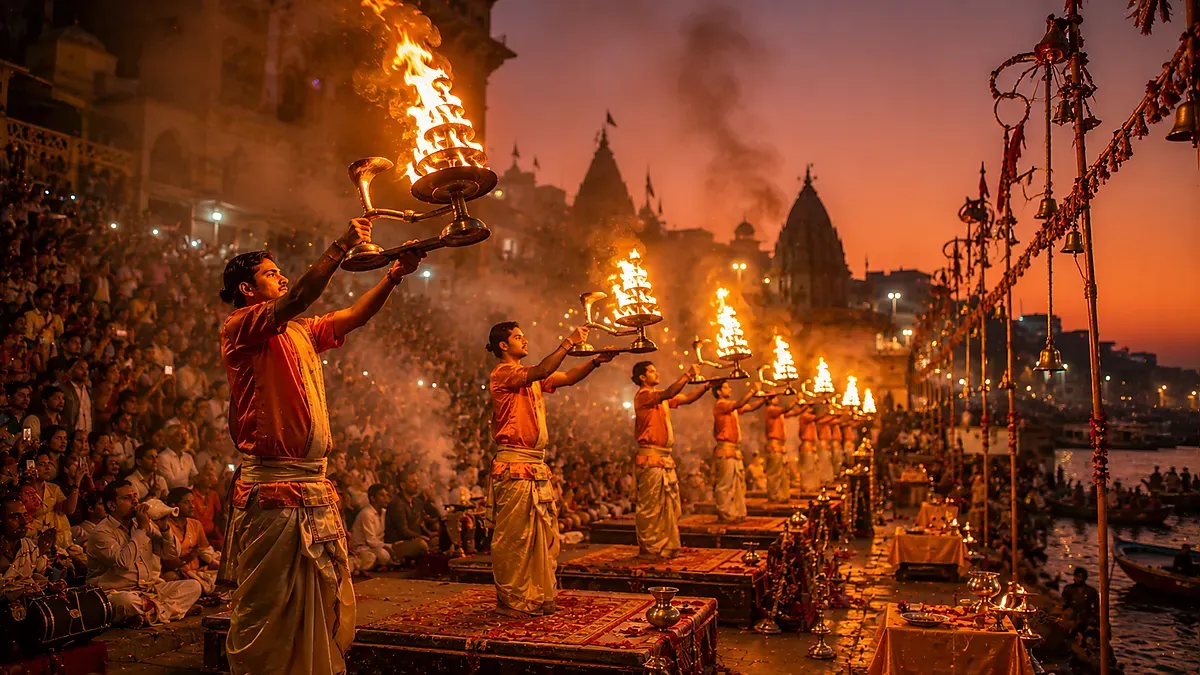
The core conceptual and theological structure of Aarti has been articulated by sages (ṛṣis) and commentators (ācāryas) across centuries: Examines the liturgical procedure and symbolism of Āratī: a brass, silver, or clay lamp (Dīpa / Pañcapradīpa holding one, five, seven, or twenty-one cotton wicks soaked in pure ghī or fragrant camphor / karpūra) is waved in slow, clockwise circles before the deity—first at the lotus feet (4 times), then the navel (2 times), the face (1 time), and around the entire form (7 times), tracing the sacred geometry of the syllable Oṃ—while worshippers ring bells (ghaṇṭā), blow conches (śaṅkha), beat ḍamaru or nagārā drums, and sing choral Āratī hymns. Within the pluralistic spectrum of Hinduism, Vaiṣṇava, Śaiva, Śākta, and Smārta lineages alongside the six classical darśanas (IEP – Hindu Philosophy) interpret these principles through complementary lenses of knowledge (jñāna), devotion (bhakti), righteous action (karma), and meditation (dhyāna).
4. Important Aspects, Classifications, and Editorial Scope
Key classifications, structural subdivisions, and traditional varieties of Aarti include: Analyzes the profound spiritual meaning of the *Camphor Flame (Karpūra-gaura): camphor burns completely with a fragrant, luminous flame and leaves zero ash or residue behind—symbolizing how the devotee’s ego (ahaṃkāra) and latent karmic impressions (vāsanās*) should dissolve completely in the fire of divine knowledge and love. Afterward, the lamp is carried among the congregation, and devotees cup both palms over the warm flame and touch their eyes and forehead (Āratī-grahana), receiving the blessing of inner light. Also highlights the grand evening River Āratīs (Gaṅgā Āratī at the Triveni Sangam in Prayagraj, Dashashwamedh Ghat in Varanasi, and Har Ki Pauri in Haridwar, and Sarayū Āratī in Ayodhyā). Editorial differentiation within this portal: Focuses specifically on the ritual of Aarti (Nīrājana), the Upanishadic light mantra, camphor symbolism, clockwise Oṃ-tracing mechanics, and sacred river Āratīs.
5. Regional Traditions and Contemporary Relevance
Across the diverse regions of India and the global diaspora, Aarti is sustained through living customs, seasonal observances, and pilgrimage networks: Features beloved regional hymns such as Om Jaya Jagadīśa Hare, Jaya Śiva Oṅkārā, Samartha Rāmadāsa’s Marathi Sukhakartā Duḥkhahartā, and Bengali Sandhyā-āratī with dhunucī. At the sacred confluence city of Prayagraj (Tīrtharāja)—where the Gaṅgā, Yamunā, and invisible Sarasvatī meet at the Triveni Sangam—pilgrims, scholars, and monastic orders from every corner of India converge, keeping this heritage vibrant and relevant for contemporary seekers.
6. Frequently Asked Questions
What are the primary scriptural sources for Aarti?
Primary sources include Muṇḍaka Upaniṣad (2.2.10) / Kaṭha Upaniṣad (2.2.15) / Śvetāśvatara Upaniṣad (6.14); Skanda Purāṇa; Kāmikāgama; Pandit Śraddhārām Phillaurī’s Om Jaya Jagadīśa Hare (1870s)., studied alongside classical Sanskrit commentaries and vernacular traditions (Encyclopaedia Britannica – Arti (Hindu Ritual)).
How do diverse Hindu traditions interpret Aarti?
Different sampradāyas (Vaiṣṇava, Śaiva, Śākta, Smārta) and philosophical schools highlight distinct metaphysical, devotional, or ritual facets while sharing core commitments to dharma and mokṣa (Encyclopaedia Britannica – Puja and Hindu Ritual Practice).
How does this article differ from related portal pages?
Focuses specifically on the ritual of Aarti (Nīrājana), the Upanishadic light mantra, camphor symbolism, clockwise Oṃ-tracing mechanics, and sacred river Āratīs.
7. Conclusion
In summary, Aarti exemplifies the spiritual depth, intellectual rigor, and living diversity of Hinduism, offering enduring insight for students, pilgrims, and readers on PrayagTourism.com.
References and Further Reading
Primary Scriptures: Muṇḍaka Upaniṣad (2.2.10) / Kaṭha Upaniṣad (2.2.15) / Śvetāśvatara Upaniṣad (6.14); Skanda Purāṇa; Kāmikāgama; Pandit Śraddhārām Phillaurī’s Om Jaya Jagadīśa Hare (1870s). (Kaṭha Upaniṣad 2.2.15 / Muṇḍaka Upaniṣad 2.2.10 (Recited as the Vedic Mantra-Āratī)).
Academic & Institutional: Encyclopaedia Britannica – Arti (Hindu Ritual); Encyclopaedia Britannica – Puja and Hindu Ritual Practice; GRETIL Archive; IIT Kanpur Gita Supersite.
Government & Heritage: IGNCA (Ministry of Culture); Vedic Heritage Portal; Prayag Tourism Heritage Guides.
Related pages
Related Prayag Tourism reading
Related Prayag Tourism reading
- Understanding Om in Sanatana Dharma
- Daily Spiritual Practices in Hinduism
- Meaning of Aarti in Hinduism
- The 16 Samskaras in Hinduism
Sources and editorial context
Separate scriptural accounts, traditional beliefs, philosophical interpretations, historical evidence and modern scholarship. Attribute translations and quotations, avoid unsupported medical claims, and verify changing travel or festival details against current local sources.