

A complete guide for pilgrims, seekers, yogis, and anyone who has ever watched the first light and felt something ancient stir within them.
Table of Contents
The Experience of Dawn

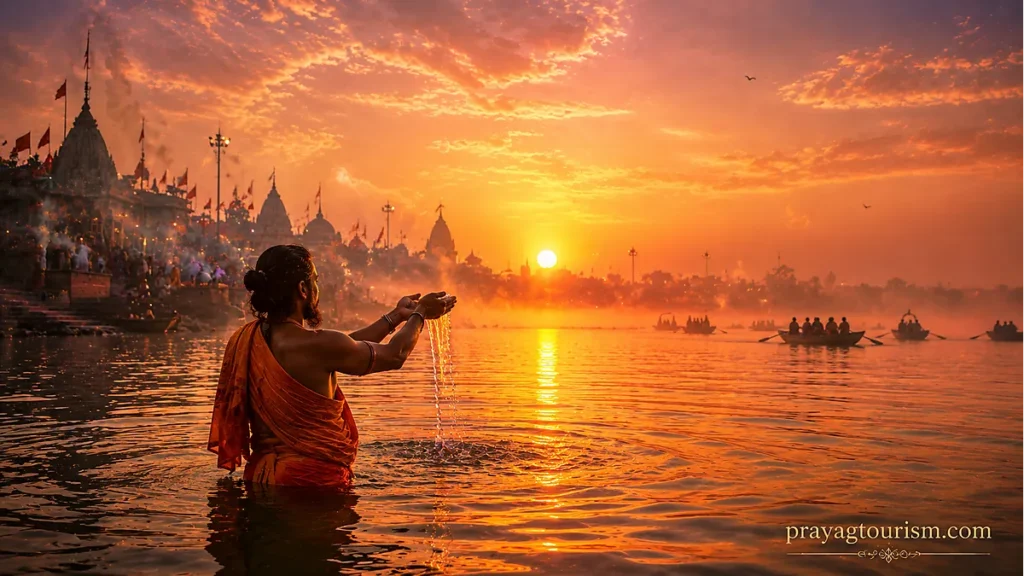
Close your eyes for a moment. Imagine you are standing at a ghat in Prayagraj, barefoot on cold stone. It is 4:30 in the morning.
The air smells of marigold garlands, wet earth, and camphor. The Ganga moves silently below you — black as ink, ancient as time. Around you, hundreds of people have already gathered in the darkness. Some are whispering mantras. Others simply stand, arms folded, eyes closed, waiting.
And then it begins.
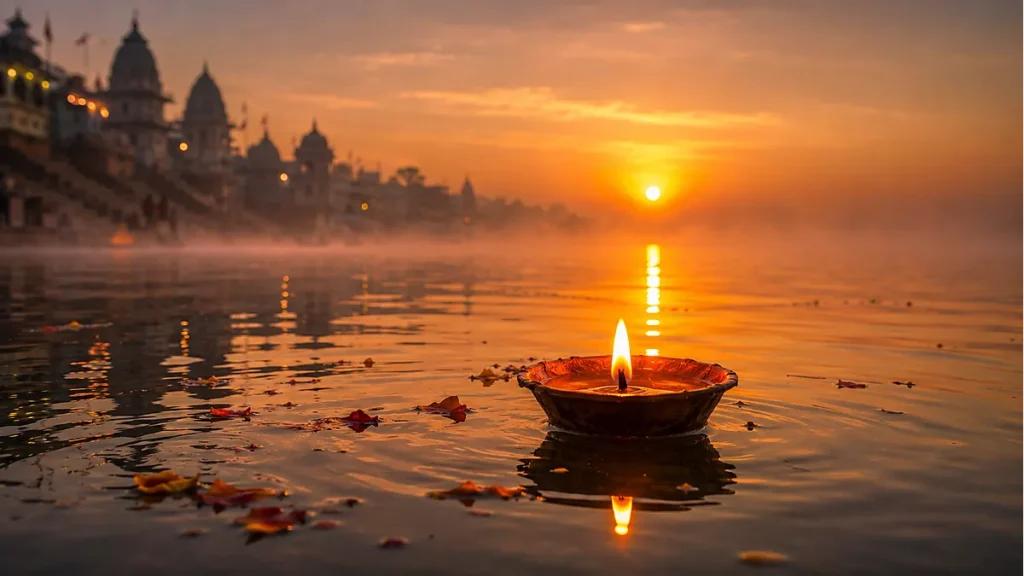
First, a faint violet blush over the eastern horizon. Then saffron. Then a burning, molten gold that slowly lifts above the mist like the first breath of a god waking from deep sleep. The entire river catches fire. Temple bells ring out across the water. A conch shell sounds its ancient call from somewhere behind you — Oooommmm — and it vibrates in your chest like a tuning fork struck against the universe.
You are not watching a sunrise. You are witnessing something sacred.
This is Sandhyā — the holy twilight. This is the moment Sanātana Dharma has considered the most powerful instant of every single day for thousands of years.
So Why Sunrise Is Sacred in Sanātana Dharma? Why have Hindus, for millennia, faced east at dawn, cupped water in their hands, and offered it back to the sky? Why have sages, saints, yogis, and ordinary grandmothers woken before the world and stood in the half-dark to greet the rising sun?
The answer is not merely religious custom. The answer is cosmic, psychological, neurological, and profoundly human — and once you understand it, you will never look at sunrise the same way again.
The Cosmic Meaning of Sunrise
Sūrya: The Visible God
In Sanātana Dharma, the universe is not a machine running on automatic. It is a living, breathing, conscious system — and at its heart burns Sūrya, the Sun.
The Vedas are among the oldest spiritual texts known to humanity, composed between 1500–1200 BCE and transmitted orally for centuries before that. Among the thousands of hymns in the Rigveda, a remarkable number are dedicated to Sūrya and to his herald, Uṣas — the goddess of dawn.[1]
Why? Because ancient seers understood something fundamental: the Sun is not merely a star. The Sun is the most direct manifestation of the divine that human eyes can perceive. It cannot be touched, yet it touches everything. It cannot be grasped, yet it holds all life in its warmth.
The Handbook of Hindu Mythology records that in the Vedic period, Sūrya was acknowledged as the creator, the principle of life, and the supreme ruler of the heavenly sphere. In the three-tiered Vedic cosmos, Sūrya ruled svar — the heavens — while Agni governed the earth and Indra the middle sky.[1]
“Some Purāṇas said that Sūrya was the cause of all, worthy of praise, and the supreme light, and that Sūrya dwells in humans and humans in Sūrya.”[1]
This is not poetry. This is a statement of sacred physics.
Ṛta — The Cosmic Order
Central to Vedic understanding is the concept of Ṛta (ऋत) — the universal order that governs all things. The cycles of seasons. The rhythm of breath. The movement of planets. The return of dawn. All of these are expressions of Ṛta — the cosmic law that binds existence together in harmony.
Sunrise is one of Ṛta’s most visible heartbeats.
Every morning when the sun rises, it is the universe reasserting its order. Darkness dissolves. Light returns. The law holds. And Sanātana Dharma asks its followers to consciously participate in this cosmic renewal — not passively observe it, but actively align themselves with it through prayer, breath, and intention.
Uṣas — The Goddess of Dawn
Before Sūrya himself appears each morning, his herald arrives — Uṣas (उषस्), the radiant goddess of dawn, one of the most celebrated deities in the entire Rigveda.
In Rigveda 1.48, the ancient seers sing to her with breathtaking beauty: “For in thee is each living creature’s breath and life, when, Excellent! thou dawnest forth.” She is called devānāṁ cakṣuḥ — the eye of the gods — for she opens the world each morning and makes it visible to all.[5][6]
Uṣas is described as eternally young, ever-returning, driving her chariot of golden hue across the sky. She never ages, yet she appears fresh every morning. The ancient sages saw in her the ultimate spiritual truth: renewal is not just possible — it is cosmically guaranteed.
✨ SACRED VERSE 1 — The Gāyatrī Mantra
The most famous Sanskrit verse ever composed is chanted daily at sunrise across India, and across the world wherever Sanātana Dharma reaches. This is the Gāyatrī Mantra:
1. Devanāgarī:
ॐ भूर्भुवः स्वः ।
तत्सवितुर्वरेण्यं ।
भर्गो देवस्य धीमहि ।
धियो यो नः प्रचोदयात् ॥
2. IAST Transliteration:
Oṃ bhūr bhuvaḥ svaḥ
tat savitur vareṇyaṃ
bhargo devasya dhīmahi
dhiyo yo naḥ pracodayāt
3. Source Citation: Source: Rigveda, Mandala 3, Sūkta 62, Verse 10 (Rigveda 3.62.10)[2][7]
4. Word-by-Word Meaning:
- ॐ (Oṃ) — the primordial cosmic sound
- भूर् (bhūr) — the physical plane / earth
- भुवः (bhuvaḥ) — the vital / astral plane / atmosphere
- स्वः (svaḥ) — the celestial plane / heaven
- तत् (tat) — that (the transcendent)
- सवितुर् (savitur) — of Savitā / the divine Sun, the life-giver
- वरेण्यं (vareṇyaṃ) — most worthy of worship, most excellent
- भर्गो (bhargo) — radiance, luminous glory
- देवस्य (devasya) — of the divine / of the god
- धीमहि (dhīmahi) — we meditate upon
- धियो (dhiyo) — our intellect, our understanding
- यो (yo) — who
- नः (naḥ) — our
- प्रचोदयात् (pracodayāt) — may inspire, may illuminate, may awaken
5. Simple Translation:
“We meditate upon the radiant, luminous glory of the divine Sun — Savitā — who encompasses all three planes of existence. May that divine light inspire and awaken our intellect.”
6. Practical Life Insight:
This mantra is not asking the Sun for gold or success. It is asking for illumination of the mind itself. Chanted at sunrise, when the brain’s neural activity shifts from the sleeping state to wakefulness, this mantra acts as a sonic anchor — aligning your consciousness with the cosmic light that dissolves ignorance. Recite it once each morning facing east, and you are participating in a practice performed by sages for over 3,000 years.[8]
Sunrise in Scripture & Mythology
Sūrya Deva — The Sun as Person
In the Purāṇas, Sūrya is not an abstraction. He is a being with a chariot, a family, and a profound story.
Sūrya rides across the sky each day in a golden chariot drawn by seven horses. The seven horses represent the seven colors of light — the very spectrum that modern optics has confirmed. His charioteer is Aruṇa (अरुण) — literally “the Reddish One” — the deity of the pre-dawn crimson sky, who appears before his master to prepare the way, just as the rose glow precedes the full sunrise.[1]
Aruṇa is himself a fascinating figure. The mythological texts record that he is the brother of Garuḍa, the great eagle — and between them they rule the skies. When you see the horizon blush red before the sun appears, you are watching Aruṇa take his station. The chariot is already moving. The light is already on its way.
“He acquired a golden chariot with one wheel making the chariot orbit the sky, drawn by seven horses.”[1]
The Sun and Hanumān — A Story of Devoted Learning
One of the most beloved stories in Hindu mythology involving the Sun is the tale of Lord Hanumān and his education.
When the young Hanumān sought to learn all the Vedas and sacred arts, he approached the mighty Sūrya Deva as his teacher. But Sūrya had a problem: he could not stop moving. His duty was to traverse the sky each day without pause, for if the Sun stopped, the entire cosmic order — Ṛta itself — would collapse.
Undaunted, young Hanumān simply expanded himself to an enormous size and walked backwards, facing the Sun at all times, as his teacher moved across the sky. He learned all knowledge while walking in reverse across the heavens. The story is a testament to the depth of devotion and the extraordinary lengths a true student will go to receive divine wisdom.
The Sun, touched by this devotion, taught him everything — all the Vedas, all the sciences, all the arts. This is why sunrise in Hanumān’s temples is especially sacred. It is the hour when the teacher arrives.
Karṇa — The Son of the Sun
Among the most poignant sunrise stories in the Mahābhārata is that of Karṇa, the great warrior who was the biological son of Sūrya Deva.
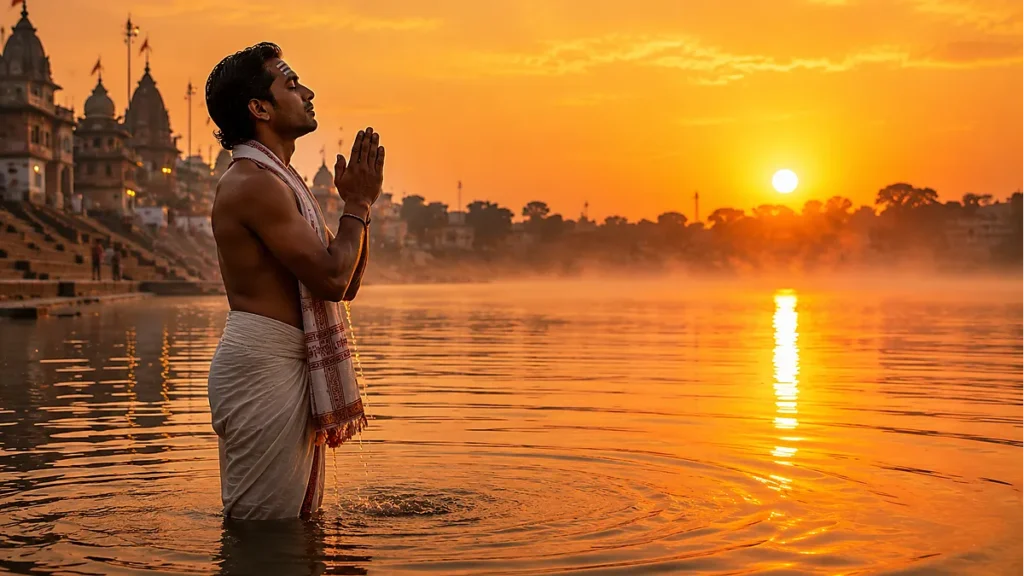
Karṇa performed his Surya Pūjā — his daily worship of his father, the Sun — every single morning without fail. He would stand in the river at sunrise, facing east, arms raised in prayer. It was during these sacred morning prayers that Karṇa became legendary: he would never refuse anyone who came to him during his Surya worship with a request. Not once. Not even when his enemies — knowing this — arrived to strip him of his divine armor.
Karṇa’s sunrise practice was not mere ritual. It was who he was. His daily dawn worship was the source of his extraordinary generosity and his unbreakable integrity. The sun had given him life; each morning he returned to that source.
This is the deeper symbolism of Surya Pūjā: we return each dawn to the source of our existence, to remember who we are and why we are here.
The Chhath Pūjā — Sunrise as the Ultimate Offering
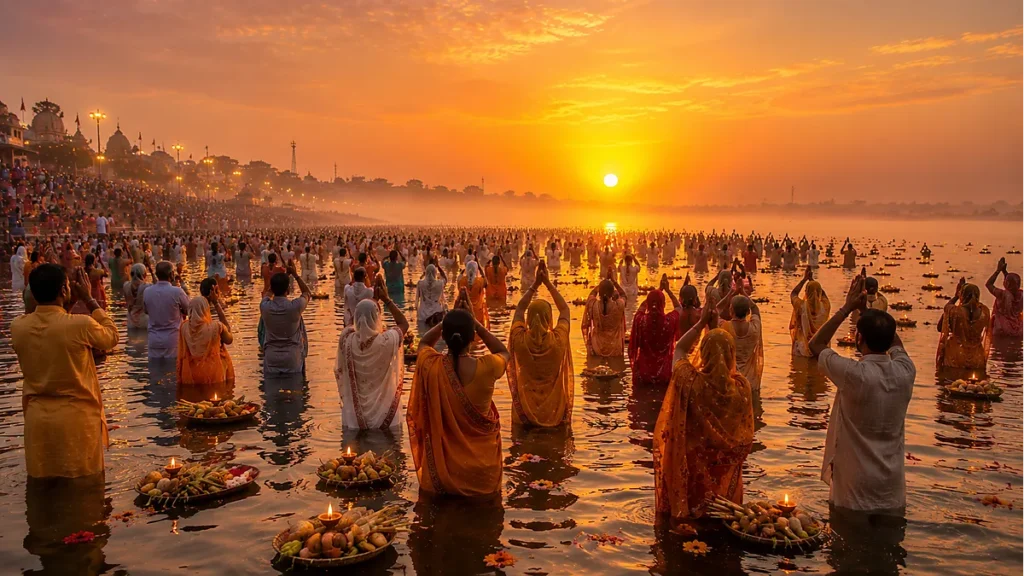
Among all Hindu festivals, Chhath Pūjā stands apart as the one that is entirely, completely, and exclusively centered on the rising and setting sun.
Celebrated primarily in Bihar, Jharkhand, and Uttar Pradesh, Chhath requires devotees to stand in a river for hours — sometimes waist-deep in cold water, sometimes fasting for days — to offer their prayers directly to Sūrya Deva at sunset and then, crucially, at the precise moment of sunrise.
The sunrise offering in Chhath is called Uṣā Arghya — “the gift of dawn.” Devotees raise their offerings of fruit, cane, and sacred items toward the just-rising sun with an almost indescribable joy on their faces. There are no priests needed. No intermediaries. Just you, the river, and the Sun.
This is Sanātana Dharma’s most democratic practice: direct communion with the divine through natural elements at the most sacred hour.
✨ SACRED VERSE 2 — Uṣas Sūkta (Rigveda 1.48.10)
1. Devanāgarī:
त्वयि हि विश्वं भुवनं जीवति यदुषः प्रतिदीयसे ।
2. IAST Transliteration:
tvayi hi viśvaṃ bhuvanaṃ jīvati yad uṣaḥ pratidīyase
3. Source Citation: Source: Rigveda, Mandala 1, Sūkta 48, Verse 10[5]
4. Word-by-Word Meaning:
- त्वयि (tvayi) — in you, within you
- हि (hi) — indeed, truly
- विश्वं (viśvaṃ) — the entire universe, all worlds
- भुवनं (bhuvanaṃ) — all living beings, all existence
- जीवति (jīvati) — lives, breathes, is alive
- यत् (yad) — when, because
- उषः (uṣaḥ) — O Dawn, O Uṣas
- प्रतिदीयसे (pratidīyase) — you shine forth, you illumine, you dawn
5. Simple Translation:
“O Dawn! In you, indeed, lives the entire universe — all beings — for you shine forth.”
6. Practical Life Insight:
This extraordinary verse from the Rigveda tells us something that seems like poetry but is actually profound biology: all life depends on dawn. Every creature that breathes — plant, animal, human — is sustained by the rhythm of day and night. Waking at dawn consciously is joining that great pulse of existence. You are not just starting your day. You are participating in the very heartbeat of the universe.
The Psychology & Science of Dawn
Ancient Wisdom, Modern Science
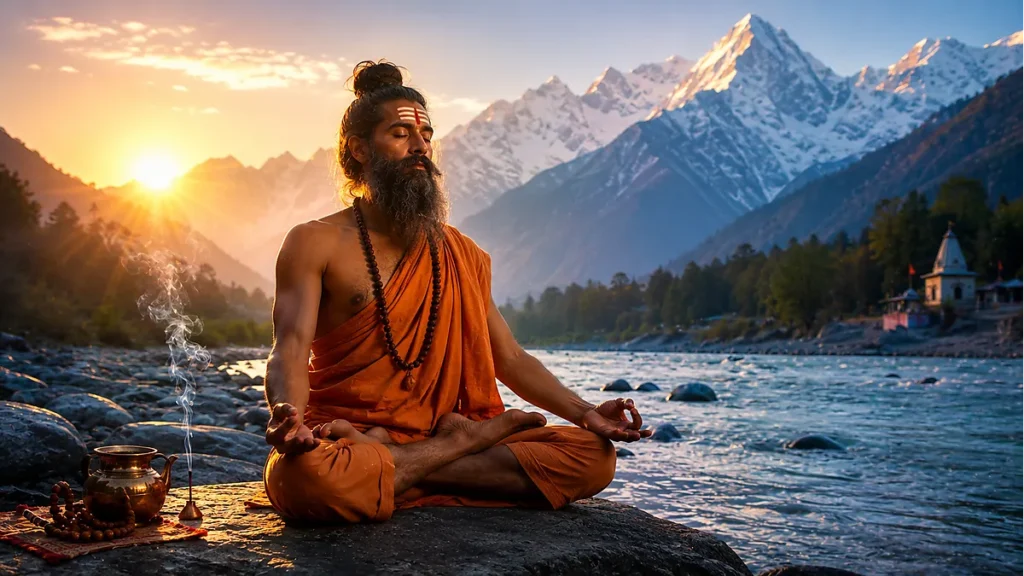
The ancient sages of Sanātana Dharma did not have electron microscopes or neuroscience laboratories. Yet they arrived, through meditation and observation, at insights about the human body and mind that modern science is only now formally confirming.
This is nowhere more striking than in the science of Brahma Muhūrta — the “time of Brahma.”
What Is Brahma Muhūrta?
Brahma Muhūrta (ब्रह्ममुहूर्त) is a specific 48-minute window that begins approximately 1 hour and 36 minutes before sunrise and ends 48 minutes before it. For example, if sunrise occurs at 6:00 AM, Brahma Muhūrta runs from approximately 4:24 AM to 5:12 AM.[4][9]
Āyurveda describes this period as the most sāttvic — the most pure, calm, and balanced — time in the entire 24-hour cycle. The air is rich with prāṇa. The mind has completed its deepest sleep cycles. The world is quiet. And the cosmic boundary between the sleeping and waking state is at its thinnest.[10]
“The cosmic energy, or Brahma Tatva, is at its highest during Brahma Muhūrta. The line separating the spiritual and the physical is the thinnest.”[10]
The Neuroscience Behind the Sages
Modern science now confirms what the Vedic seers intuited:
- Cortisol patterns: The body naturally begins producing cortisol — the alertness hormone — in the pre-dawn hours, peaking just after sunrise. Waking at Brahma Muhūrta aligns with this natural surge, creating effortless alertness instead of the groggy struggle of artificial alarm clocks.
- Serotonin and sunlight: The first rays of morning sunlight trigger the production of serotonin — the brain’s primary mood-stabilizing chemical. This is why people who regularly watch sunrise report feeling calmer, happier, and more resilient. The sun is quite literally medicating you.
- Melatonin regulation: Morning light suppresses melatonin and sets the body’s circadian clock. Disrupted circadian rhythms — caused by artificial light, late nights, and screens — are now linked to depression, anxiety, obesity, and compromised immunity. Sunrise exposure resets this clock.
- Brain wave states: During Brahma Muhūrta, the brain naturally operates in the alpha-theta boundary state — the same state achieved through deep meditation. This is why prayer and meditation feel effortless at this hour. You are not fighting your way into stillness. The universe is offering it to you freely.[4]
Āyurveda and the Rhythm of Dawn
In Āyurvedic medicine, the concept of Dinacharya (दिनचर्या) — the daily routine — begins at Brahma Muhūrta. The ancient Āyurvedic texts prescribe rising at this hour as the single most important health practice because it harmonizes the body’s rhythms with the rhythms of nature.[3]
The logic is elegant: nature has a schedule. The sun rises, sets, and rises again. The body’s hormones, digestion, and cellular repair cycles follow this same schedule. When you align your waking hour with the sun, you are not fighting your body — you are flowing with it.
Āyurveda teaches that early morning prāṇa — the life force in the atmosphere — is of the highest quality. The air is not yet polluted with the noise, stress, and energetic residue of daily human activity. Breathing at dawn is like drinking water from the source of a river, rather than from its downstream where everything else has already passed.
Yogic Psychology and the Guṇas
Vedic philosophy speaks of three guṇas (qualities) that pervade all of existence: Tamas (inertia, darkness), Rajas (activity, passion), and Sattva (clarity, purity).
Each period of the day is dominated by a different guṇa. Late night is tamasic. The busy middle of the day is rajasic. But dawn is sattvic — naturally calm, clear, balanced.[10]
Spiritual practice done in sattva has a different quality. The mind is not distracted, the emotions are not agitated, the body is not full of food. This is why even 10 minutes of genuine prayer at dawn is considered more powerful in the yogic tradition than an hour of distracted meditation in the afternoon.
The sages were not being mystical. They were being profoundly practical.
The Sacred Practices of Sunrise
The Living Traditions of Dawn
In Sanātana Dharma, knowing is not enough. The sacred must be lived. And so Vedic tradition gives us a set of morning practices that transform abstract philosophy into lived experience. Here are the key traditions of the sacred sunrise hour — each one rich with meaning and open to every sincere seeker.
1. Surya Arghya — Offering Water to the Sun
This is the simplest and most universal of all dawn practices. After bathing, or simply after waking and washing, you step outside (or to a window), face east, and offer water to the rising sun.
How to do it: Fill a copper vessel (or any clean vessel) with water. Add a few drops of sandalwood or rose water if available. Stand facing east. Raise the vessel and pour the water in a thin stream toward the direction of the sun, allowing the light to pass through the water as it falls. Recite the words: “Oṃ Sūryāya Namaḥ” — “I bow to Sūrya.”
What it means: Water is the element of emotion, memory, and life. Offering it to the Sun is an act of profound gratitude — acknowledging that all life, all nourishment, all existence flows from the sun’s energy. The light passing through the water and reaching your eyes also literally activates the retinal light receptors that trigger the serotonin-melatonin cascade. Ancient ritual and neuroscience in perfect harmony.
2. Sandhyāvandana — The Dawn Salutation
Sandhyāvandana (सन्ध्यावन्दन) — literally “the salutation to the twilight” — is the formal Vedic practice performed at the three sandhyā moments: dawn, noon, and dusk. The dawn sandhyā is considered the most sacred.
The practice involves ritual purification (ācamana), breath control (prāṇāyāma), postures, and the recitation of the Gāyatrī Mantra. It is traditionally prescribed for those who have received the sacred thread (yajñopavīta), though its spirit is accessible to anyone.[11]
In the Handbook of Hindu Mythology, the sandhyā periods are described as cosmically significant — the twilight windows between great epochs of time, when the boundary between realms grows thin. The morning sandhyā is the daily version of this cosmic opening. It is the moment when the sleeping world awakens — and the sincere seeker meets the awakening universe halfway.[1]
3. Sūrya Namaskāra — The Sun Salutation
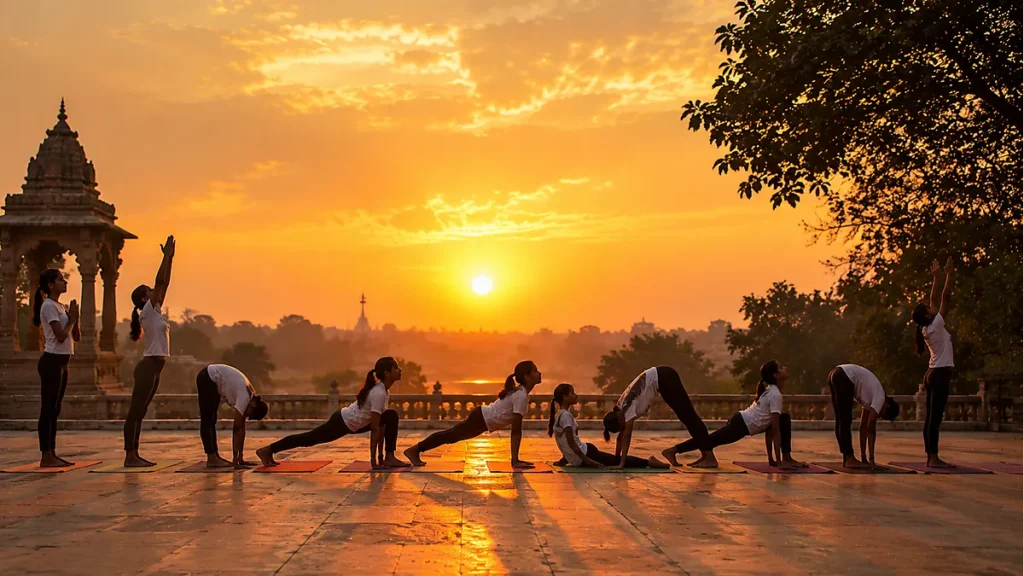
Sūrya Namaskāra (सूर्य नमस्कार) is a sequence of 12 physical postures — the famous “sun salutation” known now across the entire world through modern yoga.
Each position in the sequence corresponds to one of the 12 names of Sūrya. The sequence begins and ends in a position of prayer, with the hands at the heart. The body bends, extends, and bows — a physical prayer that honors the sun through movement itself.[1]
Performed at dawn, facing east, with the eyes closed and the awareness turned inward, Sūrya Namaskāra is not exercise. It is embodied meditation. The body becomes the prayer. The breath becomes the mantra. And the first sunlight on the skin becomes the answer.
4. The Gāyatrī Japa — Meditation with the Sun Mantra
The Gāyatrī Mantra (Rigveda 3.62.10) is specifically a sunrise mantra — it is addressed to Savitā, the Sun at dawn, the life-giver. Traditionally, it is chanted 108 times at sunrise.[2][8]
108 is not random. In Vedic mathematics, 108 = 1 (the Self) × 0 (the void) × 8 (infinity). It is the number of beads on a traditional Rudraksha mala. It is also approximately the ratio of the Sun’s distance from Earth to its diameter — a cosmic proportionality that ancient Indians knew and encoded in their sacred numerology.
Even 3 repetitions at sunrise, done with full awareness and a quiet mind, can shift the quality of your entire day.
5. Prāṇāyāma — Breathing with the Dawn
Yogic breathing practices — prāṇāyāma — are uniquely powerful at dawn. The most recommended for the morning hour are:
- Anuloma Viloma (alternate nostril breathing) — Balances the left and right hemispheres of the brain, creating mental clarity and emotional equilibrium.
- Bhastrikā (bellows breath) — Energizes the prāṇic body for the day ahead.
- Kapālabhāti (skull-shining breath) — Cleanses the subtle energy channels (nāḍīs), particularly effective in the sattvic dawn atmosphere.
The air at dawn contains the highest concentration of negative ions — electrically charged air molecules that have been scientifically linked to elevated serotonin levels, reduced stress, and improved respiratory function. The sages called this quality prāṇa. Scientists call it ionization. The experience is the same: you breathe at dawn and feel alive in a way that is qualitatively different from any other hour.
✨ SACRED VERSE 3 — Āditya Hṛdayam (from the Vālmīki Rāmāyaṇa)
One of the most celebrated solar hymns in all of Sanskrit literature is the Āditya Hṛdayam — “The Heart of the Sun” — taught to Lord Rāma by the sage Agastya on the battlefield of Laṅkā, just before his final confrontation with Rāvaṇa.
1. Devanāgarī:
आदित्यं हृदयं पुण्यं सर्वशत्रुविनाशनम् ।
जयावहं जपेन्नित्यं अक्षय्यं परमं शिवम् ॥
2. IAST Transliteration:
ādityaṃ hṛdayaṃ puṇyaṃ sarvaśatruvināśanam |
jayāvahaṃ japen nityaṃ akṣayyaṃ paramaṃ śivam ||
3. Source Citation: Source: Vālmīki Rāmāyaṇa, Yuddha Kāṇḍa (exact verse location in the Āditya Hṛdayam chapter — verse location omitted for scholarly integrity, as verse numbering varies across recensions).
4. Word-by-Word Meaning:
- आदित्यं (ādityaṃ) — of Āditya, of the Sun
- हृदयं (hṛdayaṃ) — the heart, the essence
- पुण्यं (puṇyaṃ) — holy, auspicious, merit-giving
- सर्वशत्रुविनाशनम् (sarvaśatruvināśanam) — destroyer of all enemies
- जयावहं (jayāvahaṃ) — bringer of victory
- जपेत् (japet) — one should recite
- नित्यं (nityaṃ) — daily, always, without break
- अक्षय्यं (akṣayyaṃ) — imperishable, inexhaustible
- परमं (paramaṃ) — supreme, the highest
- शिवम् (śivam) — auspicious, the good, the divine
5. Simple Translation:
“This Heart of the Sun — the holy Āditya Hṛdayam — is the destroyer of all enemies, the bringer of victory. One should recite it daily. It is imperishable, supremely auspicious.”
6. Practical Life Insight:
Sage Agastya did not give Rāma a weapon. He gave him a sunrise prayer. The “enemy” the mantra destroys is not an external adversary — it is the inner enemy: fear, doubt, inertia, despair. Every morning, these inner enemies gather in the pre-dawn darkness. This hymn, chanted at sunrise, disperses them with the same inevitability that light disperses shadow.
Sunrise as a Daily Rebirth
Every Dawn Is a New Karma
In Sanātana Dharma, time is not linear. It does not move only forward in a straight line from birth to death and nowhere else. Time is cyclical — expanding and contracting like breath, like the universe itself.[1]
And within that great cycle, each day is a smaller cycle. Each sunrise is a tiny sṛṣṭi — a creation. Each night is a tiny pralaya — a dissolution. And each morning, you are reborn.
This is not metaphor. This is cosmological architecture applied to daily life.
“The Sandhyā periods that precede each Yuga last for hundreds of divine years — they are the periods of awakening and dissolution that frame each cosmic age.”[1]
The daily dawn is the microcosmic version of the cosmic sunrise. When the universe began, light was the first thing created. Each morning, that act of creation is performed again. And you are invited — not merely permitted, but invited — to be awake and aware for it.
The Psychology of Beginning Again
There is a profound psychological truth in the sunrise that no therapy manual quite captures.
During the night, the unconscious mind processes the day’s experiences. Emotions are metabolized. Memories are consolidated. The nervous system recovers. By the time dawn arrives, the psychic slate has been partially cleaned.
This is why most people feel, even if they have had a terrible previous day, that the morning carries a faint scent of possibility. This is not wishful thinking. This is the brain’s natural renewal mechanism — and Sanātana Dharma has been intentionally amplifying this mechanism through sunrise ritual for thousands of years.
When you wake at Brahma Muhūrta and greet the dawn consciously — with prayer, breath, and gratitude — you are not just acknowledging the sunrise. You are choosing who you are going to be today. You are exercising the most powerful spiritual faculty you possess: sankalpa — the power of conscious intention.
From Darkness to Light — The Universal Human Story
Every spiritual tradition in the world has a myth about light conquering darkness. The resurrection of Christ. The victory of Dīpāvalī. The Buddha’s enlightenment under the Bodhi tree, which happened — significantly — at the moment of dawn.
This universal pattern exists because it is describing something real in human experience: the movement of consciousness from ignorance to wisdom.
The Sanskrit word for ignorance is Avidyā — literally, “not-seeing.” The Sanskrit word for knowledge is Vidyā — literally, “seeing.” Dawn is the moment when not-seeing gives way to seeing. When the world becomes visible again.
Every morning, Sanātana Dharma is saying: This is your chance. Darkness does not have to be your default. Light is available. Will you face east and receive it?
✨ SACRED VERSE 4 — Bhagavad Gītā on the Sun and Consciousness
1. Devanāgarī:
यदादित्यगतं तेजो जगद्भासयतेऽखिलम् ।
यच्चन्द्रमसि यच्चाग्नौ तत्तेजो विद्धि मामकम् ॥
2. IAST Transliteration:
yad ādityagataṃ tejo jagad bhāsayate ‘khilam |
yac candramasi yac cāgnau tat tejo viddhi māmakam ||
3. Source Citation: Source: Bhagavad Gītā, Chapter 15, Verse 12
4. Word-by-Word Meaning:
- यत् (yad) — that which
- आदित्यगतं (ādityagataṃ) — residing in the Sun / Āditya
- तेजः (tejaḥ) — radiance, luminous energy
- जगत् (jagat) — the world, the universe
- भासयते (bhāsayate) — illumines, lights up
- अखिलम् (akhilam) — entirely, completely
- यत् (yac) — that which
- चन्द्रमसि (candramasi) — in the moon
- अग्नौ (agnau) — in fire
- तत् (tat) — that
- तेजः (tejaḥ) — radiance, brilliance
- विद्धि (viddhi) — know it, understand it
- मामकम् (māmakam) — as Mine (Kṛṣṇa’s / the Divine’s)
5. Simple Translation:
“That radiance which resides in the Sun and illumines the entire universe, that which is in the moon, and that which is in fire — know that luminous energy to be Mine.”
6. Practical Life Insight:
This verse from the Bhagavad Gītā is perhaps the most direct declaration in all of scripture about the spiritual nature of sunrise. When you watch the sun rise, the Gītā is telling you: you are not watching a physical event. You are watching the Divine. The sunlight that touches your face every morning is the touch of the absolute reality itself. There is no greater proximity to the sacred than this — available to every human being, every single day, for free.
The Living Horizon
The Modern Darkness
There is a quiet crisis in the modern world, and it is deeply connected to the absence of dawn.
Most people today — particularly in cities — never see a natural sunrise. They wake up after the sun has already risen, in rooms with blackout curtains, to the blue light of a phone screen. The first thing many see each morning is news alerts, social media notifications, and the accumulated anxieties of a world that never sleeps.
The circadian rhythm — the body’s ancient alignment with the sun — is being systematically disrupted. Scientists now call this disruption “circadian misalignment,” and they link it to a staggering array of modern health crises: depression, anxiety, insomnia, metabolic disorders, reduced immunity, and cognitive decline.
Sanātana Dharma saw this coming thousands of years ago. Not the specific technology, but the fundamental human tendency to move away from natural rhythms — and the suffering that follows.
The Vedas describe a concept called Ṛta — the cosmic order — and its opposite: Anṛta — disorder, falsehood, misalignment. Modern life, in its disconnect from natural time, is a perfect expression of Anṛta. And the body, the mind, and the spirit all feel it.
The Return to the East
The healing is not complicated. It does not require a monastery, a guru, or an expensive retreat. It requires only one thing: facing east at dawn.
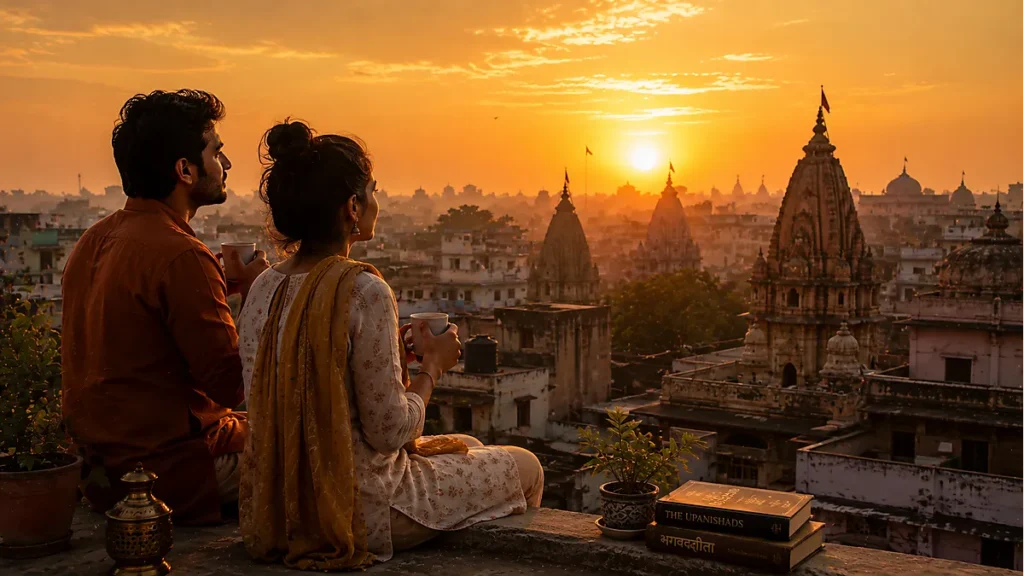
Waking before sunrise — even just occasionally at first — and sitting quietly with a cup of chai, watching the sky change from black to violet to rose to gold. Breathing slowly. Setting no agenda. Letting the light arrive.
This single act, done with awareness, is one of the most profoundly healing things a modern human being can do. Not because of any mystical reason. But because it realigns the body with its biological truth, the mind with its natural clarity, and the spirit with the cosmic order that has sustained life for billions of years.
Why This Matters Now More Than Ever
We live in an age of information overload and spiritual hunger. More people than ever before are searching — for peace, for meaning, for a feeling of being connected to something larger than their own small, scrolling lives.
The answer the ancient sages of Sanātana Dharma offer is both radical and simple: the sacred is not hiding. It rises every morning in the eastern sky. It has been rising, without fail, since before the first human prayer was ever spoken. It does not charge admission. It does not require belief. It only requires your presence.
There is a reason that across thousands of years and thousands of miles, from the shores of the Ganga to the ghats of Varanasi, from the plains of Prayagraj to the peaks of the Himalayas, the people of Sanātana Dharma have faced east at dawn. They were not following superstition. They were following something far more reliable: the deepest intelligence of nature itself.
The Cosmic Promise
Every night, darkness comes. Every morning, light returns.
This is not merely meteorology. It is the universe’s most consistent promise.
Sanātana Dharma has understood this promise for thousands of years — and built an entire civilization of morning practices, sunrise prayers, and dawn rituals around the sacred knowledge that light always returns.
In your darkest night — and every human being has those — somewhere in the world, the sun is already rising. The wheel of Ṛta turns without ceasing. Aruṇa is already taking his station at the horizon. The chariot horses of Sūrya are already in motion.
Dawn is not the absence of darkness overcome. It is the daily proof that darkness was never permanent to begin with.
✨ SACRED VERSE 5 — Sūrya Namaskāra Mantra
1. Devanāgarī:
ॐ सूर्याय नमः ।
2. IAST Transliteration:
Oṃ Sūryāya Namaḥ
3. Source Citation: Source: Traditional Sūrya Namaskāra mantra sequence; widely cited in Vedic liturgy and the Sūrya Upaniṣad tradition (exact origin across multiple Vedic sources).
4. Word-by-Word Meaning:
- ॐ (Oṃ) — the primordial cosmic vibration, the sound of existence itself
- सूर्याय (sūryāya) — to Sūrya, to the Sun (in the dative case — meaning “in honor of” / “I bow to”)
- नमः (namaḥ) — I bow, I salute, I offer reverence
5. Simple Translation:
“I bow to the Sun. I offer reverence to Sūrya.”
6. Practical Life Insight:
This is perhaps the simplest mantra in all of Sanātana Dharma — three syllables — and yet it contains a universe. Namaḥ is not just “hello.” It is the recognition that something greater than yourself exists, and you are choosing, consciously, to honor it. Three syllables. Three seconds. One bow toward the rising sun. That is enough to begin. That is, in truth, a complete spiritual practice in itself. Start here. Start tomorrow morning.
The Final Light
You have come a long way from that ghat in Prayagraj where we began.
You now know that sunrise is not a time of day. It is a cosmological event that the greatest spiritual tradition in human history has recognized, honored, and carefully preserved practices around for over four thousand years.
You know that Sūrya is the visible face of the divine — the deity whose light literally sustains all life on this planet.[1]
You know that Uṣas, the goddess of dawn, is the universe’s herald — arriving each morning to announce that renewal is available, that the cosmic order holds, that light has kept its promise.[5]
You know that Brahma Muhūrta is not superstition but a precise window of neurological and spiritual opportunity — confirmed by Āyurveda, Yoga, and modern neuroscience alike.[3][4]
You know that the Gāyatrī Mantra, chanted at sunrise for three millennia, is a request for the illumination of the mind itself — asking the divine light to dissolve the inner darkness of confusion, fear, and ignorance.[7]
And you know that every morning, regardless of what happened yesterday, the sun rises. Ṛta holds. The cosmos reasserts its order. And you have a choice: to scroll past it — or to step outside, face east, and participate in the most ancient spiritual practice in human history.
The dawn is not waiting for your permission. It is arriving regardless. The only question is whether you will be awake to receive it.
Stand up. Face east. Raise your palms.
The light is already on its way.
“Sunrise is not merely the beginning of a day — it is the universe reminding humanity that light always returns.”
Oṃ Sūryāya Namaḥ।
Written for prayagtourism.com — your guide to the sacred heart of Bhārata.
May every reader find their way to the water’s edge at dawn.
⁂
References:
- Handbook of Hindu Mythology — George M. Williams — ABC-CLIO — 2003
- https://www.wisdomlib.org/hinduism/scripture/gāyatrī-mantra/d/doc7659.html
- https://www.raghavthukral.com/brahma-muhurta-in-ayurveda/
- https://en.wikipedia.org/wiki/Brahmamuhurtha
- https://sacred-texts.com/hin/rigveda/rv01048.htm
- https://www.youtube.com/watch?v=ohX7Ix8VlDU
- https://www.wisdomlib.org/hinduism/book/rig-veda-english-translation/d/doc832206.html
- https://ancientscience.in/rigveda/rigveda3-62-10
- https://en.wikipedia.org/wiki/Brahmamuhurta
- https://timesofindia.indiatimes.com/astrology/zodiacs-astrology/what-is-the-power-of-brahma-muhurat/articleshow/121253336.cms
- https://en.wikipedia.org/wiki/Gayatri_Mantra
- Classical Hindu Mythology: A Reader in the Sanskrit Purāṇas — Cornelia Dimmitt and J. A. B. van Buitenen — Temple University Press — 1978.
- Interpretations of the Bhagavad-Gita and Images of the Hindu Tradition: The Song of the Lord — Catherine A. Robinson — Routledge — 2006.
- https://johndupuche.com/2015/09/18/gayatri-mantra/
- https://www.shubhdivas.in/stotras/gayatri-mantra
- https://en.wikisource.org/wiki/The_Hymns_of_the_Rigveda/Book_1/Hymn_48
- https://www.puja.today/en/guides/gayatri-mantra
- https://orca.cardiff.ac.uk/id/eprint/157746/1/63fe0d551bfab.pdf