

Everything you need to start — and nothing you don’t
Table of Contents
Let’s Start With the Honest Worry
You have probably thought about it. Maybe you have seen a full pūjā performed — the priest chanting with speed and confidence, the arrangement of dozens of items on the altar, the precise choreography of hands and water vessels and flowers and flames, the Sanskrit flowing effortlessly for minutes on end — and thought, somewhere in the back of your mind: I could never do that.
Maybe someone in your family performs daily worship with what seems like deep knowledge, and you feel faintly embarrassed that you do not know the steps. Maybe you grew up away from these practices and now, older and more curious, you want to begin — but do not know where. Maybe you have tried once or twice, felt self-conscious, fumbled with the lamp, forgotten what comes next, and quietly given up.
This guide is written for you.
And the first thing it wants to tell you — before any step, any mantra, any ritual instruction — is this: the complexity you have seen is not the requirement. It is one beautiful form of the practice. But the practice itself, at its heart, is something every human being already knows how to do. You have been doing part of it your whole life without calling it pūjā.
“I remember the morning I first truly understood pūjā — not from a book, but from watching my grandmother. She would wake before anyone else in the house, wash her hands quietly, and go to a small corner shelf in her kitchen. No elaborate altar. Just a small brass Lakṣmī, a clay dīya, and a single flower from the garden she had saved the night before. She would light the lamp, cup her palms around its warmth for a moment with her eyes closed, and just… be there. Five minutes. Not a word of Sanskrit. When she opened her eyes, her whole face had changed — softer, more settled, as if she had just set something heavy down. That was the day I understood: pūjā is not a performance. It is a return.”
You know how to show genuine care for someone you love. You know how to be fully present with another person. You know how to express gratitude when you have received something precious. You know how to sit quietly and feel the quality of a moment. That is pūjā. The ritual forms are simply a structure that helps the ordinary human mind do what it already, in its best moments, knows how to do.
What Does Pūjā Actually Mean?
The word Pūjā (पूजा — from the Sanskrit root pūj, meaning to honor, to revere, to show respect) is most commonly translated as “worship.” But that translation, while not wrong, is a little thin. It suggests performance — going through the motions of religious obligation.
The tradition’s own understanding is warmer and more intimate than that.
The Āgama Śāstras — the ancient texts that govern temple worship — describe pūjā using a specific and beautiful analogy: it is the act of welcoming an honored guest into your home. Not a passing acquaintance. Not someone you are being polite to out of social obligation. The most honored guest you could possibly receive — a guest before whom you want to bring your very best: your cleanest space, your most generous hospitality, your most genuine attention, your most sincere care.[3]
In pūjā, that honored guest is the Divine — in whatever form you most naturally relate to, through whatever name or image feels most alive to your heart.
And here is what makes this analogy so powerful: genuine hospitality cannot be faked. You can go through the physical motions of welcoming a guest — set the table, arrange the chairs, bring out food — while your mind is elsewhere and your heart is absent. The guest will feel it. In the same way, pūjā performed mechanically — hands going through the correct motions while the mind runs its daily commentary on tomorrow’s to-do list — is not really pūjā at all. It is its shell.
The heart of pūjā is not technique. It is bhāva (भाव — inner feeling, devotional sincerity, genuine emotional orientation toward the Divine). With bhāva, the simplest offering — a single flower placed with love — is a complete pūjā. Without bhāva, the most elaborate ceremony is just a performance.
The Theological Heart — What the Scriptures Say
This is not a modern spiritual opinion. This is the explicit teaching of the Bhagavad Gītā — one of the most authoritative texts in all of Sanatana Dharma.
In Chapter 9, Verse 26, Śrī Kṛṣṇa speaks directly to Arjuna — and through him, to every beginner who has ever worried that they do not have enough, do not know enough, are not ready enough:
1. Devanāgarī Script:
पत्रं पुष्पं फलं तोयं यो मे भक्त्या प्रयच्छति ।
तदहं भक्त्युपहृतमश्नामि प्रयतात्मनः ॥
2. IAST Transliteration:
patraṃ puṣpaṃ phalaṃ toyaṃ yo me bhaktyā prayacchati |
tad ahaṃ bhakty-upahṛtam aśnāmi prayatātmanaḥ ||
3. Source: Bhagavad Gītā, Chapter 9, Verse 26[1]
4. Word-by-Word Meaning:
- पत्रम् (patram) — a leaf
- पुष्पम् (puṣpam) — a flower
- फलम् (phalam) — a fruit
- तोयम् (toyam) — water
- यः (yaḥ) — whoever
- मे (me) — to Me
- भक्त्या (bhaktyā) — with devotion, with love
- प्रयच्छति (prayacchati) — offers, gives
- तत् (tat) — that offering
- अहम् (aham) — I
- भक्ति-उपहृतम् (bhakty-upahṛtam) — brought with devotion
- अश्नामि (aśnāmi) — I accept, I partake of
- प्रयतात्मनः (prayatātmanaḥ) — from one who is pure in consciousness
5. Translation & Practical Takeaway:
Translation: “If one offers Me with love and devotion a leaf, a flower, a fruit, or even water — I accept that offering, brought with devotion, from one who is pure in heart.”
Practical Takeaway: This single verse dismantles, in one breath, every excuse you have ever given yourself for not beginning. Kṛṣṇa is not asking for silver lamps, expensive flowers, or perfectly chanted Sanskrit. He is asking only for bhakti — the sincerity of your heart. The offering is almost irrelevant. What He receives is the love behind it. If you light a clay dīya tomorrow morning and place a single jasmine blossom before your chosen deity with genuine attention, the Bhagavad Gītā says — directly — that this is received, completely, at the highest level.[4][1]
And the Nārada Bhakti Sūtra — the great text of pure devotion composed by the Devarṣi Nārada — opens with an even more luminous declaration. In Sūtra 2, Nārada defines the very nature of parā bhakti (supreme devotion) in words so simple they feel like a homecoming:[2]
Devanāgarī: सा त्वस्मिन् परमप्रेमरूपा
IAST: sā tv asmin paramapremarūpā
Source: Nārada Bhakti Sūtra, Sūtra 2[2]
Meaning: “Bhakti is, in its very nature, the form of Supreme Love for the Divine.”
Practical Takeaway: Nārada is not describing an advanced spiritual state reserved for saints and renunciates. He is describing the nature of devotion itself — and that nature is simply love. Pure, warm, unconditional love directed toward the Divine. This is something every human heart already knows. Pūjā is simply the practice of turning that love — which you already have — consciously toward its ultimate source.[2]
Why Have a Physical Image or Idol?

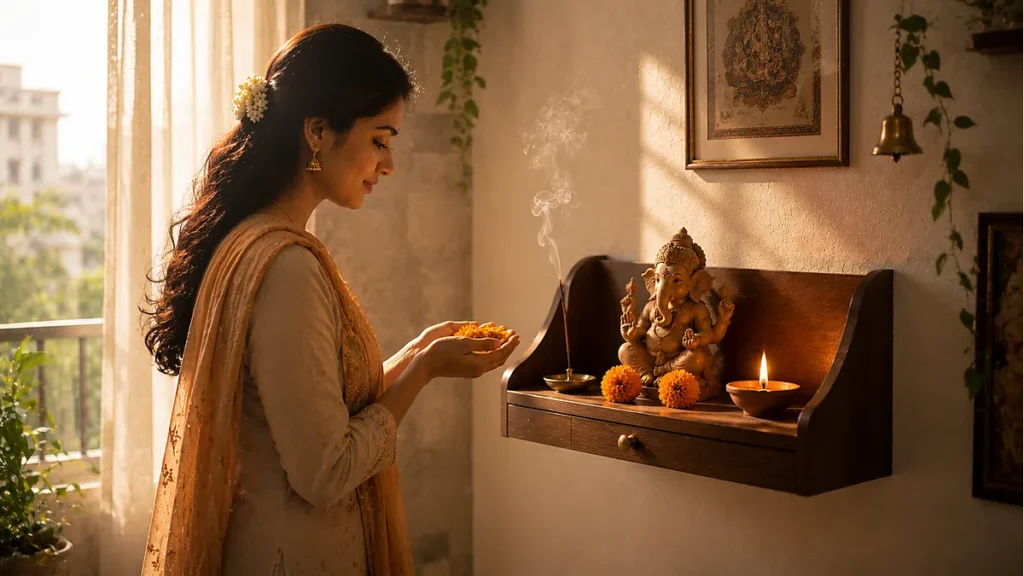
Many beginners wonder about this — and it is a fair question. If the Divine is infinite, formless, and omnipresent, why do we need a statue or a photograph?
The answer is deeply practical and deeply psychological: the human mind needs a place to focus.
Try, for a moment, to think about the infinite. About something vast beyond measurement, without beginning or end, beyond all qualities and descriptions. You will find that within moments, the mind either goes blank or starts thinking about something else entirely. The mind is not designed for the formless — not yet, not without years of meditative training. It needs a point of concentration.
The image or idol — whether a clay Gaṇeśa, a silver Lakṣmī, a framed picture of your Iṣṭa Devatā (इष्ट देवता — your chosen form of the Divine) — is precisely this point. It is not the Divine reduced to a statue. It is an invitation for the Divine to be present and accessible in this moment, through this form — so that your mind, which is concrete and sense-bound, has somewhere to land, somewhere to direct its love.
The great Vedāntic tradition is clear: the image is not an idol in the dismissive sense. It is a mūrti (मूर्ति — form, embodiment) — the formless made approachable through form, so that the devotee’s heart can make contact with what is, in its ultimate nature, beyond all form. You are not worshipping stone or metal. You are using the form as a window into the formless.
The 16 Steps of Pūjā — Simply Explained
The classical form of home worship is called Ṣoḍaśopacāra Pūjā (षोडशोपचार पूजा — worship with sixteen offerings). Each step is an act of service offered to the Divine Guest — following, beautifully and precisely, the Indian tradition of honoring a guest with every form of care.
| Step | Name | What You Do | What It Means |
| 1 | Dhyāna (Meditation) | Sit quietly, picture the deity in your mind | Arriving fully — bringing your attention |
| 2 | Āvāhana (Invitation) | Invite the Divine to be present | Opening the door to the Guest |
| 3 | Āsana (Seat) | Offer a symbolic seat | Welcoming the Guest to sit |
| 4 | Pādya (Foot washing) | Offer water symbolically to wash the feet | Cleansing, honoring the arrival |
| 5 | Arghya (Water for hands) | Offer water to refresh the hands | The Guest is made comfortable |
| 6 | Āchamana (Sip of water) | Offer water for drinking | Nourishment for the Guest |
| 7 | Madhuparka (Honey-milk) | Offer sweetened water or milk | A special welcome drink |
| 8 | Snāna (Bathing) | Ritually bathe the idol | Cleansing and consecrating |
| 9 | Vastra (Clothing) | Offer cloth or drape the image | Dressing the honored Guest with care |
| 10 | Gandha (Fragrance) | Apply sandalwood paste | Anointing with what is precious |
| 11 | Puṣpa (Flowers) | Offer fresh flowers | Beauty offered from the heart |
| 12 | Dhūpa (Incense) | Light incense | The sense of smell engaged in worship |
| 13 | Dīpa (Lamp) | Wave the lamp before the image | Light offered — the eyes of devotion |
| 14 | Naivedya (Food) | Offer food — fruit, sweets, grain | The Guest is fed with love |
| 15 | Pradakṣiṇā (Circumambulation) | Walk around the altar clockwise | Honoring from all sides |
| 16 | Namaskāra (Prostration) | Bow fully, placing head to the ground | Complete surrender, gratitude |
These sixteen steps engage every sense — smell (incense), sight (lamp), taste (food offering), touch (flowers, water), and sound (bell, mantra) — and through each sense, orient the entire being toward the Divine.
But here is what every beginner must hear clearly: you do not need to do all sixteen.
The tradition itself identifies the five most essential offerings — called Pañcopacāra (पञ्चोपचार — the five essential offerings): Gandha (fragrance), Puṣpa (flowers), Dhūpa (incense), Dīpa (lamp), and Naivedya (food). If you can offer these five, in a space that is clean, with a heart that is genuine, you have performed a complete and wholehearted pūjā.
And if even five feels like too much to start — then start with one. One lamp. One flower. One moment of sincere attention. That, the Bhagavad Gītā says directly, is also received.[1]
Setting Up Your Home Pūjā Space — Beautifully Simple
![Simple five-item Panchopachara puja setup at home — beginner Hindu home altar with Ganesha, diya, incense and flowers on wooden shelf]](https://prayagtourism.com/wp-content/uploads/2026/05/A-peaceful-devotional-moment-with-diya-1024x576.webp)
You do not need a dedicated pūjā room. You need a clean corner.
Look for a small space — ideally facing east or north — that you can keep consistently clean and quietly dedicated. It might be a shelf, a low table, a windowsill, or a corner of a bookcase. The size does not matter. The consistency does.
What to keep there:
- One image or idol of your chosen deity — whatever calls to you most naturally. If you are drawn to Lord Gaṇeśa’s cheerful, obstacle-removing energy, begin with Gaṇeśa. If to Lakṣmī’s generous abundance, begin there. The tradition’s teaching is clear: any genuine form of the Divine, approached with sincerity, is the whole Divine.
- One lamp — a simple clay dīya, a small brass lamp, whatever you have. This is the non-negotiable. Without the lamp, there is no pūjā space. With just the lamp, there already is.
- One incense holder and a packet of incense sticks — the fragrance transforms the quality of the space almost immediately. It signals to the mind: this is a different kind of time.
- A small vessel of water — for the symbolic offerings throughout the pūjā.
- Flowers — even a single fresh flower placed daily is enough. Tulasī (holy basil) is considered especially sacred.
That is all. That small, simple, clean arrangement is a complete pūjā space. The grandest temple in India began with an arrangement less elaborate than this.
Your Daily Pūjā — A Five-Minute Routine That Actually Works
Here is the honest secret that no elaborate ritual manual will tell you: regularity beats complexity, every time. A sincere five-minute pūjā performed every morning without fail will transform your inner life far more than an elaborate ceremony performed occasionally and without consistency.
The mind learns from repetition. It builds around consistent, meaningful acts the way a river builds its banks — slowly, gradually, but with increasing depth and direction. Every morning that you show up at your altar, however simply, you are deepening the channel through which peace and clarity can flow.
Here is a routine you can begin tomorrow morning:
- Before you look at your phone — before the notifications, before the news, before the morning’s first demand — go to your pūjā space.
- Light the lamp (30 seconds). Watch the flame for a moment. Arrive.
- Light the incense (10 seconds). Let the fragrance change the quality of the air and your awareness with it.
- Offer a flower or a few grains of rice (10 seconds). Place it before the image with the simple internal acknowledgment: I offer this with gratitude.
- Say this simple prayer — aloud or silently:
Devanāgarī Script:
त्वमेव माता च पिता त्वमेव ।
त्वमेव बन्धुश्च सखा त्वमेव ।
त्वमेव विद्या द्रविणं त्वमेव ।
त्वमेव सर्वं मम देव देव ॥
IAST Transliteration:
tvam eva mātā ca pitā tvam eva |
tvam eva bandhuś ca sakhā tvam eva |
tvam eva vidyā draviṇaṃ tvam eva |
tvam eva sarvaṃ mama deva deva ||
Source: Traditional Śloka, attributed to Ādi Śaṅkarācārya (exact verse location omitted for scholarly integrity)
Word-by-Word Meaning:
- त्वमेव (tvam eva) — you alone are
- माता (mātā) — mother
- पिता (pitā) — father
- बन्धुः (bandhuḥ) — companion, dear one
- सखा (sakhā) — intimate friend
- विद्या (vidyā) — knowledge
- द्रविणम् (draviṇam) — wealth, nourishment
- सर्वम् (sarvam) — everything
Simple Meaning:
“You alone are my mother, my father, my companion, my dearest friend. You alone are my knowledge, my sustenance, my everything, O Divine.”
This single prayer says, in twelve words, everything that pūjā is trying to say: You are everything that sustains me. I acknowledge this. I am grateful.
- Sit quietly for two minutes. Do not chant, do not plan, do not think. Simply be present with the lamp and the fragrance and the quiet. This is the part that changes you — not the ritual, but the stillness after it.
- Accept the Prasāda (प्रसाद — Divine grace, the blessed return). Touch your hands together before the image, as if receiving what has been given back to you. Take a sip of water from the vessel. Then begin your day.
That is it. Six steps. Five minutes. The most powerful morning practice available to any human being, without a single item of special equipment and without a single word of Sanskrit you cannot pronounce.
The Real Secret — What Pūjā Is Actually Doing
Every morning that you perform this small practice, something is happening beneath the level of the ritual itself.
The mind — which left to its own devices will immediately attach to the most urgent or most anxious item in its queue — is being gently but firmly redirected. Toward gratitude. Toward beauty. Toward the recognition that before the day’s demands, before the world’s noise, there is something present, warm, and fundamentally benevolent at the center of life.
Over days and weeks and months of this practice, the mind develops a different default setting. It becomes, gradually, a mind that looks for the sacred in the ordinary rather than the ordinary in the sacred. A mind that is a little less reactive, a little more spacious — a little more capable of finding, even in difficult moments, the quality of quiet that a flame and a flower and two minutes of genuine attention can summon.
The great teacher Rāmakṛṣṇa Paramahaṃsa spent years in ecstatic, effortless communion with the Divine. When asked how he had attained this, he spoke not of years of abstract philosophy but of the way he had sat, daily, before the image of Mā Kālī — offering flowers, weeping with longing, speaking to her as a child speaks to a mother — with complete openness, complete vulnerability, complete trust.
Pūjā is not a lesser practice for those who cannot manage abstract meditation. It is the most human of all spiritual practices — the offering of what you have, from where you are, with all that you feel, to the presence that has been quietly receiving all of this, all along, waiting only for you to turn toward it and begin.
Kṛṣṇa says in the Gītā that even a leaf, even water, offered with love — is received. Nārada says that the very nature of devotion is supreme love. And your grandmother, if she was anything like mine, showed you both of those truths every morning — in five minutes, before the household woke, with a clay lamp and a single flower and a face that changed.[1][2]
You do not need to be ready. You just need to begin.
Tomorrow morning. One lamp. One flower. Two minutes of quiet. That is all. That is everything.
⁂
- https://vedabase.io/en/library/bg/9/26/
- https://chinfo.org/wp-content/uploads/2024/05/35_Narada_Bhakti_Sutras_1-07b0b3d6-7668-4228-b80b-ab0a7698a707.pdf
- https://sreenivasaraos.com/2012/09/07/agama-shastra-and-temple-worship/
- https://www.bhagavadgitaforall.com/verses/9-26
- https://www.jkyog.org/blog/offerings-of-heart-power-of-devotion-bhagavad-gita
- https://www.satyavedism.org/divine-ecstasy/narada-bhakti-sutra-3-translations-narada
- https://nextbigwhat.com/bhagavad-gita-9-26-even-a-leaf-flower-fruit-or-water/
- https://www.chinmayamission.com/global/article/the-essence-of-devotion-gems-of-wisdom-from-narada-bhakti-sutra
- https://www.facebook.com/SpiritualyBharat/posts/sacred-symbolism-theology-and-murti-puja-idol-worship-in-hinduism-hinduism-is-a-/25730926556554907/
- https://www.instagram.com/reel/DNPSvEBiw6J/
- https://www.holy-bhagavad-gita.org/chapter/9/verse/26/
- https://www.facebook.com/GaurangaDarshanDas/posts/krishna-says-in-the-bhagavad-gita-926-if-one-offers-me-with-love-and-devotion-a-/524963316397953/
- https://gitadaily.com/gita-09-26-explanation-from-bhakti-shastri-class/
- https://www.sivanandaonline.org/?cmd=displaysection§ion_id=1122
- https://shastradeep.com/agamas-tantras