

How the Panchatattva Earth, Water, Fire, Air, and Space inside you are the same as the universe outside
You Are Not Separate From Nature. You Are Nature.
Stand outside for a moment. Feel the ground beneath your feet. Notice the air moving in and out of your lungs without you asking it to. Feel the warmth of the sun on your skin. Hear the silence between sounds. Notice the water you drank this morning, already traveling through your bloodstream, keeping you alive.
Now ask yourself an honest question: Where does nature end — and where do you begin?
The ancient wisdom of Sanatana Dharma has a simple and extraordinary answer. It says: there is no line. The same five elements that make up the mountains, the rivers, the forests, and the sky — are the same five elements that make up your bones, your blood, your warmth, your breath, and your awareness. You are not visiting nature. You are made of nature. You have always been made of nature. Every cell of your body, every emotion you feel, every thought that moves through your mind — all of it is woven from the same cosmic fabric.[1][2]
This is the teaching of the Pañcatattva (पञ्चतत्त्व — Pañcatattva, meaning the five fundamental realities) — also called the Pañca Mahābhūtas (पञ्च महाभूत — the five great elements). In Sanatana Dharma, these five elements are not just the building blocks of matter. They are a complete philosophy of life, a map of your inner world, a guide to health and balance, and a reminder — one you can feel in your body right now, at this very moment — that you belong to something much larger than yourself.[2][1]
The Panchatattva — Told Simply
🌎 Pṛthvī (पृथ्वी) — Earth: The Element of Stability
Touch the ground. Pick up a stone. Feel your own weight pressing into a chair. That solid, stable, dependable quality — that is the Earth element, Pṛthvī (Pṛthvī, meaning the broad one, the vast).[1][2]
In your body, Pṛthvī is your bones, your muscles, your teeth, your nails — every solid structure that gives you physical form. But it is also something deeper. Have you ever met someone and felt immediately that they are grounded — calm, steady, unshaken by drama, reliably themselves no matter what storm is blowing around them? That is the Earth element expressing itself through a human being.
When your Pṛthvī is in balance, you feel stable, secure, and rooted. You are not easily rattled. You wake up with a sense that the ground beneath you is solid, even when life is uncertain. When it is out of balance — perhaps from too much travel, disrupted routines, or chronic anxiety — you feel unmoored, scattered, unable to concentrate. The remedy? Return to the earth, literally. Walk barefoot on grass. Sit on the ground. Eat warm, nourishing food. Let your body remember what it is made of.[3][4]
💧 Jala (जल) — Water: The Element of Flow
Watch a river for five minutes. Notice how it never insists on one path. It flows around obstacles, finds the lowest point, takes the shape of whatever contains it — and yet it never loses its essential nature. It is always, unmistakably, water.
Jala (जल — Jala, meaning water, flow) is the element of fluidity, adaptability, and nourishment. In your body, it is your blood, your lymph, your tears, your saliva — over 70% of you is Jala. In your emotional life, Jala is the quality that allows you to feel, to be moved, to connect with others.[3][2]
When Jala flows freely in a person, their relationships are warm, their emotions are genuine, their creativity runs like a stream. When Jala is blocked or stagnant, you find rigidity — the person who cannot forgive, cannot adapt, cannot let life move them. And when Jala is in excess, you find someone overwhelmed by emotion, unable to find dry ground.
The tradition asks: can you be like water? Responsive without losing yourself. Adaptable without being spineless. Moving through life’s obstacles not with force, but with patient, persistent, unstoppable flow.[1][4]
🔥 Tejas (तेजस्) — Fire: The Element of Transformation
Nothing in nature transforms quite like fire. A log of wood enters the flame as one thing and emerges as heat, light, ash, and smoke — completely changed, and in changing, it illuminates the surrounding darkness. This is Tejas (तेजस् — Tejas, meaning radiance, luminosity, transformative heat).[1][5]
In your body, Tejas is your digestive fire, your metabolism, your body warmth, your immune system — every process that transforms something raw into something useful. In your psychological life, it is your motivation, your courage, your capacity to metabolize experience — to take what life gives you, including its difficulties, and transform it into wisdom.
A person with strong Tejas has what we call presence — they walk into a room and the room changes. They do not just respond to life; they illuminate it. They have the inner fire that converts fear into courage, confusion into clarity, raw experience into hard-won understanding.
When your inner fire is low — a cold morning when everything feels heavy, purposeless, hard to start — that is the Tejas calling for attention. Light a lamp. Cook a warm meal. Step into sunlight. Speak honestly, even when it costs something. Fire is reignited by small acts of courage.[2][4]
🌬️ Vāyu (वायु) — Air: The Element of Life-Force
Here is a simple test. Stop breathing for thirty seconds.
You cannot do it for long — not because breathing is a habit, but because Vāyu (वायु — Vāyu, meaning wind, breath, life-force) is not optional. It is the element that makes all the other elements come alive. In the tradition, Vāyu is closely linked to Prāṇa (प्राण — Prāṇa, the life-force itself) — the invisible energy that animates every living being.[1][3]
In your body, Vāyu is your breath, your nervous system, the electrical impulses in your brain, the movement of your limbs. In your psychological life, it is your thoughts — observe them: they move the way air moves, arising and dissipating, traveling in currents, sometimes a gentle breeze and sometimes a storm.
When Vāyu is in harmony, the mind is clear and the body moves with ease. When Vāyu is disturbed — excessive thinking, anxiety, restless energy, difficulty sleeping — the whole system becomes unsettled. And the most direct way to come back to balance? The simplest, most ancient remedy in all of Dharmic medicine: breathe. Consciously, slowly, deeply. Return to the one element that is always available to you, always reminding you that life is happening right now, in this breath, and this one, and this one.[4][1]
🌌 Ākāśa (आकाश) — Space: The Element of Pure Awareness
Close your eyes. Listen to the silence underneath all sounds. Notice the awareness that is noticing — the openness that holds all your thoughts without being defined by any of them. That vast, quiet, unoccupied quality of consciousness — that is Ākāśa (आकाश — Ākāśa, meaning sky, ether, open space, luminous awareness).[1][3]
Ākāśa is the subtlest of all the elements — so subtle that it is easy to forget it is an element at all. In your body, it is the spaces inside you — the hollow chambers of your heart and lungs, the cavities in your head, the space between every atom of your physical structure. Without space, the other four elements would have nowhere to exist. Without the silence between notes, there is no music. Without the gaps between words, there is no language.
In modern life, Ākāśa is the rarest and most needed element. We fill every moment with sound — notifications, media, conversation, noise. We are, as a civilization, terrified of silence. And yet Ākāśa — inner spaciousness, the quality of awareness that is larger than any thought or emotion — is the element most directly connected to peace, wisdom, and genuine insight. You cannot hear the deep things when everything is loud.[4][6]
When the Five Elements Speak to Your Senses
The tradition makes a beautiful and precise connection: each element speaks to you through a specific sense.[1][5]
| Element | Sense | The Experience |
| Pṛthvī (Earth) | Smell | The grounding fragrance of rain on soil, incense, earth |
| Jala (Water) | Taste | The nourishment of a sip of water, the sweetness of food |
| Tejas (Fire) | Sight | The clarity of dawn light, the warmth of a lamp flame |
| Vāyu (Air) | Touch | The feeling of wind on skin, a gentle hand on the shoulder |
| Ākāśa (Space) | Sound | The resonance of music, chanting, and — most powerfully — silence |
This is not abstract. It means that every sensory experience you have is a communication from the elements — nature speaking to you through your senses constantly, reminding you that you are in relationship with something vast. Your next cup of tea, your next deep breath, the next time you sit in sunlight or listen to rain — all of these are the five elements recognizing themselves in you.[5][2]
Five Temples, Five Elements — A Living Map in Stone
Sanatana Dharma did not leave the Pañcatattva as mere philosophy. It built it into the landscape of the subcontinent — in the form of five extraordinary temples, each one dedicated to Śiva as the lord of a specific element. Together, they are known as the Pañcabhūta Sthalams (पञ्चभूत स्थलम् — Pañcabhūta Sthalam, meaning the sacred places of the five elements).[7][8]
- 🌎 Earth (Pṛthvī) — Ekāmbareśvara Temple, Kāñcīpuram (Tamil Nadu) — Here Śiva is worshipped as Pṛthvī Liṅga, and legend says Pārvatī herself formed a Liṅga from wet clay beneath an ancient mango tree. The tree still stands in the temple complex, said to be thousands of years old, bearing four different varieties of mango on its branches.[8]
- 💧 Water (Jala) — Jambukēśvara Temple, Tiruvanaikāval (Tamil Nadu) — The inner sanctum here is partially submerged — a natural spring flows continuously around the Liṅga, and the entire installation is permanently immersed in water. The Divine is worshipped here within the element itself.[9][8]
- 🔥 Fire (Tejas) — Aruṇācaleśvara Temple, Tiruvannamalai (Tamil Nadu) — The sacred hill Aruṇācala itself is understood as a column of eternal fire — Śiva appearing as pure luminosity. On Kārtika Pūrṇimā, a great flame is lit at the summit, visible for miles across the landscape. Bhagavān Ramaṇa Maharṣi spent his entire adult life at the foot of this hill, drawn to it by its fire-nature.[10][8]
- 🌬️ Air (Vāyu) — Śrīkālahastīśvara Temple, Śrīkālahastī (Andhra Pradesh) — The flame in this temple’s inner sanctum flickers and dances perpetually, moved by an invisible, unfelt current of air — even when all the doors are closed and no wind should be able to reach it. Devotees have watched this for centuries. It is understood as Vāyu Liṅga — Śiva present as living breath.[10][8]
- 🌌 Space (Ākāśa) — Naṭarāja Temple, Chidambaram (Tamil Nadu) — The most extraordinary of all five. The inner sanctum of this temple — the holiest chamber — contains nothing. A set of curtains, when drawn back, reveals an empty space. This is the Cidambara Rahasyam — “the secret of Chidambaram.” Śiva here is worshipped as pure, formless, infinite space. The Divine as the Absolute Emptiness that is actually the fullness beyond all fullness.[7][8]
These five temples are not simply tourist destinations. They are a philosophy made physical — the tradition’s way of saying: these elements are so sacred, so central to existence, that they deserve temples of their own. When you visit them, you are not sightseeing. You are visiting the elements of your own being.[11][9]
When Nature Suffers, You Suffer
If you genuinely accept that you are made of these five elements — that the water in your body and the water in the Gaṅgā are the same water, that the warmth in your cells and the warmth of the sun are the same fire, that the air in your lungs and the air in the forest are the same breath — then one thing becomes impossible to ignore.
Harming nature is harming yourself.
This is not an environmental slogan. It is a metaphysical reality. When rivers are treated as industrial drains, the Jala element in every human body downstream suffers. When forests — the lungs of the earth — are cleared, the Vāyu in every living being becomes heavier, more labored. When the soil is stripped of its depth through chemical agriculture, the Pṛthvī in every person who depends on that food is diminished. The ecological crisis we face is not primarily a technological problem. It is a crisis of recognition — a civilization that has forgotten that it is made of the same substance as the world it is destroying.[12][13]
The tradition knew this five thousand years ago, which is why it placed rivers, trees, mountains, fire, and the open sky within the structure of the sacred — not as metaphors, but as genuine objects of reverence. When you perform Jalābhiṣeka (ritual bathing of a deity with water) at a sacred temple, you are not just following a ritual. You are remembering that water is holy. And if water is holy, it must be protected.[7][9]
Living the Pañcatattva — Five Simple Practices for Today

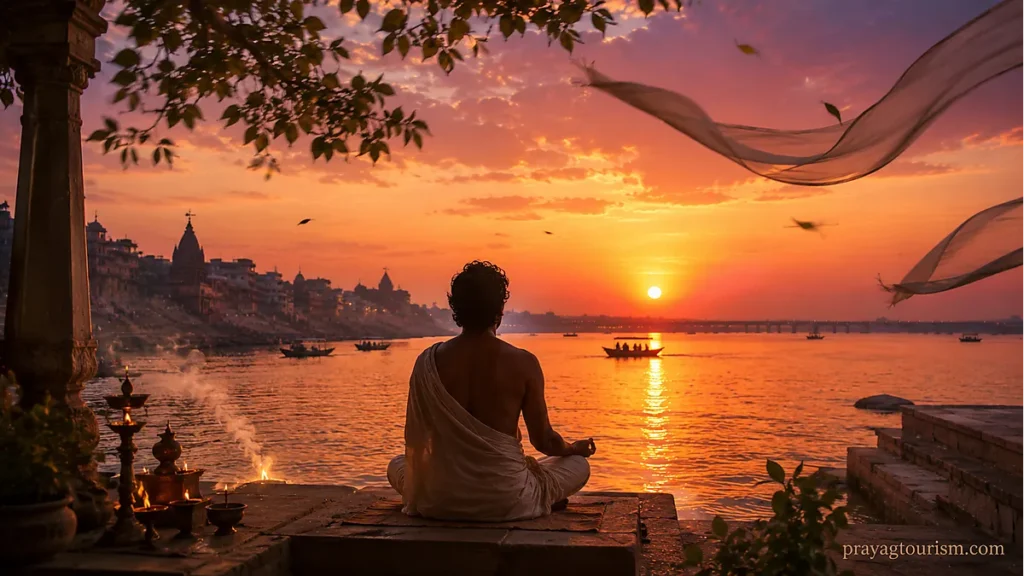
You do not need a pilgrimage or a ceremony to reconnect with the five elements. They are available to you right now — in the most ordinary moments of your day.[1][4]
- 🌎 Earth — Walk barefoot on grass, soil, or sand for ten minutes. Let your feet feel the ground directly. This simple act — called Earthing in modern wellness science — has measurable effects on the nervous system, and the tradition has known it for millennia.
- 💧 Water — Drink your next glass of water slowly, with awareness. Before drinking, hold the glass for a moment and feel its weight. Recognize that this water has traveled through clouds, rivers, and earth to reach you. Let gratitude, for once, precede the gulp.
- 🔥 Fire — Light a lamp or a candle in the evening instead of switching on a screen. Sit with the flame for five minutes. Let it remind you of the warmth inside your own body — the same fire, expressed at different scales.
- 🌬️ Air — Once a day — just once — take five slow, conscious, complete breaths. Breathe in as if receiving a gift. Breathe out as if releasing something you no longer need. Let Vāyu remind you that life is happening right now, in this breath.
- 🌌 Space — Find five minutes of genuine silence. Not just the absence of music or television — but an inner quietness where you are not planning, not reviewing, not scrolling. Just present. Just here. Let Ākāśa show you how vast and still your own awareness already is, beneath all the noise you have added to it.[2][4]
The Pañcatattva is not ancient science that has been replaced by modern chemistry. It is a living recognition that is more urgently needed today than perhaps at any time in human history — the recognition that you are not a consumer of nature. You are nature, temporarily conscious of itself, briefly walking around in a form made of earth, water, fire, air, and space, which will one day — gracefully and completely — return to what it was always made of.[12][13]
Until then: walk on the earth. Drink the water. Honor the fire. Breathe the air. And in the silence between all of these — simply notice who it is that is noticing. That noticing — open, boundless, and peaceful — is Ākāśa. It is the sky inside you. It was never born and it will never die. And it is made of exactly the same substance as the sky above Prayāgarāja on a clear January morning, when the Gaṅgā and the Yamunā meet at the Saṅgam and the mist rises from the water and the sun comes up over the river — and for one extraordinary moment, you cannot tell where the world ends and you begin.[7][1][2]
⁂
References
- https://www.fitsri.com/yoga/panch-tatva
- https://www.planetayurveda.com/library/concept-of-pancha-bhutas-five-elements-and-human-body/
- https://srisriayurvedahospital.org/5-elements-in-ayurveda/
- https://www.karunayoga.biz/post/pancha-tattvas-5-elements-5-practices
- https://www.netmeds.com/c/health-library/post/panchamahabhutas-understanding-the-five-element-theory-in-ayurveda
- https://iuvw.org/scientific-interpretation-upanishads-modern-analysis/
- https://www.artofliving.org/in-en/mahashivratri/pancha-bhoota-sthalams
- https://en.wikipedia.org/wiki/Pancha_Bhuta_Sthalam
- https://www.pilgrimagetour.in/blog/pancha-bhoota-sthalams/
- https://www.shivkhori.in/pancha-bhoota-shiva-temples/
- https://www.thestonestudio.in/pancha-bhoota-temples-significance/
- https://www.hinduismandlife.com/2025/07/the-relevance-of-sanatana-dharma-in.html
- https://www.hindu-blog.com/2025/11/sanatana-dharma-is-eternal-philosophy.html
- https://www.facebook.com/thebharatpost/posts/the-pancha-bootha-sthalams-are-five-sacred-temples-in-south-india-each-represent/1275451601108905/
- https://magikindia.com/en/pancha-bhoota-sthalas-pilgrimage/
- https://www.amargranth.com/post/a-complete-guide-to-pancha-bhoota-stalangal-lord-shiva-and-the-five-elements-of-nature
- https://www.facebook.com/100056148724574/videos/the-pancha-bhuta-lingams-are-five-shiva-temples-in-south-india-that-represent-th/650710870844721/
- https://www.planetayurveda.com/tridosha-panchmahabhoot-ayurveda/