
How an ancient science of sacred sound is being confirmed by modern neuroscience — and how you can use it to quiet your mind today
Sound Already Transforms You — Every Single Day
Before we discuss mantra, let us notice something that you already know in your body.
Think of a song that has moved you to tears. Not because of any conscious decision to feel something — but because the arrangement of sounds in that particular sequence did something to your nervous system that you did not choose and could not fully control. Something opened. Something was released. The body responded before the thinking mind had a chance to evaluate whether it was appropriate to feel this way.
Now think of a voice you have heard in your life — a parent, a teacher, a person in authority — whose tone, even without content, produced an immediate shift in your state. Not from the words. From the quality of the sound. The tension in it, or the warmth, or the coldness, or the contempt. Your nervous system processed that sonic quality and responded to it before your conscious mind had parsed the sentence.
Now think of silence — the specific silence of a room where something terrible has just been said, which is a different quality of silence from the silence of an empty church, which is different again from the silence of a forest at dawn. Silence is not the absence of sound. It is a particular kind of sound — and your nervous system distinguishes between types of silence as clearly as it distinguishes between types of music.
All of this confirms something that the tradition of Sanatana Dharma observed and systematized five thousand years ago, and that modern neuroscience is now confirming in detailed molecular and neurological terms: sound is not merely a sensory experience. It is a direct influence on the state of the human mind and body. Sound changes chemistry. Sound changes brainwave patterns. Sound changes the activation levels of the nervous system. Sound changes mood, attention, emotional tone, and physiological function — continuously, automatically, and powerfully.
The tradition’s response to this observation was characteristically practical: if sound can change the mind, then the deliberate, careful, intelligent use of specific sounds is one of the most powerful tools available for inner transformation.
This is Mantra (मन्त्र — Mantra). Not a religious formula. Not a superstition. Not a magic spell. A precise, ancient technology for using the transformative power of sound consciously, intentionally, and systematically for the benefit of the practitioner.
Let us understand what it actually is.
What Is a Mantra? — The Definition That Changes Everything
The word Mantra (मन्त्र) is one of the most direct and honest words in the Sanskrit language. It contains its own definition:
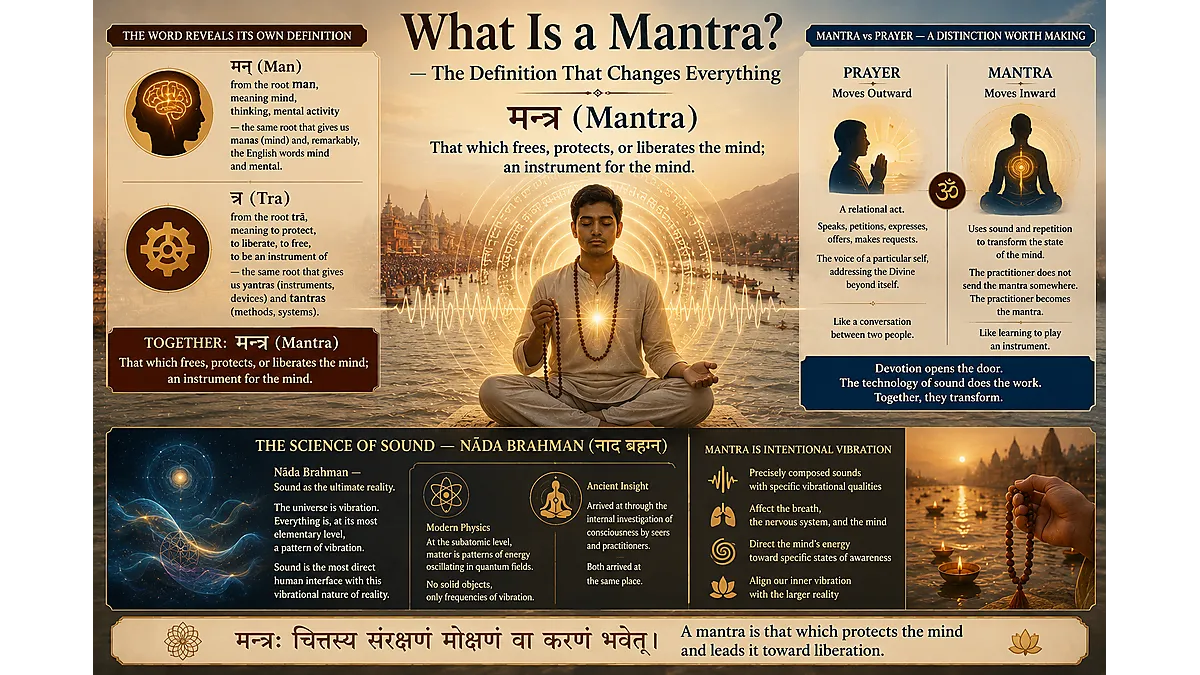
मन् (Man) — from the root man, meaning mind, thinking, mental activity — the same root that gives us the word manas (mind) and, remarkably, the English words mind and mental through ancient Indo-European linguistic roots.
त्र (Tra) — from the root trā, meaning to protect, to liberate, to free, to be an instrument of — the same root that gives us yantras (instruments, devices) and tantras (methods, systems).
Together: Mantra = that which frees, protects, or liberates the mind; an instrument for the mind.
Read that again. Not a prayer. Not a religious formula. Not a request to a deity. An instrument for the mind — a tool, a technology, a precisely designed mechanism for doing something specific to the way the mind functions.
This definition illuminates everything about how mantra works and why it has been regarded with such care and precision by the tradition. A mantra is not a collection of random words arranged in a pleasing way. It is a precisely composed arrangement of sounds — selected for their specific vibrational qualities, their phonetic properties, their effects on the nervous system and the breath, and their capacity to direct the mind’s energy toward specific states of awareness.
The tradition’s understanding of sound goes considerably deeper than modern acoustics. It begins from the principle of Nāda Brahman (नाद ब्रह्मन् — Nāda Brahman, meaning sound as the ultimate reality, the universe as vibration) — the recognition that the fundamental fabric of reality is vibrational, that everything that exists is, at its most elementary level, a pattern of vibration, and that sound is the most direct human interface with this vibrational nature of reality.
The modern physics version of this insight — that at the subatomic level, what we call matter is better described as patterns of energy oscillating in quantum fields; that there are no solid objects, only frequencies of vibration — was arrived at through mathematics and particle accelerators. The tradition arrived at the same insight through the internal investigation of consciousness by practitioners who pushed the boundaries of meditative depth far enough to encounter the vibrational nature of experience directly.
Both arrived at the same place: the universe vibrates. We are vibrating beings within it. And the deliberate use of specific vibrations — mantras — is a way of aligning the vibration of our inner world with specific qualities and dimensions of the larger reality.
Mantra vs Prayer — A Distinction Worth Making
The confusion between mantra and prayer is one of the most common misunderstandings about the practice — and clearing it up reveals something profound about what mantra actually does.
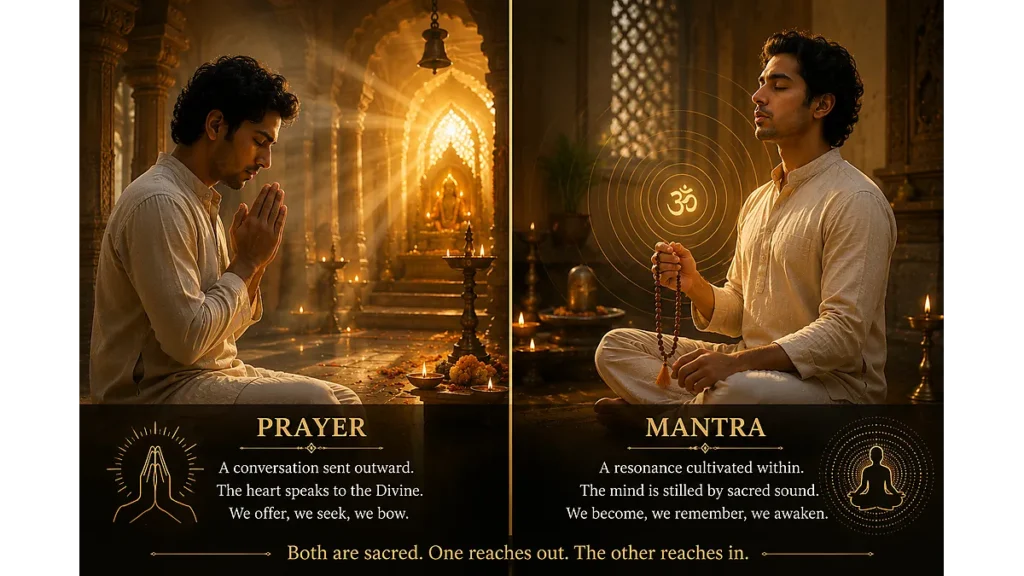
Prayer, in most of the world’s religious traditions, is a relational act. It moves outward — from the practitioner toward the Divine. Prayer speaks, petitions, expresses gratitude, offers devotion, makes requests, maintains a conversation. Prayer is the voice of a particular self, addressing a reality larger than itself. Prayer has enormous value — it cultivates humility, gratitude, dependence on something beyond the ego’s control, and the quality of open relationship with the sacred.
Mantra does something different. It moves inward. It does not primarily address the Divine from outside — it works within the practitioner’s own consciousness. It uses the vibrational quality of the sound, combined with the focusing quality of repetition, to directly change the state of the practitioner’s mind. The practitioner does not send the mantra somewhere. The practitioner becomes the mantra — through repetition, through resonance, through the gradual process by which a sound repeated deeply enough and consistently enough begins to permeate the practitioner’s inner landscape.
An analogy: prayer is like a conversation between two people. Mantra is like learning to play an instrument. In a conversation, meaning travels between two people. In learning an instrument, the practice itself changes the player — their fingers develop new capability, their ear develops new sensitivity, their relationship to sound changes from passive reception to active creation. The instrument does not go anywhere. The player is transformed.
This does not mean mantra is devoid of devotion or relationship with the Divine. Many of the tradition’s greatest mantras are expressions of profound devotion — they address specific deities, invoke specific divine qualities, align the practitioner with specific cosmic principles. But the mechanism of their transformation is not the addressing. It is the practice — the repetition, the resonance, the gradual permeation of the practitioner’s consciousness by the vibrational quality of the sound.
The devotion and the technology are not opposites. They reinforce each other: the devotion provides the quality of śraddhā (faith, receptivity) that allows the practice to go deep; the technology of the sound does the work that the devotion opens the door for.
The Science of Sacred Sound — Nāda Yoga
The tradition’s science of sacred sound is organized under the name Nāda Yoga (नाद योग — Nāda Yoga, from nāda meaning primordial sound, the vibrating universe and yoga meaning union — literally union through sound). It is one of the oldest and most comprehensive systems for understanding the relationship between sound, consciousness, and transformation.
The Nāda Yoga system begins from a fundamental observation: consciousness itself, at its most subtle level, is a form of vibration — and the sounds produced by the human voice and heard by the human ear directly influence the state of consciousness because sound and consciousness are, at their deepest level, made of the same stuff.
The tradition identifies four levels at which sound exists:
Vaikharī (वैखरी — audible, spoken sound) — the gross level of sound that has been expressed as physical vibration in the air, hearable by another person. This is the level at which mantra begins for most practitioners: repeating the mantra audibly.
Madhyamā (मध्यमा — mental sound) — the level at which sound exists as mental vibration — what you hear in your inner ear when you read silently, or when you repeat a mantra mentally rather than aloud. This is a subtler level of the same sound — more interior, more direct in its effect on the mind.
Paśyantī (पश्यन्ती — intuitive vision-sound) — the level at which sound exists as pure intuitive insight — before it has formed into words or even a mental repetition, the level at which meaning and sound are not yet separate. Advanced practitioners experience mantra at this level.
Parā (परा — the transcendent, beyond) — the level at which sound has not yet become sound — the ground state of vibration from which all manifestation arises. This is the level the tradition equates with Brahman itself — ultimate reality in its undivided, unmanifest form.
The practice of mantra begins at the Vaikharī (spoken) level and, with deep and sustained practice, progressively interiorizes — moving from audible repetition to mental repetition to the subtler levels where the mantra is no longer something you are doing but something you are.
Now here is what modern neuroscience has confirmed about this ancient framework.
When you chant a mantra audibly, the sound produced by your own voice creates vibrations that are conducted through the bones of the skull directly to the brain — bypassing the ordinary auditory processing route and reaching neural tissue through osteophonic conduction. This direct vibrational contact with brain tissue is part of why chanting feels qualitatively different from listening to music: you are not just hearing the sound, you are becoming it — your own body is the resonating chamber.
Neuroimaging studies — fMRI and EEG research on practitioners during mantra chanting — have found that mantra repetition produces a consistent and measurable deactivation of the brain’s Default Mode Network (DMN) — the network of regions responsible for mind-wandering, self-referential thinking, rumination, worry about the future and replay of the past. This is precisely the network that is overactive in anxiety, depression, and the ordinary restless mind.
Simultaneously, mantra practice produces activation of the prefrontal cortex and anterior cingulate cortex — the regions associated with focused attention, executive function, and the ability to maintain a chosen direction of thought. The brain, during mantra practice, is doing exactly what the tradition describes: quieting the background noise and strengthening the signal.
At the autonomic level, the rhythm of mantra chanting — particularly slow, even mantras with natural breath pacing like Oṃ and the Gāyatrī — produces a respiratory rate of approximately five to six breaths per minute, which is precisely the resonant frequency of the cardiovascular system’s baroreflex loop. Breathing at this rate produces maximum heart rate variability — the physiological signature of autonomic balance, resilience, and the parasympathetic (calm, restorative) state.
The tradition called this synchronization nāda anusandhāna — the tuning of the practitioner to the cosmic sound. Modern physiology calls it cardiovascular resonance. They are describing the same phenomenon from different angles.
Three Powerful Mantras — Simple Meanings, Real Effects
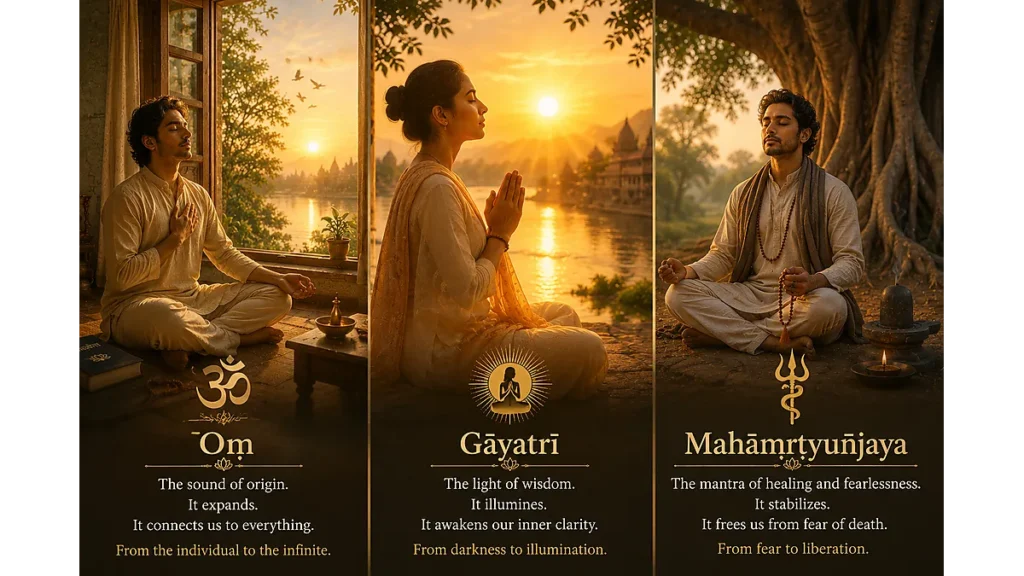
The tradition’s treasury of mantras is vast — thousands of mantras preserved across the Vedas, the Tantra texts, the Purāṇas, and the specific lineage traditions of every major sampradāya. For the purposes of this article, three mantras stand in positions of particular importance — not because they are the only powerful mantras, but because they represent the three fundamental orientations of mantra practice: being, wisdom, and protection.
Oṃ — The Primordial Sound
Devanagari Script: ॐ
IAST Transliteration: Oṃ
Source: Present throughout the Vedas, Upaniṣads, and the Yoga Sūtras; most explicitly discussed in the Māṇḍūkya Upaniṣad and Yoga Sūtras 1.27
The Sound Itself:
Oṃ (often written as AUM) is not a single sound but three sounds in one: the A sound (produced in the open throat, representing the waking state and the manifest universe), the U sound (produced in the middle of the mouth, representing the dreaming state and the subtler levels of reality), and the M sound (produced at closed lips, representing deep sleep and the unmanifest ground of being) — followed by the silence that follows the M, which the tradition identifies as the fourth state (turīya) that underlies and pervades the other three.
The Māṇḍūkya Upaniṣad opens with a declaration that became the foundation of the entire mantra tradition: Oṃ ity etad akṣaram idaṃ sarvam — “All this that exists is Oṃ.” The tradition is saying: the vibration you produce when you chant Oṃ is the vibration of the universe itself. When you chant Oṃ, you are not invoking an external reality. You are resonating with the fundamental frequency of your own nature and the nature of everything that exists.
The neuroscience research on Oṃ specifically is remarkable: the fMRI study cited earlier found that audible chanting of Oṃ produced significant deactivation of the limbic system (the brain’s emotional reactivity center) and midline structures associated with self-referential thinking — effects that subvocal (silent) control sounds did not produce. The specific vibration of Oṃ seems to have a particular physiological effect beyond generic sound.
How to use it: Sit comfortably with your spine upright. Take a slow breath in. On the exhale, open with Aaaa, transition to Uuuu as the lips begin to close, close into Mmmm as the lips meet, and allow the resonance to continue silently in the pause before the next breath. Repeat for five to fifteen minutes. Notice what the silence between the repetitions feels like — this silence, the tradition says, is the most important part of the practice.
The Gāyatrī Mantra — The Light of Wisdom
Devanagari Script:
ॐ भूर्भुवः स्वः।
तत्सवितुर्वरेण्यं।
भर्गो देवस्य धीमहि।
धियो यो नः प्रचोदयात्॥
IAST Transliteration:
Oṃ bhūr bhuvaḥ svaḥ |
Tat savitur vareṇyaṃ |
Bhargo devasya dhīmahi |
Dhiyo yo naḥ pracodayāt ||
Source Citation: Ṛg Veda, Maṇḍala 3, Sūkta 62, Verse 10; also found in Yajur Veda and Sāma Veda
Word-by-Word Meaning:
- ॐ (Oṃ) — the primordial sound, the vibrational ground of all existence
- भूः (bhūḥ) — the physical earth, the gross world
- भुवः (bhuvaḥ) — the atmosphere, the intermediate world
- स्वः (svaḥ) — the celestial, the world of higher consciousness
- तत् (tat) — that, the ultimate reality beyond names
- सवितुः (savituḥ) — of the sun, of Savitā the divine solar intelligence — the light that illuminates both the outer sky and the inner mind
- वरेण्यम् (vareṇyam) — the most excellent, most worthy, most glorious
- भर्गः (bhargaḥ) — the divine radiance, the cleansing light, the splendor that removes darkness
- देवस्य (devasya) — of the divine
- धीमहि (dhīmahi) — we meditate upon, we contemplate, we hold in awareness
- धियः (dhiyaḥ) — our intellects, our understanding, our powers of discernment
- यः (yaḥ) — who, which
- नः (naḥ) — our, ours
- प्रचोदयात् (pracodayāt) — may inspire, may impel, may guide, may illuminate
Complete Meaning:
“Oṃ. We meditate upon that most excellent divine radiance of Savitā — the celestial intelligence that illuminates the three worlds. May that light inspire and guide our intellect in the right direction.”
The Gāyatrī is not primarily a mantra of devotion, nor a mantra of protection. It is a mantra of clarity — specifically, a mantra that invokes the quality of the sun’s light (which illuminates everything equally and without preference) as a model for the ideal quality of the human intelligence: clear, steady, non-distorting, seeing things as they actually are rather than as we wish or fear them to be.
In its oldest understanding, the Gāyatrī is a mantra for dhī — wisdom, discernment, the higher intelligence that can distinguish between the real and the temporary. The practitioner who chants the Gāyatrī is not asking for intelligence in the ordinary sense. They are aligning their inner light with the cosmic light — asking that their understanding be of the same quality as sunlight: present for all, obscuring nothing, showing everything as it is.
How to use it: The Gāyatrī has traditionally been chanted at dawn (Prātaḥ Sandhyā), at noon (Mādhyāhnika), and at sunset (Sāyaṃ Sandhyā) — the three sandhyā (transitional) moments of the day when the light changes. These three moments have a natural quality of transition that the tradition recognizes as particularly supportive for inward practice. Begin with a morning chanting of the Gāyatrī — even three to five repetitions before beginning your day — and notice whether the quality of your thinking and attention in the hours that follow carries a different quality.[11][2]
The Mahāmṛtyuñjaya Mantra — The Great Victory Over Fear
Devanagari Script:
ॐ त्र्यम्बकं यजामहे सुगन्धिं पुष्टिवर्धनम्।
उर्वारुकमिव बन्धनान्मृत्योर्मुक्षीय माऽमृतात्॥
IAST Transliteration:
Oṃ tryambakaṃ yajāmahe sugandhiṃ puṣṭivardhanam |
Urvārukam iva bandhanān mṛtyor mukṣīya mā’mṛtāt ||
Source Citation: Ṛg Veda, Maṇḍala 7, Sūkta 59, Verse 12; also Yajur Veda 3.60
Simple Meaning:
“We worship the three-eyed Lord Śiva, who is fragrant and who nourishes all beings. Like the ripe cucumber that is freed from its vine, may we be liberated from the bond of death — and not from immortality.”
The Mahāmṛtyuñjaya (literally the great conqueror of death) is one of the most ancient and most powerful mantras in the Vedic tradition. Its domain is not literally death alone — it addresses fear, dissolution, illness, the anxiety about endings of all kinds, and the accumulated patterns of the past that bind the practitioner to suffering.
The beautiful image at the heart of the mantra — the ripe cucumber releasing from the vine — captures something profound: liberation is not a violent tearing away. It is a natural, gentle, complete releasing that happens when the time is right, when the fruit has ripened, when what needed to grow has grown. The mantra asks for this quality of liberation — not a forced breaking free from fear and mortality, but the natural falling away of what is no longer needed, the graceful release into the larger reality that awaits.
This mantra is traditionally used during times of illness, fear, grief, or any kind of significant loss — but its deepest use is not crisis management. It is the daily practice of maintaining relationship with the reality of impermanence — so that when change and loss arrive (as they always do), the practitioner meets them not with terror but with the rootedness that the mantra has been cultivating.
How to Practice Mantra Japa — Simple Steps for Real Life
Japa (जप — Japa, from the root jap meaning to mutter, to repeat softly, to whisper) is the practice of mantra repetition — the foundational mantra practice, the entry point through which virtually every practitioner in every lineage of the tradition begins.
It is beautifully simple. Here is everything you need to know to begin today:
The Mālā — Your Tactile Anchor
A japa mālā (जप माला — japa mālā, a rosary of beads for mantra counting) traditionally has 108 beads, plus one slightly larger bead called the Meru (मेरु — the mountain, the summit, the turning point) or Guru bead, which marks the beginning and end of one complete round.
The number 108 is not arbitrary in the tradition — it appears in the relationship between the distances and diameters of the sun, moon, and earth in ancient astronomical calculations; in the 108 Upaniṣads; in the 108 sacred sites (pīṭhas) of the tradition. But for practical purposes, what matters is the specific quality the mālā brings to the practice: the tactile sensation of moving from bead to bead creates a physical anchor for the mind that complements the sonic anchor of the mantra.
The fingers count the beads. The lips (or the silent mind) repeat the mantra. The two streams — physical touch and sound — flowing simultaneously engage more of the nervous system in the practice and make it easier for the mind to stay present. The Yoga Institute describes this beautifully: “The significance is not in the number of repetitions, but in the quality of presence and devotion.”
How to hold it: Hold the mālā in the right hand, draped over the middle finger, with the thumb moving the beads. The index finger is traditionally kept away from the beads — in the yogic physiology, the index finger is associated with the ego-self (jīvātman), and keeping it separate from the practice is a symbolic acknowledgment that this practice is not the ego’s project. Begin at the Meru bead. With each repetition of the mantra, move one bead with the thumb. When you reach the Meru bead again, do not cross it — turn the mālā around and begin again.
If you do not have a mālā, the practice is equally valid with the fingers alone — using the segments of the fingers to count repetitions — or with no counting at all. The mālā is a support, not a requirement.
Three Levels of Practice
The tradition prescribes three levels of japa, from most external to most internal — and recommends beginning with the most external and progressively interiorizing as the practice deepens:
Vācika Japa (Spoken) — chanting the mantra aloud, at a comfortable pace, allowing the sound to fill the space around you. This is the most accessible entry point, particularly for absolute beginners, because the audible sound provides an external anchor that is harder to lose than a purely mental one. The vibration of your own voice resonating in the chest and skull creates an immediate, embodied, sensory experience of the mantra.
Upāṃśu Japa (Whispered) — a barely audible whisper, the lips moving but the sound more breath than voice. This level of practice interiorizes the mantra — it is no longer projected outward into the room but held in the intimate space between the lips and the air. Most practitioners find this level particularly absorbing — the reduced external projection seems to direct more of the practice’s energy inward.
Mānasa Japa (Mental) — the mantra repeated silently, entirely in the inner ear, without any physical movement of the lips. This is the subtlest and most powerful level of japa in the tradition’s understanding — because at this level, the boundary between the mantra and the mind that is repeating it becomes thinnest. The mental mantra is closest to the Madhyamā level of sound — the interior vibration that directly works on the mind without the intermediate step of physical sound.
Begin with Vācika (spoken). Practice consistently until the mantra feels natural and the mind settles into it readily. Then experiment with Upāṃśu (whispered). Then, when the practice is established, explore Mānasa (mental). There is no rush. Each level will reveal itself when you are ready for it.
A Simple Daily Routine
Morning (10–15 minutes): Sit in a comfortable, upright posture before the day’s activity begins — before the phone has been checked, before the news has been read, before the day’s concerns have arrived in full force. This morning window is the most valuable time for mantra practice, because the mind is at its freshest and most receptive, and establishing the quality of the mantra at the beginning of the day creates a background resonance that can be subtly felt throughout what follows.
Take three slow breaths to settle. Begin your chosen mantra — aloud if you are alone, whispered if others are nearby, mental at any time. With each bead, one repetition. With each repetition, genuine attention on the sound — not forcing, not straining, simply directing the mind back to the mantra each time it wanders.
When your round is complete, sit for one to two minutes in the silence that follows — the silence that the mantra has been creating throughout the practice, now fully audible without the foreground of the mantra itself. This post-japa silence is the practice’s deepest gift: the still, resonant inner space from which the mantra arose and into which it has returned.
Throughout the day: The most advanced form of mantra practice is called ajapā japa (अजपाजप — ajapā japa, the repetition that repeats itself without being repeated, the mantra that becomes as automatic as the breath) — the state in which the mantra has been so thoroughly internalized through regular practice that it continues below the surface of conscious awareness even when the practitioner is engaged in other activities.
You do not arrive at ajapā japa by trying for it. You arrive at it by practicing regular japa so consistently, for so long, that the mantra becomes part of the mind’s natural background — a continuous, quiet current of sacred sound running beneath the day’s surface activity. Many experienced practitioners describe this as the most practical benefit of the entire mantra tradition: the sense that wherever they go, whatever they are doing, there is a thread of the mantra present, providing a continuous, subtle stability that does not require any special posture or set-aside time to access.
The Inner Transformation — From Noise to Silence
Now let us go to the heart of what mantra practice ultimately does — and why the tradition considers it one of the most powerful paths to the deepest states of meditation and inner freedom.
The ordinary mind, in its default state, is extraordinarily noisy.
Not noisy with external sounds — noisy with internal sounds: the continuous, mostly involuntary stream of thoughts, memories, anxieties, plans, commentaries, reactions, and associations that the mind generates from the moment of waking to the moment of sleep. This inner noise is so constant and so familiar that most of us do not even register it as noise — it is simply the background condition of consciousness, the way the sound of a refrigerator becomes inaudible to someone who lives with it for years.
Mantra practice begins by introducing a second sound into this inner environment — a deliberate, carefully chosen, precisely tuned sound that is different in quality from the random noise of the ordinary mind.
At first, this new sound must compete with the existing noise. The mantra begins, a thought arises about something unrelated, the practitioner notices, returns to the mantra, another thought arises, the practitioner returns again. This is the beginning of the practice — the first phase, analogous to Dhāraṇā in the meditation framework: effortful, often frustrating, requiring patience and consistency.
But something is happening beneath the surface of this apparently low-efficiency experience. Each time the practitioner returns to the mantra, the neural pathway associated with the mantra is strengthened. Each time the mind wanders and is brought back, the practitioner’s capacity for directed attention is developed — the same mechanism that builds muscle through exercise, building the mind’s capacity for focus through the repeated effort of returning.
Over weeks and months of consistent practice, several things begin to shift — gradually, without drama, the way the season changes: not in a single day but unmistakably across time.
The mantra begins to arise spontaneously — to present itself at the beginning of a practice session without requiring the practitioner to try to get it started. The settling happens more quickly, the background noise loses some of its insistence, the mantra becomes more like a current that is flowing than like an effort being made.
The quality of the silence between the repetitions becomes noticeable — and it becomes increasingly clear that this silence is not the absence of the mantra but its deepest expression. The tradition says: the mantra is a boat that takes you across the river. The other bank is the silence from which the mantra arose and into which it dissolves. The boat is necessary to cross. But the destination is the shore, not the boat.
At a sufficiently deep level of consistent practice, the mantra begins to practice itself — the ajapā japa condition. The practitioner’s inner environment has been so thoroughly reorganized by the consistent presence of the mantra that it now carries the mantra’s quality even in the mantra’s absence.
And what is that quality? Precisely what the neuroscience research confirms and the tradition has always described: a quieting of the Default Mode Network’s restless self-referential chatter; a strengthening of the attention networks; a deepening of the parasympathetic baseline; a reduction in the reactivity of the limbic system; a gradual, genuine, sustainable expansion of the quality of inner peace.
Not as a special state visited during practice and left behind when the session ends. As the mind’s new ground condition — its growing baseline, the water level rising gradually through the seasons of practice until what once required effort is simply the ordinary quality of the practitioner’s inner life.
The Sound That Was Always There
The Māṇḍūkya Upaniṣad — the shortest of all the Upaniṣads at just twelve verses, and arguably the most concentrated — opens with the verse we have already met and closes with a teaching that brings the entire arc of mantra practice to its perfect conclusion:
Devanagari Script:
ओमित्येतदक्षरमिदँ सर्वम्।
IAST Transliteration:
Om ity etad akṣaram idaṃ sarvam.
Source Citation: Māṇḍūkya Upaniṣad, Verse 1
Simple Meaning:
“All this that exists is the syllable Oṃ.”
All of it. The words you are reading. The thoughts arising as you read them. The breath moving through your body as you sit. The sound of whatever environment surrounds you right now. The space in which all of this is occurring. All of it — the tradition says — is the mantra Oṃ in its infinite expressions, the one cosmic vibration appearing as the ten thousand things, the primordial sound diversifying itself into the entire universe of experience.
What this means for the practitioner is both humbling and liberating: you are not chanting toward the sacred. You are a vibrating being in a vibrating universe, learning to recognize the frequency you and everything else already share. The mantra is not foreign to you. It is what you most fundamentally are — the specific frequency of conscious awareness expressing itself through this particular form, this particular life, this particular moment.
The practice of mantra japa is, at its deepest level, the practice of coming home to this recognition — not as a concept, not as an intellectual understanding, but as a direct, embodied, sonic experience that bypasses the thinking mind and lands immediately in the body, in the breath, in the belly.
Every repetition of the mantra is a small homecoming. Every session of japa is a longer one. And the practitioner who maintains the practice consistently, through the busy days and the quiet ones, through the sessions where the mind settles beautifully and the ones where it refuses to settle at all, is — bead by bead, breath by breath, mantra by mantra — learning the one thing the tradition says is worth learning above all others:
That beneath all the noise, you are already where you were trying to go.
The mantra does not create this. It removes what was hiding it.
That is the entirety of the teaching. That is the technology. That is the gift that has been waiting in the simplest possible place — in the breath, in the sound, in the oldest syllable in the tradition — for anyone who chooses to receive it.
ॐ (Oṃ)