
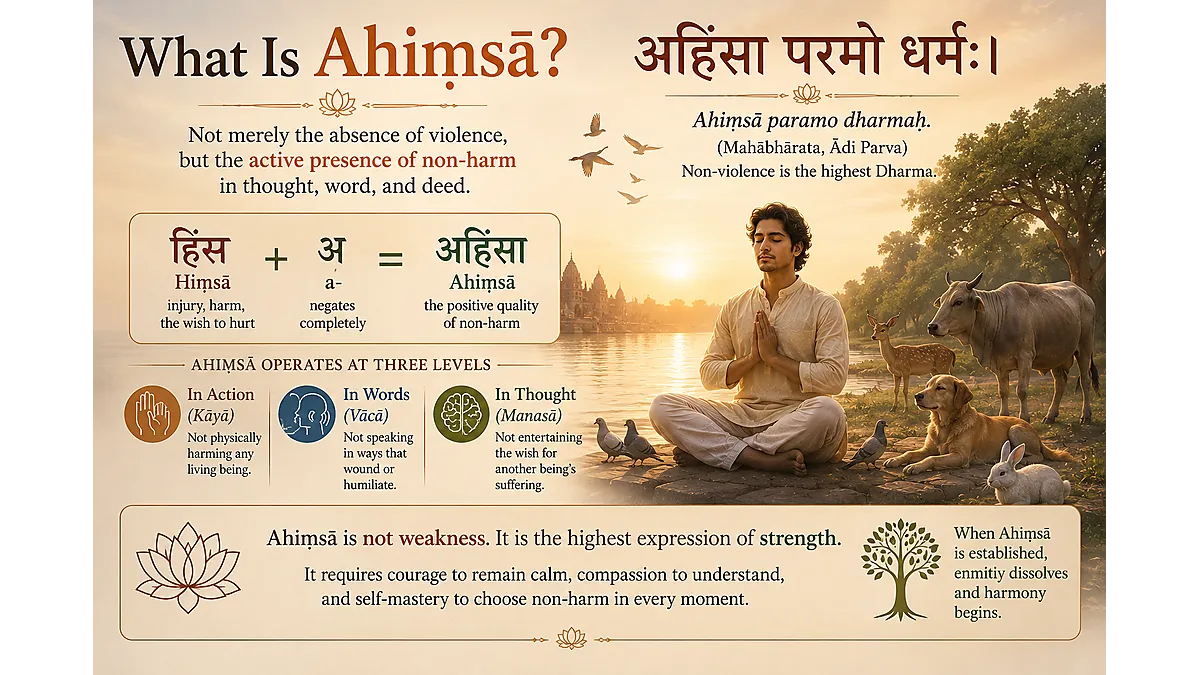
Why true non-violence is not the absence of strength — it is the highest expression of it
Look Around You. The Violence Is Everywhere.
You do not need to look at a battlefield to see it.
Watch a comment thread on any social media post about a mildly controversial topic. Watch the hostility erupt within minutes — the name-calling, the dismissal, the quick contempt for anyone who disagrees. Watch a meeting at work where someone’s idea is dismantled not with reason but with the quiet cruelty of tone. Watch a family dinner where old wounds speak through sarcasm rather than directly. Watch the inner monologue of a person who has made a mistake — the vicious self-criticism that would be called abuse if anyone else directed it at them.
Violence is not only what happens when someone raises a fist. It is what happens when someone raises their voice to humiliate. It is what happens in the thought that reduces another person to a category and then dismisses them. It is what happens every time we make the world smaller and meaner by choosing contempt over curiosity, cruelty over compassion, or the momentary pleasure of “winning” an argument over the more difficult, more rewarding work of actually understanding another human being.
The question Sanatana Dharma asks — and has been asking for thousands of years — is not “How do we manage violence?” It asks something far more radical and far more demanding: What if non-violence were not a strategy but a way of being?
The answer that emerged from the deepest wells of this tradition is a single word — perhaps the most important word in the entire Dharmic vocabulary:
Ahiṃsā. (अहिंसा)
What Is Ahiṃsā? Starting at the Root
The word is built from two Sanskrit parts. Hiṃsā (हिंसा) means injury, harm, the wish to hurt. The prefix a- (अ) negates it completely. So Ahiṃsā (अहिंसा) is not merely “avoiding violence.” It is something more active than that — the presence of non-harm, the positive quality of not wishing injury to any being, in any form, by any means.
The Mahābhārata states the principle at its most absolute:
Devanagari Script:
अहिंसा परमो धर्मः।
IAST Transliteration:
Ahiṃsā paramo dharmaḥ.
Source Citation: Mahābhārata, Ādi Parva (also Anuśāsana Parva)
Word-by-Word Meaning:
- अहिंसा (ahiṃsā) — non-harm, non-violence, non-injury
- परमः (paramaḥ) — the supreme, the highest
- धर्मः (dharmaḥ) — duty, right conduct, the way of living
Simple Meaning:
“Non-violence is the highest Dharma.”
Four words. But notice what is being claimed. Not that Ahiṃsā is a good value among others. Not that it is usually wise to be non-violent. But that it is the highest Dharma — superseding every other obligation, every other virtue, every other claim upon how a human being should live.[3][4]
That is a radical claim. And the tradition means it.
But what exactly does non-violence include? Here is where the teaching deepens — because Ahiṃsā operates at three levels, each one subtler and more demanding than the one before it.[5][6]
- In action (kāyā — कायेन): not physically harming any living being
- In words (vācā — वाचा): not speaking in ways that wound, humiliate, or diminish
- In thought (manasā — मनसा): not entertaining the wish for another being’s suffering in the mind
The third level is the one that separates genuine Ahiṃsā from its imitations. Because most of us manage not to hit people. Many of us learn, with effort, to guard our words in difficult moments. But the mind — the private theatre of thought where no one is watching — that is where violence is born, long before it ever reaches action.
Every expression of physical violence began as a thought. Every harsh word was a thought that wasn’t caught in time. Ahiṃsā asks you to go upstream — to address violence at its source, in the invisible place where it is first generated.
Why Hurting Others Is Hurting Yourself
The philosophical foundation of Ahiṃsā in Sanatana Dharma is not sentimental. It is metaphysical — and once understood, it makes non-violence not a moral obligation but a logical one.
The Upanishads teach that the same Ātman (आत्मन् — Ātman, the pure Self, the spark of Consciousness) dwells in every living being — in you, in the animal, in the tree, in the stranger whose face you have never seen. The surface differences are real — different bodies, different minds, different histories, different personalities. But beneath the surface, the same awareness is looking out of every pair of eyes.
If this is true — and the tradition insists, with great philosophical rigor, that it is — then harming another being is not simply wrong. It is incoherent. It is a hand striking the body it belongs to. It is the left hand injuring the right. You may not feel the connection in the way you feel your own pain — but the connection is there, whether you feel it or not.
The Yoga Sūtras list Ahiṃsā as the very first of the Yamas (यम — ethical restraints) — the foundation upon which every other spiritual practice is built. Patañjali is explicit: without Ahiṃsā as the ground, all other practices produce only a spirituality that is, at its core, still violent — still motivated by the ego’s desire to achieve, to dominate, to get somewhere. Non-violence is not the first item on a checklist. It is the soil in which everything else grows.
Three Lives That Proved It Was Possible
The tradition did not leave Ahiṃsā as philosophy. It showed us what it looks like when a human being actually lives it.
Bhagavān Mahāvīra — The Man Who Would Not Harm Even the Earth
Vardhamāna Mahāvīra, the 24th Tīrthaṅkara of the Jain tradition, carried Ahiṃsā to its most absolute extreme — and in doing so, demonstrated something extraordinary about human capacity. He walked without shoes, so as not to crush living creatures in the soil. He swept the ground before sitting, so no insect would be harmed. He filtered his water before drinking. He wore no clothing, accepting the discomfort of all seasons rather than use animal products.
You do not need to agree with every detail of his practice to be awed by what he was demonstrating: that a human being can choose, with absolute consistency and at great personal cost, to make their entire life an act of non-harm. That it is possible. That the instinct toward harming can be examined, questioned, and — with enormous will, enormous patience, and enormous compassion — overcome.
The Buddha — The Prince Who Chose Understanding Over Power
Siddhartha Gautama gave up the power of a kingdom to seek the end of suffering — not his own suffering alone, but the suffering of all beings. His entire teaching is built upon the recognition that dukkha (suffering) is the universal condition of unexamined life, and that compassion — the active wish for the relief of others’ suffering — is the appropriate response to this recognition.
The Buddha’s Ahiṃsā was not passive withdrawal from the world. He engaged, he taught, he challenged, he traveled on foot for forty-five years until his death, speaking truth to kings and speaking comfort to the grieving. Non-violence, for the Buddha, was not staying quiet in the corner. It was the active, tireless engagement with suffering — facing it fully, understanding it clearly, and refusing to add to it through carelessness, aggression, or indifference.
Mahatma Gandhi — When Non-Violence Defeated an Empire
And then there is Mohandas Karamchand Gandhi — who took the Dharmic principle of Ahiṃsā, tested it against the most formidable imperial power of the twentieth century, and proved, against every conventional calculation of power, that it worked.
Gandhi was precise about what Ahiṃsā meant for him: “Nonviolence requires more than the courage of the soldier of war. Nonviolence is the virtue of the manly. The coward is innocent of it.” He was equally precise about what it did not mean: it was not weakness, not passivity, not the absence of will. He wrote: “True nonviolence is an impossibility without the possession of unadulterated fearlessness.”
Gandhi did not ask people to be passive in the face of injustice. He asked them to be strong enough not to retaliate — and this, he insisted, requires infinitely more courage than fighting back. Anyone can respond to violence with violence. The reflex is automatic, biological, ancient. But choosing — in the face of injustice, in the face of humiliation, in the face of genuine suffering — to meet force with dignity and determination rather than with counter-force? That requires something the tradition recognizes as tapas (तपस् — tapas, transformative inner fire): the burning discipline of the fully awakened will.
The Most Common Misunderstanding — And Why It Must Be Corrected
Let us be direct about this, because it matters enormously: Ahiṃsā is not weakness.
The person who stays silent when they should speak — that is not Ahiṃsā. That is fear dressed in spiritual language. The person who endures mistreatment because they cannot bring themselves to set a boundary — that is not Ahiṃsā. That is the non-violence of the exhausted, the defeated, the person who has given up rather than grown.
The tradition is clear: Ahiṃsā practiced from fear is not Ahiṃsā. It is cowardice wearing a noble name.
Genuine Ahiṃsā requires, as its prerequisite, strength — the inner strength to be moved by another person’s suffering without being destroyed by it, the self-mastery to be angry without being controlled by anger, the courage to set clear limits without cruelty, to speak truth without contempt, to defend what matters without hatred for those who threaten it.
Think about the last time someone said something genuinely unkind to you. The immediate impulse — the sharp retort, the sarcastic response, the well-chosen phrase designed to wound — that came easily, didn’t it? The rage was quick. But staying calm, staying clear, responding from your center rather than from your wound — that took everything. That required more of you than reacting would have. That is where Ahiṃsā lives — in that harder, higher, more demanding choice.
Gandhi understood this perfectly when he wrote: “I can imagine a fully armed man to be at heart a coward. Possession of arms implies an element of fear, if not cowardice. But true nonviolence is impossible without the possession of unadulterated fearlessness.”
Ahiṃsā in Your Daily Life — Starting Right Now
The beautiful and demanding thing about Ahiṃsā is that it offers no days off. It is practiced not on pilgrimage or in meditation retreats alone — though those matter — but in the texture of every ordinary day.
In Your Words:
Words are arguably the most common vehicle of modern violence. They travel at the speed of a keystroke, reach thousands instantly, and leave marks that last years. Every time you choose to correct rather than humiliate, to disagree rather than dismiss, to address the argument rather than insult the person making it — you are practicing Ahiṃsā.
Every time you choose not to share the piece of information that would wound someone. Every time you speak about an absent person with the same care you would use if they were in the room. Every time you offer criticism with the genuine intent to help rather than the desire to feel superior — Ahiṃsā, in action.
In Your Thoughts:
The mind is the hidden battlefield of Ahiṃsā — and it is the hardest terrain to work with, because no one sees it. But you live there. And the violence that circulates silently in the mind — the resentment nursed over months, the contempt for a colleague, the quiet satisfaction at someone else’s failure, the self-punishing inner dialogue that never rests — all of this damages you as surely as any external injury would.[2][1]
The practice here is not suppression — pushing violent thoughts down only makes them more powerful. It is observation: noticing when the mind moves toward harm, naming it clearly, and choosing not to follow it. This practice, done consistently, gradually changes the default weather of the mind.
In Your Food:
The tradition’s ancient recognition — that the food we eat has a direct relationship with Ahiṃsā — has never been more relevant. This is not a rigid prescription. It is an invitation to bring awareness to what you eat: where it came from, how it was produced, whether the living systems that made it possible were treated with care or with industrial indifference. The tradition does not demand perfection. It asks for consciousness.
In Your Relationship with Nature:
Every living being — not only the beings that have faces we can recognize — participates in the fabric of life. The tree, the river, the insect, the soil: the tradition asks us to move through the world as if all of these matter, because they do. An Ahiṃsā rooted in the understanding that the same consciousness moves through all life cannot treat nature as raw material. It treats it as kin.
The World That Ahiṃsā Builds
Here is the teaching’s final and most important claim: Ahiṃsā is not only individually transformative. It is the only force that can genuinely transform a society.
Violence — physical, verbal, psychological — operates on a closed loop. It produces counter-violence, which produces more violence, which produces the counter-violence to that, in an escalation that history has been documenting with painful consistency for as long as human beings have been recording events. Every war ever fought was, in some measure, a retaliation for a previous harm — which was itself a retaliation for something before it. Violence does not end cycles. It is the cycle.
Ahiṃsā breaks the cycle. Not because it is passive — Gandhi proved definitively that it is not. But because it refuses to add new harm to the existing store of harm. It absorbs. It transforms. It converts the energy of hostility, through patience and fearlessness and persistent dignity, into something that the hostility cannot survive: genuine understanding.
UNESCO recognizes Gandhi’s Ahiṃsā as the basis of what it calls global citizenship — the recognition that the violence of any part of humanity diminishes the whole of humanity, and that building genuine peace requires not better weapons but better human beings.
The tradition has been saying exactly this for five thousand years. And a man from Gujarat proved in the twentieth century that it was not merely beautiful philosophy but practical, world-changing, empire-defeating fact.
Sanskrit Verse — The Yoga Sūtra’s Foundation
Devanagari Script:
अहिंसाप्रतिष्ठायां तत्सन्निधौ वैरत्यागः।
IAST Transliteration:
Ahiṃsā-pratiṣṭhāyāṃ tat-sannidhau vaira-tyāgaḥ.
Source Citation: Yoga Sūtras of Patañjali, 2.35
Word-by-Word Meaning:
- अहिंसाप्रतिष्ठायाम् (ahiṃsā-pratiṣṭhāyām) — when non-violence is firmly established
- तत्सन्निधौ (tat-sannidhau) — in that person’s presence
- वैरत्यागः (vaira-tyāgaḥ) — all enmity is abandoned, hostility ceases
Simple Meaning and Commentary:
“When a person is truly established in non-violence, all enmity ceases in their presence.”
Patañjali’s insight here is extraordinary. He is not saying: when a non-violent person stays far away from conflict, nothing bad happens. He is saying that when Ahiṃsā is genuinely and completely established in a person’s being — not performed, not adopted as a strategy, but lived as a fundamental orientation toward all of existence — the quality of their presence itself becomes a transforming force. People around them feel safe. The impulse toward aggression quiets. The room changes.
You have felt this, in someone. Someone in whose presence you simply felt less defended, less reactive, less inclined toward the small violences of ordinary social interaction. Someone whose calm was genuinely contagious. That person — whatever they called themselves, whatever tradition they followed or did not follow — was demonstrating, in their body and their life, the ancient teaching of Ahiṃsā.
That is what the practice, taken seriously, over time, produces. Not a saint. Not a pushover. Not someone who cannot disagree or set limits or speak difficult truth. But someone in whom the primary orientation toward other beings is — unmistakably, genuinely, palpably — care rather than harm.
That is the most radical thing a human being can become. And the tradition says: it is possible. For you. Starting now, in the next conversation you have, in the next thought you choose whether or not to follow, in the next moment when the sharp word rises and you let it pass without speaking it.
Each one of those moments is an act of Ahiṃsā. Each one of those moments makes you stronger — not weaker. And each one, accumulated over a lifetime, builds the kind of character that the world needs more than it needs any weapon ever forged.