
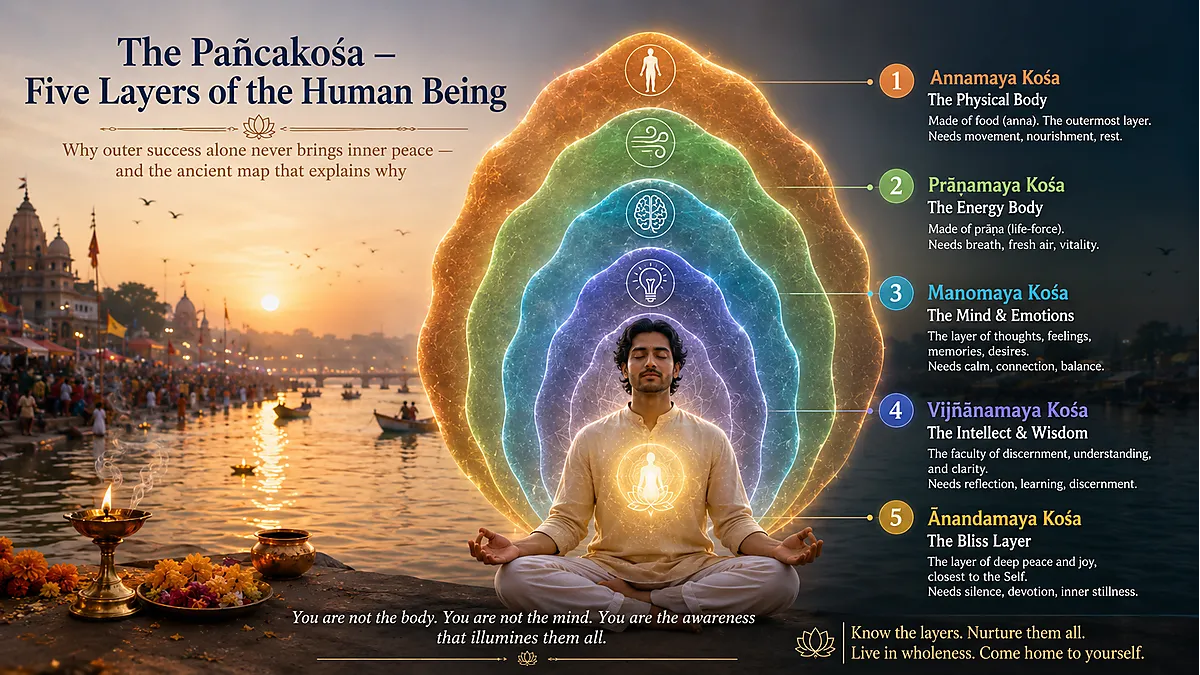
Why outer success alone never brings inner peace — and the ancient map of pancakosa that explains why
Something Feels Missing. But What?
You know this feeling. Maybe you have had it recently.
Everything, by any reasonable measure, is fine. You are healthy. You have a job. You have people who love you. There is food on the table and a roof over your head. And yet — something is hollow. A persistent, low-grade sense of emptiness that you cannot quite name. Not depression. Not grief. Just… a quiet feeling that the life you are living is somehow thinner than the life you thought you would be living by now.
Or perhaps it is a different version of the same feeling. You go to the gym. You eat carefully. Your body is in the best shape it has been in years. And yet your mind is restless, anxious, constantly churning. You lie in bed physically exhausted — and cannot sleep, because the thinking will not stop.
Or this one: you are meditating regularly, reading good books, growing spiritually — and yet your body is sluggish, your energy is low, and a persistent tiredness lives beneath all your inner work like a damp foundation.
Every one of these is the same problem, expressed from different starting points: you are attending to one layer of yourself while neglecting the others. And you are suffering the way any system suffers when one part is overdeveloped and another is starved — the way a plant in too much sun with too little water looks healthy from a distance until it suddenly doesn’t.
Sanatana Dharma, with extraordinary precision and compassion, mapped this exact problem thousands of years ago — and offered a model of the human being so complete that modern psychology, medicine, and neuroscience are still finding new reasons to take it seriously. This model is called the Pañcakośa (पञ्चकोश — Pañcakośa, meaning the five sheaths or coverings). And once you understand it, you will never look at your own wellbeing the same way again.
The Ancient Map — You Are More Than You Think You Are
The Pañcakośa teaching comes from the Taittirīya Upaniṣad (तैत्तिरीय उपनिषद् — Taittirīya Upaniṣad), one of the most beloved and practical of the 108 Upanishads, and from Ādi Śaṅkarācārya’s Vivekacūḍāmaṇi, which expands it into one of the most complete models of human existence ever written.
The model is built around one central insight: you are not your body. But more than that — you are not your mind, either. Or your emotions. Or even your intellect. You are the pure, luminous awareness that exists behind all of these — the one who has thoughts but is not the thoughts, the one who has feelings but is not the feelings. Between that pure awareness and the physical world, there are five layers — five kośas (कोश — kośa, meaning sheath, covering, layer) — each one subtler than the one before it, each one wrapping around the innermost Self like the layers of an onion, like the nested shells of a Russian doll, one inside the other, each real, each requiring its own specific kind of care.
These five layers are:
- Annamaya Kośa (अन्नमय कोश) — the physical body
- Prāṇamaya Kośa (प्राणमय कोश) — the energy body
- Manomaya Kośa (मनोमय कोश) — the mind and emotions
- Vijñānamaya Kośa (विज्ञानमय कोश) — the intellect and wisdom
- Ānandamaya Kośa (आनन्दमय कोश) — the bliss layer, closest to the pure Self
Let us meet each one honestly — not as philosophy, but as something you live in every moment of every day.
The Five Layers — Explained in Real Life
🧱 Layer 1: Annamaya Kośa (अन्नमय कोश) — The Physical Body
The word anna means food — and the Taittirīya Upaniṣad’s teaching is direct: this physical body is literally made of food. Every cell in your skin, every bone in your skeleton, every muscle in your arms — all of it was once food, water, and air, transformed by your body’s extraordinary chemistry into the physical form you call yourself.
This is the layer most people think of when they think of health. And it genuinely does need attention — regular movement, proper sleep, nourishing food, sunlight, and the simple joy of a body that is cared for.
But here is what the teaching makes clear: the Annamaya Kośa is only the outermost layer. The most visible. The most obvious. The one that the whole fitness industry has built a trillion-dollar business around. And yet — as every person who has ever had a beautiful, healthy body while being utterly miserable knows — it is nowhere near the complete story of what you are.
The Upanishad says: you are not this body. You have a body. But you are not it. The body is the vehicle, not the driver. Caring for it is not vanity — it is wisdom. But worshipping it as the whole of what you are is the most fundamental category error a human being can make.
💨 Layer 2: Prāṇamaya Kośa (प्राणमय कोश) — The Energy Body
Just inside the physical body — subtler, invisible, but entirely real — is the Prāṇamaya Kośa, the layer made of Prāṇa (प्राण — Prāṇa, the vital life-force). This is the energy that animates your body — the difference between a living human being and a body that has just died. The physical components are identical in that moment. What has left is Prāṇa.[7][2]
The Taittirīya Upaniṣad declares beautifully:
Devanagari Script:
प्राणो वै जीवनम्।
IAST Transliteration:
Prāṇo vai jīvanam.
Source: Taittirīya Upaniṣad
Meaning: “Prāṇa is indeed life itself.”[2]
The most physical expression of Prāṇa is your breath — and this is why every tradition that has ever taken the inner life seriously has made conscious breathing a foundational practice. When your breathing is shallow, rapid, and unconscious — as it is for most people under chronic stress — your Prāṇamaya Kośa is depleted. The physical body may look fine, but the energy that runs it is running on empty.
You know this layer intimately, even if you do not have a name for it. It is the difference between waking up genuinely refreshed — alive, clear, ready — and dragging yourself through a day on mechanical momentum, doing everything that is asked of you but without the aliveness that makes it feel real. That aliveness is Prāṇa. That depletion is Prāṇa being ignored.
The simplest way to restore this layer: breathe. Deliberately, slowly, consciously. Step into open air. Move your body in nature. Practice Prāṇāyāma (प्राणायाम — Prāṇāyāma, breath regulation) — even five minutes of slow, deep, intentional breathing changes the state of the Prāṇamaya Kośa in ways that register immediately in how the mind feels.
🌊 Layer 3: Manomaya Kośa (मनोमय कोश) — The Mind and Emotions
Deeper still — subtler than the energy layer, invisible to any instrument, and yet the most immediately felt dimension of your daily experience — is the Manomaya Kośa: the layer of thoughts, emotions, memories, desires, fears, and the continuous background commentary your mind runs about everything that is happening to you.
This is the layer that modern psychology spends most of its time with — and rightly so, because for most people in the modern world, the Manomaya Kośa is the most troubled layer of their being. The overthinking that will not stop at bedtime. The emotional reactivity that causes you to say things you later regret. The anxiety that arrives before important events and sometimes stays long after them. The habit of mentally replaying difficult conversations as if reviewing them enough times will change how they went. All of this is the Manomaya Kośa in distress.
The tradition is clear about what this layer needs: calm, not suppression. You cannot think your way to a quiet mind — that is like trying to stop water rippling by hitting it with your hand. The Manomaya Kośa calms through meditation, through conscious breathing (which directly communicates calm to the emotional layer via the nervous system), through time in nature, through genuine human connection, and through the gradual reduction of the relentless sensory overstimulation that modern digital life inflicts upon it every waking hour.
When the Manomaya Kośa is nourished, something wonderful happens: emotions become clear signals rather than overwhelming forces. Anger tells you when a boundary has been crossed. Fear tells you when something genuinely needs attention. Joy shows you what is genuinely good. The emotions stop being weather that controls you and become weather that informs you.
💡 Layer 4: Vijñānamaya Kośa (विज्ञानमय कोश) — The Intellect and Wisdom
Deeper than the mind is the Vijñānamaya Kośa — and this distinction is one of the most important and most underappreciated in the entire model. In the Vedantic understanding, manas (mind) and buddhi (intellect) are not the same thing. The mind receives impressions, generates thoughts, and reacts. The intellect discerns — it evaluates, judges, chooses, and understands.
Think of the difference like this: your manas is the inbox — it receives everything, reacts to everything, and holds everything at once. Your vijñāna is the editor — the part of you that steps back, sees the whole picture, and decides what actually matters, what is true, what response is actually appropriate.
The Vijñānamaya Kośa is the layer of genuine wisdom — not intellectual performance, not the ability to quote texts or win arguments, but the actual capacity to see clearly: to know the difference between what is real and what is a mental habit, between what serves you and what merely feels familiar.
This is the layer that gets neglected in an education system designed to fill the mind with information rather than develop the faculty of genuine understanding. You can have a very active, well-stocked Manomaya Kośa — lots of thoughts, lots of reactions, lots of mental content — while the Vijñānamaya Kośa remains thin and underdeveloped, unable to provide the clarity that would transform all that mental activity into genuine insight.
The Vijñānamaya Kośa is nourished by serious, reflective reading — especially of texts that ask you to think slowly and deeply rather than scan rapidly. By conversation with people who are genuinely wiser than you. By the practice of asking why before acting, not just how. By sitting with difficulty long enough to understand it, rather than immediately trying to escape it.
🌟 Layer 5: Ānandamaya Kośa (आनन्दमय कोश) — The Bliss Layer
And then — innermost of all the five, closest to the pure Self — is the Ānandamaya Kośa: the layer of bliss, of deep contentless joy, of the peace that requires no external cause.
Ānanda (आनन्द — Ānanda) is often translated as bliss or happiness — but these translations are too small. Ānanda is not an emotion. It is not the pleasure of getting what you wanted, or the excitement of a new experience. It is the deep, quiet, luminous joy that occasionally arises for no external reason at all — in meditation, in certain moments of genuine connection, in the profound peace of a beautiful dawn at the Saṅgam, in the unexpected stillness that sometimes descends during a temple āratī — a joy so complete and so sourceless that it momentarily suspends the habitual question of what do I need next.
The tradition teaches that this layer is the closest we can get, within the realm of experience, to the pure Self — the Ātman — which is described as Sat-Cit-Ānanda (सत्-चित्-आनन्द — Sat-Cit-Ānanda, meaning pure being, pure consciousness, pure bliss). The Ānandamaya Kośa is not the Self — it is still a covering. But it is the most transparent covering, the thinnest veil, the one through which the light of pure awareness shines most clearly.
This layer is nourished by genuine silence — not just the absence of noise but the inner quiet that arises when the other four layers are sufficiently cared for. By practices of Dhyāna (ध्यान — Dhyāna, meditation). By Satsaṅga (सत्संग — company of genuine seekers). By pilgrimage — by visiting places where the Ānandamaya Kośa has been nourished in countless human beings across centuries, and where the atmosphere itself seems saturated with the accumulated silence of all that inner work.
The Core Insight — Why Attending to One Layer Is Never Enough
Here is what the Pañcakośa model makes immediately clear, and what no amount of purely physical or purely mental health advice can fully explain: the layers are interdependent. When one is neglected, the others are affected.
Consider the person who works relentlessly on their Annamaya Kośa — gym every day, perfect diet, optimized sleep — while the Manomaya Kośa screams from neglect. Their body is magnificent. Their mind is a storm. They cannot understand why they feel unwell when their blood work is perfect. The answer is simple: they are feeding one layer and starving four others.
Or the sincere meditator who nourishes their Vijñānamaya and Ānandamaya Kośas beautifully while ignoring the Annamaya and Prāṇamaya — their inner life is rich, their understanding is deep, but their body is sluggish and their energy depleted. The traditions have a name for this too: spiritual bypassing — using inner practice to escape the demands of the outer layers rather than to integrate all of them.
Real health — the kind that the tradition calls Svāsthya (स्वास्थ्य — Svāsthya, meaning established in the Self, which is the Sanskrit word for health) — is not the wellness of any single layer. It is the harmonious functioning of all five, each one nourished appropriately, each one in conversation with the others, each one supported by the practices specifically suited to its nature.
A Simple Guide — Nourishing Each Layer Every Day
You do not need a complete lifestyle overhaul to begin caring for all five kośas. You need awareness, and a few intentional choices each day:
| Kośa | What It Needs | Simple Daily Practice |
| Annamaya (Body) | Movement, nourishment, rest | Walk daily, eat freshly cooked food, sleep consistently |
| Prāṇamaya (Energy) | Breath, fresh air, vitality | Five minutes of slow, deep conscious breathing each morning |
| Manomaya (Mind) | Calm, connection, reduced stimulation | Meditate briefly, reduce screen time before sleep, speak kindly |
| Vijñānamaya (Intellect) | Reflection, learning, discernment | Read one meaningful page daily, sit with a question before deciding |
| Ānandamaya (Bliss) | Silence, beauty, inner stillness | Find five minutes of genuine, undisturbed silence each day |
The modern world has built an entire civilization around the first layer — physical comfort, appearance, external achievement — while systematically impoverishing the other four. The epidemic of anxiety, loneliness, burnout, and meaninglessness that defines the early 21st century is not primarily a medical problem. It is a Pañcakośa imbalance — a civilization that has made the Annamaya Kośa its god while leaving the Prāṇamaya depleted, the Manomaya overstimulated, the Vijñānamaya underdeveloped, and the Ānandamaya almost entirely forgotten.
The tradition offers no complicated cure. Only this: attend to all five. Not equally every moment — but consistently over a lifetime, with the understanding that you are a layered, multidimensional being, and that your wellbeing requires the wisdom to know which layer is speaking at any given moment — and the love to respond.
The Deepest Insight — You Are None of These Layers
And here, at the end, the Taittirīya Upaniṣad offers the most liberating teaching of all. After describing all five kośas with great care and precision, it delivers a teaching that changes everything: you are none of them.
You have a body — but you are not the body. You have vital energy — but you are not the energy. You have a mind — but you are not the mind. You have an intellect — but you are not the intellect. You have moments of deep joy — but you are not even that.
You are the witness of all five — the pure, unchanging, luminous awareness that looks through these five layers at the world, and that remains perfectly intact and perfectly free regardless of what is happening in any of the layers.
This recognition — not as a concept but as a living experience — is what the tradition calls Ātma-jñāna (आत्मज्ञान — Ātmajñāna, self-knowledge). And every step of genuine care for the five kośas is not an end in itself. It is a clearing away — a gradual thinning of the veils — so that this innermost light can be seen more clearly, felt more directly, and lived more fully.
The journey inward begins not in an ashram or a cave, but exactly where you are — in the body you woke up in this morning, with the breath you are breathing right now, with the mind reading these words, with the flicker of recognition that says: yes, I am more than I thought I was.