
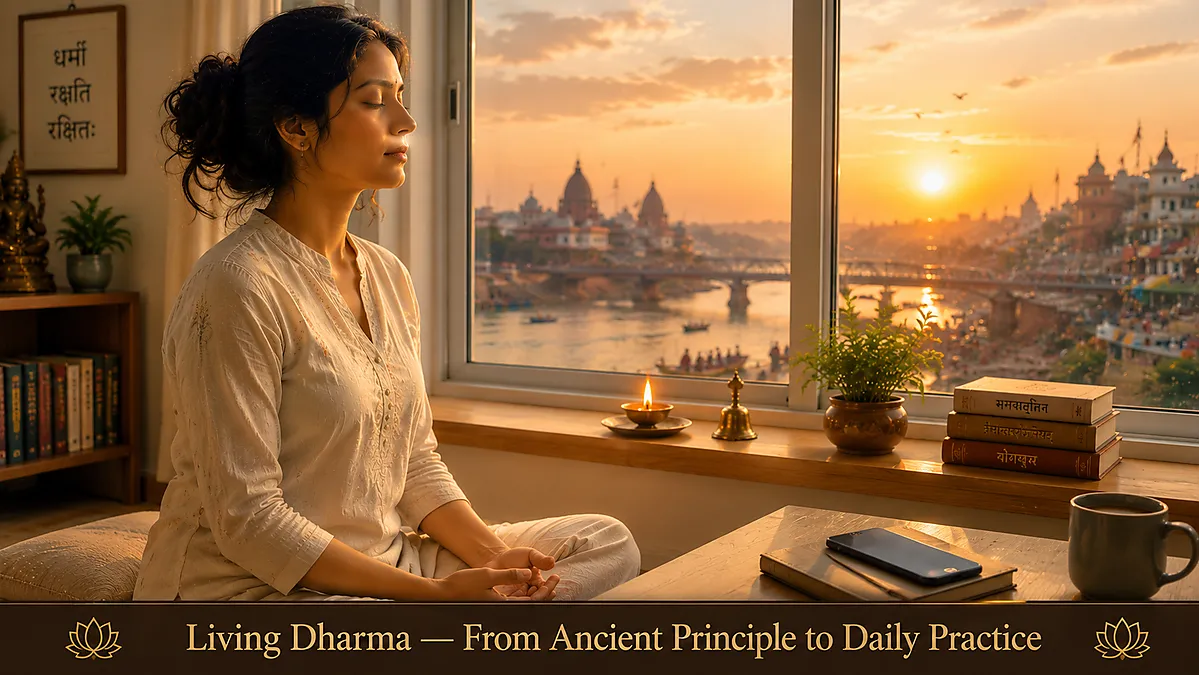
The Gap Between the Ritual and the Life
Here is something honest that most of us would recognize, if we were brave enough to admit it.
On festival days, the incense burns beautifully. The prayers are said with care. The sweets are prepared, the lamps are lit, the rituals are followed with reverence. And then — the next morning — back to the short temper with the colleague, the half-truth told to avoid a difficult conversation, the waste of food and water without a second thought, the hours lost to mindless scrolling, the gnawing anxiety that somehow never quite left even during the puja.
This is not a judgment. It is an observation that the tradition itself makes, with great gentleness and great honesty. Living Sanatan Dharma that lives only in the space of ritual — beautiful as ritual is — has not yet become Dharma that lives in you. And a Dharma that does not change how you wake up, how you work, how you speak to your family, how you treat a stranger, how you use the water in your tap — that Dharma has not yet come home.
The purpose of every ritual in this tradition was always the same: to remind you. To remind you, before the day carries you away, of who you are and how you are called to live. The lamp is lit not so that the divine needs light — but so that you remember, one more time, that there is a light in you that is always burning. The water is offered not because the river needs your palmful of water — but so that you remember your covenant with the element that sustains you. Every ritual is an alarm clock for the soul.
But the soul eventually needs to stay awake. And that is what Living Dharma means.
The Dharmic Morning — Before the World Claims You
The ancient teachers understood something that modern sleep scientists are only now formally confirming: the first thirty minutes of your morning shape the quality of the entire day.
They called the daily routine Dinacharya — a word made of dina (day) and ācarya (conduct, practice). It is the Dharmic art of beginning the day in alignment with natural rhythms rather than in reaction to the loudest notification.
In practice, here is what a Dharmic morning looks like — and notice how simple, how human, how entirely possible it is:
Wake before the noise begins. Even twenty minutes before you normally rise is enough. The pre-sunrise hour — what the tradition calls brahma muhūrta, “the hour of Brahman” — is when the mind is naturally quietest, most receptive, most itself. Modern chronobiology confirms that cortisol levels are naturally calibrating at this time, and the quality of attention in this window is measurably superior to the bleary, overstimulated state of most modern mornings.
Do not reach for your phone first. This single habit — so simple, so consistently resisted — is one of the most powerful acts of self-respect available to a modern person. Your phone, the moment you pick it up, hands your attention to everyone else: the news cycle, the inbox, the social feed, the group chats. Before the day has had a chance to be yours, it belongs to the world’s demands. The Dharmic instruction is: let the first moments of the day belong to you. Sit. Breathe. Be present to yourself before you become present to everything else.
Spend five minutes in silence, or simple prayer. It does not need to be an elaborate ritual. Light a lamp if you have one. Sit by the window. Step outside for a moment and feel the morning air. Say a word of gratitude — for the breath in your body, the roof over your head, the people you love. Research in positive psychology confirms that a morning gratitude practice, practiced consistently, measurably shifts the brain’s default attentional pattern away from threat-scanning and toward openness and clarity. The tradition arrived at this insight not through laboratory studies but through thousands of years of watching what actually nourishes a human being.
Eat at regular times. Sleep at regular times. The body is not a machine that can be run on irregular fuel at irregular intervals without consequence. Dinacharya is, at its core, the practice of aligning your body’s rhythms with the natural rhythms of the day — eating when the digestive fire is strong (midday is the optimal time for the main meal, according to both Āyurveda and modern circadian biology), resting when the body genuinely needs rest, waking when the light genuinely invites wakefulness.
The benefits are not abstract. Studies on Dinacharya practices confirm measurable improvements in stress resilience, digestion, sleep quality, and emotional stability among people who follow a consistent daily routine. Not because the tradition is magical — but because the human body genuinely thrives when treated with the consistency and respect it deserves.
Taking Back Your Attention — The Modern Pratyāhāra
Let us talk honestly about the phone.
The average person in 2026 unlocks their phone over 80 times a day. The average screen time is between six and eight hours. Most of that time is not spent doing anything they consciously chose — it is spent reacting: to notifications, to feeds, to the endless algorithmic serve of content designed by people whose only interest is to keep your eyes on the screen as long as possible.
This is not a moral failure. It is the predictable outcome of an attention economy that has invested billions of dollars in understanding exactly how to exploit human neurological vulnerabilities. But knowing this does not make it less exhausting.
Patañjali called the fifth limb of Yoga Pratyāhāra — the withdrawal of the senses from the tyranny of external stimulation. In ancient India, this meant not letting the senses run constantly after objects of pleasure and excitement, because a mind perpetually chasing sensory stimulation never gets the chance to settle, to go deep, to be still.
In the modern world, Pratyāhāra looks like this:
- Set specific times for checking your phone, rather than allowing it to interrupt every other activity. Three or four designated check-in windows in a day is sufficient for almost anyone. Between those windows, your attention belongs to whatever you are actually doing.
- Keep the first and last thirty minutes of your day screen-free. The morning reason we have already discussed. The evening reason is equally practical: screen light suppresses melatonin, the hormone that initiates sleep, and the emotional stimulation of social media or news activates the stress response precisely when your nervous system needs to begin its nightly recovery.
- Do one thing at a time. Eat without scrolling. Walk without headphones occasionally. Have one conversation without your phone visible. These are not deprivations. They are the reclaiming of your own presence — the experience of being fully somewhere, rather than fractionally everywhere.
Real freedom, in the Dharmic understanding, is not the freedom to be stimulated by anything at any time. It is the freedom to choose where your attention goes. A person who cannot sit quietly for five minutes without reaching for their phone is not free — they are, in a very practical sense, in a relationship with their device in which the device has most of the power. Pratyāhāra is the gentle, consistent practice of reversing that relationship.
Dharma at Work — Success That Leaves No Shame Behind
Here is a question worth asking yourself honestly: How does your work feel? Not the outcomes — the salary, the status, the results. But the work itself, and the way you go about it. Does it feel clean?
The tradition is completely clear that earning money is not just acceptable — it is one of the four legitimate aims of human life. Artha — material prosperity, financial security — is Dharma-sanctioned, fully supported, genuinely important. There is nothing holy about poverty, and there is nothing spiritually superior about being bad at your work.
But the tradition asks one question about every rupee earned: Was it earned with integrity? Not: Did anyone find out? Not: Was it technically legal? But: Was it honest? Did it harm anyone? Did it treat the people involved — clients, colleagues, employees, customers — with fairness and respect?
In practice:
- Pay your employees and collaborators fairly and on time. In the Dharmic understanding, withholding what is owed is not just poor business ethics — it is a direct violation of Dharma. The relationship between an employer and an employee is a sacred trust, not a power dynamic to be exploited.
- Do not misrepresent what you are selling. This one covers everything from the small exaggeration in a sales pitch to the large-scale deception of institutional fraud. The principle is the same: your word is your bond, and a business built on misleading people is a business building its own eventual ruin, through the inevitable erosion of trust.
- Practice Dāna — give back regularly. Dāna means giving — the deliberate, regular sharing of a portion of what you earn with those who have less, or with causes that serve the common good. The tradition does not specify a percentage (though ten percent is a commonly cited Dharmic aspiration). What it insists on is the habit — the understanding that accumulated wealth carries a social obligation, that the prosperity you enjoy was not built by you alone, and that giving is not charity in the Western sense of optional generosity, but an integral part of a life lived in right relationship with the world. Give quietly. Give consistently. Give because it is right, not because it makes you look good.
The result of Dharmic work is not just financial success. It is a quality that money alone cannot buy: the ability to look at what you have built and feel clean about it. That feeling — the pride that has no guilt mixed into it — is one of the deepest forms of happiness available to a human being.
Dharma in Relationships — Love as an Active Practice
The word “love” in popular culture has been reduced, largely through the influence of movies and social media, to a feeling — something that either exists or doesn’t, arrives or doesn’t, lasts or doesn’t. You are either in love or you are not, and if the feeling fades, the relationship has somehow failed.
The Dharmic understanding of relationships is richer and more honest than this. It begins from the recognition that every significant relationship — parent and child, partners, siblings, friends, teacher and student — carries Dharma. Obligations. Not joyless obligations, but the kind of obligations that come with belonging to someone: the obligation to show up, to be honest, to give your full attention, to act in their genuine interest even when it is not convenient.[1]
This does not mean martyrdom or the suppression of your own needs. It means that love, in the Dharmic sense, is primarily understood as giving rather than receiving — as an active practice rather than a passive feeling.
What does this look like?
- Be present. When you are with a family member or friend, be genuinely with them — not physically present but mentally elsewhere, half-scrolling, half-listening. Presence is the most fundamental gift one human being can offer another, and it is increasingly rare.
- Tell the truth kindly. Relationships built on comfortable falsehoods — where difficult truths are permanently avoided to preserve superficial peace — are fragile. The Dharmic relationship includes the courage to say hard things with care.
- Notice what someone needs, not just what they ask for. This is the Dharmic art of seeing the other person — their actual state, their actual needs, their actual struggle — rather than your projection of who they should be or what you want them to need.
- Honour elders and be patient with the young. The tradition’s insistence on respect for parents, teachers, and elders is not blind obedience. It is the recognition that experience carries wisdom, that the people who came before you bore costs you did not see, and that gratitude for what you were given is the foundation of a dignified life.
Environmental Dharma — Small Acts, Sacred Impact
We have spoken elsewhere about the Vedic teaching that nature is sacred — that the river is Mā Gaṅgā, the tree is a living being, the soil is Bhūmi Devī. Here let us focus simply on the practical: what does this actually look like on a Tuesday morning?
It looks like:
- Turning off the tap while you brush your teeth, because water is Jala Devī, and to waste it is to disrespect a gift.
- Refusing to throw plastic into a river or a drain, because that water flows somewhere — into the ground, into a child’s cup, into the sea where the fish you eat was swimming.
- Taking two minutes to separate your waste — organic from recyclable from non-recyclable — because the Earth absorbs everything, and what you send her matters.
- Planting something — anything — in the coming month. A pot of basil on your windowsill. A tree in the compound. A seed in a community garden. Each act of planting is, in the Dharmic understanding, a small Yajña — a giving back to the web of life that holds you.
None of these require wealth, special knowledge, or a dramatic lifestyle change. They require only the restoration of the feeling that the natural world is yours — not in the sense of ownership, but in the sense of family. You take care of it because it is yours, in the same way a child cares for a parent who once cared for them.
The Living Pilgrimage — Dharma as Experience

There comes a point where reading about Dharma and intellectually agreeing with it is no longer enough. Living Sanatan Dharma must be felt — in the body, in the breath, in the silent recognition that something larger than your individual story is present and real and accessible.
This is the purpose of pilgrimage — and in Sanatana Dharma, few places offer this experience as completely as Prayāgarāja, the Tirtha-raja, the King of all sacred places.
When you stand at the Triveni Saṅgam — the confluence of the Gaṅgā, the Yamunā, and the invisible Sarasvatī — something happens that cannot be fully accounted for by geography or tourism. The air is different. The quality of silence is different. Hundreds of thousands of pilgrims moving with the same unspoken intention, the same ancient prayers, the same cupped hands releasing flowers onto sacred water — this is not a crowd. It is a living organism of collective Dharmic intent, and you feel it in your cells.
The Mahākumbha at Prayāgarāja — where more human beings gather in one place for one purpose than anywhere else on Earth — is not a spectacle. It is the most vivid proof available to the modern mind that Sanatana Dharma is not an ancient text in a library. It is a living, breathing, river-bathing, lamp-lighting, mantra-chanting, tear-shedding, heart-opening civilization that has never stopped.
You do not need to wait for the Kumbha. You can go any day. Stand at the Saṅgam at dawn. Watch the sun rise over the confluence of the two great rivers. Feel, even briefly, the sense that you are standing at a point where something sacred is meeting something sacred — and that you, too, are part of it, as you have always been.
That feeling is not mythology. It is not nostalgia. It is Dharma, recognized in the body, in the breath, in the morning light on the water.
And it is the beginning — or the continuation — of the most important journey a human being can make.