
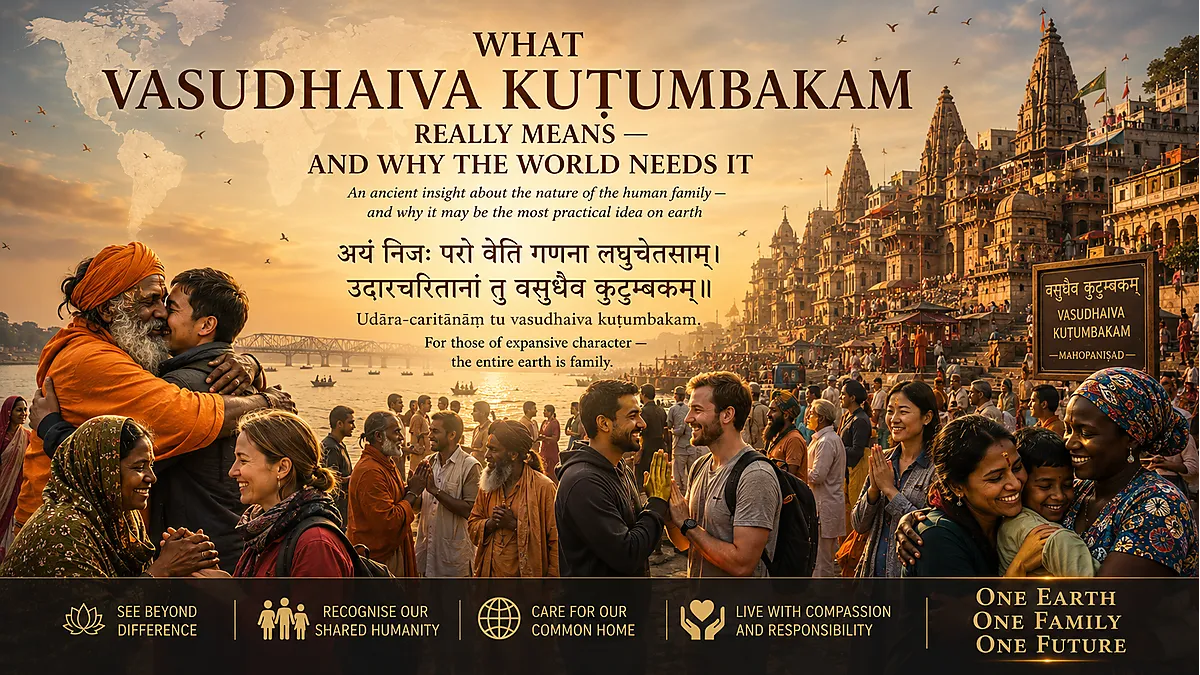
An ancient insight about the nature of the human family —Vasudhaiva Kuṭumbakam and why it may be the most practical idea on earth
A Divided World, Asking an Old Question
Turn on any news broadcast, anywhere in the world, on any given day.
What you will find — beneath the specific names and locations and issues — is a pattern that has been present in human affairs for as long as there have been human affairs: the pattern of us and them.
My country and your country. My religion and your religion. My ethnicity and your ethnicity. My economic class and your economic class. My political tribe and your political tribe. The specific content changes — the borders shift, the categories multiply, the ideological labels evolve — but the underlying architecture stays the same: the world divided into those who belong to my circle of care and those who do not.
This is not cynicism. It is observation. And it is important not to pretend that the division is simply a failure of information or goodwill — as if the right speech or the right policy would dissolve it. The tendency to divide the world into mine and other runs very deep. It appears to be a structural feature of the ordinary untrained human mind: a cognitive shortcut that made evolutionary sense in small tribal groups on the ancient savanna and has become, in a world of eight billion people and shared atmospheric chemistry and global pandemics and nuclear weapons, one of the most dangerous features of the species that developed it.
The question that faces humanity — and has always faced humanity, in every era — is whether we can outgrow this shortcut. Whether there is a way of seeing the world that is not less honest but more honest: a way of seeing that includes everything the tribal view includes and then sees further, to a truth that the tribal view cannot accommodate.
Nearly two thousand years ago — possibly much more — a sage in the Indian tradition sat with exactly this question and wrote a single verse that has been quoted, misquoted, engraved on parliamentary walls, adapted as state mottos, cited in United Nations speeches, and carried across the centuries in the hands of everyone from philosophers to politicians to ordinary people who felt, in its fourteen Sanskrit syllables, that it was saying something they had always known but never quite found the words for.[1][2]
The verse is Vasudhaiva Kuṭumbakam. And before we can understand what it means — really means, not the version that has been simplified into a bumper sticker — we need to read it in full.[
The Verse — What Was Actually Said
The verse that gives us Vasudhaiva Kuṭumbakam appears in the Mahopaniṣad (महोपनिषद् — Mahopaniṣad, one of the minor Upanishads associated with the Atharva Veda, a text of Vedāntic teaching whose central subject is the nature of the liberated being). Its most authoritative location is:
Devanagari:
अयं निजः परो वेति गणना लघुचेतसाम्।
उदारचरितानां तु वसुधैव कुटुम्बकम्॥
IAST Transliteration:
Ayaṃ nijaḥ paro veti gaṇanā laghu-cetasām |
Udāra-caritānāṃ tu vasudhaiva kuṭumbakam ||
Source: Mahopaniṣad, Chapter 6, Verse 71
Word-by-Word Meaning:
- अयम् (ayam) — this (one), here, near
- निजः (nijaḥ) — mine, my own, belonging to me
- परः (paraḥ) — other, stranger, belonging to another
- वेति (veti) — thus considers, such is the thinking
- गणना (gaṇanā) — counting, calculating, the accounting
- लघुचेतसाम् (laghu-cetasām) — of the small-minded, of those with petty consciousness (laghu = small, cetas = mind/consciousness)
- उदारचरितानाम् (udāra-caritānām) — of those of noble conduct, of the magnanimous-hearted (udāra = generous, expansive, noble; carita = character, conduct)
- तु (tu) — but, however (the pivot word of the verse — the turn from small to large)
- वसुधा (vasudhaiva — from vasudha) — the Earth, the world (vasu = wealth/goodness, dhā = that which holds/bears)
- एव (eva) — indeed, truly, without doubt (an intensifier of certainty)
- कुटुम्बकम् (kuṭumbakam) — family, household, kinship group
Complete Translation:
“The counting of ‘this one is mine, that one is other’ belongs to the small-minded. For those of noble character and expansive conduct, the entire earth is indeed family.”
Now look carefully at what the verse is actually saying — because it is not quite what the popular summary suggests.
The popular summary is: “The world is one family.”
This is true, but incomplete — and the incompleteness matters. The verse does not say: the world is one family, therefore treat everyone equally. It says: the counting of mine and other is the act of the small-minded, and the recognition that the earth is family belongs to those of noble, expansive character.
The verse is describing a state of consciousness, not issuing a social policy. It is saying: the person whose inner development has expanded beyond the ordinary contractions of ego-identification — the person of udāra carita, of magnanimous conduct and generous inner life — that person naturally sees the entire world as family. Not as an act of willpower or moral aspiration, but as a simple description of what the world looks like when you are seeing it from that level of development.
This is the crucial distinction, and it is what makes Vasudhaiva Kuṭumbakam a far more radical and far more honest statement than the bumper-sticker version: it does not pretend that ordinary consciousness naturally sees the world as one family. It acknowledges that ordinary consciousness — laghu cetas, small mind — divides. And it points to a quality of inner development — udāra carita, expansive character — as the condition under which the larger vision becomes natural.
It is not a demand. It is a description. This is what the world looks like from there.
What It Really Means — Beyond the Slogan
There is a well-documented historical complexity in the transmission of this verse that any honest treatment must acknowledge — and which, paradoxically, makes the verse’s real meaning clearer rather than more complicated.
The scholar Sarvesh Tiwari, in detailed textual research, has traced the appearance of Vasudhaiva Kuṭumbakam through different texts in the tradition and found something instructive: in certain Nīti texts (practical wisdom literature like the Pañcatantra and Hitopadeśa), the phrase appears in the mouths of characters who are wrong — who are using the language of universal brotherhood to justify naive trust in untrustworthy people, to their own destruction. In these stories, the phrase is a warning: not against the principle itself, but against its misapplication.
A person who says “the world is my family, I will trust everyone indiscriminately” and acts on this without wisdom is not demonstrating udāra carita. They are demonstrating a different kind of small-mindedness — the naivety that collapses the distinction between trust and gullibility, between universal compassion and universal indifference to consequences.
The Mahopaniṣad itself places the verse in the context of a description of the mahāpuruṣa — the great being, the one of highest spiritual development — whose vision of the world as family is not a sentimental wish but a consequence of having genuinely transcended the ego-contractions that generate the mine-other calculation.
This is not a naive or sentimental person. This is someone whose inner development has given them a vantage point from which the mine-other calculation is genuinely unnecessary — not because they pretend the world is simpler than it is, but because their sense of self has expanded to include what the calculation was originally protecting.
Vasudhaiva Kuṭumbakam is, properly understood, neither a political slogan nor a call for reckless trust in everyone. It is the description of what a mature, expanded, genuinely liberated consciousness sees when it looks at the world.
And it is, simultaneously, an invitation: this is the view from there. Would you like to develop the capacity to see it?
The Metaphysical Foundation — Why This Is True, Not Just Beautiful
Vasudhaiva Kuṭumbakam is not simply a moral aspiration — a lovely idea that would be nice if it were true. In the tradition’s understanding, it is a statement of metaphysical fact: the report of what the world actually is, at the level of its deepest nature.[7][8]
The Upanishadic foundation of this statement is the teaching we explored in the article on the Upanishads: the recognition that the individual consciousness — the Ātman — is identical in nature to the universal consciousness — Brahman.
Ayam ātmā brahma — This Self is Brahman. Tat tvam asi — That, you are. Aham brahmāsmi — I am Brahman.
If these statements are true — if the awareness that animates you and the awareness that animates every other human being on the planet, and the consciousness that is the ground of the universe itself, are all expressions of the same single consciousness — then the division between me and other is not a metaphysical reality. It is a perceptual contraction: the way a single ocean looks like many different waves if you stand close enough to the surface.
The waves are real. They have different shapes, different sizes, different directions, different momentary identities. The ocean is also real. The waves are not less real because they are all ocean — they are more real, because they are understood at every level: the surface level of their individual form and the deeper level of the substance they share.
Vasudhaiva Kuṭumbakam is the social and ethical expression of this metaphysical recognition. If at the deepest level of existence, the consciousness in me and the consciousness in you are the same consciousness — then the suffering you experience is not categorically different from the suffering I experience. The joy you feel is not categorically less real than the joy I feel. The child dying of preventable disease in a distant country is not experiencing something fundamentally different from what my child would experience. The distance between us is real. The qualitative difference between us — at the level of the awareness that constitutes both of us — is not.
This is why the tradition calls the narrow-minded view laghu cetas — small mind — not as an insult but as a precise description: the mind that cannot hold this larger truth is operating in a contracted state, like a wave that has forgotten it is ocean. The contraction is not evil. It is simply — small.
And the invitation of Vasudhaiva Kuṭumbakam is simply: expand.
How This Idea Shaped Indian Civilization
The history of the Indian civilization is not a history of perfect implementation of Vasudhaiva Kuṭumbakam. No civilization’s history is the perfect implementation of its highest ideals — the distance between the ideal and the practice is the space where history actually occurs.
But the ideal has been structurally present in the civilization’s self-understanding in ways that have shaped its distinctive character: an orientation toward darśana (seeing — the tradition’s word for philosophical vision) rather than conversion, toward the inclusion of diverse approaches rather than the insistence on a single path, toward the recognition that the divine has many faces and the truth can be approached from many directions.
The tradition gave the world the word Ahiṃsā (अहिंसा — non-violence): the ethical implication of the metaphysical recognition that the life in another being is the same life that animates me. Emperor Aśoka — after witnessing the carnage of the Kalinga war — chose to replace military conquest with the dharmic policy of Dhamma, explicitly grounded in the recognition of the shared nature of all beings.
The great classical universities of ancient India — Nālandā, Takṣaśilā, Vikramaśilā — welcomed students from China, Southeast Asia, Central Asia, and the Arab world. The tradition’s relationship with knowledge was fundamentally inclusive: wherever truth is found, it belongs to everyone.
The verse itself is engraved in the entrance hall of India’s Parliament — a deliberate architectural choice that says: every deliberation that happens inside this building should be conducted in the awareness of this principle.
India’s G20 presidency in 2023 adopted Vasudhaiva Kuṭumbakam as its official theme — “One Earth, One Family, One Future” — placing the ancient Mahopaniṣad verse at the center of the world’s most significant gathering of political leaders, as a conscious statement about the lens through which global challenges should be approached.
Why the World Needs This Now — The Modern Crises
Let us be specific about the modern crises for which Vasudhaiva Kuṭumbakam is not simply relevant but — this is the claim worth making carefully — necessary.
Climate Change: The Ultimate Proof of Shared Consequence
The atmosphere does not recognize national borders. The carbon dioxide emitted by factories in one country contributes to a warming that melts glaciers that feed rivers that water farmland in another country. The ocean that absorbs the excess heat does not warm faster near the countries that contributed most to the warming — it warms in the patterns of ocean physics, affecting the coastlines and weather systems and fisheries of countries that may have contributed least to the problem.
There is no national solution to a planetary problem. The physics of climate change is, in effect, a natural demonstration of Vasudhaiva Kuṭumbakam: the earth is operating as a single system, and the actions of any part of the family affect the whole family, whether the family members acknowledge their relationship or not.
The India-led International Solar Alliance — bringing together over 110 nations in collective pursuit of clean energy solutions — is perhaps the most direct contemporary institutional embodiment of the Vasudhaiva Kuṭumbakam principle in international policy: the recognition that the energy transition cannot happen nation by nation, because the problem it is addressing does not operate nation by nation.
Pandemics: What Viral Transmission Teaches About Unity
The COVID-19 pandemic demonstrated, in the most immediate possible terms, that human beings share a biological family. A novel pathogen that emerged in one city was, within weeks, present on every continent — not because borders were not monitored but because the global network of human connection — the travel, the trade, the communication, the ordinary human movement that the modern world depends on — is precisely the kind of dense, interconnected web that an infectious agent moves through with perfect indifference to the political categories that human beings project onto the same network.
The pandemic also demonstrated the costs of the laghu cetas response: vaccine nationalism, information hoarding, the instinct to secure supplies for my country first, the competitive rather than cooperative orientation toward the research that everyone’s recovery depended on. These responses were humanly understandable. They were also — demonstrably, measurably — less effective than the cooperative alternatives.
Immigration and the Question of Belonging
One of the most painful conflicts of the contemporary world is the question of who belongs where — which human beings are entitled to safety and opportunity in which territories, and on what basis.
This is a genuinely complex question, and Vasudhaiva Kuṭumbakam does not dissolve its complexity with a slogan. But it does offer a starting orientation: the person seeking safety on the other side of a border is a member of the human family. Their need for safety is not categorically different from the need for safety that I feel on my own behalf and on behalf of those I love.
This orientation does not tell you what policy to adopt. It tells you how to hold the person while you work out the policy — with the recognition of their full humanity, their membership in the family, the reality of their need.
Technology and the Connected-but-Isolated World
Perhaps the most paradoxical feature of the contemporary world is this: we have built, through technology, the most densely connected network of human communication in history — and we have simultaneously become, in many communities, more isolated, more anxious, more tribal, more susceptible to the laghu cetas dynamic than previous generations.
The tools of connection have, in many contexts, become tools of division — algorithmically sorted into feeds that show each person primarily the content that reinforces their existing views, that makes their particular mine feel more besieged, their particular other feel more threatening.
The response to this paradox is not technological. It is the inner development that the Mahopaniṣad was describing when it wrote of udāra carita — expansive, magnanimous character. The platform does not change. The algorithm does not change. The cetas — the quality of consciousness — that engages with the platform is the variable.
The Way Forward — Living the Idea
The most important thing to understand about Vasudhaiva Kuṭumbakam as a practical proposition is this: it does not begin at the policy level. It begins at the level of the individual — in the specific quality of attention and care that you bring to the people in your immediate circle, and in the specific quality of imagination that you extend toward people outside it.[6][3]
Here are the simplest possible entry points:
The Practice of Genuine Attention
The first step toward the udāra cetas — the expansive consciousness — is very simple and requires no philosophical preparation: pay genuine attention to the person in front of you. Not the person you have categorized — your particular demographic of mine or other — but the actual, specific human being in front of you, with their specific history and needs and fears and loves.
The quality of attention that genuinely sees another person is the smallest unit of Vasudhaiva Kuṭumbakam in practice. It begins at the breakfast table and at the office and at the shop and on the street, long before it reaches the international conference room.
The Expansion of Empathic Imagination
The laghu cetas is not malicious. It is simply a failure of imagination: the inability to viscerally experience the reality that the suffering of someone who doesn’t look like me, or speak like me, or belong to my group, is as real as the suffering I would feel in the same situation.
The practice of reading, of listening to stories from other cultural contexts, of seeking out perspectives genuinely different from your own — not to be persuaded into political positions but to expand the range of human reality that you can hold — is the sādhana (practice) of the expansive mind.
The Discipline of Pausing Before the Mine-Other Calculation
Every day brings dozens of situations in which the mind reflexively divides: mine or other, us or them, worth caring about or not my concern. The Vasudhaiva Kuṭumbakam practice is not to eliminate this reflex — it is too deep and too fast for direct suppression — but to notice it, and to pause for the one breath it takes to ask: is the person I’m about to categorize as “other” — are they actually other?
Usually, the answer that comes in that pause is softer than the automatic category.
The Recognition of the Shared Home
Perhaps the simplest and most effective of all the practices: once a day, look at the sky. The same sky that is above you is above every human being on the planet at this moment. The same sun that warms your afternoon warms the afternoon of every person alive. The same earth that holds your feet holds every other person’s feet.
You do not share this planet with strangers. You share it with family you have not yet met.
The verse in the Mahopaniṣad was composed to describe a quality of consciousness — the consciousness of the mahāpuruṣa, the great being, the one who has expanded beyond the automatic contraction of mine and other into a natural, unforced recognition of the shared humanity of every person they encounter.
It was not composed as a description of ordinary consciousness. It was composed as a description of where ordinary consciousness is capable of going.
That is the most important thing about it: it is not a description of an impossible ideal. It is not a description of a divine being with capacities unavailable to ordinary humans. It is a description of what this very consciousness — the one reading these words right now — is capable of, given the right orientation and the consistent, patient practice of expansion rather than contraction.
The world does not need more political agreements that use Vasudhaiva Kuṭumbakam as a motto. It needs more people who have genuinely developed the udāra cetas — the expansive inner character — that the verse is describing.
Those people do not change the world by making speeches. They change it by the quality of presence they bring to every conversation, every relationship, every moment of choice between the small response and the large one.
They change it by living the verse rather than quoting it.
The world is one family. Not as aspiration. Not as policy. As the simple, verifiable, metaphysically grounded description of what is actually true — and what becomes increasingly visible, increasingly natural, increasingly obvious, as the quality of consciousness expands toward the recognition that the tradition has been pointing at for three thousand years:
Udāra-caritānāṃ tu vasudhaiva kuṭumbakam.
For those of expansive character — the entire earth is family.