

The ancient story of a small flame — and the enormous difference it can make to your day
That Quiet Moment Before the Flame
You know the moment.
Someone in your household — your mother, your grandmother, perhaps now you yourself — takes a small clay diya, fills it with oil, places a cotton wick just so, and then leans forward with a lit matchstick. There is a breath held. And then — flame. Small, warm, alive, and immediately filling the room with something that electric light, however bright, never quite manages: a quality of light. A softness. A presence of Dīpa Prajvālana .[1][2]
For a moment — just a moment — everything slows down. The noise of the day steps back. Whatever you were worrying about, whatever screen you were staring at, whatever thought was pulling you in three directions at once — all of it recedes, just slightly, as if the little flame has drawn a circle of quiet around itself and invited you in.
You stand there for a few seconds longer than you planned to.
And then the moment passes, and the day resumes. But something has shifted, very slightly, in the quality of your inner weather. You feel — though you might not have the words for it — a little more settled. A little more here.
Why? The tradition has known the answer for thousands of years. The flame is not just fire. The act is not just ritual. And that quiet moment before the flame is not an accident.[3][4]
What Does the Lamp Mean? Starting Simply

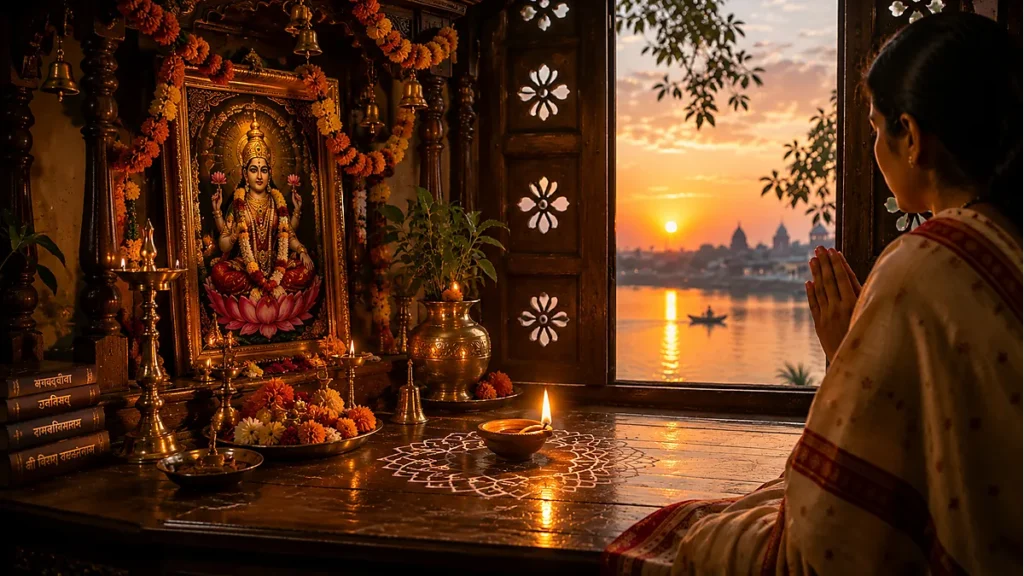
The Sanskrit word is Dīpa (दीप — Dīpa, from the root dīp meaning to shine, to blaze, to illuminate). The act of lighting it is Dīpa Prajvālana (दीप प्रज्वालन — Dīpa Prajvālana, meaning the kindling of light).[5][4]
And the tradition’s core teaching about the lamp can be stated in six words: darkness is ignorance. Light is knowledge.
Dīpa Prajvālana is not a metaphor the tradition invented for poetic effect. It is an observation about the nature of the human condition. Every problem a human being has — every act of cruelty, every harmful choice, every moment of unnecessary suffering inflicted or received — arises, the tradition teaches, from avidyā (अविद्या — avidyā, meaning ignorance, not-seeing, the failure to understand what is actually true). We hurt others because we do not see their reality clearly. We make poor choices because we do not see the consequences clearly. We suffer unnecessarily because we do not see ourselves clearly — our nature, our patterns, our actual situation.[2][3]
The solution to darkness is not to fight the darkness. You cannot beat it or push it out. You can only — simply, completely, instantly — bring light. The darkness has no answer to the flame. It simply ceases to exist wherever the light reaches.
This is what lighting a lamp enacts, symbolically and experientially, every single time you do it. You are not performing a superstition. You are performing a prayer — and the prayer is: Lead me from darkness to light. From confusion to clarity. From the sleep of inattention to genuine awareness.[4][3]
The ancient Upanishadic prayer that every Hindu child learns — and that resonates more deeply with every year of adult experience — captures this with crystalline precision:
Devanagari Script:
असतो मा सद्गमय।
तमसो मा ज्योतिर्गमय।
मृत्योर्माऽमृतं गमय।
IAST Transliteration:
Asato mā sad-gamaya |
Tamaso mā jyotir-gamaya |
Mṛtyor māmṛtaṃ gamaya ||
Source Citation: Bṛhadāraṇyaka Upaniṣad, 1.3.28
Word-by-Word Meaning:
- असतः (asataḥ) — from the unreal
- सत् (sat) — to the real, to truth
- तमसः (tamasaḥ) — from darkness
- ज्योतिः (jyotiḥ) — to light
- मृत्योः (mṛtyoḥ) — from death, from limitation
- अमृतम् (amṛtam) — to immortality, to that which does not die
Translation and Meaning:
“From the unreal, lead me to the real. From darkness, lead me to light. From death, lead me to immortality.”
Every time you light a lamp, you are — whether you say these words or not — making this prayer with your hands. You are saying: let there be less darkness in this house. Let there be less confusion in this life. Let whatever is obscure in me become, today, a little clearer.[3][5]
The Lamp as a Portrait of the Soul
Now look at the lamp itself. Not with a shopper’s eye or a ritualist’s eye — but with the eyes of someone who understands what it is showing you.
Every element of the diya carries a meaning, and the meaning is a map of what you are:[6][4]
The clay base — the physical body. Humble, made of earth, finite, temporary. Shaped by the hands of the maker. Beautiful in its plainness.
The oil or ghee — the accumulated experiences, desires, and karmas of a lifetime. The fuel that the flame will consume and transform. Nothing is wasted; all of it becomes light.
The cotton wick — the individual soul (Jīvātman — जीवात्मन्). Thin, unassuming, seemingly insignificant. And yet — without it, no flame is possible. The wick is what makes transformation possible. It is the meeting point between the fuel below and the fire above.
The flame itself — the Divine Consciousness (Paramātman — परमात्मन्). The light that illuminates everything around it without being diminished. The flame does not save a portion of its light for itself — it gives completely, in every direction, all at once, with total and effortless generosity.[4][3]
See what is being shown to you: the lamp is you. Grounded in earth, fueled by the accumulated substance of your life, animated by a soul, and containing at your center a light that is not separate from the Divine Light — but is, in fact, the same light, expressed through the particular shape of your one particular, irreplaceable life.[6][3]
This is why the tradition calls the innermost awareness the Ātma Jyoti (आत्मज्योति — Ātma Jyoti, meaning the light of the Self) — the lamp inside the lamp. And every time you light a physical diya, you are performing, outwardly and visibly, the act of kindling the lamp within.[5][3]
The Ritual — A Step-by-Step Guide That Takes Five Minutes
You do not need a priest, an elaborate altar, or forty-five minutes to practice Dīpa Prajvālana. You need a lamp, a few minutes of genuine presence, and the willingness to begin.
Step 1 — Clean the space. Before lighting the lamp, straighten the area around it — even just briefly. Wipe the surface. Remove what is unnecessary. This physical act of clearing is simultaneously an inner act: you are signaling to yourself that you are transitioning from the ordinary flow of the day into a moment of intention. The outer clearing creates the inner clearing.[1][2]
Step 2 — Fill the lamp. Use sesame oil for daily practice — the tradition specifically recommends sesame oil for its purifying properties. For special occasions and festivals, ghee (clarified butter from healthy cows) is used, and the quality of light it produces — steadier, brighter, more fragrant — is noticeably different. Even a small, inexpensive clay diya from the market, filled with a teaspoon of oil and a simple cotton wick, is entirely sufficient.[1][4]
Step 3 — Light the wick with awareness. Not casually, not while looking at your phone, not in a hurry. For this one moment — the moment the flame appears — be present. Watch it catch. Watch it stabilize. Watch the small, extraordinary miracle of combustion as something dark and dormant becomes something alive and luminous. Let it land.[2][5]
Step 4 — Offer the prayer. The simplest and most beautiful prayer for lighting the lamp:
Devanagari Script:
शुभं करोति कल्याणम् आरोग्यं धनसम्पदाम्।
शत्रुबुद्धिविनाशाय दीपज्योतिर्नमोऽस्तुते॥
IAST Transliteration:
Śubhaṃ karoti kalyāṇam ārogyaṃ dhana-sampadām |
Śatru-buddhi-vināśāya dīpa-jyotir namo’stute ||
Source: Traditional Dīpa Vandana Mantra
Word-by-Word Meaning:
- शुभम् (śubham) — auspiciousness, goodness
- करोति (karoti) — brings, creates
- कल्याणम् (kalyāṇam) — well-being, welfare
- आरोग्यम् (ārogyam) — health
- धनसम्पदाम् (dhana-sampadām) — prosperity and abundance
- शत्रुबुद्धिविनाशाय (śatru-buddhi-vināśāya) — for the destruction of the enemy-mind (negative thinking, inner obstacles)
- दीपज्योतिः (dīpa-jyotiḥ) — O light of the lamp
- नमः अस्तु ते (namo’stute) — I bow to you, I honor you
Simple Meaning:
“O light of the lamp — you bring goodness, well-being, health, and prosperity. You destroy the enemy-minded thinking within me. I bow to you.”
Notice what this prayer asks for. Not wealth from the outside. Not external victory. The most pointed request is for the destruction of śatru-buddhi — the “enemy-mindedness” within — which the tradition identifies as the real obstacle to peace, clarity, and a good life. The lamp is asked to destroy the inner enemies: doubt, confusion, resentment, fear, the habitual movements of a mind that works against itself.[7][8]
Step 5 — Sit for two minutes. Just sit with the flame. Do not reach for your phone. Do not run the day’s mental checklist. Simply watch the flame — how it moves, how it steadies, how it gives light without effort, without intention, without agenda. Let it teach you something by example.[2][1]
Three Types of Lamps — Knowing the Difference
The tradition has a richly developed vocabulary of lamps, each serving a specific purpose and carrying its own symbolic weight.[5][4]
The single-wick lamp (Eka Jyoti) — the lamp of daily household worship. One flame, one direction, one steady intention. Used every morning and evening in the home. Simple, sufficient, complete. It represents the unified mind — the mind in which, for this moment, the many competing agendas have quieted down into one clear flame.
The five-wick lamp (Pañcadīpa) — five flames, representing either the five elements or the five senses, all illuminated and offered together. Used in temple worship, at festivals, and during Āratī — the ceremony of waving the lamp before the deity as the highest act of devotional offering. The five flames together say: I offer everything — every sense, every element of my being — to the Divine.
The Nanda Dīpa (नन्ददीप — the perpetual lamp) — a lamp kept burning continuously for a fixed period, day and night, without being extinguished. The Āgama Śāstras describe this as among the most meritorious of all offerings, because the unbroken flame represents akhaṇḍa bhakti (अखण्ड भक्ति — unbroken, continuous devotion). Even when the devotee sleeps, travels, or is caught up in daily life, the flame burns on — maintaining the thread of connection between the finite person and the infinite presence.[4][5]
What Lighting a Lamp Actually Does to Your Day
Here is something worth testing honestly: for one week, begin your morning differently. Instead of reaching for your phone as the first act of the day — before the notifications, before the news, before the messages from twelve people who all need something from you immediately — light a lamp first.
One small lamp. Thirty seconds to light it. Two minutes to sit with it.
Then notice what happens to the rest of your morning.[1][2]
The tradition already knows what you will find — which is why it prescribed this practice not as an option but as a daily essential, to be performed at dawn and again at dusk. The Sandhyā times (सन्ध्या — Sandhyā, meaning the junctions — the transitional moments between night and day, and between day and night) are considered the most spiritually potent hours of the day, when the mind is naturally most permeable, most available, most susceptible to genuine inner influence.
Beginning those hours not with the chaos of the world but with the quiet of a flame is not superstition. It is what modern psychology would call intentional priming — the deliberate cultivation of a mental state that will set the tone for the hours that follow. And the Vedic understanding of why it works goes deeper than any psychological explanation: because the lamp is not only affecting your mood. It is affecting the quality of consciousness in the space itself, purifying the atmosphere, inviting the kind of awareness that ordinary busy life crowds out.[3][2]
What you will find, if you try it honestly for a week, is this: you are calmer. You are more present in the first hour of your day than you have been in years. The day feels — this is the only word for it — more intentional. As if you began it, rather than being swept away by it.[7][1]
The Simplest Spiritual Practice You Will Ever Find
The great Swami Vivekananda once said that the simplest path to the Divine is not through elaborate ritual or years of study — it is through genuine awareness applied to the simplest acts of daily life. The lamp is perhaps the most beautiful expression of this.[3][2]
You do not need to understand all of its symbolism to benefit from it. You do not need to recite the mantra perfectly or have a beautifully decorated altar or a specific kind of oil. You need a small clay lamp, a wick, some oil, a match, and — most importantly — the willingness to show up for that one quiet moment each day when you turn away from the noise of the world and toward the flame.[4][1]
The flame does not ask for much from you. It asks only for your presence.
And in return, it gives you back — every morning, every evening, every time you light it with genuine attention — a small, reliable, extraordinary reminder of the light that has been burning inside you since before you were born.[7][3]
Tamaso mā jyotir gamaya. From darkness, lead me to light.
That prayer has been answered, in small clay lamps across ten thousand years, in ten million homes, in the heart of a civilization that understood — and still understands — that the most transformative act available to an ordinary human being on an ordinary morning is sometimes as simple, and as profound, as this: the striking of a match, the touching of a flame to a wick, and the willingness to sit with the light for just a moment longer than the hurry demands.[2][3]
⁂
- https://gowdurbar.com/blog/importance-of-lighting-lamps-in-hindu-culture/
- https://www.linkedin.com/pulse/why-we-light-diya-spiritual-science-behind-ancient-hindu-ruchi-bansal-keqqc
- https://www.rudraksha-ratna.com/articles/significance-importance-of-lighting-oil-lamps-during-puja-ceremony
- https://www.bharathiyam.com/traditions/traditions-rituals/lighting-the-lamp-the-meaning-ritual-and-power-of-deepa-puja/
- https://rujuyogi.org/seva-articles/significance-lighting-lamps-deepa-hindu-worship/
- https://vedikheritageblog.wordpress.com/2020/11/13/importance-of-lighting-a-deepa/
- https://pujayagna.com/blogs/facts-about-hinduism/why-do-hindus-lit-lamp
- https://www.devshoppe.com/blogs/articles/sloka-for-lighting-lamp-deep-jyoti-mantra
- https://www.youtube.com/watch?v=FIaxbb-HY5M
- https://www.britannica.com/technology/diya
- https://timesofindia.indiatimes.com/life-style/soul-search/5-meanings-behind-lighting-a-diya-during-prayer/photostory/129627341.cms
- https://timesofindia.indiatimes.com/astrology/others/unlocking-the-spiritual-significance-of-lamp-lighting-in-hindu-traditions/articleshow/109716779.cms
- https://timesofindia.indiatimes.com/religion/hindu-mythology/significance-of-lighting-a-diya-in-hinduism/articleshow/115231409.cms
- https://en.wikipedia.org/wiki/Diya_(lamp)
- https://www.facebook.com/hinduscripturesofficial/posts/symbol-deepa-lamplight-symbolizes-knowledge-and-enlightenment-the-deepa-diya-is-/3722158357848898/