
Why every great moment of life deserves a ceremony — and what we lose when we forget this
Table of Contents
The Fireside Moment
Close your eyes for a moment. You are standing in Prayagraj, near the Triveni Saṅgama, in the early hours before dawn.
The smell of camphor and marigold reaches you first. Then the sound — distant, rising, unmistakable — of conch shells and temple bells somewhere across the river mist. A woman’s voice chants a Sanskrit śloka in a house to your left. Through the open courtyard gate you can see it: a brass homa-kuṇḍa, its fire young and fierce, sending sparks upward into a sky still purple with departing night.
Around the fire, a family is gathered. Three generations. Grandparents who have traveled from Lucknow. Aunts from the mohalla two streets over. A father sitting straight-backed, eyes shining with something between joy and prayer. And in the grandmother’s lap — the reason for all of it — a six-month-old boy named Arjun, dressed in yellow silk, blinking at the light of the fire as though seeing the sun for the first time.
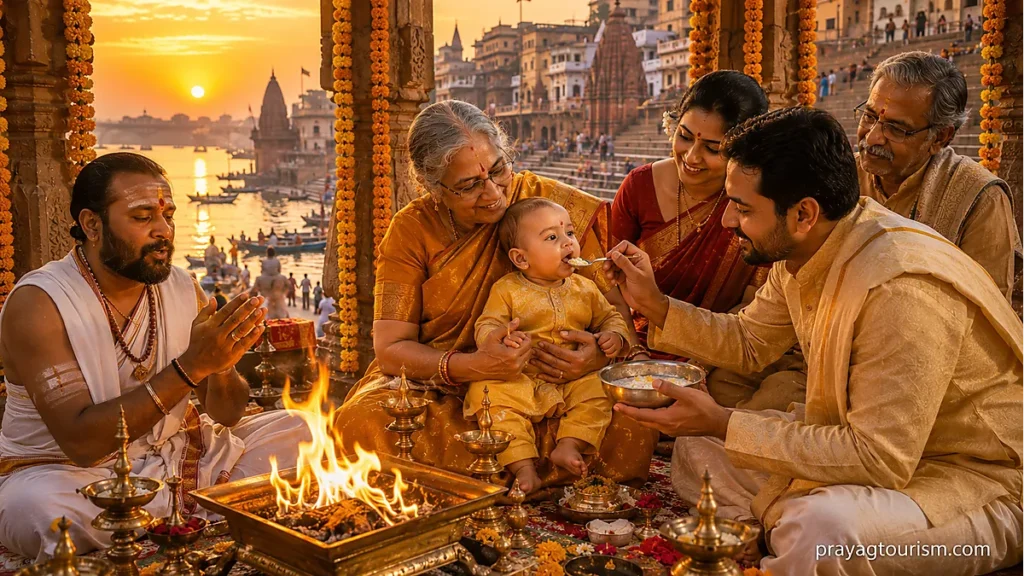
This is the day of Arjun’s Annaprāśana. His first taste of the earth. His first real encounter with nourishment, with community, with the sacred.[1]
A silver spoon dips into a clay bowl of kheer — rice, milk, jaggery, made this morning in a pot that has never been used before. The priest chants. The father’s hand trembles slightly. The spoon touches the child’s lips.
Arjun’s face — surprise, delight, a reaching-forward for more — fills the courtyard with laughter and quiet tears simultaneously.
In one heartbeat, food has ceased to be food. It has become a sacrament.
What Is a Saṃskāra?
That scene in the Prayagraj courtyard is not just a family celebration. It is one of the sixteen Saṃskāras (संस्कार) — the sacred rites of passage that Sanatana Dharma designed to accompany a human being from before birth to after death.[2]
The word Saṃskāra comes from two Sanskrit roots: sam (completely, well) and kāra (to do, to make). Together: to refine completely. To shape into something better.[3]
Think of it this way. If you plant a seed in random soil and leave it entirely to chance, it will grow — but haphazardly. Bent by wind, choked by weeds, confused in its direction. But if you tend it consciously — prepare the soil, water it at the right moments, give it sunlight at the right season — it grows into something magnificent.
A human being, the tradition understood, is no different. The Saṃskāras are the conscious tending. They are not mere cultural customs layered on top of life events. They are the method by which raw human experience is shaped into genuine character, rootedness, and purpose.
And critically: the word carries a second meaning. A saṃskāra is also the psychological impression that a ceremony leaves on the mind of the person undergoing it. The ancient sages understood — five thousand years before modern neuroscience confirmed it — that conscious, witnessed, meaningful experiences create deeper and more lasting impressions on the developing mind than unconscious ones.[4]
The ceremony is not decoration on top of the event. The ceremony is the event, in its fullest dimension.
From the Vedic Dawn
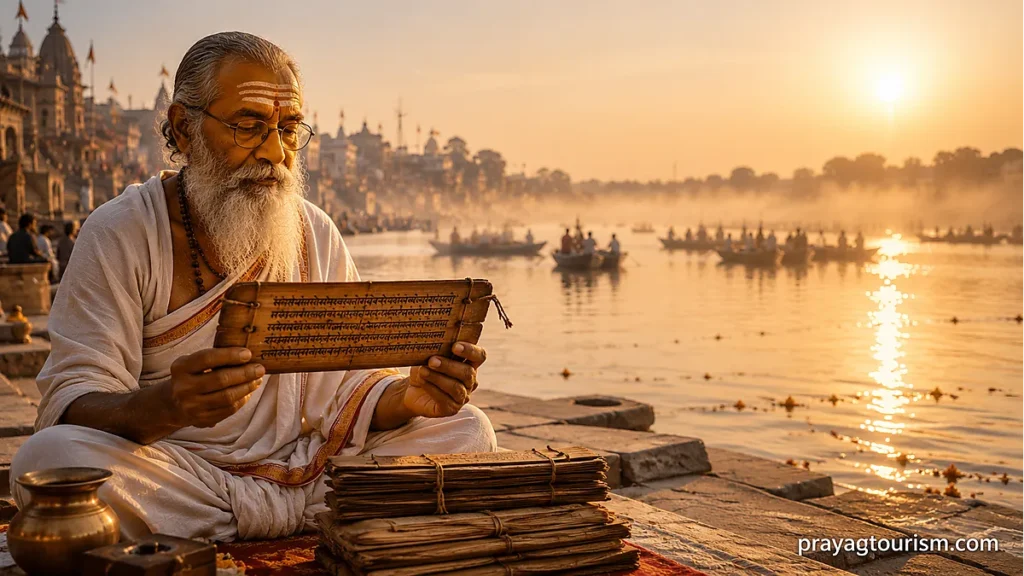
The question that makes historians lean forward is this: how old, exactly, is this system?
The answer is both humbling and astonishing. The roots of the Saṃskāras reach back to the Ṛgveda itself — the oldest continuously living literary tradition on earth. The seeds of the rites were already embedded in the earliest Vedic hymns: prayers for the mother’s health in pregnancy, invocations at birth, the handing of fire to the student.[2][3]
But it was in the age of the Gṛhyasūtras — roughly the 8th to 5th centuries BCE — that the system was first codified into a structured domestic science. These were the practical handbooks of the household priest: meticulous, precise, covering the performance of every ceremony from conception to cremation with the same systematic care a modern surgeon brings to a medical procedure.
The great Āśvalāyana Gṛhyasūtra — one of the earliest and most authoritative of these texts, composed for the Ṛgvedic tradition — prescribed the Annaprāśana in the child’s sixth month, directing specific mantras, the correct fire preparation, and the prayer invoking āyu (longevity), bala (strength), and dīrgha āyu (long life) as the first grain touched the child’s tongue.[5]
This was not superstition. It was a civilization doing what only the most sophisticated civilizations do: treating the development of a human being as a project worthy of the same rigorous design as architecture or statecraft.
“Just as a picture is painted with various colors, so the character of a person is formed by undergoing various saṃskāras.”
— Paraśara Smṛti (Source: Paraśara Smṛti, traditional attribution — exact verse location omitted for scholarly integrity)
Then came Manu. When the Manusmṛti synthesized the entire tradition of Dharmaśāstra — probably between 200 BCE and 200 CE — it gave the saṃskāra system the force of legal and cosmic law:
देवनागरी:
वैदिकैः कर्मभिः पुण्यैर्निषेकादिर्द्विजन्मनाम् ।
कार्यः शरीरसंस्कारः पावनः प्रेत्य चैह च ॥
IAST Transliteration:
vaidikaiḥ karmabhiḥ puṇyair niṣekādir dvijanmanām |
kāryaḥ śarīrasaṃskāraḥ pāvanaḥ pretya caiha ca ||
Source: Manusmṛti, Adhyāya 2, Verse 26[6]
Word-by-Word Meaning:
- वैदिकैः (vaidikaiḥ) — by Vedic
- कर्मभिः (karmabhiḥ) — sacred rites / acts
- पुण्यैः (puṇyaiḥ) — auspicious, meritorious
- निषेकादिः (niṣekādiḥ) — beginning from Conception (Niṣeka/Garbhādhāna)
- द्विजन्मनाम् (dvijanmanām) — for the twice-born
- कार्यः (kāryaḥ) — should be performed
- शरीरसंस्कारः (śarīrasaṃskāraḥ) — the corporeal consecration / sacrament of the body
- पावनः (pāvanaḥ) — purifying; that which removes impurity
- प्रेत्य (pretya) — after death
- चैह च (caiha ca) — and also in this very world
Translation: “For the twice-born, corporeal consecration — beginning from the rite of Conception — should be performed with auspicious Vedic rites; it purifies in this world and also beyond death.”
Practical Takeaway: Manu is saying something radical here. These rites are not cultural habits — they are medicine for the soul, effective both in this lifetime and in whatever comes after. When you perform your child’s naming ceremony with genuine prayer and attention, you are not just following custom. You are administering a purification that the tradition says transcends even death itself.[6]
By the Purāṇic era — roughly 300 CE onwards — the number sixteen had become canonical, enshrined in texts like the Sāṃskāradīpikā and the lists attributed to Vyāsa. The Ṣoḍaśa Saṃskāras — the sixteen rites — had become the architecture of a complete human life.[7][3]
What is remarkable is how consistent the system remained across millennia. Different Gṛhyasūtra traditions — the Āśvalāyana for Ṛgveda devotees, the Pāraskara for the Śukla Yajurveda tradition — vary in small details of sequence and prescription. But the essential architecture was preserved with extraordinary fidelity across three thousand years.[8][
The Sixteen Rites: Life’s Complete Sacred Journey
Let us now walk through the sixteen. Not as a list of ceremonies, but as a human life — lived from its very first moment of intention to its final, conscious completion.
Before Birth — Preparing the Ground
1. Garbhādhāna (गर्भाधान — Conscious Conception)
The extraordinary thing about this system is where it begins: before the child exists.
Garbhādhāna is the conscious, prayerful preparation of husband and wife to invite a new soul into the world. The mind is stilled. Prayers are offered. The act of conception is approached not as biology but as an act of creation — a co-authorship with the divine.[3][7]
The tradition’s message is radical: a child’s formation begins not at birth, not even at conception, but in the quality of consciousness and intention with which two people prepare to become parents. The womb they create begins in the mind before it exists in the body.
2. Puṃsavana (पुंसवन — Rites for the Developing Child)
Performed typically in the third month of pregnancy — before fetal movement begins — Puṃsavana is the ceremony of prayers for the developing child’s body, mind, and spirit.[7][8]
Modern neonatal science has confirmed what this ceremony intuited thousands of years ago: the developing child in the womb registers its mother’s emotional state neurochemically from astonishingly early in gestation. Creating peace around the mother is creating the architecture of the child’s nervous system.[9]
3. Sīmantonnayana (सीमन्तोन्नयन — The Blessing Ceremony)
![Simantonnayana ceremony — traditional Hindu baby blessing ceremony for expectant mother in Prayagraj Allahabad with diyas and women's gathering]](https://prayagtourism.com/wp-content/uploads/2026/05/Simantonnayana-ceremony-—-traditional-Hindu-baby-blessing-ceremony-1024x576.webp)
In the sixth or seventh month of pregnancy — what we might today recognize as a sacred baby shower — the expectant mother is surrounded with music, flowers, blessings, and the warm attendance of every woman in the family and community.
This is the tradition saying plainly: a woman who is carrying new life is doing something sacred, and that sacred work deserves the full, loving, celebratory attention of everyone around her. She is not to be left alone with her anxieties. She is to be held by community.[3][7]
Birth and Infancy — The World Receives the Soul
4. Jātakarma (जातकर्म — Birth Rituals)
The moment the child enters the world, the father is waiting — not with paperwork, but with prayer. He whispers sacred mantras in the newborn’s right ear, touches a drop of honey and ghee to the tiny tongue, and speaks prayers for a life of wisdom, courage, health, and devotion.[7][3]
The first thing a new human being hears in this world is a blessing. The first thing they taste is honey. Sweetness as the world’s first gift. What a way to begin.
5. Nāmakaraṇa (नामकरण — The Naming Ceremony)
On the eleventh day after birth — when the initial period of post-natal ritual seclusion ends — the family gathers for one of the most universally observed saṃskāras in Indian culture to this day.[8][7]
The child receives their name. Not chosen randomly, not from a baby-name website, but through consultation with the family astrologer, the child’s birth chart, and the qualities toward which the family wishes to direct their blessing.
A name, in the Vedic understanding, is not a label. It is a vibration — a daily invocation of the qualities it carries. Every time someone calls your name, the tradition believed, they are participating in the ongoing shaping of your character.[2]
6. Niṣkramaṇa (निष्क्रमण — The First Outing)
In the third or fourth month of life, the child is taken outside for the first time — to sunlight, open sky, and ideally to a temple. This is made a conscious ceremony so that the child’s first impression of the world outside the family home is made in an atmosphere of beauty, reverence, and belonging.
The tradition is saying: the world the child first encounters should be a sacred one.[3][7]
7. Annaprāśana (अन्नप्राशन — The First Solid Food)
We have already seen this ceremony in Arjun’s courtyard. And now we know what it is, fully.[10][1]
The Āśvalāyana Gṛhyasūtra prescribes this rite in the sixth month, with specific oblations to the sacred fire, the father’s prayer for the child’s āyu and bala, and the careful preparation of grain as the first offering of earth’s nourishment to a new human life.[5]
But look at what the tradition adds: after the kheer is given, a small tray is placed before the child. On it: a pen, a coin, a clump of earth, a book. The child reaches for one. The family watches with their breath held. A whispered prophecy of temperament — the scholar, the merchant, the farmer, the sage.[11]
The ritual understands something no neuroscientist has yet fully mapped: the moment of first conscious nourishment is a moment of identity formation. To surround it with sacred fire, family witness, and the divinatory act of self-revelation is not superstition. It is a civilization making art of the moment when a child first meets the world as a participant rather than a passenger.
8. Karṇavedha (कर्णवेध — Ear Piercing)
Performed traditionally around the sixth or seventh month — for both boys and girls — the ceremonial piercing of the ears is understood in the Āyurvedic tradition as addressing specific nāḍī (energy channel) points that correspond to reproductive health and sensory regulation.[8][7]
Beyond its physiological dimension, the ceremony marks the child’s formal entry into a sacred aesthetic world — the world of adornment, of beauty recognized and honored.
9. Cūḍākaraṇa (चूडाकरण — The First Haircut)
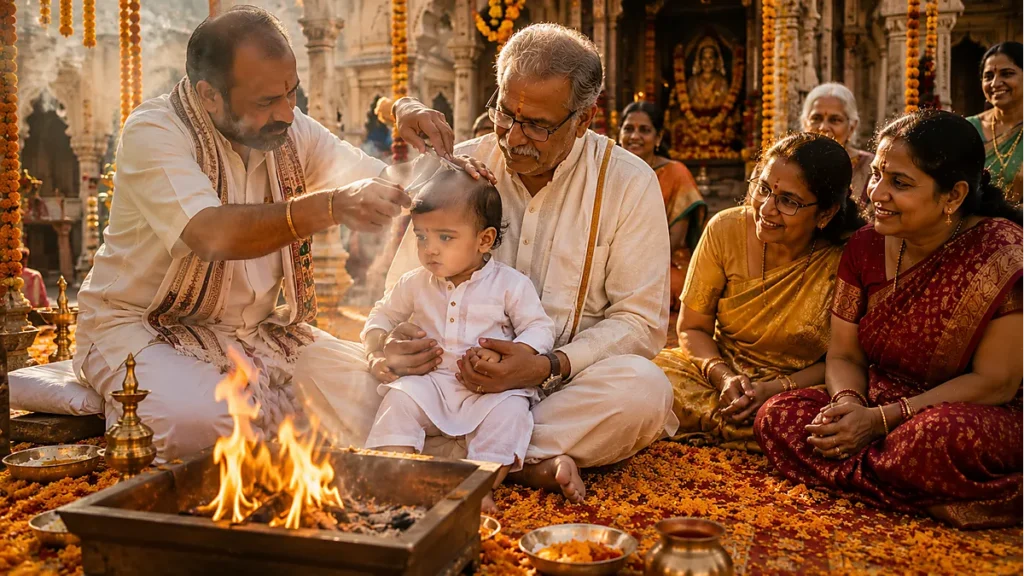
At the end of the first year, or during the third year, the child’s birth hair — the hair they carried into the world — is ceremonially shaved.[12][7]
It is a beautiful act of symbolic release. The old impressions are surrendered. The child is offered forward into new growth — clean, consecrated, ready for the next chapter.
Note: The sequence of Karṇavedha and Cūḍākaraṇa varies between Gṛhyasūtra traditions. The Pāraskara Gṛhyasūtra places Cūḍākaraṇa before Karṇavedha in the post-Annaprāśana sequence; the Amritapuri Smārta canonical list and most widely observed modern practice follows Karṇavedha first. The spirit of both is identical across all traditions.[7][3
Education — The Journey of the Mind Begins
10. Vidyārambha (विद्यारम्भ — The Beginning of Learning)
The child’s first day of formal education is approached as a sacred threshold — marked with prayers to Sarasvatī (सरस्वती), the goddess of knowledge, offerings of raw rice into which the child traces the first letters of the alphabet with a fingertip, and blessings from the teacher.[8][7]
The message is deliberately radical: learning is not a transaction. It is not a service purchased from an institution. It is a sacred act of receiving something that belongs to the cosmos, transmitted through the living presence of a teacher. This ceremony acknowledges the extraordinary nature of that transmission.
11. Upanayana (उपनयन — The Sacred Thread Ceremony)
This is the saṃskāra that most powerfully demonstrates the tradition’s understanding of what human beings are and what education is for.
The word Upanayana means “to lead toward” — toward the teacher, toward knowledge, toward the higher self.[2][3]
A young person — standing at the threshold between childhood and adulthood — is brought before a teacher and a sacred fire. The yajñopavīta (यज्ञोपवीत — the sacred thread) is placed over the left shoulder and under the right arm. Under a white cloth, with the father and mother present, the Guru leans close and whispers the Gāyatrī Mantra — the luminous prayer to the divine sun — into the student’s right ear for the first time.[13]
गायत्री मन्त्र:
ॐ भूर्भुवः स्वः । तत्सवितुर्वरेण्यम् ।
भर्गो देवस्य धीमहि । धियो यो नः प्रचोदयात् ॥
IAST Transliteration:
oṃ bhūrbhuvaḥ svaḥ | tat saviturvareṇyam |
bhargo devasya dhīmahi | dhiyo yo naḥ pracodayāt ||
Source: Ṛgveda, Maṇḍala 3, Sūkta 62, Verse 10[2]
Word-by-Word Meaning:
- ॐ (oṃ) — the primordial sound
- भूर्भुवः स्वः (bhūrbhuvaḥ svaḥ) — earth, sky, and heaven
- तत् (tat) — that (Supreme Reality)
- सवितुः (savituḥ) — of the divine Sun (Savitr)
- वरेण्यम् (vareṇyam) — most worthy of worship
- भर्गः (bhargaḥ) — the radiant light / spiritual lustre
- देवस्य (devasya) — of the divine
- धीमहि (dhīmahi) — we meditate upon
- धियः (dhiyaḥ) — our intellect / understanding
- यः (yaḥ) — who (that divine light)
- नः (naḥ) — our
- प्रचोदयात् (pracodayāt) — may inspire, may illumine
Translation: “We meditate upon the radiant glory of the divine Sun. May that luminous Being inspire and illumine our understanding.”
Practical Takeaway: The Gāyatrī is not a request for material favors. It is a daily act of alignment — a conscious turning of your inner intelligence toward the source of all light. If you recite it each morning before you open your phone, before you check your messages, before the day’s demands rush in, you are making an appointment with your highest self before the world claims you.[2]
The student who undergoes Upanayana is declared a brahmacārī — one who walks in the awareness of Brahman. The thread is the visible symbol of an invisible commitment: childhood is complete. You are now responsible for your own inner development.
12. Vedārambha (वेदारम्भ — Beginning of Vedic Study)
Immediately following Upanayana — in the Gṛhyasūtra tradition, performed on the same day or the very next morning — the student formally receives the first transmission of sacred texts from the Guru. In later Smṛti tradition, this is acknowledged as its own distinct saṃskāra, marking the threshold of the student’s deepest engagement with the wisdom of the civilization.[14][3]
The message: receiving knowledge is itself a sacred act. The student does not merely sit in a classroom. They participate in an unbroken transmission that began with the Ṛṣis and continues through every generation that receives it.[14]
13. Keshānta (केशान्त — The First Shaving of the Beard, also Godāna)
When a young man reaches approximately sixteen years of age — the ceremony varies in timing across communities, with the Manusmṛti specifying the sixteenth year for Brahmins — his first beard is ceremonially shaved.[15][16]
The ceremony is called Godāna — the gift of a cow — because the young man traditionally offers a cow (or its symbolic equivalent) to his teacher as his deepest expression of gratitude for years of formation.[17]
The shaved hair is offered to a sacred river or buried near water. The Guru gives final instructions for conduct. What stands now before the family — newly shaved, quietly transformed — is no longer the boy who arrived at the Guru’s household years ago. He is a man. Shaped. Ready.
14. Samāvartana (समावर्तन — Graduation)
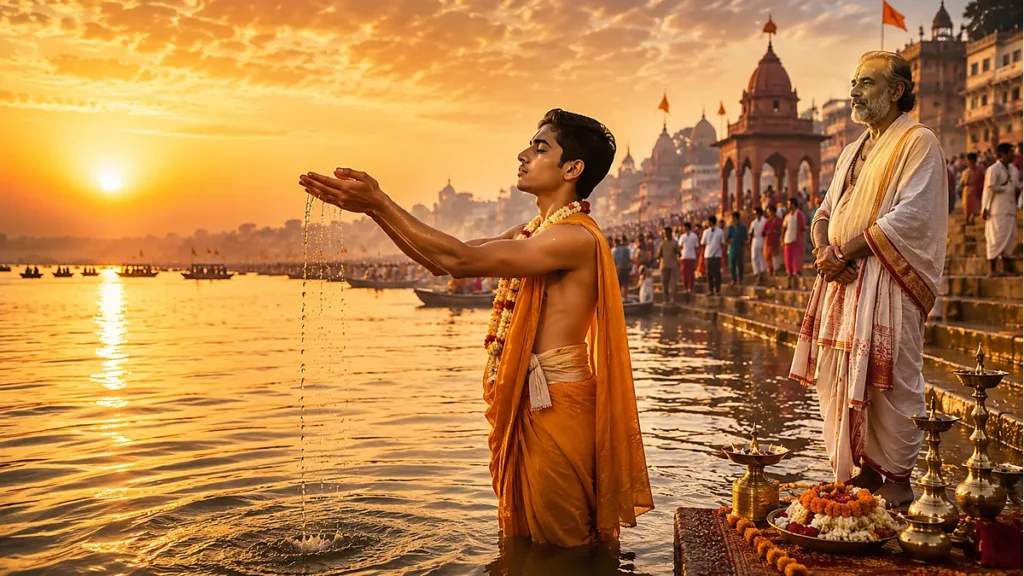
The formal completion of the student’s years of education and his return to household life. Before leaving the teacher’s home, the student performs the snāna — the ritual bath that gives him the title snātaka, “one who has bathed in knowledge.”[3][7]
Gifts are offered to the Guru with full ceremony. Blessings are received. And the student crosses the threshold — back toward family, toward the city, toward marriage and responsibility — carrying within him the light that was placed there, mantra by mantra, year by year.
Householder Life — The Sacred Art of Love and Responsibility
15. Vivāha (विवाह — Marriage)
Of all the Saṃskāras, this is the one most people have witnessed — and most people have half-forgotten the meaning of.
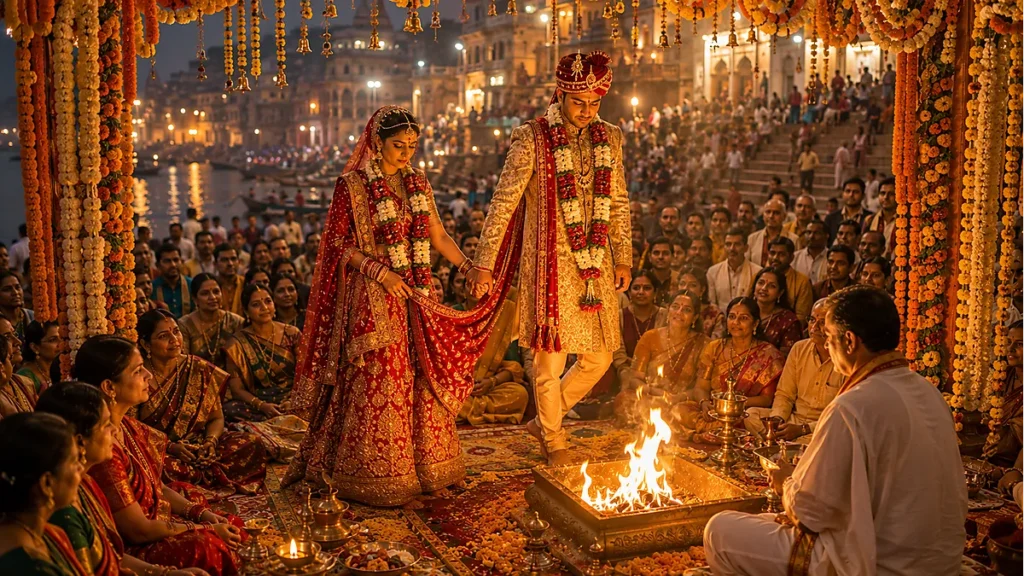
The Vivāha ceremony is not a party. It is not a social event. It is a covenant made in the presence of Agni (अग्नि), the sacred fire, before the entire community and the cosmos itself.[3][2]
The central act — the heart of the entire ceremony — is the Saptapadī (सप्तपदी): the seven steps.
The couple walks seven times around the sacred fire. With each step, a vow:
- For nourishment — I will sustain your body
- For strength — I will be your courage
- For prosperity — I will work for our wellbeing
- For wisdom — I will support your growth
- For children — I will be present for the lives we bring forward
- For health — I will care for your body as my own
- For friendship and loyalty above all else — I choose you, daily, consciously, completely
Seven steps. Seven vows. Made with fire as witness, before every person who loves you. The tradition understood what the modern world of casual relationships struggles with: love is not a feeling. It is a choice — made first with full consciousness in a ceremony that leaves an indelible impression on both the heart and the mind.
The Final Passage — The Most Courageous Ceremony of All
16. Antyeṣṭi (अन्त्येष्टि — The Final Rites)
The last saṃskāra. And in some ways, the most profound statement the tradition makes about what it believes human life to be.
When a person completes their journey, the tradition does not look away. It does not schedule the cremation as quickly as possible. It does not manage grief by keeping people busy. It approaches death with the same consciousness and care that it brought to every other threshold.[2][3]
The body is cremated — returned to fire, the same sacred fire that has witnessed every saṃskāra since birth. The five elements are consciously returned to the five elements of nature. Earth to earth. Fire to fire. Water to water. Air to air. Space to space.
The family gathers not to distract themselves from grief — but to sit with it. To perform the Tarpaṇa — offerings of water and sesame to the departed soul. To tell stories. To complete the relationship with gratitude rather than abandonment.
“The tradition holds grief as sacred as joy. Every ending is honored as seriously as every beginning. This is the final act of love — refusing to let a life slip away unceremonized, unnamed, unwitnessed.”
The Hidden Wisdom
Now step back from the ceremonies and look at the architecture of the whole.
What, exactly, was this system trying to build?
A fully formed human being — in the four dimensions that matter most:
| Saṃskāra Phase | Dimension Being Cultivated | Vedic Principle |
| Pre-birth rites (1–3) | Quality of invitation & womb environment | Bhāvana — the power of intention |
| Birth & infancy (4–9) | Sensory orientation, belonging, identity | Sneha — the bond of love |
| Education (10–14) | Discipline, knowledge, gratitude toward teacher | Brahmacharya — the walk toward wisdom |
| Householder (15) | Love as conscious commitment, not feeling | Dharma — duty chosen freely |
| Final rite (16) | Conscious completion; grief as honor | Mokṣa — the freedom of letting go |
The deepest wisdom in the system is this: it treats every transition as a threshold, and every threshold as an opportunity for conscious shaping.[3]
Modern psychology independently confirms this with striking precision. Research published in Psychological Science shows that people who mark major life transitions with deliberate ceremony — even simple ones — adapt more successfully, integrate the change more fully, and carry less unresolved emotional weight into the next chapter.[18][4]
The grief counselor who encourages a meaningful funeral is practicing the spirit of Antyeṣṭi. The school that marks a student’s graduation with genuine ceremony is practicing the spirit of Samāvartana. The mother who pauses on her child’s first day of school to say a quiet prayer together is practicing Vidyārambha. They are all practicing what this civilization formalized five thousand years ago.
Here is the verse that captures the whole system’s philosophy in a single image:
देवनागरी:
संस्काराः पुरुषं सृजन्ति यथा भित्तिं चित्रकाराः ।
IAST Transliteration:
saṃskārāḥ puruṣaṃ sṛjanti yathā bhittiṃ citrākārāḥ |
Source: Paraśara Smṛti, traditional attribution — exact verse location omitted for scholarly integrity
Word-by-Word Meaning:
- संस्काराः (saṃskārāḥ) — the rites of passage
- पुरुषम् (puruṣam) — a person / the individual soul
- सृजन्ति (sṛjanti) — they create, they shape
- यथा (yathā) — just as
- भित्तिम् (bhittim) — a wall / a canvas
- चित्रकाराः (citrākārāḥ) — painters, artists
Translation: “The Saṃskāras shape a person just as painters shape a canvas.”
Practical Takeaway: You are the canvas. The saṃskāras are not constraints imposed on you — they are the brushstrokes that produce a masterpiece. A canvas left entirely unpainted is not free. It is just blank. Ceremony is how civilization paints human beings into their fullest possibility.
Core Life Lessons — What Each Phase Teaches
- Before birth: Your children’s formation begins in your own consciousness before they arrive. How you prepare to receive them matters
- Birth & infancy: The world a child first encounters shapes their foundational orientation toward existence — make it beautiful, sacred, witnessed
- Education: Learning received from a living teacher, in a relationship of genuine respect and gratitude, creates a different kind of human being than information downloaded from a screen
- Marriage: Love that is chosen consciously, witnessed publicly, and committed to with ceremony builds a different foundation than love that simply happens to two people
- Death: How you complete a relationship — whether you let someone go consciously and gratefully, or simply lose them in confusion — determines what you carry forward. Grief completed is grief transformed.
The Pilgrim’s Path: Sacred Geography of the Saṃskāras
If the Saṃskāras are the ceremonies, then Prayagraj and Varanasi are the stage upon which they reach their most potent form. These two cities are not merely locations. They are instruments — amplifiers of intention.
Kashi (Varanasi) — Where Every Saṃskāra Is Witnessed by the Divine
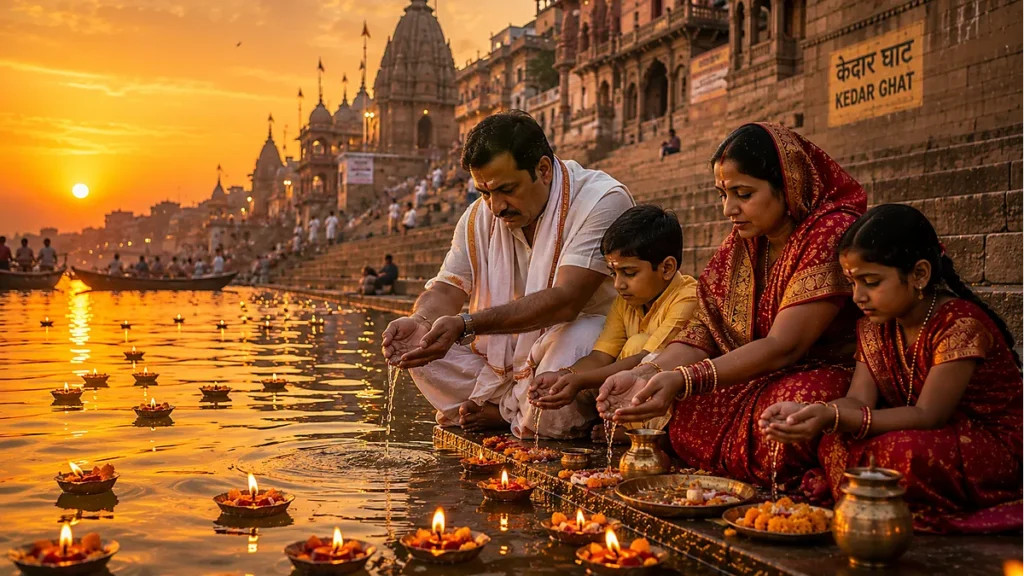
Varanasi has been described as a city where every ghāṭ is a threshold, every dawn a ceremony, every stone a witness. From the sacred thread ceremony (Upanayana) to the final rites, the ghāṭs of Kashi bear witness to every significant event in a person’s life.[19]
Walking the ghāṭs from south to north, you will encounter:
Manikarṇikā Ghāṭ — where the Antyeṣṭi fires have burned without interruption for at least three thousand years. The smoke is constant. The fire, tradition says, was lit by Lord Śiva himself and has never been extinguished. To have one’s final rites performed here is considered by the tradition to guarantee mukti — liberation from the cycle of birth and death.[19]
Dashāśvamedha Ghāṭ — the great ceremonial ghāṭ, where the nightly Gaṅgā Āratī transforms the river into a sea of light. Families come here for Nāmakaraṇa, for Niṣkramaṇa (the child’s first outing to the sacred river), for the blessing of newborns. Here, the Gaṅgā becomes the first temple a child enters.
Kedar Ghāṭ — one of the older, quieter ghāṭs, its narrow lanes opening suddenly onto the river. It is here, in the courtyards of the houses that back up against the stone steps, that families like Arjun’s have performed their Annaprāśana for generations. The courtyard fire, the marigolds, the grandmother’s lap — all of it happening within earshot of the river.
Kashi Viśvanātha Temple — the living heart of Kashi, where Lord Śiva is said to reside as Jyotirliṅga. Upanayana ceremonies, when performed in Varanasi, traditionally include a visit to Kashi Viśvanātha for the newly initiated student to receive the first darśana (sacred sight) of the divine as a brahmacārī. The Annapūrṇā Mandir, adjacent to it, is specifically invoked during Annaprāśana — the goddess of nourishment is present here in a way the tradition says is unique to Kashi.[20][1]
Prayagraj — Triveni Saṅgama: Where All Rivers Meet
If Kashi is the city of Śiva’s witness, Prayagraj is the place of cosmic convergence — where the Gaṅgā, Yamunā, and the invisible Sarasvatī meet at the Triveni Saṅgama.[19]
This confluence has a specific resonance with the Samāvartana saṃskāra — the student’s graduation snāna. The tradition prescribed that the snātaka (the graduated student) bathe in a sacred river before returning to household life. There is perhaps no more appropriate river than the one where three streams of wisdom meet — the physical devotion of the Gaṅgā, the intellectual clarity of the Yamunā, and the invisible depth of the Sarasvatī.
The Triveni Saṅgama at Prayagraj is also where Pitṛ Tarpaṇa — the ancestral water offerings of the Antyeṣṭi sequence — carry particular potency. The tradition holds that the ancestors receive offerings made at the Saṅgama with special directness. Families come from across India to complete their grief here, to release their departed in the most sacred waters available.
What You Can Do as a Pilgrim Today
If you are visiting Prayagraj or Varanasi with your family, here is how to enter the living world of the Saṃskāras as a participant rather than a spectator:
- At Triveni Saṅgama: Hire a boat at dawn. As the sun rises over the confluence, perform a simple tarpaṇa — offer water in joined palms in the direction of the rising sun, remembering those who came before you. No priest is required. The act is the ceremony.
- At Dashāśvamedha Ghāṭ, Varanasi: Attend the evening Gaṅgā Āratī. When the priests lift the lamps and the entire river becomes fire reflected in water, ask yourself: which threshold am I standing at right now in my own life? Let the ceremony answer you.
- At Kashi Viśvanātha: If you have children, enter with them for their first darśana at Kashi. Make a quiet ceremony of it. Tell them where they are and why it matters. A temple visit with conscious awareness is itself a saṃskāra.
Bringing the Cosmos Home
Here is the truth the tradition wants to offer you: you do not need to travel to Prayagraj to live the spirit of the Saṃskāras. You need only to bring intention to your significant moments.
The Saṃskāra system is not asking you to revive every Vedic rite in its classical form. It is asking something far simpler and far more demanding: that you refuse to sleepwalk through the thresholds of your life.
A Simple Saṃskāra Practice for Modern Life
Morning — Vidyārambha in miniature:
Before your child leaves for school, pause. Just thirty seconds. Place your hand on their head and say quietly: “May you receive something true today. May your teacher be a genuine guide. May you remember that learning is a gift, not a task.” You have just performed the spirit of Vidyārambha.
When a new chapter begins:
Starting a new job? Moving to a new city? Beginning a new relationship? Light a lamp. Sit before it in silence for five minutes. Set one intention. Speak it aloud, even if only to yourself. Make the threshold real. The universe, the tradition says, notices when you notice it.
At every naming:
When a child is born in your family — whether yours or someone you love — pause before the naming ceremony and ask: What qualities do we want this name to invoke? What kind of human being are we inviting into the world? Let the name carry weight.
In marriage — or any deep commitment:
The tradition does not require you to walk seven times around a fire to honor the Saptapadī. But it asks you, once in a while, to remember the seven vows — and to choose them again. Love is not the feeling that happens to you on the best days. Love is the daily renewal of a commitment made with your eyes open.
At death:
When someone you love completes their journey, do not rush past the grief. Gather. Tell stories. Perform whatever small act of completion feels true — a candle, a song, a river. Give the grief the ceremony it deserves. You will carry less of it undigested into the next chapter of your life.
“The Saṃskāra tradition asks one thing: live consciously. Know when a threshold is before you. Step across it with awareness, with ceremony, with gratitude for the stage you are leaving and openness toward the one you are entering. That is all. And that, it turns out, is everything.”
The Final Verse — For the Road Ahead
देवनागरी:
सर्वे भवन्तु सुखिनः । सर्वे सन्तु निरामयाः ।
सर्वे भद्राणि पश्यन्तु । मा कश्चिद् दुःखभाग्भवेत् ॥
IAST Transliteration:
sarve bhavantu sukhinaḥ | sarve santu nirāmayāḥ |
sarve bhadrāṇi paśyantu | mā kaścid duḥkhabhāg bhavet ||
Source: Bṛhadāraṇyaka Upaniṣad, traditional attribution — this verse is recited at the conclusion of Vedic ceremonies across traditions[2]
Word-by-Word Meaning:
- सर्वे (sarve) — may all
- भवन्तु (bhavantu) — be / become
- सुखिनः (sukhinaḥ) — happy, content
- निरामयाः (nirāmayāḥ) — free from illness
- भद्राणि (bhadrāṇi) — auspiciousness, good
- पश्यन्तु (paśyantu) — may they see / experience
- मा (mā) — may not
- कश्चित् (kaścit) — anyone
- दुःखभाग् (duḥkhabhāg) — partake of sorrow
- भवेत् (bhavet) — become
Translation: “May all be happy. May all be free from illness. May all behold what is auspicious. May no one suffer.”
Practical Takeaway: This prayer — chanted at the close of every Vedic saṃskāra ceremony — makes a radical claim. It does not pray for my family, my community, my tradition. It prays for all beings without exception. The Saṃskāras are not about private religious performance. They are about the gradual refinement of a human being into someone whose circle of care has expanded to encompass everyone. That is the final destination of every rite — a human being so fully formed that love itself has become their natural condition.
⁂
Frequently asked Questions(FAQ)
1. What are the 16 Samskaras in Hinduism?
The 16 Samskaras are sacred Hindu rites of passage that guide a person through major life stages from conception to death.
2. Why are Samskaras important in Sanatan Dharma?
Samskaras help individuals cross life transitions consciously and spiritually, shaping character, discipline, and values.
3. Which Samskaras are still commonly practiced today?
Nāmakaraṇa, Annaprāśana, Vivāha, Vidyārambha, and Antyeṣṭi remain widely practiced in modern Hindu families.
4. What is the last Samskara in Hinduism?
Antyeṣṭi, the funeral rites, is the final Samskara and symbolizes returning the body’s elements back to nature.
5. Are Samskaras only religious rituals?
No. They are also psychological and cultural practices designed to bring awareness and meaning to major life transitions.
- https://www.youtube.com/watch?v=EaFJ7-Yir-o
- https://en.wikipedia.org/wiki/Samskara_(rite_of_passage)
- https://dharmawiki.org/index.php/Samskaras_(संस्काराः)
- https://pubmed.ncbi.nlm.nih.gov/29130838/
- https://www.australiancouncilofhinduclergy.com/uploads/5/5/4/9/5549439/asvalayana-eng.pdf
- https://www.wisdomlib.org/hinduism/book/manusmriti-with-the-commentary-of-medhatithi/d/doc145604.html
- https://www.amritapuri.org/1967/16samskaras.aum
- https://vaidicpujas.org/samskaras/
- https://psychiatryinstitute.com/lost-in-transition-how-reviving-rites-of-passage-might-support-mental-health-part-1-of-2/
- https://www.instagram.com/reel/DYMEFzNOO4Y/
- https://sadhanajyotish.weebly.com/anna-prasan-sanskar.html
- http://hinduphilosophymoralsrituals.blogspot.com/2012/11/sacraments-samskaras-by-sri-vak-ayer.html
- https://pluralism.org/upanayana-the-sacred-thread
- https://www.sanatanadecode.com/the-vedarambha-samskara-12/
- https://en.wikipedia.org/wiki/Keshanta
- https://hinduonline.co/HinduCulture/KeshantaAndRitusuddhi.html
- https://samskaaram.com/samskaram/keshanta/
- https://faculty.haas.berkeley.edu/jschroeder/Publications/Hobson et al Psychology of Rituals.pdf
- https://servdharm.com/blogs/post/varanasi-the-spiritual-capital-of-india-and-its-sacred-ghats
- https://kashiannapurnatemple.com/yagyopaveeth-sanskar/
- https://www.tirthpurohit.org/pandits-for-upanayana-samskaranam-in-varanasi
- https://www.indica.today/long-reads/sixteen-samskaras/
- classical-hindu-mythology-a-reader-in-the-sanskrit-puranas.pdf
- studies-in-hindu-law-and-dharmastra.pdf
- interpretations-of-the-bhagavad-gita-and-the-images-of-the-hindu-tradition.pdf
- hindu-temples-what-happened-to-them-2-vol-set.pdf
- handbook-of-hindu-mythology.pdf
- decolonizing-the-hindu-mind-ideological-development-of-hindu-revivalism.pdf
- https://www.facebook.com/groups/126749457725264/posts/2527732474293605/
- https://www.instagram.com/reel/DYfbLQhB2qr/
- https://www.instagram.com/reel/DYjY3XWtqrW/
- https://www.instagram.com/reel/DOOl1SJk1O4/
- https://www.instagram.com/reel/DKwIMIZPxdw/?hl=en
- https://www.facebook.com/AbuDhabiMandir/videos/ritualsofthemandir-annaprashanthe-ritual-of-annaprashan-is-performed-to-mark-an-/1744649262979166/
- https://www.youtube.com/watch?v=iuQBmZqwmGc
- https://www.facebook.com/UNINewsagency/posts/a-nine-day-traditional-recitation-of-ramayana-began-at-the-kashi-vishwanath-dham/1368226878650763/
- https://www.facebook.com/IndiaToday/posts/yogi-adityanath-performs-annaprashan-ritual-for-children-from-multiple-faiths-in/1582317197265156/